The worldwide acceptance of AI is happening faster than ever recorded. According to industry statistics, 78 percent of companies have already accepted artificial intelligence in some form, with hundreds of millions of active users around the world. However, the discussion around AI seems to have developed beyond performance of the model now centering on how systems process and interpret information.
This is what multi model AI does well. Unlike the standard single model AI that can only accept one sort of input, for example text or imagery, multi model AI creates a number of modalities (text, audio, video and imagery) within one single architecture. This allows a more natural, human type interaction and a greater context understanding of more complicated forms of data.
This change from single model to multi model AI systems suggests that AI as a service (AIaaS), is taking a huge leap forward and is changing how enterprises will automate processes, communicate with customers and harvest real time insights.
When considering business AI chat solutions, enterprises often weigh the strengths of ChatGPT vs Claude, leading to a crucial decision between chatgpt and claude.ai
Capabilities and Examples
Single-Model AI
Single Model AI is an AI system that can complete a single task using a single source of information. Single Model AI can include several examples such as:
1. Natural Language Processing (NLP): The GPT-3.5 model and the GPT-4 model can take in text and create new text.
2. Computer Vision: There are many AI models used for computer vision, including models that can identify images and those that can recognize faces.
3. Speech Recognition: Speech recognition software converts spoken words into text so that commands can be executed by a machine.
Although powerful in their respective areas, each has some inherent limitations. Each will only accept data from a single format and are unable to interpret information about other formats (modalities). To analyze both text and image data for example, multiple different models and APIs would need to be connected, resulting in a lack of efficiency and fragmentation.
Multi-Model AI
On the other hand, Multi Model AI integrates the several above mentioned modalities into one structure of AI. The most prominent example of this type of AI is multi model AI which has the ability to perform on images, understand written descriptions of those images, as well as generate spoken responses based upon them; and it does so under a singular architectural construct. Therefore, multi model AI provides reduced infrastructure requirements, and enhanced contextual understanding.
The size of the Global Multi Model AI Market is expected to expand from approximately $2.51 billion in 2024 to more than $42 Billion by 2034. An explosion in demand for enterprise-wide multi model AI systems that enable seamless transition between various forms of data, drives this expansion.
Some examples of multi model AI are:
– GPT-4o (OpenAI) – Multi Model AI for real time conversation analysis at a token level of 128K and response times near instantaneous.
– Gemini 2.5 Pro (Google DeepMind) – Enables a 2-million-token context window, allowing for both document intensive and analytic workflows, providing a great deal of evidence of strong multi model AI functionality.
– Claude Opus (Anthropic) – Provides Constitutional Training for safe, compliant and accurate outputs particularly important for compliance sensitive enterprises. This represents a major differentiation point in the ChatGPT vs Claude comparison for business AI chat applications.
The use of these types of multi model AI, represent how they are being used to provide core components of business AI chat applications, creative industries, and enterprise analytics.
Comparing ChatGPT and Claude
The debate around ChatGPT vs Claude highlights two dominant design philosophies in business AI systems. When considering claude.ai vs chatgpt, enterprises face a crucial decision.
ChatGPT (OpenAI)
1. Strengths: Exceptional versatility, creative generation capabilities, and integration across text, images, and audio. Widely embedded in business workflows through AI as a service platforms such as Microsoft Copilot and ChatGPT Team.
2. Limitations: Prone to occasional hallucinations and restricted by shorter context windows compared with some competitors.
Claude (Anthropic)
1. Strengths: Built with a strong focus on safety, logical consistency, and ethical AI. Features longer context windows, which make it suitable for document processing, coding, and compliance tasks.
2. Limitations: While more cautious and accurate, it can be less spontaneous or “creative” than ChatGPT in open-ended applications.
Business Impact
When evaluating claude.ai vs chatgpt, enterprises should consider:
– Creativity vs. Control: ChatGPT suits dynamic, idea-driven workflows; Claude is ideal for structured environments needing precision.
– Compliance Requirements: Claude’s constitutional training aligns better with regulated industries.
– Context Length and Memory: For extended documents or legal datasets, Claude offers stronger long-context performance, a critical aspect of advanced multi model AI.
– Integration Needs: ChatGPT integrates seamlessly into existing enterprise ecosystems like Microsoft 365 or Slack.
Benefits of Multi-Model AI
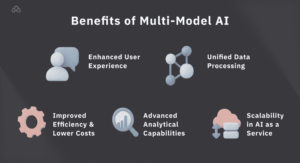
Adopting multi model AI provides transformative benefits for organizations aiming to scale automation, data analysis, and customer experience.
1. Enhanced User Experience: Multi-modal interactions, combining speech, images, and text, create natural communication interfaces that mimic human behavior.
2. Unified Data Processing: Reduces dependency on multiple APIs and models by merging different data modalities into one architecture, a core advantage of multi model AI.
3. Improved Efficiency and Lower Costs: By processing varied inputs within one model, organizations reduce integration costs, increase speed, and achieve faster time-to-insight.
4. Advanced Analytical Capabilities: Enables complex tasks such as video summarization, cross-modal search, and interactive content generation.
5. Scalability in AI as a Service: Simplifies deployment within cloud environments, allowing enterprises to leverage AIaaS platforms without needing extensive reconfiguration.
For example, a digital marketing firm using multi model AI can simultaneously analyze customer reviews (text), sentiment from voice calls (audio), and engagement with visual ads (images), all in real time, to optimize campaigns automatically.
Challenges and Considerations
Multi model AI is very effective; however, there are a number of factors to consider prior to implementing a multi model AI solution:
– Cost – There is an increased need for GPU resources for complex multi model architectures. This results in both greater operational and energy costs.
– Data Privacy and Compliance Risks – The handling of different types of data increases the potential for compliance risks in a wider range of industries including those with a high degree of sensitivity (healthcare, finance).
– Integration Challenges – Older legacy systems often do not have the ability to interface with newer AI software packages capable of processing various types of data modality.
– Talent and Expertise – Organizations must develop cross-functional teams with expertise in data engineering, fine tuning AI models, and developing and enforcing governance frameworks for their AI and data platforms.
However, companies are using advancements in AI infrastructure to reduce barriers to entry and implement multi model AI solutions at scale. In addition, many of the major cloud providers are offering AI as a Service solutions.
Business Impact and Future Outlook

There are business implications of multi model AI for all industries:
1. Customer Experience – Chatbots and digital assistants are becoming much more intuitive due to multi model AI’s ability to understand voice tone, user intent and visual context.
2. Operations and Automation – By integrating data analysis, manual oversight is reduced, and faster decision making is achieved.
3. Compliance and Risk Detection – Multi model AI systems are able to analyze text and visual compliance data at the same time, increasing the ability to detect risk.
4. Innovation Enablement – Real-time visual troubleshooting, and voice-based analytics are examples of new product experiences enabled by multi model AI.
As organizations move towards ecosystems of AI-driven services, multi model AI will be the foundational element of intelligent automation, bringing together human understanding and computational precision.
Conclusion
Adopting a multi model AI strategy (i.e., combining multiple AI models) for business applications is a strategic transformation of an organization’s technology infrastructure; it is far more than just a simple “upgrade” from a single model system to a multi model system. While single model systems are well-suited to specific uses or business cases and continue to provide value today, they inherently limit the scalability of business data systems. On the other hand, multi model systems allow organizations to integrate different forms of data into a unified framework, create streamlined processes, and derive greater insight from complex interactions across different data systems.
Before an organization chooses one model over another, it needs to identify its priorities. Organizations that need to quickly deploy creative AI applications with conversational capabilities (e.g., natural language understanding and generation) will likely prefer ChatGPT style models. Organizations that require AI models capable of deeper reasoning, understanding of documents, and ability to meet regulatory compliance standards will likely find Claude style models preferable. Identifying which type of model best fits an organization’s needs is critical to implementing the most effective business AI chat application solutions.
The ultimate choice of which approach is used by an organization will depend on the organization’s objectives, the maturity level of its data assets and whether there are any regulatory compliance issues that must be addressed. In doing so, organizations will begin to realize the potential benefits of using a multi model AI strategy in their Business AI chat solution and AI as a Service ecosystem to implement intelligent and context aware automation that will fundamentally transform both productivity and customer engagement.
Technical FAQs
1. How does multi model AI differ from single model AI?
Single model AI can process only one form of data at a time — i.e., either an image or a piece of text. Multi model AI, however, has the ability to handle all four forms of media simultaneously; that is, text, video, audio, and images.
2. Which is better suited to be used by businesses, ChatGPT or Claude?
This ultimately will depend on which business you are working with, and what their specific requirements may be for their AI chat solution. In general, ChatGPT is well-suited to applications that require the creation of new, creative content that is also interactive/conversational. On the other hand, Claude is better suited for applications that require longer lengths of context, higher accuracy, and/or regulatory compliance.
3. What are some of the key benefits of using multi model AI?
The key benefits of multi model AI are increased efficiency, a more natural experience between users and technology, lower costs to build and maintain AI systems due to less need for separate infrastructure for each modality, and faster insights across different modalities.
4. How does AIaaS enable the adoption of multi model AI?
AIaaS platforms provide a scalable infrastructure for running AI systems, pre-trained multi model AI models, and robust support for integrating these models into existing systems. This makes it easier and less expensive for companies to implement large-scale, multi modal systems without needing to have large amounts of in-house expertise and/or invest in the required capital.
Do you like to read more educational content? Read our blogs at Cloudastra Technologies or contact us for business enquiry at Cloudastra Contact Us.