The rapid growth of Generative AI adoption in the marketplace has created tremendous opportunities for the transformation of businesses and its operations. However, this same growth creates a greater threat to business due to increased vulnerabilities as a result of the accelerated use of AI within organizations. There is an increasing trend in organizations developing multi-model AI applications that process large volumes of different types of data such as text, images, audio and video. Therefore, as we see more multi-model applications being developed, the need for solid security and ethics principles to protect the organization will continue to grow. Industry expert reports such as those from Invicti (2025), have identified that organizations that adopt AI-based solutions without the necessary protections in place are at risk for a variety of AI-related security threats such as data breaches, model manipulation, and unauthorized access to sensitive information.
AI infrastructure 2025 will consist of multiple, interconnected services and AI-as-a-Service (AIaaS) models will become much more prevalent. As a result, security cannot be thought of as something that is done “after” AI is developed and deployed, rather security must be considered and integrated throughout every aspect of ai security risks and AI application development and deployment. In addition to strong security measures, there will also be a need for AI-governance practices that ensure fairness, transparency and accountability for the millions of daily decisions made by systems based on AI infrastructure 2025. These are the building blocks for the Enterprise AI future.
The Hidden Dangers: AI Security Risks in Multi-Model Deployments
Large scale multi model AI deployments present a plethora of unique ai security risks that companies must fully comprehend. Their complex nature, driven primarily by data, presents a significant opportunity for sophisticated cyber attackers to exploit such systems.
AI Threats:
The first two threats are both related to input to the AI models.
1. Prompt Injection/Jail Breaking:
An attacker attempts to give the AI an illicit command (similar to how a hacker would attempt to give an illegal command to a computer). There are numerous examples of successful attacks using the technique of crafting a prompt to elicit a response that should have been blocked by traditional security mechanisms. The responses to these prompts can include the leakage of confidential corporate information and/or AI generated unauthorized content. For example, in early 2019 an attacker used a specifically crafted prompt to obtain proprietary code snippets from an internal language model at a technology company.
2. Data/Key Exposure:
Consider the “keys” to an AI’s “kingdom”.
API Keys and Model Credentials for Enterprise AI Applications, particularly those utilizing chatbot interfaces, are highly sought after items on the Dark Web (Invicti, 2025). If malicious actors steal or obtain these keys, they compromise the security of the AI pipeline and risk the confidentiality and integrity of potentially millions of customer records. A recent example (2024) involved stolen API Keys that allowed a malicious actor to gain unauthorized access to a Company’s Customer Service AI, which exposed thousands of User Records.
The next three threats are all related to the quality of the data that the AI has been trained upon.
1. Training Data Poisoning:
Feeding a Child Bad Food: An adversary is able to poison an AI’s training dataset by introducing malicious data, which subsequently causes the model to output skewed results and create long-term integrity issues. Once poisoned, the AI will make decisions that are either discriminatory or inaccurate, creating distrust in the system and reducing efficiency. Research conducted by the AI Security Institute demonstrated that as little as a 0.1% malicious data injection can dramatically impact model prediction accuracy in critical financial applications.
2. Hallucination Exploitation:
Sometimes, AIs produce false information (they hallucinate). An adversary will take advantage of this by embedding false information into publicly available sources. When the multi model AI references the false information, it may end up spreading falsehoods that will irreparably harm a Brand’s Reputation. One prominent example included an AI powered News Aggregator mistakenly reporting a false acquisition based on a fabricated online article, resulting in market volatility.
3. Pipeline Vulnerability:
As the entire process of developing and deploying an AI includes preparation, training, and deployment, there exists a multitude of potential vulnerabilities throughout the entire supply chain. Each phase in the process requires strict Version Control of software, robust Dependency Management, and continuous testing for vulnerability to prevent exploitation. In 2025, an audit of a major Cloud Provider’s AI Infrastructure discovered multiple known vulnerabilities in their Model Deployment Pipelines
To mitigate these AI-specific security threats associated with Large Scale Multi Model AI Deployments, companies will require to begin integrating threat detection capabilities into their development cycle, as well as conducting “Red Teaming” Exercises (where Ethical Hackers attempt to compromise the System), and Adversarial Testing in order to reduce the overall risk of these types of attacks.
The Regulatory Maze: Enterprise AI Adoption and Its Rules
The Enterprise AI future and AI security risks implies integrating AI technology directly into core business processes such as analytics, customer support, DevOps, and compliance. However, it is with that integration comes an increase in regulation and an expansion in the compliance burden due to the integrated nature of AI technology within all those functions.
– Growing Regulation:
Frameworks Like the EU AI Act Demand Thorough Risk Assessments, Model Transparency, and Human Oversight for High-Risk Applications. The UK government (gov.uk, 2025) stated that Generative AI adoption increases the potential for threats like fraud, disinformation and automated cyber attacks which requires higher levels of ai security risks understanding.
– Increasing Compliance Burden:
With AI technology being regulated by multiple, and often overlapping, standards such as GDPR, ISO 42001 and NIST AI Risk Management Framework, businesses will have to continuously monitor the operation of their AI systems and conduct full and comprehensive ethical risk assessments.
– Shared Responsibilities:
In the enterprise environment, AI security risks and ethics are not simply the responsibility of one individual or team, but rather a collective responsibility of various functional teams including security engineers, legal departments, compliance officers, and data scientists who must collaborate and work together.
To be compliant and to maintain stakeholder trust, businesses must ensure that AI based decisions are transparent and traceable throughout their entire AI infrastructure 2025.
– Global Movement Towards AI Governance:
In addition to growing regulation in North America, the Asia-Pacific region and other regions of the world, there is a global movement toward developing AI-specific legislation and regulations that include provisions related to model transparency, human involvement in the decision-making process and cross-border data protections.
These new regulations require businesses to not only be compliant, but to demonstrate good governance internally through regular audits and publicly disclose their compliance with AI specific regulations. Businesses that develop and implement responsible AI governance models today will be well-positioned to meet future AI regulations and establish trust with their stakeholders in the Enterprise AI future environment.
AI as Your Shield: A Strategic Imperative for Cyber Defense
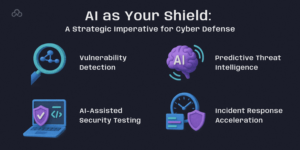
While AI as a service introduces new vulnerabilities, it also dramatically strengthens a company’s cyber defense capabilities. When properly implemented, AI as a service can detect, analyze, and respond to threats much faster and more accurately than traditional systems.
1. Vulnerability Detection: AI models are excellent at spotting unusual patterns in vast amounts of data, uncovering weaknesses before they can be exploited. Advanced analytics can connect network activity, endpoint behavior, and model outputs to provide early warnings of potential AI security risks.
2. Predictive Threat Intelligence: Generative AI adoption tools can forecast potential attack vectors based on emerging patterns from global threat feeds. This predictive ability allows businesses to act proactively, often before an incident escalates.
3. AI-Assisted Security Testing: Automated testing frameworks powered by multi model AI and AI as a service can simultaneously analyze code, logs, and configurations, offering deeper coverage and prioritizing vulnerabilities by their potential impact.
4. Incident Response Acceleration: Combining different types of data, text alerts, audio logs, and visual feeds, through multi-modal data fusion enables faster triage and remediation of security incidents, significantly reducing the mean time to detect (MTTD) and mean time to respond (MTTR).
Building a Secure Future: Best Practices for Ethical AI Adoption
To minimize ai security risks and protect an organization’s enterprise AI future ecosystem, organizations will need to consider AI security risks and ethics as foundational principles rather than only reactive measures. The following are the recommended best practices for protecting and responsibly deploying enterprise AI systems:
1. Integrating Security into Every Phase of the AI Lifecycle: Organizations must incorporate comprehensive cyber-security controls into each step of the AI life cycle (i.e., data collection, model development, model deployment) including thorough threat modeling of AI architecture.
2. AI-Specific Security Testing: Regularly test for vulnerabilities such as prompt injection, model inversion, and data exfiltration via automated testing and ‘red-team’ testing of AI systems. Recently a major financial services firm discovered a prompt injection vulnerability in their customer support chat-bot through a focused ‘red team’ effort.
3. Total Visibility and Access Control: Use AI Observability Tools to monitor every interaction, API Call, and Data Flow within the AI system by 2025. Establish “Least Privilege Access” across all AI systems so users can only have the minimum required access to function properly.
4. Ethical Governance: Follow the principles of fairness, transparency, and accountability when developing AI Systems. Create a record of all model decision processes, the methods used to mitigate potential bias and the source(s) of all data used in the model.
5. Creating a Security-Conscious AI Culture: Develop ongoing employee education/training programs to deter misuse, unauthorized shadow AI deployments and unintended policy violations. A culture of ethical literacy should be developed parallel to a culture of technical expertise across all employees.
Conclusion
Multi Model AI is changing the way companies work, by increasing cyber and ethical risk in ways previously unknown. AI Security is a Strategic Business Risk Factor; it will impact your business on two fronts; Continuity and Trust.
A Data Breach or an Algorithm that is Biased could have a major Financial Impact, plus Damage your Brand Long Term.
Organizations will need to have a Holistic AI Governance Strategy that includes Technology, Policy and Human Oversight, with Security Checkpoints at Every Stage of the AI Lifecycle.
Proactive Monitoring and Auditing of AI Systems is Essential.
Ethics needs to be at the Heart of Your AI Adoption Strategy; Fairness, Transparency, and Accountability, and Collaboration between Security, Compliance, Data Science, and Legal Teams is Key.
Companies who Prioritize ai security risks and Ethics will Lead the Responsible AI Movement and Create Intelligent Systems that are Secure, Compliant and Trusted in the Enterprise AI Future.
Technical FAQs
What are some of the Most Common AI Security Risks in Enterprise Systems?
Some of the key threats include Prompt Injection, Data Poisoning, API Credential Theft and Supply Chain Vulnerabilities in AI Pipelines. All of these pose serious AI Security Risks and can Compromise the Integrity of Models, or Expose Sensitive Information.
How Can Enterprises Protect Multi-Model AI Systems from Prompt Injection Attacks?
Enterprises can implement Input Validation (Validation), Monitor Real-Time Interactions between Models, Implement Dynamic Output Filtering, and Conduct Regular Red Teaming Exercises to Identify Potential Weaknesses in Prompts and Enhance AI Security.
In What Way Does AI Contribute to Modern Cyber Defense?
AI Significantly Enhances Cyber Defense by Providing Advanced Anomaly Detection, Predictive Analytics and Automated Incident Response Capabilities, which Improves Detection Speed and Accuracy when Mitigating ai security risks.
How Do Ethical Guidelines Influence Enterprise AI Deployment?
Adherence to Ethical AI Guidelines Ensures Fairness, Transparency and Accountability, all of which are Critical Factors to Reduce Reputational Risk and Support Compliance with Evolving Global Regulations, Such as the EU AI Act, to Encourage Responsible Generative AI Adoption.
Do you like to read more educational content? Read our blogs at Cloudastra Technologies or contact us for business enquiry at Cloudastra Contact Us.