If there’s one thing that has shifted the most for early-stage founders, it’s the speed at which ideas must be validated. Markets evolve in months, not years. User expectations jump quickly, competitors iterate endlessly, and the old idea of spending a quarter building a first version simply isn’t compatible with how people build products now.
This is where ai mvp development steps in, not as a band-aid, but as a different approach altogether. AI reshapes the foundation of MVP strategy, changing how startups explore an idea, scope a feature set, measure demand, and react to real user signals. And because the cost of building has dropped dramatically, the cost of being wrong has dropped too. That’s a luxury early-stage teams never had until recently.
Startups embracing startup mvp development today don’t just ship faster; they learn faster. And the learning part is really the edge.
Why AI Has Become the Center of Modern MVP Strategy

AI has quietly become the “co-founder” many startups rely on during the earliest phases of building. Instead of guessing user behavior, teams now use predictive analytics. Instead of endless stakeholder debates on which feature comes first, AI clusters requirements based on user intent. In place of waiting weeks for prototypes, founders get working flows in hours.
The reason this shift feels so dramatic is simple: mvp development services for startups no longer revolve around manual scoping or heavy engineering. They revolve around fast experimentation. Fast failure. Fast discovery.
Below is a quick comparison illustrating why teams adopting ai mvp development move differently:
|
Phase |
Traditional MVP Workflow |
AI-Driven MVP Workflow |
|
Idea Validation |
Surveys, interviews |
NLP trend scanning, LLM-based market insights |
|
Scoping |
Manual feature prioritization |
AI clustering + predictive effort analysis |
|
Prototype Build |
Weeks of manual design |
Auto-generated UI flows & screens |
|
Testing |
Slow feedback cycles |
Synthetic user testing + real-time heatmaps |
|
Iteration |
Manual redesigns |
Automated variant generation |
The pattern is obvious: fewer bottlenecks, more clarity.
How AI Accelerates MVP App Development Services
The value of mvp app development services increases dramatically when paired with AI tooling. Instead of relying on manual wireframes, traditional analytics, or long QA processes, AI helps compress every stage into a more focused, data-backed cycle.
1. Rapid Prototype Generation
AI turns rough ideas into testable artifacts almost instantly. Whether it’s generating UI layouts, user flow suggestions, or interaction models, this alone shortens the MVP cycle significantly.
A small logistics startup once cut their prototype time from 10 weeks to 4 days by using an AI-assisted design engine. They ended up discovering that their “core” feature wasn’t even what customers cared about.
2. Predictive Feature Prioritization
Rather than stakeholder debates, AI evaluates demand signals, historical patterns, and industry benchmarks. This helps teams avoid bloated MVPs and focus on what actually contributes to early traction.
3. AI-Enhanced Testing & Validation
Modern MVP strategy leans heavily on automated testing agents, simulation models, and instant variant analysis. This means founders can validate multiple solutions before the engineering team writes a single production-ready module.
4. Real-Time User Intelligence
Heatmaps, attention tracking, behavioral clustering, funnel predictions, they’re no longer tools reserved for mature companies. Even new teams adopting startup mvp development get access to predictive analytics that would have been too expensive five years ago.
The Trends Pushing AI MVP Development Forward
Here are the forces shaping the current landscape:
– Low-code/AI code generation is reducing the cost of early builds.
– LLMs are producing structured workflows, documentation, and requirement sets.
– AI QA agents simulate thousands of test cases automatically.
– Synthetic user cohorts let founders validate flows before acquiring traffic.
– Predictive dashboards shorten the learning curve after launch.
Recent industry data shows companies using ai mvp development achieve time-to-market reductions of 40–55%, depending on complexity.
Why This Matters for Startups
The biggest risk in early-stage product building is not being slow, it’s building the wrong thing. AI helps reduce this risk by giving founders a clearer view of user intent, market gaps, and feature alignment before committing heavy engineering effort.
A few examples:
1. A B2B HR startup discovered via AI clustering that only 18% of users cared about the feature they were planning to develop first.
2. A fintech MVP used AI-driven conversational simulations to validate its onboarding flow before the app even existed.
3. A marketplace team used AI predictions to learn that dynamic bundles increased conversion probability by nearly 70%.
These kinds of insights improve decisions across the entire MVP lifecycle.
A Framework for AI MVP Development (Used by Top-Tier Firms)
This is the framework most mvp development services for startups follow today:
1. Problem Framing With AI-Supported Research
Founders begin by feeding market information, competitor signals, user stories, and business constraints into an AI reasoning model. The system returns thematic clusters, gaps, and opportunity areas.
2. Multi-Path Solution Mapping
Instead of one solution, AI generates several possible product paths. Teams score each option based on feasibility, cost, and time-to-validate.
3. Prototype + Simulation Layer
AI produces low-fidelity and high-fidelity prototypes. Synthetic users run through flows to identify friction points early.
4. Insight-Driven MVP Definition
Only the features that consistently correlate with value and engagement make it into the MVP. Everything else gets lower priority.
5. Automated Testing & Continuous Learning
Post-launch, AI handles QA, user segmentation, churn prediction, and behavioral scoring. This replaces guesswork with measurable signals.
AI Risk Mitigation in Modern MVP Development
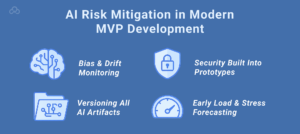
Moving fast is great, but moving fast without guardrails leads to technical debt or flawed assumptions. This is why modern ai mvp development includes structured risk-mitigation layers.
1. Bias & Drift Monitoring
AI predictions evolve as data changes. Bias scans ensure recommendation models, prioritization engines, or segmentation clusters stay accurate.
2. Security Built Into Prototypes
Because mvp app development services now involve automated code generation, teams embed SAST scans, permission audits, and dependency checks from the prototype stage, not the pre-launch stage.
3. Versioning All AI Artifacts
AI-generated documents, flows, and diagrams are version-controlled to preserve traceability. It makes reversions painless and prevents compounding errors.
4. Early Load & Stress Forecasting
AI models simulate onboarding surges or traffic spikes long before real users arrive. For a healthtech MVP, this forecasting revealed session-handling issues early enough to prevent a full rewrite.
Technical FAQs
1. How does AI shorten the MVP development timeline?
AI automates scoping, prototype creation, variant testing, and analytics processing. This drastically shortens every iteration loop in startup mvp development.
2. Can AI models replace real user testing completely?
No, synthetic users and predictive tools handle early-phase validation, but real customers still make the final judgment. AI simply reduces the cost of reaching that stage.
3. Which AI tools are typically integrated into MVP workflows?
Teams use LLM-based requirement engines, AI UI builders, behavioral prediction models, automated QA agents, and analytics systems designed for ai mvp development.
4. How do mvp development services for startups ensure scalability?
They incorporate predictive load testing, automated architecture reviews, dependency mapping, and AI-driven scaling simulations early in the MVP lifecycle.
5. Does AI improve long-term architectural quality?
Yes. Many tools analyze dependencies, evaluate modularity, and forecast where scaling issues might arise. This lets founders fix structural problems before the MVP evolves into a full platform.
The New MVP Mandate: Learn Fast, Adjust Fast
If there’s one big takeaway here, it’s that ai mvp development completely changes the game for founders trying to test their ideas. It’s not about the AI making the product perfect right out of the gate. It’s about getting you to the “Aha!” moment, that point of real clarity, much faster, cheaper, and with way less risk. Today, a smart MVP isn’t just about speed; it’s about being a quick study, pivoting easily, and keeping your ear glued to what real users are actually saying. The startups that embrace this “learn-fast, adjust-fast” mindset usually find product-market fit way ahead of the ones who are still just trusting their gut.
Do you like to read more educational content? Read our blogs at Cloudastra Technologies or contact us for business enquiry at Cloudastra Contact Us.