Python has been a standard language for many years when it comes to artificial intelligence. As noted by Vasundhara’s 2025 review, most companies rely on Python and python development services as their go-to language for developing prototypes quickly, because they can run across platforms and due to its large community of users. Its simplicity with syntax is what makes it so easy for developers to be able to write complex concepts down in a short amount of space, which gives them room to experiment. With an enormous amount of libraries available to use, such as TensorFlow, PyTorch, Scikit-learn, NumPy, Pandas, Matplotlib, Seaborn and Transformers, it helps engineers to develop and deploy models in a timely manner. Many of these libraries allow engineers to work with AI, but also provide the tools needed to manipulate and visualize data, therefore, eliminating the need to create custom code.
This ability of Python to work well in AI, doesn’t stop at AI. In addition to being a great language for AI development, it also has web frameworks to make back-end development very quick, including Django, Flask and FastAPI. Libraries that are designed for asynchronous programming (such as asyncio and Trio), and libraries that add support for type hinting (PEP 484 was introduced in Python 3.0 and in Python 3.12 there were improvements made to this feature), help to make it possible to build high-performance, scalable architectures. Due to the fact that Python can do all things in a single stack, it is attractive for creating full-stack applications that have AI models working in conjunction with typical business logic.
Library ecosystem and community momentum
The table below highlights key Python AI libraries and their primary use cases:
|
Library |
Purpose |
Notes |
|
TensorFlow / Keras |
Deep learning |
Widely adopted; supports distributed training and production deployment |
|
PyTorch |
Deep learning & research |
Favoured for dynamic computation graphs and intuitive API |
|
Scikit‑learn |
Classical machine learning |
Offers algorithms for regression, classification, clustering and feature engineering |
|
NumPy / SciPy |
Numerical computation |
Provides vectorised operations and scientific computing tools |
|
Pandas |
Data manipulation |
Simplifies data cleaning, filtering and analysis |
|
Transformers (Hugging Face) |
Natural‑language models |
Hosts pre‑trained models and tokenisers for NLP tasks |
|
FastAPI / Django / Flask |
Web frameworks |
Facilitate backend development and API integration |
Beyond libraries, Python development company benefits from a vibrant open‑source community. New frameworks, model architectures and tools appear quickly, and documentation is abundant. Major companies, Google, OpenAI, Microsoft, Meta and Amazon, standardise on Python for AI research and production. This corporate backing ensures continued investment in optimisations and new features.
Python in backend integration
For AI to deliver business value, models must integrate seamlessly into backend systems. Python’s web frameworks make this straightforward. Django provides a full‑featured MVC framework with ORM, authentication and admin interfaces. FastAPI offers a lightweight, asynchronous alternative with automatic OpenAPI documentation and high throughput, ideal for serving machine‑learning models as REST or GraphQL endpoints. Flask gives developers granular control for microservices. Python also interfaces easily with message brokers (RabbitMQ, Kafka) and databases (PostgreSQL, MongoDB), enabling event‑driven AI pipelines.
Enterprise adoption and future trends
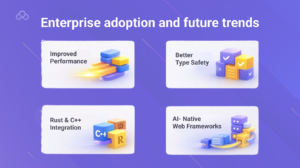
Leading technology firms rely on Python for AI. Vasundhara’s article notes that companies across industries, from Google’s research teams to Microsoft’s Azure services, use Python as a primary language for AI development. As generative models proliferate, Python’s ecosystem continues to expand with libraries that simplify building chatbots, summarisation tools and code assistants.
Emerging trends include:
1. Improved performance, Projects like PyPy, Cython and Just‑in‑Time compilers continue to close the performance gap with compiled languages. Python 3.12 adds zero‑cost exceptions and optimised subinterpreters, improving concurrency.
2. Better type safety, Tools such as mypy and Pyright make static analysis mainstream. Pydantic and dataclasses enforce type‑safe data models in web APIs.
3. Integration with Rust and C++, Libraries like PyO3 allow developers to call Rust code from Python, blending ease of use with performance.
4. AI‑specific web frameworks, New frameworks embed model serving, request batching and GPU management directly into the web layer, further simplifying deployment.
Example: Building an AI‑powered backend with FastAPI
A startup wants to deploy a sentiment‑analysis service that scores customer reviews. The team trains a BERT‑based model using Hugging Face’s Transformers library in Python. To expose the model, they write a FastAPI app that accepts text input, feeds it to the model and returns the sentiment score. FastAPI automatically generates API documentation, enabling frontend developers to integrate quickly. Because FastAPI is asynchronous, the service can handle many concurrent requests with low latency. This example illustrates how Python unifies model training and deployment within a single language and ecosystem.
Python’s Unified Role in AI and Web App Development
The continued success of python for ai is intrinsically linked to its prowess in general application and Python for web apps development. The language’s inherent flexibility allows a single codebase and a single team of developers to manage everything from training complex machine learning models (using libraries like PyTorch and Scikit-learn) to deploying them as high-performance REST APIs (using frameworks like FastAPI). This unification significantly reduces friction in the MLOps pipeline, allowing companies to transition AI research into production-ready features faster. Python thus acts as the primary connective tissue, ensuring seamless data flow and integration between the intelligent core and the user-facing application layer.
Choosing a Python Development Partner for AI-Powered Solutions
As the technology stack matures, many enterprises look to external expertise to accelerate their digital transformation. The demand for a custom python web development company has grown, particularly for those with deep expertise in both AI and web technologies. When selecting a custom python web development company, businesses should look for a provider that offers end-to-end python development services, covering:
- AI/ML Consulting: Model design, training, and optimization.
- Backend Engineering: Scalable API development with frameworks like Django and FastAPI.
- DevOps/Deployment: Containerization (Docker, Kubernetes) and cloud integration.
Partnering with a focused firm ensures that the final solution is not only mathematically robust but also architecturally sound, scalable, and secure, leveraging Python’s entire ecosystem for maximum business value.
Conclusion
Due to python’s expressive syntax and large collection of libraries, python continues to be the top programming language for artificial intelligence. Python is now also being used to develop the backends of applications by Python development company using frameworks such as FastAPI which integrate AI inferencing with application program interfaces (APIs). Through the rapid evolution of performance, typing and tooling, python’s importance in combining AI and backend technologies is expected to continue into 2026 and beyond.
In addition to being a primary language choice, python’s future will be as a key “bridge” between the multiple disciplines of data science, machine learning, and production engineering. The seamless integration of these complex disciplines via python’s many versatile libraries (key to python for ai) and robust web frameworks (vital to Python for web apps) are the two main reasons why python will remain relevant. As the industry transitions to more sophisticated and real time artificial intelligence solutions, the demand for skilled professionals at a python development company or custom python web development company that can provide full range of python development services (from developing models to deploying them at scale) will continue to increase and solidify python’s and Python for web apps position as the base technology for the next generation of intelligent applications.
Technical FAQs
1. Why is Python preferred over languages like Java or C++ for AI?
Python is better than Java or C++ because Python is easy to use. Python has a lot of pre-made packages for machine learning and data science so you don’t have to write your own code. While C++ and Java are faster they do not help developers get their job done as fast as Python.
2.Does Python give enough speed to run backend services that require a large amount of processing power?
Yes, but only if you use modern async frameworks such as FastAPI and Starlette. Those frameworks will support tens of thousands of concurrent connections. If there is some part of your service that needs to be optimized for performance you can write that portion of your service using Cython, Rust, or C++.
3. How does Python support scalable deployments?
You can deploy your python application by using containerization (docker/kubernetes) and/or serverless platforms. Once deployed, you can then use tools like gunicorn and uvicorn to manage your worker processes and autoscaling groups to increase/decrease the number of instances running your application depending on the workload.
4. What are the downsides to using Python for AI?
The main downside to using Python is that it is slow when compared to compiled languages. Therefore, for those applications that require high-performance, you will likely need to optimize the code. Additionally, managing memory in Python can be unpredictable, and compatibility issues between different versions of Python need to be addressed carefully.
5. Will new languages replace Python?
New languages such as Julia and Rust are being developed to perform certain tasks (scientific computing and system programming), however, due to Python’s established community and ongoing development, it is unlikely that Python will be replaced anytime soon. Instead, we expect to see Python develop ways to work more effectively with languages like Julia and Rust.
Do you like to read more educational content? Read our blogs at Cloudastra Technologies or contact us for business enquiry at Cloudastra Contact Us.