Businesses are using AI in their hiring processes, when approving loans for customers, and when diagnosing illnesses in patients. The lack of an ethical framework may lead businesses to use AI in ways that perpetuate existing biases; alternatively, it may expose them to both legal and reputational consequences. As such, business enterprise clients increasingly seek out AI consulting firms that prioritize ethics and governance as much as technical performance; however, achieving “safe” adoption will require that these organizations navigate through a highly complex array of regulatory requirements, data governance issues and organizational values.
Defining AI governance, ethics and responsible AI
Responsible enterprise AI governance consists of a set of policies, processes, controls, and standards that ensure organizations develop and use AI responsibly, legally, and securely. Enterprise AI Governance provides oversight for accountability, transparency / explainability, risk based decisions, compliance by design and ongoing monitoring. Ethics in business AI refer to the moral principles that guide the development and deployment of AI in an organisation. These include fairness, respect for human autonomy, beneficence (doing good) and justice. The application of these principles as responsible AI in practice will be demonstrated through actions that provide equal treatment to all groups and align with the organisations mission and legal obligations.
While there is a close relationship between Data Governance and AI Governance, they are different. Data Governance has to do with ensuring the quality, integrity, and access rights of data. AI Governance has to do with providing the frameworks for ethical AI Consulting.
Core ethical principles and guidelines
Technology firms, and regulators have developed guidelines that will help develop AI responsibly. Microsoft’s Responsible AI Framework focuses on the following: Fairness; Reliability & Safety; Privacy & Security; Inclusivity; Transparency; Accountability. These principles are general principles that Consultants take to be specific practice. For example, Bias Testing; Secure Design; Clear Communication of Users’ Data.
Liminal AI has expanded upon the principle of Governance through the incorporation of three key aspects: Accountability; Transparency; Risk-Based Approaches; Compliance By Design; Continuous Improvement. Liminal AI recognizes that High Impact Domains (Healthcare, Finance etc.) need a more restrictive, auditable control environment than Low Impact Domains. Therefore, Liminal AI suggests, Continuous Monitoring is necessary in order to ensure that Models Remain Safe even as Data Distributions Change.
The emerging European Union AI Act and other Regulations, recognize certain AI Applications as being High-Risk and therefore they will require a rigorous Documentation and Human Oversight requirement. Thus, these Regulations provide a Regulatory Backdrop that will emphasize the Need for Proactive Governance at the Outset.
Frameworks for ethical AI consulting
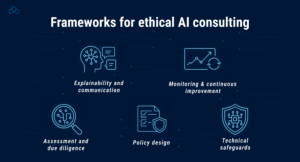
AI consulting engagements typically follow a structured framework:
1. Assessment and due diligence – Consultants evaluate the client’s data landscape, business goals and risk appetite. They identify potential ethical issues (e.g., bias, data privacy) early in the project.
2. Policy design – Develop explicit AI policies aligned with corporate values and regulatory requirements. This includes data handling standards, model documentation protocols and escalation procedures for anomalies.
3. Technical safeguards – Apply differential privacy, adversarial robustness testing and secure model deployment techniques. Audit datasets for representativeness and correct imbalances.
4. Explainability and communication – Incorporate interpretable models or post‑hoc explanation tools to make decisions transparent to stakeholders, regulators and end‑users.
5. Monitoring and continuous improvement – Deploy monitoring pipelines that detect model drift, performance degradation or emergent biases. Feedback loops facilitate ongoing improvements.
Case examples and lessons learned
1. Financial services bias incident – A global bank was fined millions after biased loan‑approval algorithms disproportionately rejected minority applicants. The failure stemmed from training on unrepresentative historical data and insufficient model validation. This incident underscores the need for bias audits and governance before deployment.
2. Healthcare predictive model – A hospital system deployed an AI system to predict patient readmissions. Consultants implemented fairness constraints, ensuring the model performed equally across demographic groups. Continuous monitoring revealed drift as treatment protocols changed, prompting retraining.
3. Retail recommendation engine – A retailer’s AI system inadvertently amplified price disparities across regions. Consultants introduced explainability tools, enabling the business to detect and correct the issue quickly.
The consultant’s role in governance and security
AI consultants act as translators between technical teams, legal counsel and business leaders. They help organisations understand the risks and benefits of AI, design policies and implement secure architectures. Security considerations include data encryption, access controls, secure ML supply chains and vulnerability assessments. Consultants also advise on model documentation and audit trails to satisfy regulators and auditors.
Strategic Necessity: Embedding AI Ethics in Governance
Successful integration of AI requires embedding AI Ethics in business strategy at inception. This sets the foundation for a proactive approach to governance rather than simply reacting to issues once they arise. Many businesses face challenges in translating general high-level principles of ethics such as fairness, transparency and accountability into actionable company-wide policies. That’s exactly where expert AI Consulting can assist. Businesses providing AI Consulting Services help establish the governance frameworks needed for their clients, which include cross-functional ethics committees, formalized methods for assessing risks, and defined protocols for escalating ethical discrepancies. Without this strategic underpinning, any organization will be exposed to considerable risk of both reputational and regulatory nature when using any AI Solution, no matter how sophisticated, due to large-scale regulatory enforcement actions and public scandals.
One key objective of AI Consulting during this phase is developing a continuous risk posture. Ethical Risk does not remain static, it changes as the model interacts with real world data and user behavior. Thus, in order for effective AI Ethics in business to exist, policies need to be developed to accommodate this changing environment. This includes clearly defining roles for human review and establishing that all sources and uses of data are compliant with principles of privacy and integrity. High quality AI Consulting services ensure that the governance framework is an enabler of customer, regulator and public trust, not a barrier to entry.
Strategic Objective: Embedding Ethics in Every Project’s Business Case
The strategic goal of AI Consulting is to make ethics a fundamental consideration in every AI project’s business case, prior to commencing the design and build phases of the AI Development Service. In other words, ethics needs to be embedded so profoundly that it is considered an essential aspect of every AI project from inception.
Technical Implementation: Ethical MLOps and AI Consulting
Operationalization of AI Ethics in Business Principles occurs within the Machine Learning Operations (MLOps) life cycle, the area of the Engineering Life Cycle where the AI Development Service performs its work. For this operationalization to occur, specialized knowledge is required, commonly provided by an AI Consulting Firm. The Consultant serves as a bridge between the Ethics Policy and the Engineering Toolkit, translating abstract concepts into tangible technical safeguards that are measurable and auditable.
The Ethical MLOps pipeline starts with thorough auditing of bias in training data and extends through model development, where the AI Development Service must implement fairness-aware machine learning techniques (i.e., fairness constraints and/or re-weighting), and apply security mechanisms (e.g., adversarial robustness testing). Explainability is also a critical component, for “black box” models, post-hoc interpretation tools (e.g., SHAP and LIME) need to be implemented to provide transparent decision rationales to end-users and regulatory auditors, fulfilling a key principle of AI Ethics in Business.
In addition, AI Consulting Services are critical for establishing ongoing monitoring systems that identify degradation of ethics. This entails deploying automated monitoring pipelines that monitor not only traditional performance metrics, but also fairness metrics across various demographic subgroups, and alerts for data and model drift. Selection and management of the AI Development Service is critical; the Consulting Partner provides advice on selecting the right tools and implementing a secure ML Supply Chain to mitigate vulnerabilities such as Model Poisoning. Ultimately, through these practical and tangible technical steps, high-value AI Consulting Services enable the successful and sustainable realization of the ethical mandates established at the strategic level in production systems.
Conclusion
Integrating AI ethics in business is no longer optional; it is fundamental to building trustworthy, compliant AI systems. By grounding projects in clear governance frameworks, ethical principles and continuous monitoring, enterprises can reap the benefits of AI while safeguarding human rights and complying with evolving regulations. Consultants who master these domains will provide the strategic guidance that organisations need in the rapidly changing AI landscape.
Technical FAQs
What is the difference between AI ethics and responsible AI?
AI Ethics and Responsible AI are two related but distinct concepts that have different purposes. Ethics represent the overall philosophical framework for AI (autonomy, fairness, beneficence) while Responsible AI represents a set of operational practices that implement those frameworks through methods including bias detection/evaluation, documentation/transparency and so forth.
How do I minimize bias within my AI Systems?
The most important way to address bias within your AI Systems is to first collect a large amount of data that is representative of the population that will use your system. Once you’ve collected this data, you should begin using bias-detection metrics, fairness constraints, or re-weighting techniques on the data when it is being used to train the AI. In addition, you should conduct regular audits of the model using domain experts who will help you to understand the findings of the audit. As well, once your AI System is deployed, you need to continue to monitor how it behaves in order to identify emerging biases.
What are compliance by design and risk-based approaches?
Compliance by Design is a concept where the organization builds regulatory compliance directly into its entire systems development lifecycle (i.e. from data collection to deployment). On the other hand, a Risk-Based Approach is an organizational governance approach where organizations tailor their governance to the risk profile of each AI System. Organizations are likely to develop more stringent controls for high-stakes AI Systems such as those that affect the health care or financial industries.
How do I achieve explainability for my complex models?
When building complex AI Models, there are several ways to achieve explainability. First, consider using Interpretable Models (e.g. Decision Trees, Linear Models). If you’re working with Black-Box Models (which are difficult to interpret), you may want to consider applying Post-Hoc Techniques (such as SHAP Values, LIME, Counterfactual Explanations) to help interpret the Model. In addition, ensure that you provide clear documentation regarding Model Inputs and Limitations.
What types of ongoing monitoring are necessary?
To continuously monitor your AI Systems, you’ll need to monitor Performance Metrics, Bias Indicators and Data Distributions. Consider implementing Automated Alerts for changes in Performance Metrics or Drift in Data Distributions. Finally, establish Regular Periodic Reviews to update Models and Policies as Regulatory Landscapes Evolve.
Do you like to read more educational content? Read our blogs at Cloudastra Technologies or contact us for business enquiry at Cloudastra Contact Us.