Multi-cloud DevOps usually doesn’t start because engineering teams want it. It starts because the business wants options.
One cloud gets too expensive. Another region has regulatory requirements. A vendor negotiation goes sideways. Suddenly, what used to be a clean, single-cloud setup turns into a multi-cloud reality that DevOps teams are expected to “just handle.”
And they do. For a while. Then the cracks show.
Multi-cloud DevOps is not just single-cloud DevOps repeated twice. The complexity doesn’t double. It multiplies. That’s why cloud native devops stops being a nice concept and becomes the only way this setup stays operational.
Why Multi-Cloud Breaks Comfortable DevOps Assumptions
Most DevOps workflows are built on assumptions that quietly fall apart in multi-cloud environments.
Assumptions like:
- identity behaves the same everywhere
- networking failures look similar
- observability data is consistent
- automation scripts are portable
They aren’t. Each cloud has its own defaults, edge cases, and opinions. DevOps teams feel this first in their pipelines, then in their monitoring, and finally during incidents.
Without cloud native devops, teams end up compensating with tribal knowledge. “This fails on Cloud A but not Cloud B.” “Ignore that alert in this region.” That kind of workaround culture does not scale.
Multi-Cloud, Cloud Native DevOps is not simply a buzzword here
Here in multi-cloud environments, cloud native devops is not a matter of aligning with trends, but rather one of survival.
Survival, because if you have systems that can’t adapt to changing circumstances (clouds), then your system will fail.
If you have an environment where your infrastructure isn’t disposable, where your environments aren’t reproducible, or where failures are unexpected, then your environment will be a nightmare to maintain.
To achieve this practical result, cloud native devops typically takes the form of:
- infrastructure defined declaratively
- immutable deployments
- more automation, less manual intervention for errors
- a clear division between platform logic and application logic
When these characteristics are absent, multi-cloud is a nightmare to maintain. However, when they do exist, the fact that there may be differences in the cloud does not consume the majority of time spent on everyday tasks.
The difference in time spent on everyday tasks due to cloud differences in many cases is greater than what most architecture diagrams indicate.
Tooling Reality: DevOps Tools Don’t Magically Become Multi-Cloud
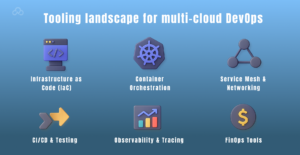
There is a persistent myth that picking the “right” DevOps tool solves multi-cloud complexity. It doesn’t. Every DevOps tool has assumptions baked into it. Some align better with multi-cloud environments than others, but none eliminate complexity entirely.
The goal is not to find perfect tools. The goal is to find tools that behave consistently enough across clouds to be predictable. In multi-cloud environments, DevOps tools usually succeed when they:
- abstract provider differences instead of exposing them
- integrate cleanly with automation pipelines
- avoid deep coupling to a single cloud’s APIs
This is where cloud and devops services often enter the picture. External platforms and managed services increasingly focus on portability rather than optimization for a single provider. That shift didn’t happen by accident.
CI/CD Pipelines Are Where Multi-Cloud Pain Shows First
CI/CD pipelines feel provider-agnostic until they aren’t. The moment deployments target more than one cloud, assumptions leak out. Authentication works differently. Artifacts are stored differently. Rollbacks behave differently.
In cloud native devops, pipelines are designed to avoid knowing where they’re deploying. Environment-specific logic lives in configuration, not in scripts. This sounds obvious. It’s also one of the most commonly ignored practices.
DevOps cloud engineers who’ve been through failed multi-cloud rollouts usually learn this lesson the hard way. Pipelines that “mostly work” become fragile under pressure.
Observability Gets Complicated, Fast
Monitoring is often considered a resolved issue in single-cloud environments. However, when dealing with multi-cloud DevOps, monitoring has become political. The same dashboard may be trusted by a particular team while alerts from the same dashboard may fire at varying rates, or at all. Even though metrics are provided for a service, they will never line-up completely.
Engineers waste valuable time determining where to look for their issues.
Cloud-native DevOps approaches monitoring/observability as a common layer. All logs, metrics, and trace data are made uniform (normalized) prior to an engineer seeing any data. An engineer thinks about services, not the provider of the service.
One of the most critical areas where the choice of tooling can impact your ability to successfully implement observability DevOps is how you approach monitoring/observability across multiple clouds. Many monitoring/observability DevOps tools are designed to operate within a single cloud and therefore remain silent when there are problems in multi-cloud environments.
Security and Policy Drift Are Guaranteed Without Automation
Multi-cloud environments amplify security drift. Different IAM models. Different defaults. Different patching behaviors.
Relying on manual reviews doesn’t work. By the time someone checks, the environment has already changed.
DevOps cloud engineers who succeed here lean heavily on policy-as-code. Security rules are defined once and enforced everywhere through automation.
This aligns naturally with cloud native devops. Policies are versioned. Changes are reviewed. Drift is detected early.
Without this discipline, security becomes reactive, and audits turn into fire drills.
Case Insight: When Multi-Cloud Was Forced Overnight
A global SaaS enterprise needed to deploy applications to a secondary cloud due to local regulatory compliance requirements. Initially, they used similar tools as before but made little operational adjustment to their deployment pipeline. Although it functioned technically, operationally it did not.
Inconsistent deployment failures occurred frequently. There were conflicting monitoring alerts. Engineers lost faith in automated processes and began to manually address issues that had previously been resolved by automation. The process of restoring the original state of automation involved going back and re-architecting based on native cloud development and operations principles. Pipelines were minimized. All provider specific logic was moved away from pipelines and centralize observability.
The platforms were not exactly the same between clouds. However, each one became easier to understand which itself resulted in less frequent incidents.
Cloud DevOps Best Practices That Don’t Fall Apart Later
While many cloud DevOps best practices are viable on their own, few have a chance of surviving real-world multi-cloud conditions.
What generally survives and tends to be dull and/or restrictive include:
- the avoidance of all “shortcuts” specific to a particular cloud service provider
- aggressive standardization of environments
- the explicit documentation of any assumptions you make about how an environment works
- the automation of anything that can be repeated
In addition to supporting Cloud Native DevOps (reducing surprise) these three are particularly beneficial when operating in multi-cloud environments (where surprise is your worst enemy).
Consistency for a seasoned DevOps Cloud Engineer will beat cleverness almost every time.
Analytics and Industry Signals
|
Indicator |
Trend |
|
Enterprises adopting multi-cloud |
Steady increase |
|
Teams practicing cloud native devops |
Majority |
|
Spend on cloud and devops services |
Rising |
|
Reported operational complexity |
Still high |
Multi-cloud adoption is growing, but maturity varies widely.
The Human Cost of Poor Multi-Cloud Design
One thing metrics don’t capture well is burnout. Multi-cloud environments with weak cloud native devops practices exhaust teams. Engineers spend more time diagnosing environment differences than solving actual problems.
Good tooling reduces this load. Bad tooling amplifies it.
This is why senior DevOps cloud engineers are often skeptical of multi-cloud initiatives. They’ve seen what happens when the operational cost is underestimated.
When Cloud and DevOps Services Actually Help
External cloud and devops services can add real value, but only when they focus on fundamentals.
Good partners help teams design abstractions, choose portable DevOps tools, and enforce cloud native devops practices. They don’t just replicate single-cloud setups twice.
Bad partners deliver configuration without strategy. That mistake shows up months later, during outages and audits.
Technical FAQs
What is cloud native devops in multi-cloud environments? It’s the practice of building DevOps workflows that tolerate change and operate consistently across different cloud providers.
Why is multi-cloud DevOps harder than expected? Because small provider differences compound into operational complexity over time.
Is there a single DevOps tool that solves multi-cloud? No. Integration and discipline matter more than individual tools.
Do cloud DevOps best practices change in multi-cloud setups? The principles stay the same, but enforcement becomes stricter.
What defines a strong DevOps cloud engineer? System thinking, automation discipline, and comfort with abstraction.
Multi-Cloud DevOps Is Earned, Not Enabled
Multi-cloud DevOps is not a checkbox. It’s a continuous discipline.
Without cloud native devops, multi-cloud environments become fragile, expensive, and exhausting. With it, they become manageable, even boring in the best way.
The difference isn’t the clouds. It’s how teams choose to work across them.
Do you like to read more educational content? Read our blogs at Cloudastra Technologies or contact us for business enquiry at Cloudastra Contact Us.