For a long time, EC2 was AWS. If you asked a team how they were running production workloads, the answer was almost always “EC2 with autoscaling.” That model worked, and in some cases it still does. But it’s no longer where most of the leverage is.
AWS has changed quietly over the last few years. The platform didn’t move away from EC2, but it stopped treating virtual machines as the center of everything. Instead, AWS invested heavily in aws developer tools and managed services that reduce operational work, remove glue code, and scale without constant tuning.
In 2026, teams still defaulting to EC2-first architectures are often carrying more complexity than they realize. Not because EC2 is bad, but because AWS now provides better tools for most modern workloads, especially for SaaS on AWS.
This article looks at underrated AWS services that are shaping modern AWS SaaS architecture, improving AWS cloud scalability, and changing how experienced teams actually build systems today.
Why AWS Developer Tools Matter More Than Ever
Infrastructure used to be the main problem. Provisioning servers, managing capacity, and handling failures were the hard parts. That’s no longer true. Today, complexity shows up in orchestration, deployments, configuration drift, and service-to-service communication.
This is where aws developer tools become more important than raw compute. These tools exist to remove repetitive operational decisions and standardize how systems behave under stress.
Teams building SaaS on AWS increasingly care about:
1. predictable deployments
2. safe configuration changes
3. event-driven communication
4. scaling without constant human involvement
EC2 can do all of this, but only if you build it yourself. Most modern AWS developer tools give you those capabilities out of the box, with fewer failure modes and fewer late-night incidents.
Step Functions: Orchestration Most Teams Still Ignore
AWS Step Functions is one of those services that looks boring until you need it. And then it suddenly becomes very important.
In modern AWS SaaS architecture, workflows are rarely simple. Background jobs, retries, conditional logic, external API calls, compensation steps, all of that logic usually ends up buried inside application code. That makes systems harder to reason about and harder to debug.
Step Functions solves this by making workflows explicit. You define what happens, in what order, and under which conditions. AWS handles state, retries, timeouts, and failure paths.
From an aws developer tools perspective, this is huge. You remove hundreds of lines of fragile orchestration code and replace them with a visual, auditable workflow.
For SaaS on AWS, Step Functions often reduce operational incidents caused by partial failures. Things don’t silently break as often, because the workflow itself knows what “failed” actually means.
Amazon EventBridge: Real Event-Driven Architecture, Finally
A lot of systems claim to be event-driven. In practice, they’re just API calls with better marketing.
EventBridge actually delivers on the idea. It gives AWS a real event backbone, one that services can publish to without knowing who’s listening. Consumers subscribe to events independently, and new features can hook in without changing upstream systems.
This matters a lot for AWS cloud scalability. When systems are loosely coupled, scaling one part doesn’t destabilize the rest.
EventBridge is especially useful for SaaS on AWS where features evolve quickly. You don’t want every new feature to require touching core services. With EventBridge, features subscribe to events and move at their own pace.
Despite this, many teams still rely on direct service-to-service calls, which makes architectures brittle. EventBridge is one of the most underused aws developer tools in production systems today.
AWS App Runner: Containers Without the Headache
Containers are everywhere, but managing them is still painful. ECS and EKS are powerful, but they introduce operational overhead that many teams don’t actually need.
AWS App Runner sits in a strange middle ground. It lets you deploy containerized services without managing clusters, scaling rules, or load balancers. You push an image, define resources, and that’s basically it.
For many SaaS on AWS workloads, App Runner is enough. APIs, dashboards, internal tools, they don’t always need Kubernetes-level flexibility.
From an AWS SaaS architecture standpoint, App Runner simplifies deployment pipelines and reduces the surface area for misconfiguration. It’s not the right tool for everything, but it’s massively underused.
AWS Glue: Not Just for Data Lakes Anymore
AWS Glue is often associated with big data and analytics teams, which makes application teams ignore it. That’s a mistake.
Glue is a managed data integration service. It handles extraction, transformation, and loading at scale, without you having to manage workers or scheduling infrastructure.
In SaaS on AWS, data pipelines show up everywhere. Usage metrics, billing data, audit logs, customer analytics. Many teams build custom ETL systems on EC2 when Glue would do the job more reliably.
As part of aws developer tools, Glue fits naturally into architectures where data needs to move continuously and predictably. It also scales automatically, which matters as datasets grow.
AWS AppConfig: Configuration Without Self-Inflicted Outages
Configuration changes break systems more often than code changes. Feature flags, thresholds, toggles, all of these are dangerous when rolled out carelessly.
AWS AppConfig exists to make configuration boring again. It allows controlled rollouts, validation checks, and automatic rollback if something goes wrong.
For SaaS on AWS, this is critical. A bad configuration pushed to all tenants at once can take down an entire platform. AppConfig helps prevent that.
Many teams use third-party tools for this, but AppConfig integrates cleanly with other aws developer tools, which reduces complexity and external dependencies.
A Realistic SaaS Migration Away from EC2
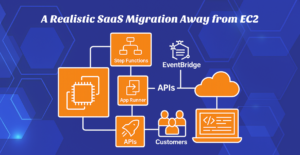
A SaaS company running entirely on EC2 started to feel the pain as the platform grew. Autoscaling groups multiplied. Deployment scripts became fragile. Incident response slowed down.
Instead of rewriting everything, the team migrated selectively. Step Functions replaced custom background job orchestration. EventBridge became the communication layer for internal services. App Runner handled customer-facing APIs.
EC2 didn’t disappear, but it stopped being the default. Operational effort dropped, deployment confidence increased, and developers spent less time babysitting infrastructure.
This is what modern AWS SaaS architecture actually looks like in practice. It’s not serverless everywhere. It’s intentional service selection.
AWS Cloud Scalability Is Not Just About Traffic
Scalability used to mean handling more users. In 2026, it also means scaling teams, scaling deployments, and scaling operations without burning people out.
The AWS services that scale best are usually the ones that remove decisions, not add them. Managed services scale not just technically, but organizationally.
That’s why aws developer tools matter more than raw compute. They allow teams to grow without complexity growing at the same rate.
Reference Metrics and Signals (For Context)
|
Indicator |
Direction |
|
SaaS platforms using managed AWS services |
~65% and rising |
|
Reduction in ops effort with managed tools |
30–50% |
|
Event-driven AWS architectures adoption |
Strong YoY growth |
|
EC2-only architectures |
Declining in SaaS |
These numbers are representative industry signals, not guarantees. But the direction is clear.
Where AWS Consulting Services Fit In
As AWS becomes more complex, aws consulting services have shifted focus. Less time is spent sizing instances. More time is spent choosing the right combination of services.
Good consulting in 2026 is about teaching teams how aws developer tools fit together. Poor consulting still treats EC2 as the answer to everything.
For organizations modernizing SaaS on AWS, outside guidance often accelerates adoption of better architectural patterns without painful trial and error.
Technical FAQs
What are aws developer tools, exactly?
They are managed AWS services that support building, deploying, orchestrating, and operating applications with less manual work.
Is EC2 still useful in modern AWS SaaS architecture?
Yes, but it should be used intentionally, not by default.
Can these services replace Kubernetes entirely?
For many workloads, yes. For others, they complement it.
How do these tools improve AWS cloud scalability?
They reduce operational bottlenecks and scale automatically under load.
When should teams consider aws consulting services?
When complexity starts slowing delivery or architectural decisions stall progress.
Beyond EC2 Is Where AWS Actually Wins
AWS didn’t become dominant because of virtual machines alone. It won because it kept abstracting complexity away. In 2026, the most effective teams understand this. EC2 still has a place. But the real power of AWS lives in its aws developer tools, in services that remove work instead of creating more of it.
Teams building SaaS on AWS that embrace these tools will ship faster, break less, and scale more smoothly. The ones that don’t will keep solving problems AWS already solved for them. And that’s the difference.
Do you like to read more educational content? Read our blogs at Cloudastra Technologies or contact us for business enquiry at Cloudastra Contact Us.