Healthcare doesn’t usually change quickly. Systems are large, regulated, and deeply interconnected, making experimentation risky and slow. But in recent years, something has shifted. The combination of cloud platforms and artificial intelligence has started to change how healthcare organizations operate day to day, not just how they plan for the future.
This is where MedAI platforms come in. Instead of treating AI as a standalone project, MedAI embeds intelligence directly into clinical and business workflows. When deployed on cloud infrastructure, these systems don’t just analyze data after the fact. They participate in decision-making as work happens.
The growing overlap between cloud and healthcare has made this possible. Scalable infrastructure, centralized data access, and mature integration standards have turned AI in healthcare from a research topic into an operational tool. MedAI sits at this intersection, quietly changing how care is documented, coordinated, and delivered.
Why Cloud and Healthcare Are Now Tightly Linked
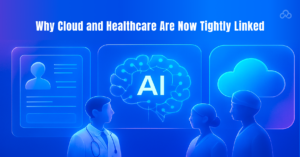
For a long time, healthcare technology was built for stability rather than adaptability. Electronic health records, imaging systems, and lab platforms were designed to run reliably on-premises, often with minimal integration between systems. That approach worked, but it came with trade-offs.
Data lived in silos. Upgrades were slow. Advanced analytics were difficult to deploy. And introducing AI into these environments usually meant bolting on yet another system.
Cloud adoption changed that foundation. By moving data and workloads into shared, scalable environments, healthcare organizations gained the ability to process information centrally and in near real time. More importantly, cloud platforms created a practical path for deploying AI across multiple processes without rewriting entire systems.
This is why cloud and healthcare have become inseparable. AI in healthcare depends on the cloud not just for compute power, but for interoperability, scalability, and continuous improvement.
MedAI as a Workflow Layer, Not Just an Analytics Tool
There were several reasons why early AI in health care projects were so unsuccessful; one of the most important was that AI was positioned and implemented outside real clinical workflow. The model would generate some insight, but for a clinician to get at that insight they would have to leave their workflow.
MedAI takes a different approach.
Instead of being a separate advisor, MedAI embeds AI right into the systems that clinicians are using today. When a physician writes a note, when a radiologist reviews images, when a nurse monitors patients, clinical AI models are evaluating those inputs simultaneously.
The fact that MedAI is running on cloud-based infrastructure allows it to always be “on”. As new data flows in, the model evaluates that data, and then surfaces outputs that help with decision making. That is a subtle difference, but a significant one. It decreases the amount of friction associated with implementation, and thus will increase adoption.
Practically speaking, MedAI converts both cloud and medical systems from static repositories into living workflows.
Clinical AI and the Changing Nature of Clinical Work
Although many people associate Clinical AI with Diagnostics; Diagnostics remains a very viable and important Use Case for Clinical AI – especially as it relates to image analysis, Pathology Support, and Pattern Recognition which have all shown measurable results. However, MedAI Platforms are expanding Clinical AI beyond the Diagnostic realm and into other areas of Care Delivery that are not always visible.
AI is being utilized in Clinical Settings to assist with Documentation, Triage, and Risk Assessment. The use of natural language processing (NLP) enables AI Models to identify and pull structured data from unstructured “Free-Text” Notes written by Clinicians. Additionally, forecasting algorithms enable early identification of Patients at risk of deterioration or requiring interventions. While none of these processes replace Clinicians, they do modify the manner in which Clinicians utilize their Time and Attention.
These NLP & Forecasting Algorithms can also be continually updated and re-trained based on additional data entered into the system as it becomes available. This continuous process of updating/re-training the AI Model(s) enables them to continuously improve over time and avoid the potential pitfalls of becoming outdated and brittle.
AI in Healthcare Beyond the Exam Room
One of the key immediate gains of MedAI adoption appears outside direct patient care. Administrative and business processes have long been a source of inefficiency in healthcare. Scheduling, resource planning, and care coordination often depend on manual processes and dispersed information.
MedAI platforms apply AI in healthcare to these areas by examining historical patterns and real-time signals. For example, forecasting algorithms can estimate patient flow based on admission trends, seasonal patterns, and staffing levels. That information helps hospitals plan ahead rather than react under pressure.
Because these capabilities are delivered through cloud platforms, they can be deployed consistently across departments and facilities. This uniform approach is a major driver of healthcare efficiency, especially in large systems.
Cloud Infrastructure as the Enabler, Not the Feature
It’s easy to focus on AI models and overlook the role of infrastructure. MedAI depends heavily on cloud architecture to function at scale. Training models, processing imaging data, and running analytics across population-level datasets requires elastic computing resources.
Cloud platforms make this feasible. They allow healthcare organizations to scale workloads up or down without investing in fixed hardware. They also support high availability and redundancy, which are necessary in clinical environments.
From a cloud and healthcare perspective, infrastructure becomes less about servers and more about reliability, security, and performance. When those foundations are stable, MedAI systems can focus on delivering intelligence instead of managing constraints.
Elevating Healthcare Efficiency Where It Actually Matters
Efficiency in healthcare has been talked about abstractly, but MedAI will have an impact on it in a real way. One example of this would be documentation burden. Physicians, for instance, spend a great deal of time entering information; reading and interpreting what others have written; and filling out forms (e.g., billing, etc.).
These burdens are reduced with MedAI platforms through automation of some aspects of the documentation process. The conversation to structured note is created via speech recognition and language models. Suggested codes are displayed at the point of use as well. These little efficiencies do add up over time.
Since MedAI platforms run on cloud systems, changes made to these systems can then be pushed across all other locations, eliminating the need for change at each individual site, which increases the impact of the improved efficiency as operational change.
Case Insight: MedAI in a Regional Hospital Network
A regional health system that had been experiencing documentation delays, along with irregular transitions between shifts, used a MedAI application developed on cloud-based architecture as part of an effort to improve clinical workflows and decrease clinician mental load. The main focus was not the deployment of cutting-edge artificial intelligence technology; it was to improve the stability in clinical work flow and to improve documentation completion times for clinicians.
In less than six months after the MedAI application began being used, the time needed to complete documentation improved, and the number of clinician disruptions due to incomplete or missing patient records decreased. Additionally, forecasting algorithms were used to identify patients who were at greater risk of hospital readmission and enable care teams to take action early enough to potentially prevent the need for additional hospitalization.
The positive impact experienced by the healthcare system was not due to one single feature. It was the result of many incremental changes in clinical workflows made possible by cloud architecture and the integration of this architecture into the healthcare industry.
Interoperability Remains the Hard Part
Although there has been considerable improvement in MedAI adoption, the main obstacle continues to be Interoperability (Healthcare Data). The data is split among systems that were created over time and developed with different standards. Although frameworks such as HL7 FHIR have significantly improved the process of integrating data; Legacy Systems continue to create barriers to interoperability.
In order to handle this issue, most MedAI systems use a modular layer to perform the integration. Using Application Program Interfaces (APIs) to normalize, validate and exchange data, allows MedAI models to function independently from a singular source of data. By doing so, it also decreases risk and enables MedAI systems to adopt incrementally.
With respect to cloud and healthcare; interoperability is less about creating a new system and more about smartly connecting existing ones.
Reference Metrics and Industry Signals
|
Indicator |
Approximate Trend |
|
Healthcare organizations using cloud platforms |
~70% |
|
Documentation time reduction with clinical AI |
20–40% |
|
Diagnostic accuracy lift with AI assistance |
10–25% |
|
Annual growth of AI in healthcare solutions |
>25% |
These figures are representative industry benchmarks intended to illustrate direction rather than guarantee outcomes.
Governance, Security, and Trust
Any discussion of AI in healthcare has to address governance. Cloud and healthcare integration prompts questions concerning data privacy, model transparency, and accountability. MedAI platforms increasingly incorporate explainability features and audit trails to support regulatory and ethical requirements.
Security is equally critical. Cloud environments must be configured carefully, with encryption, access controls, and monitoring baked in from the start. When implemented correctly, cloud platforms can meet or exceed the security posture of traditional on-premise systems.
Trust, ultimately, is what determines adoption. MedAI systems succeed when clinicians understand what the AI is doing and why.
Technical FAQs
How does MedAI support cloud and healthcare workflows? MedAI embeds AI-driven intelligence into cloud-based medical systems, allowing workflows to adapt in real time rather than relying on static processes.
What role does clinical AI play in MedAI platforms? Clinical AI supports diagnostics, documentation, and risk assessment, helping clinicians make well-informed decisions with less manual effort.
Why is cloud infrastructure essential for AI in healthcare? Cloud infrastructure provides the scalability, availability, and interoperability functions required to deploy and maintain AI models throughout healthcare systems.
Can MedAI integrate with existing EHR platforms? Yes. Most MedAI platforms adopt standards-based APIs and interoperability frameworks intended to work alongside existing EHR systems.
How does MedAI improve healthcare efficiency? By automating documentation, supporting anticipatory planning, and reducing workflow friction, MedAI improves streamlining without increasing staff workload.
Where MedAI and Cloud-Based Healthcare Are Headed
Healthcare’s integration with Cloud is no longer a fad, it is now the operational landscape of today’s healthcare framework. MedAI Platforms demonstrate what can be accomplished when AI in Healthcare is viewed as an embedded capability as opposed to an add on.
The organizations that will thrive as data volume expands and complexity of care increases are those that embed intelligence directly into how they accomplish their work. MedAI provides a roadmap to that future, not through replacement of the clinician, but by providing the clinician with the systems necessary to operate at the same speed as healthcare itself.
Do you like to read more educational content? Read our blogs at Cloudastra Technologies or contact us for business enquiry at Cloudastra Contact Us.