Enterprise risk management has traditionally focused on reducing uncertainty. However, the nature of uncertainty has evolved. Contemporary organizations operate within environments characterized by real-time transactions, cloud-native architectures, API ecosystems, and globally distributed users. Risk now emerges, evolves, and escalates at digital speed rather than accumulating gradually.
The rapid transformation of business risk management has rendered traditional Enterprise Risk Management (ERM) frameworks less effective. Conventional review-based frameworks, which rely on periodic assessments or static risk registers, are unable to identify threats that arise between scheduled reviews. Consequently, many organizations are adopting AI-based intelligence platforms such as RiskIntel to modernize the identification, assessment, and mitigation of risk.
RiskIntel signifies more than a technological enhancement. It embodies a fundamental shift in enterprise risk management strategy, moving from retrospective oversight to continuous, data-driven risk intelligence enabled by AI and big data.
Why Enterprise Risk Management Strategies Are Being Rebuilt
Legacy enterprise risk management strategies were designed for stable environments. Risks were categorized, scored, and mitigated using controls based on the assumption of predictable operating conditions. This assumption is no longer valid.
Digital transformation has blurred the boundaries between risk domains. A cyber intrusion can quickly escalate into financial loss. Fraud attempts can expose identity governance gaps. Intellectual property misuse can evolve into reputational and legal risk. The primary challenge is the sheer volume of data. Enterprises now generate millions or even billions of events daily across applications, networks, and third-party integrations. Human-centric review models are inadequate for processing this scale efficiently.
As a result, organizations are re-evaluating enterprise risk management strategies based on three core principles: continuous monitoring, cross-domain correlation, and predictive insight.
RiskIntel as a Continuous Risk Intelligence Layer
RiskIntel platforms function as centralized intelligence layers instead of isolated reporting tools. These platforms aggregate high-volume data streams from across the enterprise and utilize machine learning models to detect patterns, anomalies, and emerging threats.
Instead of treating risks as discrete checklist items, RiskIntel evaluates how signals interact. A suspicious login event identified through an IP risk analysis API may correlate with abnormal transaction behavior flagged by a fraud prevention API. When combined, these signals produce a higher-confidence risk assessment than either would alone.
This ability to correlate signals enables enterprise risk management strategies to transition from reactive responses to anticipatory controls.
The Strategic Role of IP Risk Analysis APIs
Risk at the network level has become a key component for many enterprise-wide risk management strategies due to the increasing adoption of remote work, use of cloud infrastructure and integration with third party services. Because an IP address represents both the source and type of communication taking place, it provides critical information about an organization’s potential risks from network-based events.
IP Risk Analysis APIs analyze a variety of factors including; geographical consistency of the originating IP, reputation of the originating IP, if proxy servers were used, and past history of abuse of the originating IP. IP Risk Analysis APIs do not provide a binary result (yes/no). Instead, they generate probabilistic risk indicators that are then inputted into larger decision-making engines.
The value of an IP Risk Analysis API can be maximized by integrating them within a layered risk management framework. In this way, when the IP Risk Analysis API identifies risk associated with a particular user, it will automatically increase the number of authentications required, increase the threshold for raising alarms or initiate secondary verifications rather than simply blocking the user. The layered approach provides a balance between minimizing false positive results and maximizing the effectiveness of the overall risk control.
Fraud Prevention APIs as Predictive Risk Controls
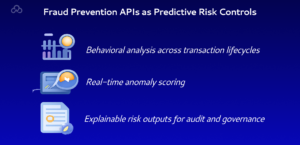
Fraud prevention has evolved from static rule sets into adaptive, learning-based systems. Modern fraud prevention APIs use machine learning models to continuously adjust to emerging attack techniques and changing transaction patterns. Within enterprise risk management strategies, these APIs serve both protective and analytical roles by identifying threats early and generating actionable risk insights. They prevent financial loss and generate valuable risk intelligence that can be correlated with other domains, including cybersecurity, compliance, and operational risk. operational risk.
Key capabilities typically include:
– Behavioral analysis across transaction lifecycles
– Real-time anomaly scoring
– Explainable risk outputs for audit and governance
Integrating fraud prevention APIs directly into ERM platforms enables organizations to achieve a more comprehensive view of risk exposure, rather than treating fraud as an isolated issue.
Threat Detection Beyond Traditional Security Boundaries
Detection of risks and threats today has moved beyond just Firewalls and Endpoint Detection/Prevention (EDP) solutions. The modern risk environment necessitates visibility into all aspects of the User Experience, including user behavior, application programming interfaces (API), Data Access Patterns, System to System Communications etc.
Big data analytic engines in RiskIntel Platforms analyze all events utilizing artificial intelligence (AI) based models to determine anomalies in user behavior relative to established baselines for normal behavior. This type of analysis enables the identification of threats such as Insider Threats, Lateral Movement, and Indicators of Subtle Compromise which can often go undetected by traditional signature-based detection systems.
In addition to providing context to the Technical Severity of a threat, the primary benefit of using RiskIntel Platforms for Enterprise Risk Management is the ability to assess threats based upon their Potential Business Impact. For example, an Anomaly with Low Noise on a Critical Process may require priority over a Noisy Alert on a Non-Essential System.
AI as a Service and the Scalability of Risk Intelligence
Historically, deploying AI capabilities at scale required substantial investment in infrastructure, specialized talent, and ongoing model maintenance. The advent of AI as a Service has fundamentally altered this dynamic.
By leveraging AI capabilities through cloud-based services, organizations can incorporate advanced analytics into their enterprise risk management strategies without developing solutions internally. These models can be updated continuously to address emerging threats, regulatory changes, and industry AI as a Service also enables elastic scaling. During periods of increased risk, such as mergers, regulatory audits, or major product launches, analytical capacity can expand automatically without operational disruption.
How RiskIntel Reshapes Enterprise Risk Management Strategy
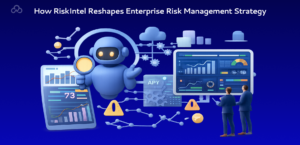
The integration of AI, big data, and API-driven intelligence represents a fundamental redesign of enterprise risk management strategy.
Risk aRisk assessment transitions from episodic to continuous processes. Risk scoring becomes dynamic instead of static. Governance evolves from manual oversight to evidence-based decision-making supported by real-time data. Evolution enables stronger alignment between risk teams and executive leadership. Risk is no longer communicated solely through reports, but through live indicators that reflect current exposure and trajectory.
Case Insight: Risk Intelligence in Financial Services
A regional financial service company was experiencing an increase in fraud loss, and regulatory attention due to increased scrutiny, although they had performed regular audits, and were utilizing established internal controls. The companies’ current Enterprise Risk Management (ERM) strategy for managing risk is dependent upon static threshold measures, and post-incident reviews.
After implementing a RiskIntel Platform that utilized IP risk analysis APIs, fraud prevention APIs and AI based threat detection capabilities, the financial service company implemented a continuous risk monitoring program. Within 12 months, significant reductions were seen in fraud related losses, as well as in incident response times. More important than these improvements was the fact that executive level risk discussions changed from reviewing summaries of incidents to providing forward looking exposure analysis. These changes were evidence that the company’s ERM strategy had both improved due to the use of new technologies, and has matured.
Reference Metrics and Industry Indicators
|
Metric |
Observed Trend |
|
Enterprises using AI-driven ERM (2024) |
~60% |
|
Average fraud loss reduction |
25–45% |
|
Risk detection latency improvement |
30–50% |
|
Annual growth of AI as a Service in ERM |
>20% |
Figures represent aggregated industry benchmarks and are provided for reference context.
Technical FAQs
How Does Risk Intel Support Your Enterprise Risk Management Strategy?
Risk Intel Provides Continuous Risk Assessment (Risk Monitoring), Cross Domain Correlation and AI Driven Prioritization of Risks for ERM to Run in Real Time Versus Review Cycles Based Upon Fixed Time Frames.
What Role Does an IP Risk Analysis API Play In ERM?
An IP Risk Analysis API Provides Contextual Network Level Risk Signals That Enhance Access Control, Fraud Detection, and Anomaly Detection Within A Broader ERM Framework.
Are Fraud Prevention APIs Relevant Outside Financial Services?
Yes. Fraud Prevention APIs Are Used In SaaS, Ecommerce And Digital Platforms To Detect Abuse, Account Manipulation And Transactional Anomalies.
How Does AI As A Service Improve Scalability For ERM?
AIAAS Allows Organizations To Deploy And Update Advanced Risk Models Without Maintaining In-House Infrastructure, Supporting Elastic Scaling and Faster Innovation.
Does AI-Based Threat Detection Replace Existing Security Tools?
No. It Complements Them By Adding Behavioral and Contextual Intelligence That Feeds Into Enterprise Risk Management Platforms and Decision Workflows.
Where Is The Direction Of Enterprise Risk Management
Enterprise risk management strategy is transitioning from static oversight to intelligent anticipation. Platforms such as RiskIntel demonstrate how AI and big data can transform fragmented signals into actionable insights.
As Risk Environments Become More Complex and Interconnected Organizations That Embed Predictive Intelligence into Their ERM Frameworks Will Be Better Equipped to Protect Value, Maintain Trust and Make Decisions Under Uncertainty.
Do you like to read more educational content? Read our blogs at Cloudastra Technologies or contact us for business enquiry at Cloudastra Contact Us.