Nowadays, building a successful startup only depends on magical ideas. It is because what actually matters is how quickly and accurately you can test that idea for real. And this is where MVP validation becomes the backbone to build modern products. Instead of waiting a long time to build a complete product, today we all depend on artificial intelligence, which is data-driven and supports experiments to understand what customers really want.
In this blog, we will explore how AI agents and rapid experimentation are transforming MVP validation, helping founders reduce risk, save money, and move from idea to impact with confidence.
Why MVP Validation Is Critical for Startups
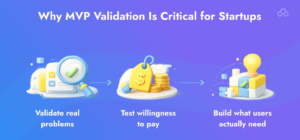
Every startup begins with assumptions and probability. You can think there is an issue. You can assume that users will pay for the solution. You also assume your features matter the most to them. However, assumptions without testing often lead to another problem.
MVP validation is the process of testing these assumptions with a minimum viable product before scaling further. It helps founders answer important questions early. Does the problem actually exist? Do users care enough to engage? Are they willing to pay?
Moreover, validation ensures that your startup is building something meaningful, rather than chasing vanity features. As a result, teams make smarter decisions backed by data rather than intuition alone.
The Rise of AI Agents in Product Development
Artificial intelligence has changed the way products are built and tested. AI agents can now simulate users, analyse behaviour, and generate insights at a speed that was previously impossible. Because of this shift, AI in product discovery has become a game-changer for early-stage startups.
AI agents can understand the market trends to analyse customer reviews that help them study competitor products, and even predict user needs. Therefore, founders get clarity much earlier in the journey. Instead of focusing on what users want, AI helps to unlock the patterns and preferences hidden in huge data sets.
When AI is combined with MVP validation, AI agents lower the uncertainty and allow startups to move ahead with high confidence.
How AI Helps Validate Startup Ideas Faster
Speed is non-negotiable in today’s startup ecosystem. The faster you learn, the better your chances of success will be. And AI makes it possible to validate startup ideas faster by automating research and experimentation. For example, AI tools can easily analyse thousands of survey responses in minutes. Chat-based AI agents can conduct interviews on a large scale.
This spontaneous learning loop improves MVP validation because the decisions are made using real data rather than delayed feedback.
MVP Testing With AI and Rapid Experiments
Traditional testing methods were time-consuming and costly. Today, MVP testing with AI allows startups to work on multiple experiments simultaneously. AI agents can test landing pages to check pricing models, feature combinations, and onboarding flows in parallelly.
Because of this, MVP validation becomes a ritual process rather than a one-time task. Startups constantly learn and use based on live feedback.
Using AI Agents to Reduce Human Bias
Human bias is one of the biggest issues while building any product. Founders often incline towards their ideas and ignore negative signals. AI agents, however, work on data and insights rather than emotions.
By depending on AI-driven insights, startups get objective perspectives. AI highlights the patterns that humans might miss. It questions the assumptions and surfaces uncomfortable truths. Therefore, MVP validation becomes more reliable across all industries.
Additionally, AI can work with different customer personas that can help the teams to understand diverse needs. This is especially important during early startup MVP development when users may still be limited.
The Role of MVP Development Services for Startups
Many founders choose to work with experts who specialise in MVP development services for startups. And these services frequently combine AI tools and validation structure into the development process.
Such teams help the startups to design experiments so they can interpret AI insights and apply learnings effectively. As a result, startup MVP development becomes more structured and less risky.
By combining technical expertise with AI-driven MVP validation, these services allow the founders to focus on strategy and vision while ensuring the product is aligned with market demand.
Real Life Examples of MVP Success
Some of the biggest companies today started as MVPs. Let us look at a few inspiring stories.
Dropbox: Before building a full platform, Dropbox first launched a simple video explaining the idea. The positive response in the MVP market encouraged them to move forward.
Airbnb: The founders tested their concept by renting out their apartment to conference visitors. This small MVP validated the idea before scaling.
Spotify: The widely used Spotify launched with basic streaming features. As feedback poured in, they added more functions and became a global leader.
These examples show that starting small with MVP app development services can lead to massive success later.
Common Mistakes to Avoid During MVP Validation
Mistakes still happen even if you have powerful tools. One common error is highly dependent on AI without a human monitor. AI provides insights, but founders must understand them accurately.
Another mistake is validating too late. Delaying MVP validation increases the risk and costs. Instead, validation should start as early as possible and continue throughout development.
Finally, ignoring negative feedback can slow your progress, and AI may show shocking truths, but those insights are valuable. So, listening to data ensures better outcomes for your startup.
The Future of MVP Validation With AI
The future of MVP validation is increasingly automated, intelligent, and fast. AI agents will become more advanced and offer deeper insights and predictive capabilities. Validation will shift from reactive testing to proactive innovations.
As AI in product discovery evolves, startups will identify opportunities even before competitors notice them. And this will surely redefine how products are built and launched.
Conclusion
Building a startup is no longer about sensing and hoping for the best. But also, it is about learning fast, testing smart, and adapting continuously. MVP validation using AI agents and rapid experiments empowers the founders to make confident decisions that are backed by data.
By using AI to validate startup ideas faster, conducting MVP testing with AI, and using structured startup MVP development, teams reduce risk and increase their chances of success.
Whether you are building your first product or refining any existing idea, combining human creativity with AI intelligence can transform the way you validate and grow your startup.
FAQs
1. Why are MVP development services important?
MVP development services are important because they help in reducing risk by validating business ideas with real users. They also save costs and reduce the time to market, which makes it easier for companies to adapt.
2. How much does MVP cost?
MVP cost depends on product complexity, chosen technology, and development time. But it is always more affordable than building a full product because only the main features are developed first.
3. How does custom MVP software development help businesses?
Custom MVP software development creates solutions customised to your specific business needs. Unlike generic tools, it ensures flexibility, scalability, and industry relevance.
4. How does AI improve MVP validation for early-stage startups?
By analysing user behaviour, feedback, and market data, AI improves MVP validation all at once. It helps entrepreneurs identify patterns to test assumptions quickly and make data decisions.
5. When should startups start using AI for MVP validation?
Startups should initiate using AI as early as possible in the idea stage itself. AI tools support market research, user discovery, and rapid experiments even before development starts.
Do you like to read more educational content? Read our blogs at Cloudastra Technologies or contact us for business enquiry at Cloudastra Contact Us.