It’s exciting to release a new product, but there are also certain things you don’t know. Do people really want it? Will they pay for it? Will it solve an actual problem? This is known as product market risk reduction, and it’s one of the key reasons why new enterprises fail.
This is when MVP testing comes in handy. Founders may test their ideas early, learn faster, and make wiser choices instead of wasting time and money on guesswork. MVP testing helps companies make sure there is a market for their product, enhance its direction, and avoid developing something that no one needs.
In this blog, we’ll speak about how MVP experiments work, why they’re important, and the best ways for businesses to try things out that minimize the probability that their goods won’t sell.
What Are MVP Tests?
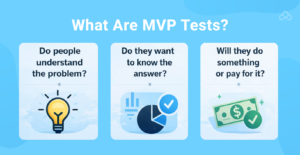
MVP trials are testing that are set up in a certain way to confirm basic notions about a product with as little time and money as feasible. Instead of making an entire product, entrepreneurs test small, focused ideas with prototypes, landing pages, mockups, or a small number of features.
These tests answer questions like:
– Do people understand the problem?
– Do they want to know what the answer is?
– Will they do something or pay for it?
By implementing MVP experiments early, teams can learn directly from real users instead of just going with their gut.
Why MVP Experiments Are Important for Reducing Product Market Risk Reduction
Most goods don’t fail because the technology is bad. They happen because there isn’t a real need for them. MVP tests assist minimize the likelihood of a product failing in the market by confirming three key areas:
– Validation of the issue: Is it genuine and distressing?
– Validation of the solution: Does your method truly work?
– Market validation: Are people prepared to pay or get involved?
Without testing, new businesses can grow too quickly and without thinking.
Important MVP Tests That Make It Less Likely That You Will Sell a Product
These are the greatest MVP tests that product teams and successful startup experimentation.
1. Problem interviews as experiments
– Before you start making anything, make sure the problem is real.
– Talk to your target customers in a structured way and focus on getting to know:
– The issues they’re dealing with right now
– The answers they already use
– How often the problem happens
– How much it changes their lives or job
This kind of testing at the beginning helps make sure that you’re not working on a problem that isn’t real. If users care about the problem, you’re on the right course.
2. Try out a Landing Page MVP
Making a landing page MVP is one of the simplest ways to find out if visitors are interested.
Make a simple page that says:
– The problem
– Your suggested fix
– The most essential advantages
A clear call to action, like “Join the waitlist” or “Request early access,”
A lot of professional MVP services include this experiment because it delivers quick, affordable information.
3. Test for Concierge MVP
In a concierge MVP, a person delivers the product instead of a machine. individuals assume they are using a product, but in reality, individuals do the work behind the scenes.
This way lets you:
– Make sure that workflows are correct
– Watch how users behave very closely.
– Change the solution in real time
Concierge MVPs are powerful because they value learning more than growth. Many mvp development services propose this as a popular technique to validate an idea in its early stages.
5. Testing the Clickable Mockup and the Prototype
You can test how easy it is to use and how well it flows with clickable prototypes without having to develop the complete thing.
– Figma and other tools can help teams:
– Check the order of the most important features
– Find the places where things don’t make sense
– Look at how the navigation makes sense
– Make the experience better for people that use it
People act like the prototype is real and give feedback that makes less effort for the future. This plan makes lean MVP testing easier by keeping the labor light and focused on gathering feedback.
6. Trying out different rates and how much people are prepared to pay
Interest alone isn’t enough. People who use it have to be ready to pay.
– Try out prices by:
– Giving different people different prices
– Asking customers to pay ahead of time or make a reservation
– Offering discounts for getting in early
These tests confirm revenue estimates early on, which is vital for long-term growth and investor trust.
7. Try out the Feature Scope MVP
Instead of launching your product with a lot of features, try out the smallest version that works.
Look for:
– One important thing the product needs to do
– The fewest features it needs to work
– What can be put off or taken away
This strategy works great with lean MVP development services, which makes launches and learning cycles go faster.
How MVP testing help startups build a culture of trying new things
MVP experiments do more than just show that ideas work. They make a learning environment. Teams who often try new things:
– Make decisions based on facts, not feelings.
– Go through the process faster than your competitors
– Less emotional attachment to features
– Change quickly based on what users say
How to stop making mistakes in validation all the time
If you want to learn faster with less risk, structured MVP development services can help. Things You Shouldn’t Do When You Do MVP Experiments. Even if you mean well, some mistakes can make the results less strong:
– Testing too many assumptions at once
– Not caring about unfavorable feedback
– Focusing on vanity measures instead than genuine activities
– Making too much before testing
– Loving the idea instead of the facts
The best MVP tests are honest, focused, and based on results.
Final Thoughts

MVP tests don’t mean doing less. They’re about learning more while taking less risks. By checking their assumptions early and often, startups experimentation may reduce uncertainty, save money, and come up with solutions that people genuinely want.
If you want to make smart product decisions, MVP tests are the way to go. They can help you test prices, validate an idea, or make something work better. When done right, they make it much less likely that the product would fail in the market and set the stage for long-term success.
FAQs
1. What do MVP experiments mean in simple terms?
MVP experiments are small tests that assist you make sure your product ideas are good by gathering input from real consumers before you develop a full product.
2. How can MVP tests make it less likely that a product will fail in the market?
They check early on to see whether there is a need for it, if it is convenient to use, and if people are willing to pay for it. This stops business owners from manufacturing things that don’t fit what people want.
3. What does it mean to “lean MVP test”?
Lean MVP testing is all about doing rapid, cheap tests that put learning ahead of having all the features.
4. Should new firms hire organizations that make MVPs?
Yes, especially if they want to get feedback quickly, seek guidance from professionals, and avoid making costly mistakes right away.
5. How many MVP tests should a new business run?
There isn’t a set amount. Startup experimentation should continuously test their ideas until they can show that their basic notions about users and value are right.
Do you like to read more educational content? Read our blogs at Cloudastra Technologies or contact us for business enquiry at Cloudastra Contact Us