All throughout the world, healthcare systems are under a lot of stress. Because there are more patients, fewer clinical staff, and more expectations for faster and more accurate care, traditional triage techniques are hard to scale. This is where clinical AI can be very helpful. Secure AI assistants are transforming clinical triage by helping healthcare workers prioritise patients, identify risks, and make choices more rapidly without putting data privacy or compliance at risk. If implemented correctly, these smart solutions can be a trusted support layer instead of a replacement for doctors.
We’ll talk about how secure AI assistants operate in clinical triage, what their benefits are, some real-world instances of how they are utilized, and why being safe and ready for the cloud are so critical for success in this specific AI Assistants for Clinical Triage related blog.
How to Get a Handle on Clinical Triage in Today’s Healthcare
Clinical triage is the process of checking on patients to find out how bad their medical needs are. Whether they are made in emergency rooms, telemedicine platforms, or outpatient settings, triage decisions have a direct impact on patient outcomes.
But there are drawbacks with doing triage by hand:
– A lot hinges on workers being able to work.
– Inconsistent reviews when things are busy
– Delays in getting care
– More doctors and nurses are getting burned out.
What are some AI helpers that are safe to use in clinical triage?
Smart devices called secure AI assistants let healthcare professionals bring in patients and put them into groups. These assistants use machine learning, natural language processing, and predictive analytics to look at patient data in real time.
Secure healthcare AI solutions are not the same as conventional automation tools because they are made up of:
– Data encryption
– Access controls that depend on roles
Safe cloud infrastructure devices can work in emergency rooms, virtual care platforms, and configurations that let doctors see patients from a distance.
How Clinical AI Improves Triage Accuracy
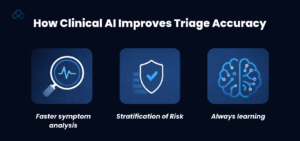
One of the best things about clinical decision support AI is that it can swiftly sort through a lot of data. AI assistants will keep becoming better at being trusted copilots for doctors, helping them make decisions without taking power away from those who work in the medical field.
This is how AI assistants help with triage:
1. Faster symptom analysis
AI helpers can look at symptoms that people provide in through chat, speech, or electronic forms and compare them to health care standards.
2. Stratification of Risk
By looking at prior data and using predictive models, clinical AI can locate patients who are at high risk early on. This is especially true for persons who have health difficulties that last for a long time. AI makes sure that triage criteria are consistently followed, which cuts down on the discrepancies that could emerge when individuals are sleepy or have a lot of work to accomplish.
3. Always learning
With the correct management, AI models get stronger over time by learning from what doctors say and the results of their work.
Why security is important for AI systems in healthcare
There is no argument about security in healthcare. Personal health information is exceedingly private, and any compromise could have huge legal and moral implications. Following requirements like GDPR and HIPAA
That’s why privacy-first rules should be applied when building AI for healthcare that is safe.
Some essential security features are:
– Encrypting patient data from beginning to end
– Managing identification and access safely
– Audit logs for taking responsibility
Using clinical AI in a reasonable and the best way to help patients and doctors trust each other.
Cloud and Healthcare: How to Make AI Assistants Useful for Everyone
The cloud is quite significant for AI assistants these days. Cloud computing and healthcare work together to keep data safe, process it swiftly, and connect systems without any problems.
With cloud-based healthcare AI, you get:
– Scalability when there are a lot of patients
– Real-time updates and improvements to the model
– Linking up with telehealth and EHR systems
– High availability and the ability to bounce back from calamities
Real-life examples of how medical AI assistants aides are utilized for triage
AI assistants in emergency departments help sort new patients by how critical their condition is. This makes the wait times shorter for the most urgent instances. AI assistants will keep becoming better at being trusted copilots for doctors, helping them make decisions without taking power away from those who work in the medical field.
1. Telemedicine platforms
Clinical AI may check patients out ahead of time and send them to the right care pathway during virtual consultations.
2. Watching Patients from a Distance
AI helpers aid people with long-term illnesses by recognizing problems before they get worse.
Outpatient Clinics: AI-powered triage tools make it easier to book appointments and cut down on visits that aren’t necessary.
In all of these cases, clinical decision support AI helps doctors do their jobs faster while keeping patients safe.
Advantages for doctors and healthcare groups
As we know that Clinical AI doesn’t replace human judgment but it adds a second layer of knowledge that helps clinicians focus on what matters most. Secure AI helpers really do improve the whole healthcare system by:
– Less work for doctors
– Faster assessments of patients
– Better coordination of care
– Less expensive to run a business
– Patients are happier
Clinical AI doesn’t replace human judgment; it adds a second layer of knowledge that helps clinicians focus on what matters most.
Problems and How to Use Them Responsibly
Even though secure healthcare AI provides benefits, there are issues with employing it.
These are:
– Data quality and bias
– Models that are easy to understand
– Adoption by doctors
Following the regulations that healthcare organizations need to:
– Include doctors in the planning of AI
– Look at models very closely
– Watch people closely
– Make sure that AI is run in a moral way.
What Will Happen with Clinical AI in Triage
In the future, we shall all undertake triage together. AI assistants will keep becoming better at being trusted copilots for doctors, helping them make decisions without taking power away from those who work in the medical field. As clinical AI grows better, cloud and healthcare systems work together better, and security standards get stronger, AI-powered triage will become a common element of modern care delivery.
Healthcare organizations who invest early in AI solutions that are safe, secure and can expand will be able to give care that is faster, safer, and better suited to each and individual patient.
FAQs
1. What is clinical AI in triage?
Clinical AI is a kind of AI that aids doctors by looking at patient data and helping them decide how urgent care is, improving accuracy, speed, prioritization, consistency, and overall patient outcomes in busy healthcare environments.
2. Are AI assistants in the medical field safe?
Secure healthcare AI systems provide encryption, access restrictions, and compliance frameworks to protect patient data and fulfill regulatory standards.
3. Is it possible for AI to do the job of doctors in clinical triage?
No. AI for clinical decision assistance is not supposed to replace the place of doctors. It is still very necessary to have people in charge.
4. How could merging cloud computing and healthcare make AI systems better?
AI-powered healthcare apps can look at more data, get updates in real time, and keep data safe thanks to cloud infrastructure.
5. Can AI medical aides be used for telehealth?
Yes, telehealth uses medical AI assistants a lot to assess patients’ symptoms, screen them ahead of time, and send them to the correct care swiftly.
Do you like to read more educational content? Read our blogs at Cloudastra Technologies or contact us for business enquiry at Cloudastra Contact Us