Artificial intelligence is no longer just one model that can perform one thing. Companies today utilise a variety of AI tools at once, like big language models, computer vision systems, prediction engines, and AI tools that are built for a certain field. This offers up a lot of great options, but it also makes things a lot more difficult.
To stay safe, obey the laws, and do their jobs successfully, organisations need to employ powerful multi-model AI governance solutions. Without clear oversight, companies risk leaking data, breaching the law, going over budget, and getting results that aren’t always the same.
This blog article will talk about why multi model AI governance is becoming more relevant, how it connects to enterprise AI governance, and the rules that enterprises need to follow to use AI responsibly.
Why Multi Model AI Is the New Normal
Businesses used to test with just one AI system. But things have changed quite quickly.
These days, organisations often use:
– One approach to make customer service easier is
– Another way to write code
– A third for putting documents into short form
– Models that are specific to finance or healthcare
– AI as a service platforms from other places
How does multi-model AI works?
To put it simply, multi model AI governance is the rules, methods, and controls that a company utilizes to maintain track of more than one AI model.
– It makes sure that people utilise models in a reasonable way.
– Standards for keeping data private are followed
– We look at outcomes to make sure they are fair and correct.
– Teams decide who can get in
– Costs are maintained to a minimum.
The Shift to AI Governance in Business
Startups can experiment, but major firms require structured enterprise AI governance.
Following the guidelines is what enterprise AI governance is all about.
– Lowering risk
– Rules for keeping data safe
– Managing suppliers
– Managing the lifecycle of a model
For example, if a company has different LLMs for its marketing and legal teams, its governance rules must make sure that:
– Private legal data is not available to external APIs.
– Marketing outputs are in line with what the brand expects.
– You can look at the decisions made by the model.
The Risks of Poor Multi-Model AI Governance
More models might help you do more, but they can make things more dangerous.
1. Data Loss
If employees use several AI technologies without supervision, they risk sending critical data to systems that shouldn’t have access to it.
2. Breaking the rules of compliance
Some fields demand very strict records and audit trails. Without appropriate multi-model AI governance, it’s challenging to follow the rules.
3. Cost Explosion
When various teams join up for different AI as a service providers on their own, the fees might build up quickly.
4. Outputs that are different
Different models might offer you different answers. When things aren’t in harmony, the brand voice and the accuracy of decisions go down. So, we need to use multi-model AI governance. It is a strategic need.
The major aspects of governing multi-model AI
Businesses need to focus on structured pillars to deal with complexity well.
1. A policy framework that is all in one place
First, set clear rules about how to use AI. These should have:
– List of tools that are okay to use
– Rules for putting data into groups
– Rules regarding how to use things
– Things that need to be looked over by a person
2. Watching how AI is applied
After that, make sure there are solid rules in place for keeping an eye on how AI is employed.
Keeping an eye on how individuals use AI helps maintain track of who is using which model.
– What type of data is being processed?
– How often does it get utilised?
– Cost of use
3. Running several LLMs
As corporations start to employ more than one big language model, it’s necessary to manage them all. Managing more than one LLM means:
– Looking at how well models work
– Automatically routing between models
– How to switch over
– Scoring for evaluating output
4. Role-Based Access Controls
Not all AI models should be available to all employees. So, controls on use must say:
– Access levels
– How to see data rules
– Limits on prompts
– Logging needs
5. Taking care of the lifecycle
Every AI model must go through these steps:
– Testing
– Deployment
– Watching over
– Updating
– Retirement
How to manage things in AI systems with several models
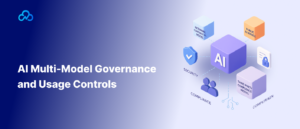
When there is more than one AI model in an environment, integration gets harder.
For example, a company might use:
– A model for confidential data inside the company
– An AI service provider that handles a lot of different things for the public
– A third party’s compliance model
So, both internal and external models should be part of governance.
Multi-model AI governance also makes sure that all systems keep track of and report in the same way. This makes things obvious, which is very crucial for overseeing at the board level.
What AI as a Service Does for Government
A lot of companies employ AI as a service to speed up the process of putting it into action.
But AI as a service has risks that come from outside sources. So, governance needs to check the security certifications of vendors.
– Rules for preserving data
– Clear model training
– Moving data across boundaries
AI as a service makes it easier to manage infrastructure, but the rules for internal governance stay the same. So, as part of their bigger multi-model AI governance approach, firms need to include vendor evaluation.
Final Thoughts
AI usage monitoring is being used by more and more companies. But the shift to multi-model AI settings demands more oversight than it ever has previously. If businesses don’t have clear rules, usage limitations, and strong monitoring, they could lose data and be fined by regulators.
So, companies need to adopt enterprise AI governance ideas along with strict usage constraints, better monitoring, and multi-LLM management methodologies. Ultimately, multi model AI governance transcends mere compliance.
It’s about building trust, making sure people are accountable, and letting AI grow and change in a way that lasts.
Questions That People Ask Often
1. What does it mean to control more than one AI model?
Multi-LLM management is the collection of rules that a company uses to maintain track of all of its AI models. It makes sure that systems are watched over, that data is safe, that regulations are obeyed, and that they all work the same way.
2. What sets it apart from enterprise AI governance?
Enterprise AI governance is making sure that the overall AI plan is followed and that AI is used properly. AI governance, on the other hand, is all about keeping track of and coordinating the activities of more than one AI model at once.
3. Why is it important to keep a watch on how AI is used?
AI usage monitoring maintains a track of who is using what models and how they are being used. This helps firms save money, deter people from abusing their resources, and get ready for audits.
4. What does it mean to manage a lot of LLMs?
When you manage a lot of large language models (LLMs), you have to check on them, route them, and keep an eye on them. So, it helps keep the quality of the work high and makes it less likely that you’ll need to rely on vendors.
5. How does AI as a service affect the way we govern?
AI as a service makes it easy to utilise. But robust governance is needed to keep an eye on vendor risks, data security, and compliance.
Do you like to read more educational content? Read our blogs at Cloudastra Technologies or contact us for business enquiry at Cloudastra Contact Us