Introduction
The technology of Artificial Intelligence has arrived beyond its future prediction status. AI serves as the main force that drives modern business advancements in 2025. AI services help businesses defeat industry opponents while building new customer expectations in entertainment fields and financial sectors as well as healthcare systems and logistics networks.
The initial experimental phase of AI has turned into a mainstream adoption of AI as a Service which functions as the primary framework for creating scalable innovative solutions. Companies apply AI services to simplify their operations along with improving decision quality and automation of repetitive work while creating tailored customer interactions. Organizations must use AI in operations because it has become essential to business success. Thanks to AI as a Service (AIaaS) flexibility all types of companies from small to mid-sized enterprises can connect themselves to advanced AI models while skipping deep infrastructure requirements and big R&D expenses.
AIaaS provides organizations and businesses with quick deployment speeds as well as innovation capacity through its adaptable structure and simple entry points. We will explore behavioral changes in businesses and their impact on future workplace conditions and the transformation of consumer support and competitive market approaches.
Understanding AI as a Service in 2025
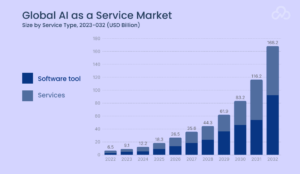
Through AI as a Service, users gain cloud-based access to leading AI tools together with their supporting models and infrastructure. Organizations can benefit from AI as a Service by subscribing to ready-made services that multiple providers such as Amazon Web Services, Microsoft Azure and Google Cloud provide in addition to specialized AI startups.
The on-demand nature of this model makes it simpler for new companies to start working with it. Website subscribers gain access to sophisticated AI tools which become reachable to organizations that lack funds for ownership or system management of such advanced capabilities.
Key components of AI as a Service include:
– The detection and prognosticating ability of machine learning platforms available as services
– Chatbots and virtual assistants for AI customer service
– Image and speech recognition tools
– Decision management systems provide human operators with data-based suggestions through their decision support capabilities.
These fast advancements lead businesses to experience actual profit gains at booming speeds.
How AI Services Are Reshaping Industries
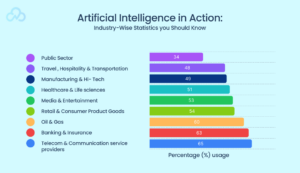
1. Retail: Personalized Experiences at Scale
Retailing now stands as a competition based on customer experience delivery. Through AI services, companies can offer highly personalized shopping because these systems analyze customer shopping behaviors with their purchase records and social media and review emotions.
Modern AI recommendation systems through AIaaS solutions determine customer preferences even before the customers realize what they want. Service providers need to use AIaaS tools to establish customer loyalty based on product and content relevance while generating sales gains.
AI customer service technology featuring AI chatbots and virtual agents manages all customer needs, starting with order document tracking to issuing refunds. The systems develop a better understanding because they study each dialogue, which leads to improved experience for users when repeated.
2. Healthcare: Diagnosis and Decision Support
Healthcare operations embrace the power of AI as a Service. Machine learning tools enable the diagnosis of patterns within medical imaging data alongside patient records that doctors at any level cannot identify. The precision used to diagnose cancer alongside Alzheimer’s and heart disease symptoms is now achievable through AI assistance to doctors by 2025, when compared to 2020 standards.
Healthcare institutions utilize AI services for optimizing how patients move through their facilities and for anticipating how to maintain equipment as well and for scheduling surgical operations. The result? Lower operational costs and better patient outcomes.
Medical chatbots serve as patient symptom triage tools, which both accelerate medical care access and reduce overworked healthcare worker burdens, but maintain detailed patient assistance.
3. Financial Services: Real-Time Risk and Fraud Detection
The core value of accurate forecasting paired with quick decision-making in finance finds perfect alignment with AI technologies. Financial institutions, together with fintech companies, utilize AI services to track current transaction behaviors to discover fraud and stop it from happening. Quantitative analysis conducted by machine learning algorithms, which require massive dataset training, reveals anomalies better and more efficiently than typical rule-based systems.
Loan underwriting has also evolved. A thorough risk evaluation process enabled by AI incorporates behavioral indicators together with transaction records and social aspects, while feeling comfortable with personalizing fair lending solutions for clients.
AI systems used in customer service positions create both economic advantages and higher levels of satisfaction for clients. The system of intelligent virtual assistants strengthens customer service by providing detailed answers to complex mortgage, investment, and account-related questions so representatives can focus on advanced responsibilities.
4. Manufacturing: Predictive Maintenance and Smart Supply Chains
Manufacturer operations have received powerful capabilities through the AI as a Service development. Companies use predictive maintenance with sensor data analytics and AI algorithms to identify equipment trouble before failures happen, which shortens expensive production stops. The manufacturing organization benefits from longer product lives and safer work environments through the minimization of surprise equipment failures at the production site. Early anomaly detection enables manufacturers to schedule maintenance work during low-demand periods without disrupting their entire production operation.
Several advancements in supply chain technology are currently in effect. The predictive capabilities and operational improvements provided by AI services produce forecasting results and delivery route optimization and supplier performance evaluation, and inventory management excellence superior to what humans could achieve. The responsive system cuts wasteful practices while creating higher operational stability when raw material shortages and delivery delays emerge. Through AIaaS implementation, mid-sized manufacturers successfully conduct elaborate simulations that help them identify supply chain hurdles so they become more adaptable during markets with volatile conditions. AIaaS serves to build a manufacturing system that operates faster and adapts with ease, and runs efficiently.
5. Entertainment: AI-Curated Content and Dynamic Storytelling
The entertainment industry uses artificial intelligence to create new products as well as assist behind the camera. Streaming services employ artificial intelligence to customize their recommendation algorithms. AIaaS platform tools enable certain companies to develop storylines automatically from user preferences through their natural language generation capabilities.
The video editing, audio refinement, and music creation processes rely on AI service platforms for content creators. Through a cloud-based AI tool, ordinary people can create professional-level content because of this development.
AI Customer Service: The New Standard
The standard of customer requirements for 2025 exceeds all historical benchmarks. Customers expect institutions to deliver prompt assistance at all times with tailored solutions, so these aspects have become mandatory instead of optional. AI customer service tools provide the solution for these needs.
AI chatbots from today understand contextual meanings and the tone of voice alongside the overall purpose of the message. These systems perform natural conversations with customers and solve problems efficiently before smoothly connecting them to human operators.
Short deployment terms for these tools are made possible through AI as a Service technology. AI customer service platforms come equipped with simple interfaces and prepared language models alongside API connections that let them merge directly with current CRM platforms.
Additionally, AI customer service provides:
– Historical analysis of customer emotions enables immediate reaction by appropriate support staff.
– Multilingual support, expanding global accessibility
– A system connects customers to automatic processes that optimize service delivery through iterative enhancement measures.
Higher efficiency and reduced churn, and better customer satisfaction become achievable outcomes through this result.
The Democratization of Innovation
The most significant benefit AIaaS brings is its capability to create equality between businesses of all sizes. Startups of all sizes can acquire identical development tools that enormous technological corporations use. Companies introducing their products to the market can integrate advanced machine learning functionalities through a basic subscription plan in just a few days.
The dissemination of these services drives the growth of modern innovation. Remote entrepreneurs, along with businesses of all sizes and non-profit organization,s can start using AI through AIaaS guidance while avoiding costly staff additions.
Challenges and Ethical Considerations
This transition faces multiple obstacles on its path to development while being achieved. The increase in AI services has led to significant attention being paid to privacy questions and bias concerns, and responsible decision-making accountability requirements.
Standards exist for holding accountable parties in situations when AI systems generate incorrect choices. Methods to preserve transparency should be established for the system’s learning and changing over time.
Organizations with governments across 2025 have started the development of AI governance frameworks to establish control over AI systems. Providing responsible AI features and conducting explainability examinations and fairness audits are now essential practices for AIaaS service providers.
The adherence of Artificial Intelligence to ethical practices represents a business necessity beyond being merely a good practice. Failure to place trust and accountability among company priorities leads businesses to suffer from regulatory consequences alongside damaged reputations.
The Future of Work in an AI-Driven Economy
AI has unquestionably revised the employment market. Repertoire roles designated for automation continue to disappear because new employment options have become available. The growing market demands specialists in multiple AI-related fields, especially AI trainers and ethics officers, as well as prompt engineers and role-bridgers who connect business requests to technological capabilities.
The inclusion of AI technology in work processes enhances rather than diminishes human creative abilities. The creative process of designers takes place with AI support, marketers utilize predictive capabilities, and writers generate content by working together with language models. The new workforce blends human intuition with machine intelligence.
To remain competitive, businesses are putting money into AI literacy development. The acquisition of AI collaboration abilities by employees now stands on the same importance level as Excel abilities did a generation ago.
Why AI as a Service Is the Game-Changer
AIaaS provides quick deployment together with flexible capabilities and scaling features that stand in contrast to standard enterprise AI system requirements for personal development. Organizations can evaluate new concepts while expanding small projects before making immediate adjustments according to results.
AI as a Service provides organizations with reliable costs combined with regular system improvements and convenient integration capabilities, which lowers the risk and increases the value of AI deployment. Companies must decide about AI service adoption, not whether they will adopt AI, but when they should adopt it and at what level of effectiveness.
FAQs
1. What is AI as a Service (AIaaS)?
Through AI as a Service (AIaaS), established businesses can lease artificial intelligence tools alongside capabilities from the cloud, whereas they avoiding developing their own AI infrastructure. The service package includes natural language processing technologies alongside machine learning mechanisms and AI-driven customer service tools.
2. How is AI as a Service different from traditional AI implementation?
Implementation of traditional AI demands that organizations possess specific expertise while developing programs independently using their infrastructure with substantial funding. Users can access AI capabilities through subscription-based platforms that deliver ready-to-use AI functionality and offer speed, cost-effectiveness, and scale merits.
3. What are the benefits of using AI services for customer service?
AI-based customer service programs through chatbots and virtual assistants provide continuous support alongside quick responses that handle numerous questions across various languages at lower operational costs, alongside satisfied customers.
4. Which industries are benefiting the most from AI as a Service in 2025?
Several industries, including retail and healthcare and finance and manufacturing, and entertainment, experience decisive benefits from AIaaS. These services enable organizations to use AI technology for individualized customer interactions, together with predictive support for maintenance operations, as well as protecting against fraud activities while producing new content.
Conclusion
AI as a Service functions as the essential foundation for organizational business transformation during 2025. The technology enables businesses of any scale to rework their systems and deliver sophisticated solutions while achieving market success in this aggressive business environment. Businesses of today rely significantly on AIaaS as they use it to speed up workflows and process real-time data for enhanced decision making.
Individuals who use AI services methodically and intelligently will establish the business standards that will shape the upcoming economy. Organizations that use AI obtain market supremacy while establishing prospects for business innovation, together with enhanced growth and enduring business strength.
Do you like to read more educational content? Read our blogs at Cloudastra Technologies or contact us for business enquiry at Cloudastra Contact Us.