Introduction: Why Speed Matters for Startups
In today’s fast world, speed can be the difference between success and failure. You might have a great idea, but if it takes too long to reach your audience someone else might reach there first. Reducing time-to-market is one of the top priorities for startups. Fast execution allows founders to experiment their ideas to adapt quickly, and get an early advantage over competitors. One of the smartest ways to launch faster is by using MVP development services for startups. An MVP, or Minimum Viable Product, is a basic version of your product that includes only the main features. It’s designed to experiment your business idea with real users before spending time and money on big development. With the right MVP strategy any startups can go to market quickly, which helps in reducing risks, and grow with confidence.
What Is an MVP and Why Startups Should Care
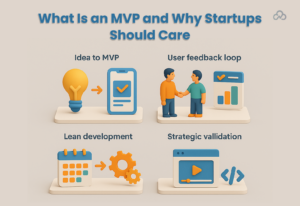
An MVP is not an incomplete product. It’s a complete and functional version that delivers the most important value to your users. The idea is simple- build a product with just enough features to solve a real problem and gather feedback. You can also use this feedback to improve and grow the product. Think of it as a guiding tool, not a final product. MVPs are important for startups because they allow you to understand the assumptions without betting everything on a full launch. For instance, Dropbox begins with a simple video explaining concepts before even building the product. This is the power of a strategic MVP.
How MVP Development Services for Startups Help To Launch Faster
Startups often do not have time, resources, or technical team to build an MVP with their own. And that’s where MVP development services for startups come in the picture. These services are mainly built to help the founders quickly bring their ideas to life with expert help. From product discovery to design, development, and testing, MVP service providers support the whole process. This allows founders to focus on their vision, while the technical team can focus on fast and smooth execution.
MVP development services for startups follow proven strategies to save time. They use agile development, build scalable architectures, and depend on reusable code components. Most importantly, they help you to define the right MVP scope like what to build now and what to save for later. This strategic planning ensures that your MVP can solve a real problem, not just looks good on paper.
Key Benefits of MVP Development for Startups
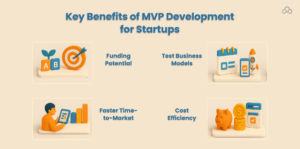
The biggest advantage of using MVP development services for startups is reducing your time-to-market. Instead of spending a year building a perfect product, now you can launch in weeks or months. This fast launch lets you test your product with real users and start learning immediately. You get feedback faster to identify bugs earlier, and can make smarter decisions.
Another key benefit is cost efficiency. Startup MVP development services for startups helps you to avoid money spending on features that users don’t need. Instead, you can invest only in what’s important. After that, you can expand based on your user needs and feedback, not based on assumptions.
Using MVP app development services also improves your chances of getting funding. Investors love to see working prototypes and real user feedback. A well-built MVP tells that your idea has potential and that you can execute fast. In some cases, early traction from an MVP is enough to attract angel investors or seed funding.
Lastly, MVPs allow you to experiment with different business models and marketing strategies. You can try out pricing strategies, distribution channels, and target audiences and all with minimum risk. As your product grows, you’re making decisions based on data, not assumptions.
Real-World Examples of MVP Success
Some of the world’s most successful startups started with MVPs that helped them to test assumptions and gain early traction, and modified their ideas based on real user feedback. These early versions were not filled with features as they were simple, targeted, and strategic. Let’s look at a few well-known examples of MVP success to see how powerful this approach can be for your business as well.
- Airbnb:
Before becoming a global hospitality leader, Airbnb started with a simple website that was created by the founders to rent out space in their own apartment during a local design conference. They didn’t build a complete platform right away. Instead, they used a basic MVP to test a single idea: Would strangers pay to stay in someone else’s home rather than a hotel? The response was positive. And guests booked the space, and the founders realized they were onto something. From there, they expanded their platform, eventually adding listings, secure payments, reviews, and global coverage. - Spotify:
Spotify the popular- audio streaming platform implemented its MVP as mvp development services for startups in a very focused way. Instead of building a mobile app, recommendation engine, or full music library, Spotify started as a simple desktop app for a small group of users in Sweden. Its main mission was to prove one thing: that users could stream music legally, instantly, and without glitches. The MVP was a super hit. It solved a real problem and did it better than existing solutions. This early success helped Spotify to secure licensing deals, raise funds, and gradually expand into new markets. Features like curated playlists, mobile access, and offline listening were added only after the main product had proven itself. - Dropbox:
Dropbox’s MVP didn’t even have a real product in the beginning.The team made a simple explainer video explaining- how the service would work. The goal was to validate the demand for cloud file storage and syncing. The video made thousands of sign-ups, telling that people wanted the solution. This gave them confidence to build the actual product realising that a market is waiting. - Zappos:
Before becoming a billion-dollar shoe retailer, Zappos experimented its idea by listing photos of shoes from local stores online. When a customer ordered, the founder would go buy the shoes and deliver them. This MVP development services for startups understands the demand for online shoe shopping without building warehouses or managing inventory for real.
These examples tell us that startup MVP development isn’t just a story but it’s a strategy and great way to launch smarter, faster, and with real market validation.
How to Choose the Right MVP App Development Services
Choosing the right MVP development services for startups can make or break your startup journey. Here are some tips that help you find the right team:
First, look for experience. You want a team that experts in MVP development services for startups, not just general app development. Ask a portfolio of previous MVPs they’ve built and the results those startups achieved.
Second, check their process. A good MVP team will start with product discovery. They will help you define your goals, audience, and key features. Then they’ll move to outlines, design, and development. SAnd finally, they’ll test the MVP and help you to launch.
Third, evaluate communication. You’ll be working closely with this team, so make sure that they’re responsive, transparent, and aligned with your vision.
Lastly, think of the long-term. The best MVP development services for startups don’t just build your MVP but they help you plan for the future. Look for a partner who offers post-launch support, scaling advice, and product growth with strategies.
MVP Strategy Tips to Succeed
To get the benefits out of your MVP, start with clear goals. Like what do you want to learn from your MVP? Are you testing whether the product is market fit, user engagement, or pricing?
Next, keep your scope strong. It’s good to add extra features, but the goal is to learn, not to impress. Stick to your main values and build only what’s necessary.
Always take feedback. Use surveys, interviews, and usage data to understand what users like and what’s missing and what they want. Then work based on that feedback.
Also, be ready to change. Sometimes your MVP will show that your original idea needs to change. And that’s okay. The earlier you learn, the better your chances of success.
Finally, think beyond launch. Plan how you’ll promote your MVP, onboard users, and measure success. MVP development services for startups include marketing support or guidance on user acquisition.
Conclusion: Start Small, Learn Fast, Grow Smart
Launching a startup is amazing but risky as well. Every decision matters, especially in the early stages. That’s why MVPs are a powerful tool that help you to move fast, learn early, and build products people actually want.
With the right MVP development services for startups, you can change your idea into a real product quickly and cost-effectively. You’ll be able to understand your vision to attract users and investors, and grow your business with confidence.
Whether you’re building a new app or just testing a concept, or entering a new market, using an MVP is a smart move. So take a jump, start small, learn fast, and grow your startup the smart way.
Do you like to read more educational content? Read our blogs at Cloudastra Technologies or contact us for business enquiry at Cloudastra Contact Us