Introduction
Across the United States, nearly 1.7 million people design, construct, operate, and govern water infrastructure, yet many occupations (including water treatment operators) skew older than the national median. The sector remains male-dominated with under-representation of women and some racial/ethnic groups. The result is a looming skills gap just as complexity in water treatment wastewater operations increases. Recruiting, educating, and upskilling new talent is now a strategic necessity, not a luxury.
Current Workforce Challenges
-
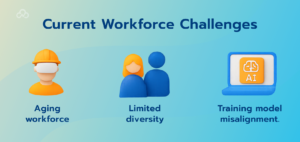
Aging workforce. Water occupations are older than the U.S. average; retirement eligibility is rising and threatens institutional knowledge transfer.
-
Limited diversity. Women account for a small share of the water workforce and leadership; Black and Asian workers are under-represented relative to the overall labor market.
-
Training model misalignment. A heavy reliance on on-the-job training and less formal education slows readiness for modern, data-rich plants that rely on water management software and analytics.
Workforce signals at a glance
|
Indicator |
Signal |
|
Workers in U.S. water infrastructure |
~1.7 million |
|
Age profile |
Older than national median |
|
Diversity gap |
Women & some minorities under-represented |
|
Training model |
OJT-heavy; need for digital skills |
Strategies to Empower Future Engineers
1) Purpose-built education and funding
The U.S. EPA’s Innovative Water Infrastructure Workforce Development Program funds apprenticeships, education pipelines, and public awareness to expand utility career entry points (multiple award rounds since 2020–2025). Engineering programs and community colleges can align curricula and certificates to these grant priorities (e.g., operator pathways, safety, and digital literacy).
Case snapshot: In 2024–2025, EPA announced new selections and webinars to help utilities and partners stand up regionally tailored workforce initiatives, useful scaffolding for academic-utility partnerships.
2) AI-enabled training: simulations, digital twins, AR
- Digital twins give students and early-career engineers a safe sandbox for process control, energy optimization, and incident playbooks, before touching live assets.
- AR/VR and scenario engines create repeatable practice for rare events (e.g., membrane integrity failure, storm surges).
- Water management software with embedded analytics builds fluency in data quality, historian queries, and alarm rationalization, skills required in modern SCADA/HMI environments.
Universities that embed field-oriented research and translation mechanisms (e.g., Bristol’s SDG-6 water engineering activities and “papers to practice” dissemination) help close the research-to-practice gap while exposing students to real-world constraints.
3) Academia-industry bridges
Structured partnerships (utility mentors + university labs + vendors of advanced AI services) accelerate tool adoption and shorten the ramp to competency. Use capstones around genuine utility problems: energy-intensive aeration, nutrient control, or reuse QA/QC. Co-develop operator-facing dashboards so students learn to design for operators, not just about operators.
Illustrative model: Cohort-based leadership development like the Transformative Water Leadership Academy (TWLA) builds cross-functional skills, governance, stakeholder engagement, and resilience, complementing technical training.
4) Inclusive pathways and early career access
-
Water UP! (Water Utility Pipeline) offers paid, cohort-based training (e.g., OSHA-30, treatment & distribution, facility tours) aimed at candidates from underserved communities; multiple cohorts since 2021 with college-credit options.
-
Regional programs (e.g., IEWorks, Work-4-Water) provide internships, pre-apprenticeships, and job placement focused on water treatment wastewater.
-
Vendor-led curricula (e.g., PACT® Engineering training) reinforce operations, safety, and optimization for industrial water treatment wastewater systems.
Role of Advanced AI Tools (what to teach and why)
-
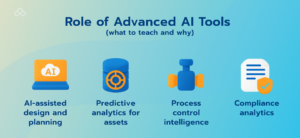
AI-assisted design and planning. Generative and optimization tools evaluate treatment trains, network hydraulics, and siting constraints rapidly, useful in design studios and senior projects.
-
Predictive analytics for assets. Models trained on vibration, amperage, and pressure detect pump and blower faults early; students learn feature engineering, model validation, and failure-mode mapping.
-
Process control intelligence. Reinforcement or model-predictive layers recommend setpoints for aeration or coagulant dosing; trainees must master guardrails (bounds, rate-limits, rollback).
-
Compliance analytics. Automated QA/QC on sensor streams and e-reporting pipelines reduces manual burden and improves auditability, a key exposure for future plant managers.
What “job-ready” looks like
- Data discipline: tag structures, historian queries, time-sync, and sensor calibration.
- Process modeling: steady-state & dynamic models; familiarity with digital twins and scenario testing.
- Control literacy: PID tuning basics, alarm rationalization, safe-automation concepts.
- Cyber & safety: least-privilege access, change control, and SOP alignment.
- Equity & engagement: understanding community impacts and inclusive hiring, as emphasized by TWLA and Water UP!
Short examples/facts
-
Example, wastewater: A class twin of an aeration basin lets students test lower DO bands that reduce kWh without ammonia excursions, then formalize guardrails for bounded automation. (Pedagogical twin; no live risk.)
-
Example, industrial water treatment: Using RO skid data, students train a simple classifier to anticipate fouling and generate a just-in-time CIP schedule, cutting chemical use and downtime in the simulation.
-
Fact, pipeline scale: Water infrastructure employs ~1.7M workers and offers upward mobility with less emphasis on four-year degrees, strong entry points for apprentices and community-college grads
Technical FAQs
1) Which AI modules belong in an undergraduate water engineering education track?
Start with anomaly detection (sensor QA), regression/forecasting (flow, ammonia), and optimization (aeration energy). Add a digital twin lab so students can link models to control logic and change management.
2) How do we evaluate student projects that use advanced AI services?
Require a validation plan (train/test split, drift checks), an operator-readable dashboard, and a safety case (setpoint bounds, rollback). Grade on both model performance and human-factors design.
3) What is the minimum stack for a training-grade water management software lab?
Historian (time-series DB), simulated PLC/HMI, analytics runtime (Python/R), and version control. Optional: AR headset for maintenance SOPs. Tie each assignment to a water treatment wastewater use case.
4) How do we ensure equity and broaden participation?
Leverage EPA workforce grants, cohort leadership programs (TWLA), and targeted pipelines (Water UP!, IEWorks). Offer stipends and credit articulation to reduce financial barriers.
5) What’s the difference between academic “digital twin” projects and production twins?
Academic twins emphasize learning objectives and safe experimentation; production twins require robust calibration, cybersecurity, OT integration, and audited change control. Both reinforce model-to-operations traceability.
6) Do vendor trainings (e.g., PACT®) fit into curricula?
Yes, especially for industrial water treatment wastewater electives. They cover operations, safety, and troubleshooting aligned with employer needs; integrated as a module or for continuing education credit.
Designing the AI-Ready Water Workforce
The water sector’s workforce challenge is clear: older demographics, uneven diversity, and growing technical demands across water treatment wastewater systems. The solution is equally clear: targeted programs, inclusive pipelines, and rigorous, practice-oriented education that normalizes AI tools, digital twins, and water management software from day one. With EPA funding streams, leadership cohorts like TWLA, inclusive pipelines such as Water UP!/IEWorks, and vendor-aligned curricula, stakeholders can equip graduates to step directly into complex facilities, bringing data discipline, control literacy, and community awareness with them. The payoff is a resilient, modern workforce that safely deploys advanced AI services to improve public health, environmental outcomes, and long-term utility performance.
Standardizing curricula around data quality, digital twins, and water management software shortens time-to-competency and improves safety, compliance, and throughput across water treatment wastewater operations. By pairing advanced AI services with equitable training pathways and strong governance, utilities and industrial water treatment wastewater plants build a resilient talent pipeline and a durable competitive advantage.
Do you like to read more educational content? Read our blogs at Cloudastra Technologies or contact us for business enquiry at Cloudastra Contact Us.