Why sustainable travel in 2026 is finally becoming real
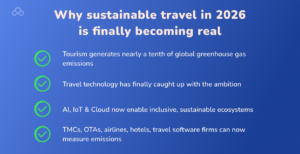
For years, sustainable travel sounded like a nice idea squeezed onto the last slide of a strategy deck. Meanwhile, tourism kept growing and so did its emissions. Recent studies estimate that tourism generates nearly a tenth of global greenhouse gas emissions. That makes sustainable travel one of the biggest levers we have in the climate transition.
The difference in 2026 is that travel technology has finally caught up with the ambition. Thanks to better data pipelines, cheap Internet of Things (IoT) sensors and mature cloud platforms, it’s now possible to track the real carbon footprint of trips in near real time, not just model it once a year in a spreadsheet. Research on smart tourism also shows how AI, IoT and cloud based tools can optimise resources, personalise experiences and support more inclusive, sustainable travel and tourism ecosystems.
If you work anywhere in the travel B2B space as a TMC, OTA, hotel group, airline or travel software development company you no longer have to rely on slogans. You can see exactly where emissions come from, test changes and prove impact with hard numbers.
The foundations: data that makes sustainable travel measurable
You can’t talk about sustainable travel without data. Every decision take the train or shorthaul flight, choose a certified hotel or a cheaper alternative, add a stopover or fly direct has a different carbon cost. The job of modern travel technology is to surface that cost in time for people to act on it.
In practice, this means building a clean data layer that pulls information from booking engines, GDSs, payment systems, IoT devices and sustainability partners into one place. Many leading platforms now use a centralised, cloudbased data warehouse as a single source of truth for trip records, enriching each booking multiple times with carbon, risk and wellbeing data.
Once you have this foundation, you can start turning abstract commitments into specific nudges: flagging low carbon routes at search time, recommending longer but cleaner itineraries for nonurgent trips, or highlighting hotels that have verified energy, water and waste data.
This is the quiet backbone of sustainable travel: not a glossy campaign, but an honest data layer that makes better choices visible and easy.
IoT: giving every journey a live carbon “heartbeat”
IoT sounds complex, but in the sustainable travel context it’s surprisingly tangible. Think of connected meters, sensors and beacons quietly measuring what used to be guesswork in hotels, airports and vehicles energy use, occupancy, speed, idling and route choices.
When IoT devices feed realtime data into AI and analytics platforms, operators can optimise lighting, heating, cooling and traffic flows with far more precision than manual rules ever allowed.
For sustainable travel and tourism, this matters because emissions differ hugely between properties and routes. A cloud based platform that ingests IoT data from multiple partners can benchmark hotels, vehicles and attractions side by side, making low carbon options visible and bookable in everyday workflows.
Suddenly, sustainability stops being a generic badge and becomes a live “vital sign” attached to each trip.
Cloud: the backbone of scalable low carbon travel tech
Cloud computing doesn’t automatically make travel greener, but it makes serious climate action possible at scale.
Cloud platforms give travel B2B providers elastic storage and processing power for granular emissions data. Instead of running heavy calculations overnight on local servers, platforms can calculate carbon footprints on demand at search and booking time, even for millions of itinerary combinations.
Cloudnative architectures also make it easier to plug in sustainability microservices carbon calculators, ecohotel directories, rail and publict ransport APIs, or dynamic routing engines that avoid congestion or contrail heavy airspace. Because everything lives behind APIs, a travel software development company can stitch together a modular stack tailored to its clients without ripping out existing systems.
The result: sustainable travel features become part of the platform’s DNA, not an add on.
Case study 1: A corporate travel program cuts emissions with smarter data
Let’s make this concrete.
Imagine a midsize European consulting firm with thousands of employees flying around the region. Before 2024, they tracked travel emissions once a year using rough averages per flight and hotel night. The sustainability report looked neat, but nobody changed their daytoday behaviour.
In 2025, their TMC partners with a travel software development company to build a new sustainable travel program on top of a cloud data warehouse. Every booking flight, train, hotel, taxi now flows through a central platform that:
1. Calls a realtime carbon API for each segment.
2. Flags rail and coach alternatives for journeys under 800 km.
3. Highlights hotels sharing IoT based energy and water data.
During search, travellers see simple messages like “This train emits 72% less CO₂ than your usual flight on this route.”
Within twelve months, the company sees a strong shift from air to rail on key city pairs, hotel energy intensity per night falls, and overall travel related emissions drop by close to 20% while client work continues to grow. Finance can see the tradeoffs in cost versus carbon; sustainability teams finally have credible numbers; and travellers feel part of a concrete sustainable travel story rather than being lectured after the fact.
It still looks like “normal” business travel but the default has quietly shifted toward more sustainable travel choices.
Case study 2: A hotel group uses IoT and cloud to tackle hidden waste
Now switch to the accommodation side.
A regional hotel group with 35 properties in leisure destinations knows that guests love big buffets, always on air conditioning and long, hot showers. They also know that their utility bills and emissions are going in the wrong direction.
Instead of another awareness campaign, they invest in a simple IoT and cloud setup. Smart meters and sensors track energy use per floor, kitchen and public area. Waste scales measure how much food leaves the kitchen versus how much returns. These streams feed into a cloud dashboard that combines occupancy, weather data and seasonality.
Within a few months, patterns emerge. The team realises that closing one unused wing on shoulder season weekdays cuts energy use significantly with almost no impact on guest satisfaction. Adjusting buffet prep based on real time consumption data reduces food waste by double-digit percentages.
They share this data with the travel B2B partners who sell them OTAs, tour operators and corporate booking tools so that “lowwaste, lowenergy” becomes a visible attribute in the booking flow.
The result is not a perfect netzero story, but a clear example of sustainable travel and tourism in action: fewer wasted resources, lower emissions and a more honest conversation with guests about impact.
Where travel B2B platforms fit in
If you sit between travellers and suppliers, you are in a uniquely powerful position. You see more of the journey than any single airline, hotel or ground operator. That makes travel B2B platforms the natural “operating system” for sustainable travel.
In practical terms, that means:
– Using your data graph to surface lower carbon options by default.
– Standardising how suppliers report emissions, energy and waste data.
– Giving buyers tools to set carbon budgets alongside financial ones.
– Embedding simple, storydriven sustainability messaging into every touchpoint, from search results to itineraries and invoices.
For many organisations, the fastest route to impact is partnering with a travel software development company that understands both the technical plumbing (APIs, data lakes, IoT integration) and the messy reality of travel operations. The best solutions are rarely “one big platform.” They’re usually a thin, human centred layer on top of existing systems that makes sustainable choices visible, easy and rewarded.
In other words: your platform becomes the place where sustainable travel quietly becomes the default.
Getting started: simple steps towards more sustainable travel

You don’t need a grand roadmap to start shrinking your footprint.
Map your current travel emissions using the data you already have, even if it’s imperfect. Pick one or two high impact routes or hotel clusters and test specific changes like promoting rail first or switching to properties with better energy data. Upgrade your core travel technology so you can plug in carbon data and IoT signals without months of custom work. And talk to travellers about the tradeoffs they’re willing to make, then share back clear stories about impact.
Most importantly, treat sustainable travel as an ongoing product, not a one off campaign. The technology stack will keep evolving AI route optimisation, dynamic pricing based on carbon, richer IoT signals but the mindset stays the same: make the low carbon choice the obvious one.
FAQs on sustainable travel, data and technology
1. Is sustainable travel really possible if I still have to fly?
Not every flight can be avoided, but data helps you cut the unnecessary ones and reduce the impact of the rest. Combine fewer, longer trips, prioritise direct routes, choose airlines with better efficiency records and use offsetting only as a last step, not the main strategy.
2. How can smaller companies use travel technology for sustainability?
You don’t need a huge inhouse tech team. Many cloudbased platforms now offer plugandplay carbon reporting, greener routing and ecohotel filters. Start with one tool that integrates with your existing booking process and build from there.
3.What role does IoT actually play in sustainable travel and tourism?
IoT gives operators live visibility into how buildings, vehicles and public spaces use resources. That visibility turns into action optimised heating and cooling, smarter food prep, better capacity management and those changes add up to real carbon reductions.
4. How do I choose the right travel software development company for a sustainability project?
Look for partners who talk about outcomes, not just features. They should understand emissions reporting standards, be comfortable working with multiple data sources and be willing to pilot small, measurable experiments rather than sell you a monolithic “allinone” system.
Do you like to read more educational content? Read our blogs at Cloudastra Technologies or contact us for business enquiry at Cloudastra Contact Us.