Compliance used to be something teams prepared for. You planned for it. You blocked time for it. And then you survived it.
SOC 2 or ISO 27001 audits meant weeks of collecting screenshots, digging through logs, exporting access lists, and hoping nothing important changed while the auditor was looking. Once it was over, most teams quietly relaxed until the next cycle.
That approach doesn’t work anymore.
DevOps teams ship changes constantly. Infrastructure spins up and disappears. Permissions change daily. In environments like this, compliance that only exists at audit time is mostly an illusion.
This is where continuous compliance monitoring comes in. Not as a buzzword, but as a response to how modern systems actually behave. Instead of proving compliance once or twice a year, teams verify it all the time, automatically, whether anyone is watching or not.
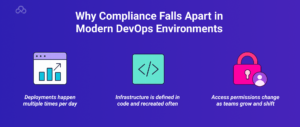
Why Compliance Falls Apart in Modern DevOps Environments
SOC 2 and ISO 27001 are still relevant. The problem is not the standards. The problem is the way they were traditionally implemented.
Most legacy compliance processes assume stability. Systems stay the same. Access changes are rare. Infrastructure lives for years. None of that is true in cloud-native DevOps setups.
In reality:
– Deployments happen multiple times per day
– Infrastructure is defined in code and recreated often
– Access permissions change as teams grow and shift
When audits rely on snapshots, they miss what actually matters. A system can be compliant on paper while drifting out of compliance in production. That gap is risky.
Continuous compliance monitoring exists to close that gap. It accepts that change is constant and builds compliance around that fact instead of fighting it.
What Continuous Compliance Monitoring Really Looks Like
A lot of content talks about continuous compliance in vague terms. In practice, it’s very concrete.
Continuous compliance monitoring means compliance checks are automated and tied directly to real system signals. Cloud configurations, identity changes, deployment events, and security logs are evaluated continuously, not manually.
Evidence is generated by default. Controls are validated automatically. When something drifts, teams know quickly.
This is very different from traditional compliance work. There is less paperwork, but more visibility. Less scrambling, but more accountability.
When teams say they’ve implemented automated compliance monitoring, this is usually what they mean: compliance is enforced by systems, not by people remembering to check things.
Automated Compliance Monitoring for SOC 2 and ISO 27001
SOC 2 and ISO 27001 both require organizations to demonstrate that controls are consistently applied. Automated compliance monitoring fits naturally with that requirement.
For SOC 2, automation commonly focuses on:
– user access and permission changes
– change management and deployment tracking
– centralized logging and monitoring
For ISO 27001, automated controls often include:
– configuration baselines across environments
– asset inventory and classification
– incident detection and response readiness
Instead of collecting evidence manually, systems collect it continuously. Instead of explaining how controls should work, teams can show how they do work in real time.
This is why continuous compliance monitoring tends to produce cleaner audits. The evidence reflects actual system behavior, not a carefully prepared snapshot.
The Role of AI in Cybersecurity and Compliance
Automation solves scale, but it introduces noise. Modern environments generate an enormous number of events, many of which are harmless. This is where the role of AI in cybersecurity becomes important.
AI is increasingly used to interpret compliance signals, not just collect them. Models can learn what normal behavior looks like and highlight deviations that actually matter.
For example, a configuration change might be expected during a deployment window but suspicious at other times. AI-driven systems understand that context better than static rules.
In continuous compliance monitoring, AI helps reduce alert fatigue. Teams spend less time chasing false positives and more time addressing real risks.
This doesn’t replace human judgment. It filters input so humans can make better decisions.
Advanced AI Services in Compliance Automation
Advanced AI services go a step further by correlating data across systems. A single signal rarely tells the whole story. It’s the combination that matters.
An access change might be fine on its own. Combined with unusual deployment behavior and missing logs, it becomes a concern. Advanced AI services are good at making those connections.
In automated compliance monitoring platforms, these correlations turn compliance into something closer to risk management. Teams don’t just know that a control failed. They understand why it failed and what the potential impact is.
This is a major shift from checkbox-based compliance toward something more realistic.
Embedding Continuous Compliance into CI/CD Pipelines
One of the most effective places to enforce compliance is inside the CI/CD pipeline. This is where changes are introduced, so it makes sense to evaluate them there.
Policy-as-code frameworks allow teams to define SOC 2 and ISO 27001 requirements as rules that machines can evaluate. If a change violates a rule, the pipeline fails immediately.
This is not theoretical. Many DevOps teams already rely on automated compliance monitoring at build and deploy time. Over time, this changes behavior. Developers learn what passes and what doesn’t without reading policy documents.
Continuous compliance monitoring becomes part of normal development, not a separate activity.
Case Insight: Moving From Audit Panic to Continuous Readiness
A SaaS company operating under SOC 2 struggled every audit cycle. Evidence collection disrupted normal work. Engineers were pulled into last-minute investigations. Findings often pointed to issues that no longer existed.
After adopting continuous compliance monitoring, the process changed. Controls were evaluated daily. Evidence was collected automatically. Drift was detected early.
When the next audit arrived, preparation was minimal. The audit itself was smoother, and findings were fewer. More importantly, the company had a clearer understanding of its real security posture.
This is a common outcome when automated compliance monitoring replaces manual processes.
Metrics and Industry Indicators
|
Indicator |
Observed Trend |
|
Organizations adopting continuous compliance |
Rapidly increasing |
|
Reduction in audit preparation time |
40–70% |
|
Compliance issues detected pre-production |
Majority |
|
Use of AI in cybersecurity tooling |
>60% of platforms |
These figures are representative industry benchmarks and provided for reference context.
Managing Compliance Drift Without Burning Out Teams
Drift is unavoidable in dynamic environments. People change things. Automation does what it’s told. The important part is detecting drift quickly and responding appropriately.
Continuous compliance monitoring systems track baseline states and flag deviations. Some systems even remediate issues automatically, depending on risk level.
This is where automated compliance monitoring saves time. Teams don’t need to constantly review configurations. They react when something changes unexpectedly.
Over time, this reduces stress. Compliance stops being a constant worry and becomes a background process.
Governance That Doesn’t Kill Velocity
A common fear among DevOps teams is that compliance will slow everything down. In reality, poorly implemented compliance slows teams down. Well-implemented compliance does the opposite.
When rules are clear and enforced automatically, there’s less debate. Fewer surprises. Fewer emergency fixes.
Continuous compliance monitoring aligns governance with delivery. It removes ambiguity, which is often the real source of friction.
Technical FAQs
What is continuous compliance monitoring in simple terms?
It’s the practice of validating compliance controls continuously using automated system data instead of periodic manual audits.
How does automated compliance monitoring help with SOC 2 and ISO 27001?
It enforces and verifies controls in real time, generating audit evidence automatically.
What role does AI play in cybersecurity compliance?
AI helps identify meaningful risks, reduce false positives, and provide context for compliance findings.
Are advanced AI services required to implement continuous compliance?
Not strictly, but they become increasingly useful as environments grow in complexity.
Does continuous compliance monitoring slow DevOps teams down?
When implemented properly, it usually speeds teams up by reducing rework and audit-related interruptions.
The Future of Compliance Is Continuous
Compliance is not going away. But the way it’s implemented has to change.
Continuous compliance monitoring reflects how modern systems actually operate. Automated compliance monitoring, combined with the role of AI in cybersecurity and advanced AI services, allows organizations to meet SOC 2 and ISO 27001 requirements without freezing delivery.
In DevOps environments, compliance that can’t keep up is compliance that fails. Continuous compliance isn’t a trend. It’s a correction.
Do you like to read more educational content? Read our blogs at Cloudastra Technologies or contact us for business enquiry at Cloudastra Contact Us.