Over the past ten years, the way software is delivered has evolved a lot. Teams are supposed to add new features faster, keep systems reliable, and make them bigger without tiring out developers. DevOps promised faster work and more teamwork, but now many companies have to deal with tool sprawl, too much information, and workflows that don’t always operate the same way. This is where internal developer platforms come in. Companies are constructing centralized platforms that provide developers more power while yet keeping control, so that every team doesn’t have to come up with their own pipelines, infrastructure, and deployment methods.
DevOps platform teams are at the centre of this change, which is changing how modern engineering companies work. Let’s look at why internal developer platforms are becoming more popular, how platform engineering DevOps is changing, and what this means for companies that use DevOps consulting services and solutions or DevOps managed services.
Getting to Know the Developer Experience Issue
As companies grow, development teams generally quickly add more capabilities. Over time, CI/CD pipelines, cloud services, monitoring tools, feature flags, security scanners, and deployment scripts evolve on their own. Each instrument solves a problem, but together they make things more complicated. Developers spend more time managing infrastructure than they do producing code. It takes weeks to get fresh engineers up to speed. Different teams have different ways of deploying. Dependability becomes erratic.
DevOps helped get rid of the barriers between development and operations, but it didn’t completely fix the problem with the developer experience. This gap led to the rise of internal development platforms as a way to solve the problem.
What do internal developer platforms do?
Companies build internal developer platforms for their own developers to use on their own. They give developers a common approach to build, install, and run software without having to know every piece of the infrastructure. Think of them as an internal product made just for technical teams. An internal developer platform usually has:
– Pre-set CI/CD pipelines
– Setting up infrastructure on your own
– Standardized ways to deploy
– Checks for security and compliance built in
– Integrations for monitoring and observability
The idea is simple: make things less complicated while yet allowing for speed and freedom.
What is Platform Engineering DevOps?
People frequently term the idea behind this movement “platform engineering DevOps.”
Platform engineering DevOps focuses on making platforms that are like products. In other words:
– Clear onboarding and documentation flows
– Feedback loops with developers
– Roadmaps that fit with corporate aims
– Improving all the time based on usage data
Instead of waiting for tickets to come in, platform teams work to make the developer experience better. This change in thinking is very important for internal development platforms to work.
Why Internal Developer Platforms Are Growing So Quickly
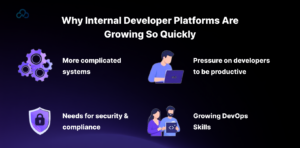
There are a number of reasons why both startups and big businesses are using it.
1. More complicated systems
Microservices, cloud-native designs, and multi-cloud environments have made systems stronger, but they are also tougher to control. Internal developer platforms make these complicated things easier by giving them a standardized interface.
2. Pressure on developers to be productive
It costs a lot to hire qualified coders. Companies want engineers who are more interested in coming up with new ideas than fixing problems with infrastructure. Internal developer platforms cut down on switching between tasks and speed up delivery.
3. Needs for security and compliance
As rules become more strict, businesses need to follow the same security rules. Platforms build compliance into pipelines, which lowers risk without slowing down teams.
4. Growing DevOps Skills
Not all product teams need to know a lot about DevOps. DevOps platform teams bring together experts and share best practices through the platform.
Internal Developer Platforms vs. Old-Fashioned DevOps
Traditional DevOps put a lot of stress on how well development and operations teams worked together. It worked, but it often meant that each team had to make its own solutions.
Internal developer platforms go even farther by providing standardized, repeatable procedures.
– DevOps as it has always been
– Internal Developer Platforms
– Pipelines for each team
– Centralized platform for self-service
– Sharing knowledge by hand
– Best practices that are done automatically
– Driven by tools
– Driven by experience
– Support that reacts
– Thinking about the product
This change makes DevOps more scalable and long-lasting.
What DevOps Managed Services Do
Not every business wants to make and keep everything in-house. A lot of businesses use a hybrid model, in which internal DevOps platform teams set standards and managed services take care of day-to-day operations. Managed DevOps services offer a different way to do things. With managed services, businesses can:
– Outsource the upkeep of the platform
– Make sure it works all the time
– Get in touch with expert platform engineers
– Lower the costs of running the business
A lot of businesses use a hybrid model, in which internal DevOps platform teams set standards and managed services take care of day-to-day operations.
Best Ways to Make Internal Developer Platforms
Organizations should follow a few essential rules to make sure their internal development platforms work.
Think of the Platform as a Product
Check how often you deploy, how happy developers are, and how many people use it. Get feedback often and make changes based on how people actually use it.
Start with a small amount and grow it over time.
Don’t try to create everything at once. Start with basic tasks like deployment or setting up an environment, and then add more features.
Pay attention to Golden Paths
Set settings that are based on your own opinions and cover most usage scenarios. There shouldn’t be too many settings for developers to get started immediately.
Don’t go too far with abstraction.
Platforms should not hide everything; they should make things easier. Developers still need to be able to see how systems work in the real world.
The Future of Platform and DevOps Teams
DevOps is not going away because of internal development platforms. They are changing it.
As companies grow, DevOps platform teams will play a bigger role in their engineering strategy. As businesses look for delivery models that are scalable, secure, and easy for developers to use, platform engineering DevOps will keep growing. Businesses can use this model without interrupting their current operations if they get help from devops consulting services and solutions or devops managed services.
DevOps platform teams are at the centre of this change, which is changing how modern engineering companies work. In the end, internal developer platforms are a step toward engineering enablement, which means that platforms give teams the tools they need to make better software faster.
FAQs
1. What do internal developer platforms do?
Internal developer platforms are systems that companies build for their own use to make software development, deployment, and operations easier and more consistent for developers.
2. What makes DevOps platform teams different from regular DevOps teams?
DevOps platform teams don’t work with individual product teams directly; instead, they design and maintain platforms that many product teams use.
3. Is platform engineering DevOps good for small groups?
Yes. Standardized procedures are helpful for even small teams, especially as systems get more complicated over time.
4. When should businesses think about using devops consulting services and solutions?
When starting a platform strategy, moving to cloud-native systems, or dealing with problems with scaling and reliability, organizations should think about getting help.
5. Can devops managed services take the place of internal platform teams?
Managed services can help or add to internal teams, but for the greatest results, the company should still own the strategic direction of its own developer platforms.
Do you like to read more educational content? Read our blogs at Cloudastra Technologies or contact us for business enquiry at Cloudastra Contact Us