Travel has always been shaped by movement, access and convenience. What is changing now is the engine behind it. Financial technology is no longer sitting quietly in the background of the travel industry. It is actively reshaping how people discover trips, pay across borders, manage bookings, interact with suppliers and move through airports, hotels and destinations with less friction than ever before.
This is why travel fintech matters so much right now.
The shift is not limited to prettier booking interfaces or faster checkouts. It runs much deeper. It affects the infrastructure that powers cross-border payments, settlement between travel businesses, fraud prevention, mobile booking, loyalty programs and real-time personalization. In other words, fintech is not just supporting travel anymore. It is helping define the next version of it.
The scale of this shift is hard to ignore. The smart travel sector is projected to grow from USD 38.6 billion in 2025 to USD 163.1 billion by 2035. At the same time, the travel fintech market itself reached USD 9.7 billion in 2024, backed by strong investor interest and growing confidence in the industry’s long-term opportunity. What makes this moment especially important is that innovation is no longer only visible on the customer side. It is now transforming the systems underneath travel too: how money moves, how suppliers get paid, how travelers choose and how platforms create better experiences at scale.
Why the travel fintech opportunity is growing so fast
Travel fintech is expanding because the travel economy itself is becoming more digital, more connected and more demanding.
For years, travel payments were often slow, fragmented and full of friction. Travelers had limited payment options. Suppliers dealt with slow settlements. Travel platforms had to manage relationships across airlines, hotels, transportation providers and intermediaries, often across more than 190 countries. That complexity created inefficiencies that the industry tolerated for a long time.
That is no longer sustainable.
The broader travel tech sector attracted USD 5.8 billion in funding during 2024, with momentum continuing into 2025. This tells us something important: investors are not simply chasing travel apps. They are backing infrastructure, operational efficiency and platforms that solve structural problems in travel commerce.
The real opportunity goes far beyond a single booking transaction. It includes:
- payment processing
- cross-border settlements
- multi-currency support
- compliance and fraud prevention
- revenue management
- expense and travel management
- embedded finance inside travel platforms
This is exactly why companies such as TravelPerk and Navan have drawn so much attention. Their success shows that the market increasingly values integrated systems that combine booking, payments, expense handling and operational visibility instead of treating each function as a separate tool.
Payments are no longer just a checkout feature

One of the clearest ways travel fintech is changing the industry is through payments.
In travel, payments are not a simple final step. They connect travelers, platforms, suppliers and finance teams. When those flows are inefficient, the entire customer experience feels heavier. When they work well, travel feels faster, smoother and more reliable.
Virtual cards are a strong example of this shift. For travel businesses, they do more than reduce operational friction. They improve cash flow, simplify supplier payouts and make it easier to work with a wider range of providers, including long-tail properties, tour operators and regional transport partners. Instead of navigating local banking requirements and country-specific payout challenges for every supplier, platforms can use virtual card-based payments to speed things up and expand inventory more efficiently.
Then there is the rise of buy-now-pay-later. For younger travelers especially, flexible payment options are becoming part of the booking expectation. BNPL reduces the stress of large upfront travel costs and can improve conversion by helping hesitant customers commit to a trip sooner. It also creates a familiar effect for travel platforms: once the main booking becomes manageable, travelers are often more open to upgrades, extra nights and add-on experiences.
Multi-currency support is also becoming essential. Travelers are increasingly using digital wallets, contactless options and alternative payment methods but international payment experiences are still often clunky and expensive. Fintech is helping travel platforms address that with transparent FX handling, real-time conversion logic and better payment orchestration. The result is a better balance between convenience and cost.
In practical terms, travel fintech is turning payments into a strategic layer of the travel experience, not just a backend utility.
Blockchain and stablecoins are opening new settlement models
Cross-border settlement has always been a weak point in travel. Traditional international transfers are often slow, costly and dependent on a banking chain that was never designed for high-speed digital travel commerce.
This is where blockchain-based payment infrastructure is becoming relevant.
Stablecoin transaction volume reached USD 32 trillion in 2024, including USD 5.7 trillion in actual cross-border payment activity. The reason this matters in travel is simple: the industry depends on international money movement. Airlines, hotels, agencies, intermediaries and travelers all interact across borders, currencies and time zones.
The benefits are obvious. Traditional wire transfers can take three to five business days. Blockchain payments can settle in under three minutes, any day, at any hour. For smaller suppliers, especially in emerging markets, that speed can make a real difference to cash flow. Lower transaction costs also matter in an industry where margins are often under pressure.
Stablecoins add another interesting layer. They offer a way to reduce exposure to currency volatility while enabling always-on settlement outside regular banking hours. That does not mean every travel platform will suddenly rebuild itself on crypto rails but it does show that travel fintech is expanding the range of settlement infrastructure available to the market.
Loyalty programs are another area where blockchain is starting to look useful. Traditional travel rewards systems are often siloed, difficult to combine and frustrating to redeem. A blockchain-based loyalty structure makes it easier to exchange, redeem and manage points across multiple providers on a shared platform. In a sector where one trip often includes flights, hotels, transport and activities, that flexibility is especially valuable.
AI is changing travel from generic to personal
If payments are transforming the operational side of travel, artificial intelligence is transforming the experience side.
One thing is already clear: personalization is no longer optional. More than 80 percent of travelers seek personalization and 33 percent already expect individually tailored communication. Even more importantly, that preference can command up to a 20 percent price premium.
That changes the role of AI in travel.
Instead of showing every traveler the same list of flights, hotels and offers, AI helps platforms narrow options intelligently. It can interpret signals from behavior, search history, travel style, budget sensitivity and prior bookings to make recommendations feel more relevant. This reduces decision fatigue, improves engagement and often increases conversion.
And this personalization does not begin only at booking. It can influence the entire travel journey:
- destination discovery
- offer personalization
- dynamic pricing
- virtual concierge support
- disruption management
- post-trip engagement and loyalty
The value here is not just emotional. It is commercial. The research points to revenue gains through better market responsiveness, stronger revenue management, higher retention and improved customer lifetime value.
Travel companies are already using AI in practical ways. Hotels, for example, need to constantly adjust pricing based on demand, booking patterns and competitor behavior. AI-powered revenue management tools are helping solve that problem at scale. This is why companies focused on pricing intelligence and hotel revenue optimization are attracting serious investor attention.
In short, travel fintech is not only helping people pay better. It is helping travel companies understand people better.
Mobile-first travel is now the standard, not the trend

The travel experience has moved to the phone and user expectations have moved with it.
Research shows that 76 percent of business travelers prefer mobile booking options, up sharply from 43 percent in 2019. That rise tells us the change is no longer about preference alone. It is about habit. Travelers now expect fast, intuitive, mobile-first interactions because that is how they already engage with banking, shopping, communication and work.
This shift goes beyond interface design.
Mobile-first platforms influence compliance, speed and traveler behavior. When business travel systems clearly guide users toward policy-compliant options inside the booking flow, compliance improves without adding friction. That is a powerful lesson: better UX can shape better operational outcomes.
The same applies to booking time. Streamlined mobile booking flows can reduce completion time from 12 minutes to 3 minutes. That is not a minor optimization. In travel, less friction often means more completed bookings and fewer abandoned journeys.
Mobile platforms also make payment controls more transparent. Single-use virtual credentials, category restrictions and spending limits can all be shown clearly inside the user journey. That helps finance teams maintain control while giving travelers a smoother experience.
This is where travel technology innovation is becoming especially visible. The best platforms are not simply shrinking desktop workflows onto smaller screens. They are designing travel around the way people actually move, decide and pay in real time.
Contactless and biometric travel is making movement smoother
Another major shift is happening at the point where digital finance meets physical travel.
Airports, hotels and transport systems are increasingly adopting contactless payments, biometric verification and frictionless check-in experiences. Research shows that 50 percent of passengers have used biometrics at some point in their airport journey, up from 46 percent the year before and 85 percent of those users were satisfied with the experience.
That matters because convenience is one of the strongest drivers of adoption in travel.
When travelers can move through check-in, security, boarding or property access without repeatedly presenting documents and payment methods, the entire journey feels lighter. And when that convenience is supported by secure tokenized payments and identity verification, it becomes even more powerful.
Hotels are experimenting with “invisible payments,” where authorized charges happen seamlessly without forcing guests into formal checkout moments. Soft-POS technology allows staff to accept payments anywhere using NFC-enabled devices, reducing queue pressure during busy periods. Electronic bag tags push this frictionless idea even further by reducing the need for printed baggage tags and manual handling at check-in.
All of this points toward the same outcome: the travel experience becomes less about transaction steps and more about uninterrupted movement.
Compliance, fraud prevention and trust are becoming core product features

For all the excitement around innovation, there is another side to travel fintech that cannot be overlooked: compliance and security.
Travel platforms operate in a high-risk environment. Transactions are often high value. Services are delivered later. Multiple parties are involved. Cross-border complexity makes investigation harder. That is why fraud is such a persistent challenge.
Consumer fraud losses rose 25 percent year over year in 2024, reaching more than USD 12.5 billion. It is also becoming clear that deepfakes are changing the fraud landscape, with 1 in 20 identity verification failures now linked to them. That is a serious shift. It means fraud prevention can no longer rely on static verification models.
Modern identity systems in travel fintech are moving toward AI-powered document checks, liveness detection, device fingerprinting and risk-based verification. The goal is not simply to block fraud. It is to do so without pushing legitimate customers away with excessive friction.
Strong customer authentication is part of this broader evolution. At the same time, regulatory developments such as ISO 20022 adoption, instant payment frameworks and stricter payment and data rules are raising the bar for how travel platforms must operate.
Trust, in this environment, is not a branding idea. It is a product requirement.
A competitive market is pushing travel platforms to go deeper
The competitive landscape also tells an important story. The winners in this market are not just building single-point features. They are expanding across workflows.
TravelPerk’s funding and acquisition activity, along with Navan’s public listing and expansion strategy, reflect a clear industry direction: integrated platforms are gaining strength. At the same time, focused players in areas such as hotel revenue management, cloud-native travel infrastructure and AI planning are also attracting capital because they solve deep, specific problems well.
That mix is important. It means the market supports both full-stack platforms and highly specialized travel technology company models but in both cases the value comes from solving real structural pain points.
Travelers themselves are also pushing the market forward. Cards are still dominant but digital wallets and instant payment methods are growing. Security concerns remain high. And when preferred payment methods are not accepted, many travelers simply abandon the purchase.
That is why payment orchestration is becoming so important. A strong travel booking software or travel management software platform can no longer treat payment acceptance as a basic gateway problem. It needs to intelligently route transactions, support more than one payment rail and minimize drop-off.
What this means for the future of travel fintech
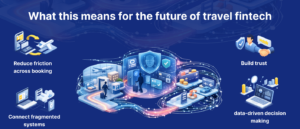
The future of travel fintech will likely be defined by platforms that can do three things well:
- reduce friction
- increase trust
- connect fragmented systems intelligently
The opportunity is large because travel itself is inherently complex. It spans geography, currency, identity, regulation and timing. That complexity creates room for better infrastructure, better software and better customer journeys.
The most promising solutions will not just add convenience. They will address structural inefficiencies in the way travel is booked, paid for, settled and managed. They will combine operational depth with user simplicity. And they will understand that modern travelers expect flexibility, personalization and security as part of the standard experience.
Where Travel Goes From Here
Travel is becoming more digital but more importantly, it is becoming more financially intelligent.
From embedded payments and multi-currency settlement to AI personalization, mobile-first booking, biometric journeys and stronger fraud controls, travel fintech is changing both what travelers experience and how travel businesses operate behind the scenes. This is not a surface-level upgrade. It is a deeper reworking of the systems that power modern travel.
For founders, product teams and operators, the opportunity is clear. The companies that win will be the ones that solve real friction, build trust into the core product and create connected experiences across the full travel journey. And for readers watching this shift closely, now is the right time to explore where your platform, product or strategy fits into this evolving landscape. If this is a direction you are considering Book a call and start the conversation from a place of clarity, not guesswork.