Fintech security is no longer a back-office concern. In 2026, it sits at the center of product trust, operational resilience and long-term growth. The sector is facing a sharper mix of risks than ever before: AI-powered cyberattacks, increasingly convincing social engineering, growing API exposure, supply chain vulnerabilities and rising pressure from regulators. For fintech founders and CTOs, the challenge is not simply to react to threats. It is to build systems that can keep performing under pressure while protecting customers, transactions and business credibility.
The numbers alone explain why this matters. The average cost of a fintech data breach has reached $5.9 million per incident and the industry now accounts for 27 percent of all data breaches handled by major security firms. At the same time or ganizations that invest in zero-trust architecture, AI-powered fraud prevention and strong third-party risk management are reducing breach costs by up to $3 million compared to peers without these controls. That gap is not just a security gap. It is a business gap.
This is why financial cybersecurity in fintech needs a more strategic approach. Security cannot be treated as a checklist, a compliance formality or a patch applied after scale. It has to be built into identity systems, APIs, infrastructure, vendor relationships and daily operations. The companies that understand this are not only reducing risk. They are building platforms customers can trust.
Why the fintech threat landscape feels different in 2026
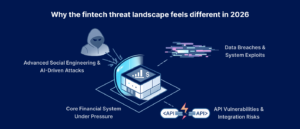
The financial sector has become one of the most attractive targets for attackers because it combines everything they want in one place: valuable personal data, direct access to funds and highly connected digital systems. Nearly 46 percent of financial institutions reported at least one data breach in the last 24 months, while 65 percent experienced ransomware attacks in 2024 alone. Smaller financial businesses are under even more pressure, with 88 percent of SMB breaches involving ransomware.
What makes this especially difficult is that these attacks are not coming from a single direction. Phishing remains a major threat, but it now sits alongside credential stuffing, API exploitation, supply chain compromise and identity-based attacks. A modern fintech platform may have strong engineering talent and advanced digital products, yet still be vulnerable through a partner integration, a weak access policy or a well-crafted social engineering attempt.
The financial impact also lasts longer than many teams expect. A breach does not end once the intrusion is contained. More than half of breach-related costs occur after the first year, as organizations continue to deal with remediation, legal exposure, regulatory obligations, customer communication and trust repair. That makes fintech fraud prevention and threat detection not just defensive functions, but essential business functions.
AI has changed the rules for attackers and defenders
Artificial intelligence has shifted the security equation in a very practical way. It has made attacks faster, more convincing and more adaptive. In 2025, 45 percent of organizations in the financial sector experienced AI-powered cyberattack attempts. That matters because traditional rule-based systems often struggle against threats that can personalize themselves in real time.
AI-generated phishing is one of the clearest examples. Fraudulent emails can now sound polished, relevant and context-aware. They imitate banks, fintech apps and senior executives with a level of fluency that makes them harder to spot. In a sector where users are used to receiving account alerts, payment updates and security messages, that creates real confusion.
Deepfake-enabled fraud raises the stakes further. Voice and video impersonation can be used to mimic executives, customers or compliance personnel. That puts transaction approvals, internal escalations and customer service interactions under pressure. For fintech firms serving businesses or high-value accounts, these attacks directly threaten transaction integrity.
At the same time, AI is also one of the strongest defensive tools available. Used well, it helps fintech companies detect fraud faster, analyze user behavior more accurately and automate response in ways manual teams simply cannot match. That is why the real question is not whether AI belongs in fintech security. It is whether the organization is using it responsibly and effectively enough to keep pace.
Identity is now the front line of fintech security
One of the clearest patterns in recent breach data is that identity-based attacks remain the most common path to compromise. Stolen credentials appear in about 31 percent of all data breaches and for fintech companies this risk is multiplied by the number of identities they manage every day. It is not just employees and customers anymore. It is also service accounts, automation credentials, API keys and machine identities embedded across workflows and cloud environments.
This is where many platforms quietly become exposed. Human identities often receive more attention, while machine identities remain poorly tracked, rarely rotated and broadly permissioned. Yet those non-human credentials often hold direct access to sensitive systems. In practice, this means an overlooked service account can become just as dangerous as a compromised admin user.
Credential misuse is also a major root cause of ransomware in financial services. Attackers obtain valid credentials through phishing, reused passwords or underground marketplaces, then use those credentials to move deeper into the environment. This process often unfolds quietly over time, which makes visibility and access control essential.

The fintech companies getting ahead of this are focusing on a few core priorities:
- Multi-factor authentication for all users
- Stronger protection for privileged accounts
- Centralized identity and access management
- Regular access reviews and permission cleanup
- Machine identity lifecycle management
- Tighter monitoring of authentication activity
This is the foundation of cybersecurity for business in fintech. Without it, even advanced tools sit on weak ground.
APIs, open ecosystems and the expanding attack surface
Fintech products are built on connected systems. APIs power partnerships, embedded finance, open banking experiences and internal service communication. That flexibility creates growth, but it also creates exposure. API and web application attacks on financial services have increased sharply and malicious bot activity has spiked across the sector.
A major reason is simple: the more functionality a platform exposes, the more carefully it must control who can do what, when and under what conditions. Authentication alone is not enough. The real issue is authorization. Broken authorization continues to be one of the most common API weaknesses, especially where access checks are too broad or too static.
In a strong fintech security model, every API request should be evaluated with precision. That means validating not only who is making the request, but also what exact action they are allowed to take on a specific resource. A user who can view account data should not automatically be able to trigger financial actions. A service that reads one dataset should not be trusted to modify another.
This becomes even more important in open banking and shared data environments. Once customer financial data moves through APIs, the security responsibility follows the data. A fintech cannot assume safety just because the source system is regulated. If it accesses, stores or processes that data, it inherits the need to protect it.
Why zero-trust architecture matters more now
Zero-trust architecture has moved from theory to necessity for fintech organizations. The core idea is straightforward: never rely on implicit trust. Every user, device, service and request must be verified continuously. In financial environments, this approach makes sense because the assumption that anything “inside” the network is safe no longer holds up.
For fintech, zero-trust rests on a few critical pillars:
- Strong identity verification with phishing-resistant MFA
- Role-based and fine-grained access control
- Microsegmentation between services and systems
- Encryption for data at rest and in transit
- Continuous monitoring of access and activity
- Clear audit logs for investigation and compliance
The value of this model is not abstract. It limits lateral movement, reduces over-permissioned access and makes abnormal behavior easier to spot. It also aligns well with the reality of modern fintech stacks, where cloud services, APIs, automation and third-party integrations are all part of the operating environment.
For founders and CTOs, the practical starting point is identity and access management. From there, the goal is to move toward narrower permissions, service-level verification and transaction-aware authorization. That kind of architecture takes effort, but it is one of the clearest ways to reduce breach impact and strengthen resilience.
Compliance is becoming more operational, not less
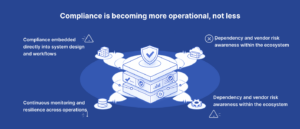
Regulation in fintech is no longer only about documentation. It is increasingly about proof that systems can withstand disruption, recover quickly and manage external dependencies responsibly. The Digital Operational Resilience Act, now in force, captures that shift clearly. It requires financial entities in the EU to map critical technology dependencies, monitor service providers, test resilience and report major incidents.
For fintech companies, this changes the role of compliance. It is not separate from engineering and security anymore. It sits directly inside operational design. The same pattern is visible in open banking rules and in the expanding attention around AI governance, customer data rights, AML and KYC controls.
This matters because regulatory expectations now overlap with day-to-day platform design. A company that grows quickly without scaling its controls may face the same pressure points that enforcement actions have already highlighted elsewhere: weak onboarding checks, poor transaction monitoring, inadequate visibility and delayed escalation of suspicious activity.
The lesson is simple. Security and compliance work best when treated as part of the same operating framework. When they are disconnected, both become weaker.
Third-party risk is still your risk
One of the most important shifts in fintech security is the recognition that vendors are part of the platform, not outside of it. When a third-party provider fails, the fintech that depends on it still carries the impact. Regulators, customers and partners do not separate the damage neatly.
This is especially relevant in fintech because so many platforms rely on shared vendors for cloud infrastructure, identity services, payment processing, CRM systems, credit data and communication tools. A compromise in one layer can cascade through many organizations at once.
That is why third-party risk management needs to be deliberate and ongoing. Point-in-time vendor reviews are not enough. A more effective model classifies vendors by sensitivity and criticality, applies deeper due diligence to higher-risk relationships and monitors changes over time.
For many teams, a scalable approach looks like this:
- Identify every external vendor and connected service
- Classify each one by data access and operational importance
- Set different review levels for critical, moderate and lower-risk vendors
- Build security requirements into contracts
- Monitor vendor incidents, changes and risk signals continuously
- Reassess quickly when a material event occurs
This is one of the most practical forms of fintech fraud prevention and operational resilience because it closes a gap many attackers actively exploit.
Emerging risks cannot stay on the “later” list
Some of the most serious risks facing fintech are not the ones that dominate everyday headlines. Quantum computing is a good example. The immediate fear is not that today’s systems suddenly break overnight. It is that sensitive encrypted data can be collected now and decrypted later, once quantum capability matures. For financial data with long-term sensitivity, that makes preparation a present-day concern.
Post-quantum cryptography planning therefore becomes a strategic task, not a speculative one. Fintech teams need visibility into what they are encrypting, which assets have long-lived value and where future migration pressure will land first.
AI governance is another emerging pressure point. As AI is used more deeply in fraud detection, credit decisions and customer workflows, fintech firms need clear controls around model integrity, explainability, monitoring and human oversight. The issue is not just model performance. It is whether the organization can explain and defend how those systems behave when decisions matter most.
What recent incidents are telling us
Real incidents continue to reinforce the same lesson: sophisticated platforms can still be compromised through ordinary weaknesses. In the Figure Technologies breach, social engineering led to exposure of customer personal information affecting nearly 967,200 accounts. The attack did not rely on some exotic breakthrough. It succeeded because human-centered attack paths still work.
That makes security awareness, strong privileged account protections and verification procedures essential. Technical sophistication in one part of the business does not protect another part automatically.
The ransomware attack on C-Edge in India showed something else: financial disruption can spread quickly through interconnected infrastructure. A weakness in a third-party environment can force large-scale payment interruptions across institutions. For fintech teams, that underlines the importance of segmentation, redundancy and architecture that can absorb dependency failures.
The SpyCloud case study points in the other direction, showing how proactive defense can work well at scale. By identifying compromised credentials early and automating response, the fintech involved reduced account takeover risk and protected high-value funds before customer harm escalated. It is a useful reminder that prevention becomes far more powerful when intelligence and response are tightly connected.
What fintech leaders should prioritize now

For 2026, the clearest priorities are not hard to identify. The challenge is executing them with discipline.
Start with the essentials:
- Assess your current security and compliance posture
- Strengthen identity controls across human and machine accounts
- Expand MFA, especially for privileged access
- Review API authorization depth, not just authentication
- Build or mature third-party risk management
- Improve employee awareness around phishing and social engineering
- Strengthen logging, monitoring and incident readiness
Then move toward the more strategic layer:
- Advance zero-trust implementation
- Prepare for post-quantum cryptography migration
- Improve AI governance and decision auditability
- Test incident response through realistic scenarios
- Bring cyber oversight to senior leadership and board discussions
The fintech companies that stand out will be the ones that make security visible in how they operate, not just in how they market themselves.
Securing the Future of Digital Financial Assets
Fintech security in 2026 is about more than blocking attacks. It is about building trustworthy digital finance products in an environment where threats are faster, dependencies are deeper and customer expectations are higher. The strongest organizations will not be the ones claiming they are secure. They will be the ones proving it through architecture, process, resilience and accountability.
That is where real competitive advantage now lives. A fintech platform that protects identities, secures APIs, manages vendors carefully, prepares for emerging risks and responds transparently when problems arise is not just reducing downside. It is creating confidence at every layer of the business.
And in financial services, confidence is everything. If your team is reviewing its fintech security strategy for 2026 and wants to translate these priorities into a practical roadmap, this is the right time to Book a call and start closing the gaps that matter most.