The travel market is no longer moving through a simple digital upgrade. It is going through a deeper shift in how travelers discover, compare, trust and book experiences. Artificial intelligence has moved from being a promising experiment to becoming part of the core infrastructure behind modern travel marketing.
That shift is already visible in the numbers. Organizations using AI across travel marketing functions are seeing revenue increases of 15–25% within 18 months. At the same time, the global AI marketing market is expected to reach $47 billion in 2026, with 88% of marketers already using AI daily. On the customer side, behavior has changed just as quickly: 38% of surveyed US leisure travelers have already used AI for trip planning, 94% trust AI recommendations as much as traditional sources and 78% have booked travel based primarily on AI guidance.
This matters because the change is not limited to better ads or smarter automation. It signals a new way the travel market works. Travelers are no longer relying only on search engines, review pages and booking flows in the way they did before. They are increasingly starting with AI, using it to narrow options, shape decisions and reduce planning fatigue.
For founders and CTOs, especially those building in travel or travel fintech, the message is clear: AI is no longer an edge case. It is shaping demand, distribution, customer trust, pricing and long-term growth.
The Travel Market Is Expanding but So Is the Competition
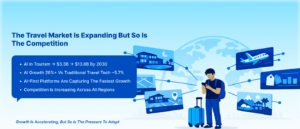
The expansion of AI in tourism is happening at a pace that stands out even within the wider technology sector. The global AI in tourism market reached USD 3,373.0 million in 2024 and is projected to reach USD 13,868.8 million by 2030. Other market estimates point to the same direction, placing the market at roughly USD 13.38 billion by 2030. The consistency across different projections tells us something important: this is not hype-driven noise. Confidence in the scale and speed of AI adoption in travel is strong.
The broader travel technology market gives even more context. That market reached USD 11.3 billion in 2025 and is forecast to reach USD 18.7 billion by 2034, growing at 5.75% annually during 2026–2034. Compare that with AI-specific growth rates above 26% and the contrast becomes hard to ignore. Traditional travel tech is still growing but AI-led solutions are moving far faster.
That gap creates pressure. Companies that keep investing in conventional infrastructure without meaningful AI integration risk falling behind segments where most of the momentum now lives. Meanwhile, businesses that design AI-first products and workflows are moving into the highest-growth parts of the travel market.
Geography also matters here. North America held 38.7% of AI in tourism revenue share in 2024. That dominance reflects early digital adoption, stronger tourism infrastructure and more mature travel technology ecosystems. For North America-based founders, this creates both a large opportunity and a high-pressure environment. The market is nearby but so is the competition.
Another interesting shift is that AI adoption in travel is not being driven by one age group alone. Unlike earlier waves of travel technology, usage now stretches across generations. That means the travel market is not splitting into “tech-savvy” users and everyone else in the old way. AI is becoming broadly usable and that widens the audience for AI-powered travel experiences.
Travel discovery is changing from search to answers
One of the biggest changes in the travel market is happening at the very top of the funnel: discovery.
For years, travel marketing depended heavily on search. Brands wanted to rank for keywords, win the click and guide the traveler from result page to booking. That model is now being disrupted. Google’s share of general information searches dropped from 73% to 66.9% in just six months of 2025. During the same period, daily AI usage more than doubled from 14% to 29.2% and ChatGPT’s share of general search queries tripled from 4.1% to 12.5%.
This is not a minor shift in traffic sources. It signals a deeper change in how people gather travel information. Many travelers now want direct answers, not long lists of links.
That changes what brands need to optimize for. Instead of focusing only on SEO in the traditional sense, travel companies now need to think about Answer Engine Optimization and Generative Engine Optimization. In simple terms, success is no longer just about ranking high. It is about being included in the answer that AI gives.
Traffic from GenAI sources to travel sites has already surged by 3,500% year over year and more than half of consumers now use AI assistants as a starting point for trip research. That means AI visibility is becoming as important as search visibility.
It also changes visitor behavior. Travelers arriving through AI recommendations tend to show stronger intent, spend more time exploring and convert better than generic traffic. But they also do not always arrive at the booking page first. They often land earlier in the consideration journey, which means travel brands need stronger content, better trust signals and clearer on-site experiences to convert that interest into bookings.
Travelers trust AI but they still verify

A useful mistake to avoid is assuming travelers blindly follow AI. They do not.
What is happening is more nuanced. AI removes some of the most frustrating parts of trip planning: too many choices, difficult comparisons and the burden of stitching together a sensible itinerary. That is one reason adoption is growing. Travelers feel less overwhelmed and they gain confidence faster.
At the same time, they still verify what AI tells them. Research describes this as a push-pull dynamic where AI does the heavy lifting but people still turn to reviews, testimonials and familiar human sources for reassurance. Around 25% of travelers report receiving out-of-date information from AI, so this caution is understandable.
This behavior matters for AI personalization in travel because it shows that visibility alone is not enough. A brand can appear in an AI-generated recommendation and still lose the booking if its reviews, content or product information do not support trust. In the same way, a company with excellent reviews may never enter consideration if its data is not structured clearly enough for AI systems to understand.
That is why strong AI travel marketing strategies now need both sides working together:
- clear AI-readable content and structured data
- strong human trust signals such as reviews and social proof
- accurate, current product information across channels
- a website experience that reduces friction after discovery
The travel market is rewarding companies that can do both.
Adoption is real and it is accelerating
Current usage rates confirm that AI is no longer limited to early adopters. In the US, 38% of surveyed leisure travelers have already used AI for trip planning. In China, adoption is even higher, with roughly eight out of 10 consumers using AI for travel planning. France and Germany are still behind, with fewer than a quarter saying the same.
This uneven adoption creates room for smart sequencing. Brands can prioritize markets where traveler expectations have already shifted, while still preparing for later growth in lower-adoption regions.
Among people already using AI, dependence is also deepening. Nearly one in seven travelers say they use AI for planning all the time. For those users, AI is not just a helper. It is becoming their main interface for trip discovery. If a hotel, airline or activity provider is not visible in that AI-led layer, it risks disappearing from that customer’s decision path entirely.
Trust data reinforces this point. Ninety-four percent of AI users trust AI recommendations at least as much as traditional sources. More than 90% report some confidence in the accuracy of travel information received through AI. Yet trust is not uniform across all tasks. Travelers feel more comfortable using AI for inspiration and idea generation than for high-stakes decisions like visa information or issue resolution.
That tells founders and CTOs something very practical: the strongest early gains may come from using AI where it already feels natural to the customer, then extending deeper into the journey over time.
The past year has shown that AI in travel is moving from pilot to infrastructure
Recent platform activity makes the direction even clearer.
OpenAI introduced Operator in January 2025, an AI-powered agent able to interact with websites and complete tasks such as booking travel and restaurant reservations. Early contributors included Booking.com, Priceline and Tripadvisor. By July 2025, Operator had been integrated into ChatGPT as “agent mode,” turning AI-assisted task completion into a more native experience.
That kind of shift matters because it removes friction. Users no longer need to jump between tools to plan and execute.
Expedia has been building in the same direction with Romie, its AI-powered travel planner. Romie supports planning, shopping, booking, group coordination, itinerary building and even disruption support. Booking.com has launched several AI features with OpenAI, including AI Trip Planner, Smart Filters, Property Q&A and AI Review Summaries. Its AI Trip Planner reportedly went from concept to launch in just 10 weeks.
The pattern here is hard to miss. AI is no longer staying in the lab or sitting in side projects. It is being wired directly into planning flows, booking interfaces and customer experiences.
Even beyond OTAs, the model is expanding. Expedia became part of early “Apps in ChatGPT” experiments. Accor launched a booking app in ChatGPT in January 2026. Tripadvisor has also brought Viator into ChatGPT as a live app experience. These are not isolated signals. They point to a travel market where AI becomes a distribution layer in its own right.
What leading travel companies are actually learning
The strongest insights from the market are surprisingly grounded.
At Expedia, the strategy has been to democratize AI across the organization rather than centralize it in one expert team. Employees reportedly built more than 1,500 AI agents and ran around 6,000 monthly sessions in an internal builder environment. That reflects a practical approach: treat AI as a working system across teams, not as a prestige initiative.
Booking.com’s experience shows the same thing from a product angle. Its teams found value in combining structured data like pricing and availability with unstructured data like reviews and natural-language descriptions. That blend made conversational planning and recommendation more useful.
Tripadvisor, meanwhile, has seen that traffic from large language models remains relatively small compared to other channels but it tends to bring higher-intent visitors and stronger revenue per visitor. That is a meaningful signal for AI personalisation and customer quality, not just traffic volume.
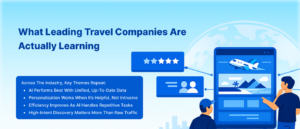
Across the industry, a few themes keep repeating:
- AI works best when data is unified and current
- personalization gains value when it feels useful, not intrusive
- operational efficiency improves when AI handles repetitive, low-friction tasks
- higher-intent discovery often matters more than raw traffic
This is why the best AI travel marketing strategies are not trying to automate everything at once. They are focusing on places where AI can remove friction, improve clarity and make decisions easier.
Where the financial upside is strongest
The fintech side of the travel market is especially important because AI is influencing not just discovery but revenue mechanics.
Dynamic pricing is one of the clearest examples. Hotels using AI-powered revenue management systems have seen average revenue increases of 7.2% compared to those using traditional methods. These systems work by continuously analyzing signals such as competitor rates, guest patterns, weather and local events.
Personalization also has direct pricing and conversion impact. Research suggests that 33% of travelers already expect individually tailored communication and personalization can support up to a 20% price premium. More than 80% of travelers seek personalization during their travel experiences and interactions with brands.
That makes AI personalization in travel more than a content feature. It becomes part of pricing power, upsell potential and customer retention.
Customer acquisition economics are shifting too. Between 2022 and 2025, the cost of acquiring new customers rose by more than 35%, while customer lifetime value only increased by 4.5%. That puts pressure on every marketing decision. AI can help here by improving media efficiency, predicting churn and supporting better service recovery.
One especially underused area is AI-powered service recovery. Brands that personalize service recovery workflows can see up to 63% higher retention, yet only 6% currently use AI in that way. That gap suggests a meaningful opportunity for founders building ai automation services for travel brands.
What founders and CTOs should do now
The travel market is not asking for a vague commitment to innovation. It is asking for practical readiness.
Start with the foundation. Customer data is still fragmented in most organizations and only 3% of brands report having fully integrated customer data. Without clean, connected data, even strong AI tools struggle to deliver useful outputs.
Then focus on a few high-return use cases first. Customer support automation, dynamic pricing and personalized recommendations consistently show measurable ROI. Chatbots alone can reduce call abandonment by 6–8%, increase reservation conversion by 25–35%, cut call volume by 20–30% and reduce average handle time by 15–25%.
Content also needs attention. If AI cannot clearly understand a property, offer or experience, it cannot confidently recommend it. Travel content now needs to be structured for both people and machines: clear language, scannable sections, direct answers, updated facts and consistent information across channels.
Partnerships matter as well. The pace of AI development is too fast for most teams to build everything internally. Strategic partnerships with model providers, distribution platforms and specialized vendors can reduce risk and accelerate delivery.
And none of this should happen without measurement. AI projects need proper KPI frameworks, testing and control groups. It is too easy to mistake motion for progress when the technology itself is moving quickly.
What This Means for Founders and CTOs
The travel market in 2026 is being shaped by a simple truth: travelers increasingly want faster answers, more relevant recommendations, less planning friction and better experiences. AI is becoming the layer that makes that possible.
For founders and CTOs, this is not just about keeping up with a trend. It is about deciding whether your company will be visible, trusted and useful in a market where discovery, comparison and booking are increasingly mediated by intelligent systems. The brands that win will be the ones that combine clean data, thoughtful AI personalisation, measurable execution and real customer trust. If that is the direction you are building toward, now is the right time to act and Book a call around what the next stage should look like.