There has been an incredible change in the world of Python backend development programming language. Although well-known backend frameworks such as Django and Flask still hold their significance for monolithic systems, the popularity of microservice architecture, real-time processing, and asynchronous computing has made FastAPI one of the top choices for developers. For all the Python development company out there, FastAPI is becoming more of a necessity than a mere hype, owing to its high performance APIs ability to perform real-world decision-making tasks.
The fundamental advantage of a Python API built with FastAPI lies in its ability to leverage modern Python features, specifically type hinting and asyncio, to reduce the “time to truth”. In an era where systems are large, regulated, and deeply interconnected, the speed of execution and the reliability of data validation are no longer optional features; they are the foundations of operational toolsets.
The Asynchronous Edge: Driving High Performance APIs
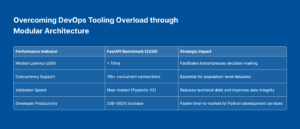
The main reason for the use of FastAPI is its asynchronous and non-blocking architecture. The usual problem faced by most Python frameworks is their inability to perform I/O bound operations, which leads to bottlenecks while dealing with databases or other services. However, with FastAPI, a Python-based API can handle multiple requests concurrently without increasing latency.
In high-stakes environments, such as real-time fraud scoring or clinical data analysis, latency budgets are razor-thin. If a system’s controls fire too slowly, it is essentially chasing yesterday’s problems. High performance APIs developed with FastAPI ensure that every request and every session is evaluated in near real-time, which is critical for scalable Python APIs operating at the edge.
|
Performance Indicator |
FastAPI Benchmark (2026) |
Strategic Impact |
|
Median Latency (p50) |
< 10ms |
Facilitates instantaneous decision-making. |
|
Concurrency Support |
10k+ concurrent connections |
Essential for population-level datasets. |
|
Validation Speed |
Near-instant (Pydantic V2) |
Reduces technical debt and improves data integrity. |
|
Developer Productivity |
200–300% increase |
Faster time-to-market for Python development services. |
Data Integrity and Type Safety in Python Backend Development
A recurring obstacle in the Python backend development process is the inconsistency of data standards. Data is frequently split among systems created over time with different protocols. FastAPI addresses this by using Pydantic for data validation, which acts as a modular layer to normalize, validate, and exchange data.
By enforcing strict type hints, FastAPI allows a Python development company to catch errors during the development phase rather than at runtime. This “fail-fast” mentality decreases the amount of friction associated with implementation and increases the overall impact of the improved efficiency. When a Python API can validate complex JSON schemas automatically, it allows the core intelligence to focus on delivering value instead of managing constraints.
Scalability and Cloud-Native Integration
The APIs of Python must be scalable and have to be developed for cloud-native architectures right from the start. The lightweight nature of FastAPI makes it highly suitable for deployment on containers like Docker and for orchestration using Kubernetes. This is when Python development services come into their own.
Why Cloud Infrastructure is the Enabler
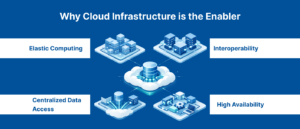
- Elastic Computing: FastAPI allows organizations to scale workloads up or down without investing in fixed hardware.
- High Availability: Redundancy and high availability are necessary in clinical and financial environments where downtime is a terminal event.
- Centralized Data Access: Moving data and workloads into shared, scalable environments allows for centralized processing in near real-time.
- Interoperability: Most FastAPI development projects adopt standards-based APIs (like OpenAPI and JSON Schema) intended to work alongside existing legacy systems.
Real-Time Logic and Security Posture
In modern web applications, security cannot be a “bolted-on” feature. For a Python API, implementing real-time risk scoring is a practical way to sharpen threat detection. FastAPI’s speed enables a scoring layer that fuses network, device, and behavior signals into a single, interpretable score between 0 and 100.
By utilizing a fast, small model within the API, a Python development company can map score bands to automated actions:
- Low Risk (0–29): Allow the user to glide through the application.
- Medium Risk (30–59): Show gentle verification on sensitive actions.
- High/Critical Risk (60–100): Implement step-up authentication (WebAuthn) or hard blocks to waste bot time.
Case Snapshots: FastAPI in Action
- Healthcare Workflow Optimization: A health system experiencing documentation delays used a FastAPI-based application to automate the conversion of speech to structured notes. This decreased the clinician mental load and improved documentation completion times within six months.
- Financial Fraud Detection: An e-commerce platform utilized high performance APIs to identify credential stuffing sequences early. By flagging Sequences of IP freshness and device reuse, they cut attack success by double digits while maintaining a flat volume of help-desk tickets.
- Modular Integration: A B2B SaaS platform used FastAPI to smartly connect existing legacy systems. By using APIs to normalize data across departments, they achieved a uniform approach to efficiency that is a major driver of modern healthcare and business growth.
Technical FAQs
1. How does FastAPI support “Interoperability” with legacy systems?
Through the use of layered and standardized APIs, FastAPI normalizes, validates, and exchanges data, enabling it to work without being tied down to one specific source of data but intelligently linking current systems together instead.
2. Why is FastAPI preferred for AI-driven Python backend development?
AI models require elastic computing resources and high-performance throughput to process imaging or population-level data. FastAPI’s asynchronous capabilities allow it to handle the heavy lifting of model inference and data processing without blocking the rest of the application.
3. What role do “MVP metrics” play in FastAPI development?
Success can be gauged by factors such as reduced documentation time (20-40%) and increased diagnostic accuracy (10-25%). Professional Python development services rely on such statistics to demonstrate the efficiency of the API’s operations in practical applications.
4. Can FastAPI handle high-security real-time risk scoring?
Yes. FastAPI can maintain rolling windows of data to compute features like velocity and cohort z-scores. This allows the Python API to apply adaptive friction only to higher-risk cohorts, preserving conversion for low-risk users.
Engineering for the Future of Python APIs
FastAPI is a revolution in Python backend development. Instead of seeing the building of the Python API as something external to the process, FastAPI allows developers to build applications that will run at the same pace as the industry. Whether by cutting down the need for extensive documentation or securing the application with real-time judgment calls, FastAPI is the way to go.
In essence, the companies that will survive in a future where there is more data and higher levels of complexity are the ones that incorporate intelligence in their processes. This can be achieved by avoiding mistakes that have been made in the past by making a paradigm shift in our way of thinking about software development.
With the help of a Python development company focused on modularity and responsiveness, developers can overcome the technical challenges associated with interoperability while at the same time solving problems related to latency. Utilizing expert Python development services to secure these systems guarantees that the system offers all the necessary components for scalability.
This high performance APIs and scalable Python APIs will be the element that ensures sustainability and ensures that any pitfalls that may have come out of operations will eventually turn out to be a roadmap for success. Finally, the decision to choose FastAPI will not just be about speed but rather ensuring that you create a sustainable future for yourself, where your scalable Python APIs become your silent, fast partner in making the right decisions.
Do you like to read more educational content? Read our blogs at Cloudastra Technologies or contact us for business enquiry at Cloudastra Contact Us.