Basic Cloud Security Practices Every Business Should Follow
Now that cloud computing technology has become the backbone for all operations in modern organizations, it’s evident that the security paradigm based on static and perimeters has become obsolete. It’s no secret that the world in 2026 will be characterized by dynamic IPs, polymorphic botnets, and fragmented data sources. For any organization, the shift from “on-premises” to “always-on” cloud infrastructure requires best practices for cloud security that are dynamic, adaptive, and embedded directly into the workflow layer.
The goal of modern cloud security strategies is not to build a wall, but to create a responsive ecosystem where security and performance coexist. This involves moving away from controls that fire once per login and toward a system that provides a rolling judgment on every request, session, and action.
Strategy 1: Implementing Real-Time Risk Assessment
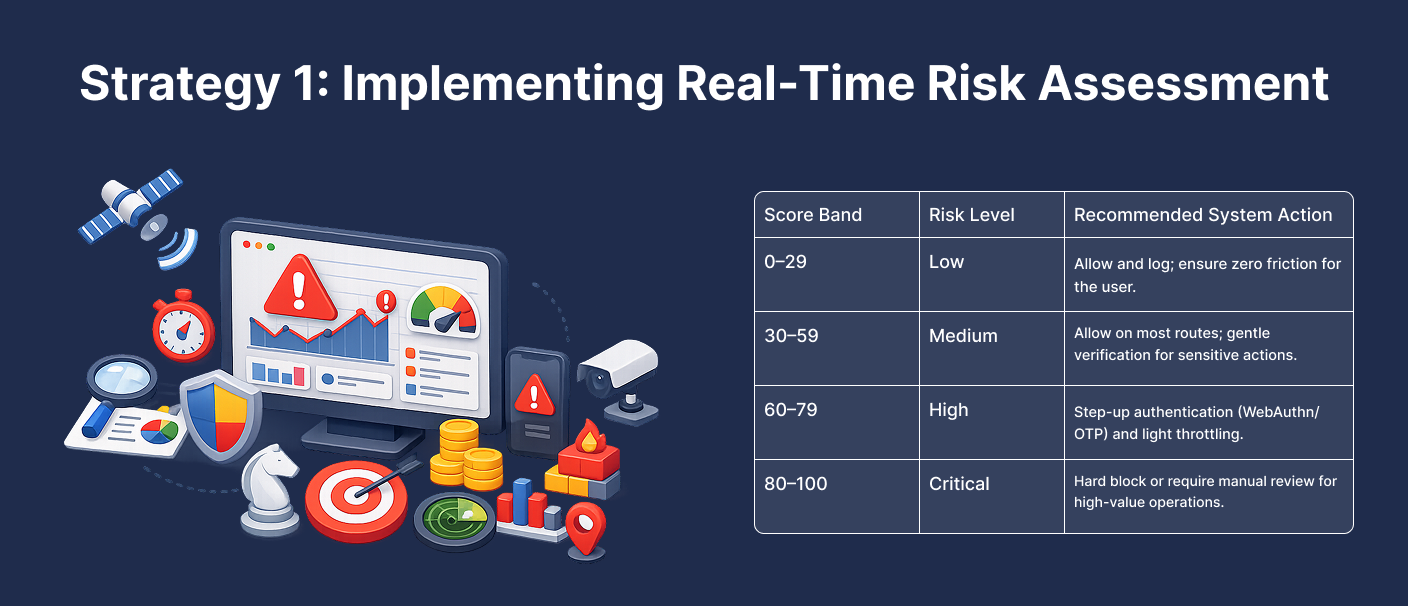
The most effective best practices for cloud security and cloud security strategies now involve a dynamic scoring layer that fuses network, device, behavior, and identity signals. This turns scattered hints into a steady decision engine, allowing the application to identify when to allow, step-up, or block a user.
Adaptive Policy Bands
A core component of cloud risk management and one of the best practices for cloud security is the use of automated policy engines that map risk scores to specific actions. This ensures that friction is applied precisely where it pays off, preserving conversion for low-risk cohorts.
|
Score Band |
Risk Level |
Recommended System Action |
|
0–29 |
Low |
Allow and log; ensure zero friction for the user. |
|
30–59 |
Medium |
Allow on most routes; gentle verification for sensitive actions. |
|
60–79 |
High |
Step-up authentication (WebAuthn/OTP) and light throttling. |
|
80–100 |
Critical |
Hard block or require manual review for high-value operations. |
Strategy 2: Hardening Cloud Data Protection with Best Practices for Cloud Security
Cloud data protection is more than just encrypting your data because it involves a modulated process in regard to data integration. In view of the fact that there may be data scattered across systems using different standards, the solution lies in utilizing APIs.
Encryption at Rest and in Transit: Cloud environments must be configured with encryption and access controls baked in from the start.
Modular Layers: Using a modular layer for integration allows systems to function independently of a singular data source, reducing the risk of widespread exposure.
Interoperability Standards: Adopting frameworks like HL7 FHIR or standards-based APIs ensures that cloud computing technology and cloud data protection remains secure while smartly connecting existing systems.
By correctly implementing these best practices for cloud security and cloud security strategies, cloud platforms can meet or exceed the security posture of traditional on-premise systems.
Strategy 3: Governance, Monitoring, and Cloud Compliance
For sustained cloud compliance, organizations have to consider governance in terms of transparency and accountability. In modern Cloud Security strategies, audit trails and explainability requirements are essential because they help organizations understand why certain system decisions were made within cloud computing managed services.
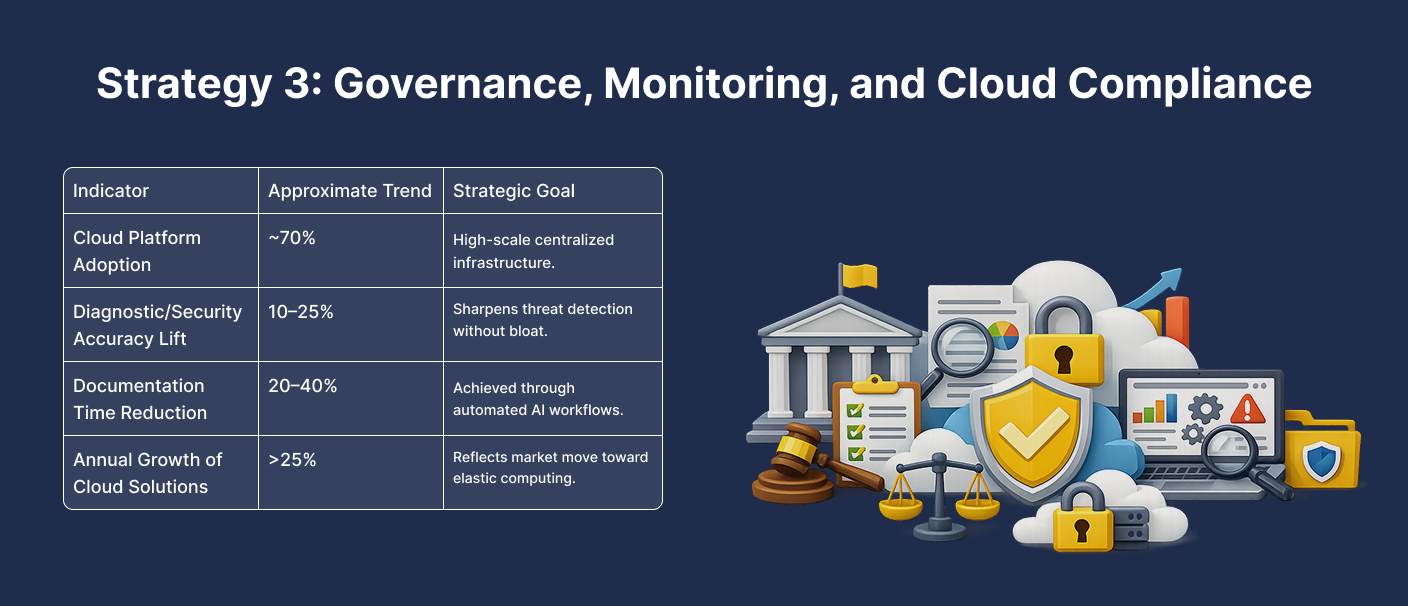
Indicators of a Healthy Security Posture (2026)
|
Indicator |
Approximate Trend |
Strategic Goal |
|
Cloud Platform Adoption |
~70% |
High-scale centralized infrastructure. |
|
Diagnostic/Security Accuracy Lift |
10–25% |
Sharpens threat detection without bloat. |
|
Documentation Time Reduction |
20–40% |
Achieved through automated AI workflows. |
|
Annual Growth of Cloud Solutions |
>25% |
Reflects market move toward elastic computing. |
-
Strategy 3: Strengthening cloud governance, monitoring, and compliance for secure and scalable operations. - Case Snapshots: Security in Motion
- Regional Hospital Network: A regional system experiencing shifts in clinical workflow stability used cloud-based architecture and forecasting algorithms to identify patients at risk of readmission. This integration of cloud computing technology improved documentation completion times and decreased clinician disruptions.
- E-commerce Marketplace: This company leveraged risk scoring at login to reduce the effectiveness of credential stuffing attacks by double digits. They accomplished this while keeping conversions extremely high, all without affecting the majority (~98%) of customers through step-up authentication.
- B2B SaaS API Protection: This company leveraged datacenter ASN alerts to apply throttling to write endpoints, protecting their partners’ legitimate data while blocking malicious bots.
- Infrastructure Redundancy and the Shared Responsibility Model: Best Practices for Cloud Security
- An essential part of best practices for cloud security is realizing that contemporary IT infrastructure can no longer be seen as consisting of physical servers, but is based on their reliability and performance capabilities. It goes without saying that technologies used in cloud computing ensure that there will always be high availability and redundancy required by mission-critical business applications. Nonetheless, using cloud services should not release organizations from their responsibility to provide proper security. Instead, a shared responsibility paradigm should be adopted with regard to configuration at the very beginning.
- An essential element for the development of effective security measures to safeguard the cloud is ensuring there is a fallback mechanism that can be used in case a model starts misbehaving or when there is a problem with its configuration. Version-pinning of the model and the ability to deploy a “last known good” configuration are critical if there is any reduction in precision and latency levels. The use of cloud computing managed services will ensure that the technical foundation of such services is maintained to guarantee smooth running of the cloud, focusing solely on providing intelligence as opposed to worrying about limitations associated with physical hardware. Standardization in the provision of services through clouds is one of the biggest sources of efficiency within companies, especially in cases where dispersed information results into inefficient processes.
- Technical FAQs
- How does “interoperability” affect cloud compliance? Interoperability is about connecting systems through standards-based APIs. This ensures that as data moves between silos, it remains normalized and validated, which is essential for maintaining strict cloud compliance and cloud risk management across different regulatory environments.
- Why is “real-time” scoring better than nightly batch jobs? Attacks like card testing and credential stuffing ramp up in minutes. Batch jobs are inherently late; real-time risk scoring allows for dynamic risk assessment that captures a “flip” in behavior as it happens.
- What role do cloud computing managed services play in cloud risk management? These services provide the systems necessary to operate at scale, managing the “hard part” of infrastructure like high availability, redundancy, and modular integration. This allows businesses to focus on delivering intelligence rather than managing servers.
- How do we reduce bias in automated fraud scoring systems? The best practices for cloud security would be to audit the proxy protection offered to each class and compare their false positives. Band calibration for each class and an open appeals process is essential for gaining trust.
- How do we ensure a safe rollback if a cloud security model misbehaves? The rollback strategy should also be effective in ensuring that all models and rules are pinned to a particular version to guarantee that a “last known good” version can be deployed in any case. Moreover, kill switches should also be put in place for each route, whether it be logins or payment checkouts, to immediately resolve any issues that may arise from accuracy or latency problems.
- The Path to Resilient Operations
- Implementing best practices for cloud security is not just a secondary concern but rather a primary one. Through the implementation of real-time risk assessment, modularization of data, and governance, organizations will be able to make the cloud their very own dynamic process. It is through cloud computing technology that organizations will achieve such a state of affairs, not by replacing old systems but rather equipping themselves to function at the speed of today’s threats.
- However, those that would succeed amidst the growing volume of data and complexities associated with it would be those that would integrate intelligence in all of their activities. A paradigm shift in approach would help them avoid some of the common mistakes made. Instead of looking at security as an individual initiative, it should be looked at as something inherent in the process. With this in mind, one can apply the principles of cloud security and make use of cloud computing’s modularity and agility to overcome interoperability challenges while addressing any possible security concerns. Collaborating with professional cloud computing managed services to fortify such integrations guarantees that the platform is equipped with everything needed to work on par with the industry standards.
-
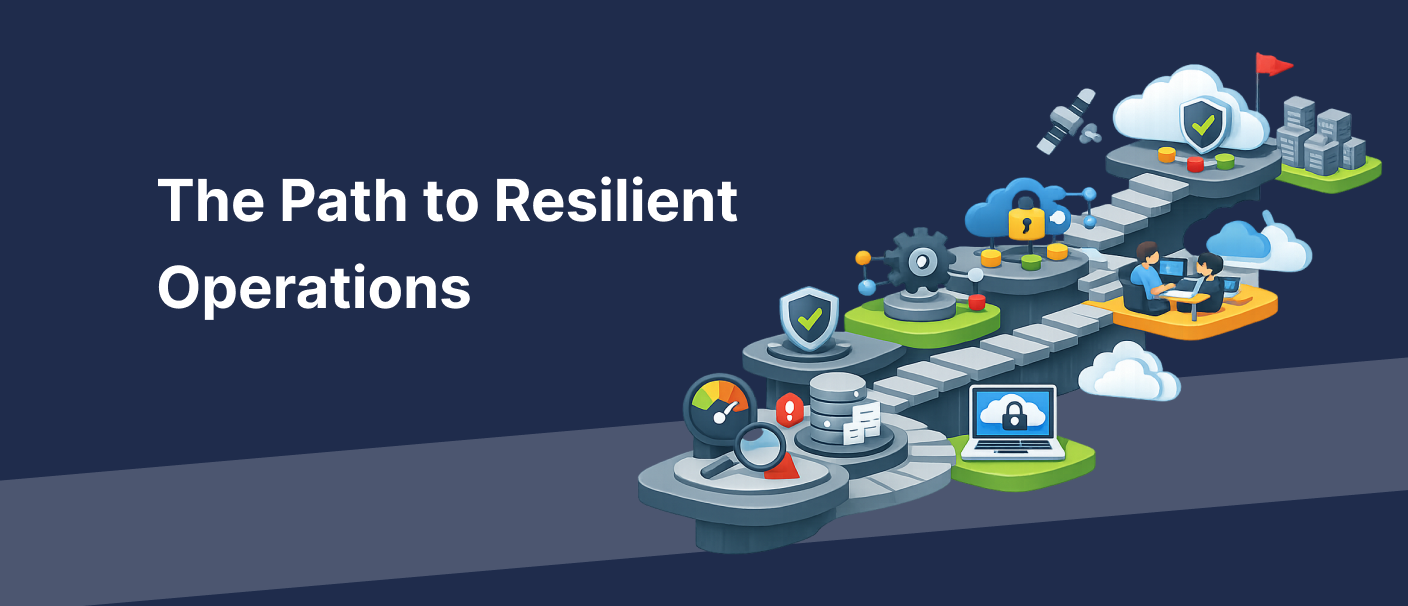
Building resilient operations through secure cloud infrastructure, monitoring, and operational continuity strategies.
Do you like to read more educational content? Read our blogs at Cloudastra Technologies or contact us for business enquiry at Cloudastra Contact Us.