Debt collection management software helps lenders, NBFCs, fintech companies and loan servicing teams manage overdue accounts, automate borrower follow ups, track repayment behaviour and improve recovery outcomes from one place.
For lenders, the problem is not only missed EMIs. The bigger issue is delayed follow-ups, scattered borrower communication, weak visibility into high-risk accounts, manual task allocation, rising collection costs, and compliance risk during borrower communication. As loan portfolios grow, these issues become difficult to manage with spreadsheets and manual calling lists.
That is why modern lenders use debt collection software to prioritize risky accounts, automate collection workflows, personalize borrower communication, and keep recovery records ready for audits.
What Problem Does Debt Collection Management Software Solve?
Lenders face one major challenge: they need to recover overdue payments faster without increasing operational costs, damaging borrower relationships, or creating compliance gaps.
As a lending portfolio grows, recovery teams need to manage more borrowers, more EMI reminders, more overdue accounts, more promise to pay cases, more escalations, and more communication channels. If this process is handled manually, delays build up quickly.
A borrower may miss an EMI reminder. A high-risk account may not be contacted on time. A repayment promise may not be followed up. A field visit update may remain in a separate tool. A compliance issue may appear because borrower communication was not properly recorded.
Without debt collection management software, teams usually depend on:
- Manual calling sheets
- Spreadsheets
- Disconnected CRM tools
- Delayed EMI reminders
- Scattered WhatsApp, SMS, email, and call records
- Manual account prioritization
- Limited borrower risk visibility
- Incomplete recovery history
These methods may work for a small portfolio. But when a lender starts handling thousands of borrowers, multiple delinquency stages, and different collection teams, manual recovery becomes slow, costly, and difficult to control.
Debt collection management software solves this by giving lenders one structured system to track overdue accounts, automate follow ups, assign tasks, monitor borrower risk, and improve collection visibility.
What Is Debt Collection Management Software?
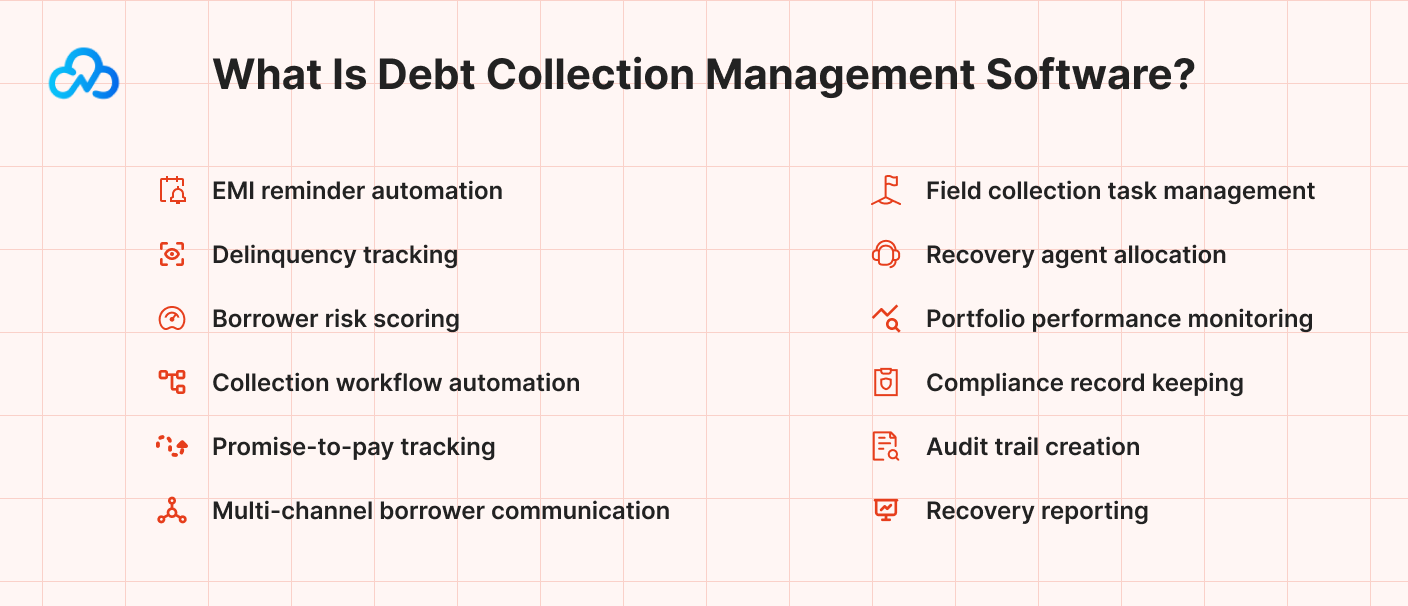
Debt collection management software is a platform that helps lenders manage overdue accounts, automate recovery workflows, track borrower risk, and improve repayment collection.
In fintech lending, NBFC operations, and loan servicing, it is commonly used for:
- EMI reminder automation
- Delinquency tracking
- Borrower risk scoring
- Collection workflow automation
- Promise-to-pay tracking
- Multi-channel borrower communication
- Field collection task management
- Recovery agent allocation
- Portfolio performance monitoring
- Compliance recordkeeping
- Audit trail creation
- Recovery reporting
In simple terms, it helps recovery teams answer practical questions like:
- Which borrowers are most likely to default?
- Which overdue accounts should be contacted first?
- Has this borrower received an EMI reminder?
- Did the borrower promise to pay?
- Which recovery agent owns this account?
- What communication has already happened?
- Which accounts are moving from early delinquency to serious default?
- Can we prove our recovery process during an audit?
For lenders, debt collection management software is not just a follow up tool. It is a recovery control system that helps teams act earlier and work with better visibility.
Why Do Lenders Need Debt Collection Software?
Lenders need debt collection software because loan recovery has become more complex, more data heavy, and more time sensitive.
A digital lender may disburse loans quickly, but repayment behaviour changes after disbursal. Some borrowers may miss one EMI and recover quickly. Some may need reminders. Some may need a repayment plan. Others may show early warning signs before default.
When these signals are tracked manually, collection teams often react late.
A high risk borrower may stay in a low-priority queue. A promise to pay may be missed. Multiple agents may contact the same borrower without context. A borrower may receive inconsistent communication across channels. Audit records may remain incomplete.
Debt recovery software helps reduce these gaps by giving lenders better visibility into borrower behaviour, overdue accounts, repayment promises, communication history, and recovery actions.
For growing lending teams, collections cannot depend only on calls and spreadsheets. It needs automation, prioritization, real time dashboards, and compliant borrower communication.
How Big Is the Debt Recovery Problem?
Debt recovery is becoming more important because digital lending and unsecured credit have expanded quickly.
According to CRIF High Mark, its Fintech Barometer with the Digital Lenders Association of India reported a 44% increase in delinquencies among personal loan borrowers who took loans between December 2023 and June 2024. This shows why lenders need stronger early-risk detection and better recovery workflows, especially in small-ticket and digital lending portfolios.
A Government of India parliamentary response citing RBI data showed that the GNPA ratio for unsecured retail loans increased from 1.56% in March 2024 to 1.82% in March 2025. For lenders, even a small rise in delinquency can create major recovery pressure when loan volumes are high. Government of India parliamentary response
The RBI’s digital lending FAQs also mention that recovery or servicing of delinquent digital loans may be undertaken by recovery agents. This makes controlled borrower communication, proper recordkeeping, and compliant recovery workflows important for digital lenders.
The broader lending environment also shows why early recovery visibility matters. Reuters, citing the RBI’s Financial Stability Report, reported that retail loan delinquencies had risen in segments such as credit cards, personal loans, and microfinance because of stress among riskier borrowers.
These numbers show why lenders need stronger recovery systems. As loan volumes, borrower segments, delinquency pressure, and compliance expectations increase, manual recovery operations become harder to manage.
What Are the Main Benefits of Debt Collection Management Software?
The biggest benefit of debt collection management software is that it helps lenders move from delayed, manual recovery to structured, data-led recovery.
Instead of waiting for accounts to become seriously overdue, lenders can detect early risk, send timely reminders, assign tasks, track borrower responses, and monitor portfolio performance from one place.
The main benefits include:
- Faster borrower follow-ups
- Better account prioritization
- Lower manual workload
- Improved recovery visibility
- More consistent borrower communication
- Better tracking of promise-to-pay cases
- Stronger compliance records
- Real-time portfolio dashboards
- Reduced operational cost
- Better recovery team coordination
For smaller lending teams and growing NBFCs, this matters because collection operations can become difficult to control once borrower volume increases.
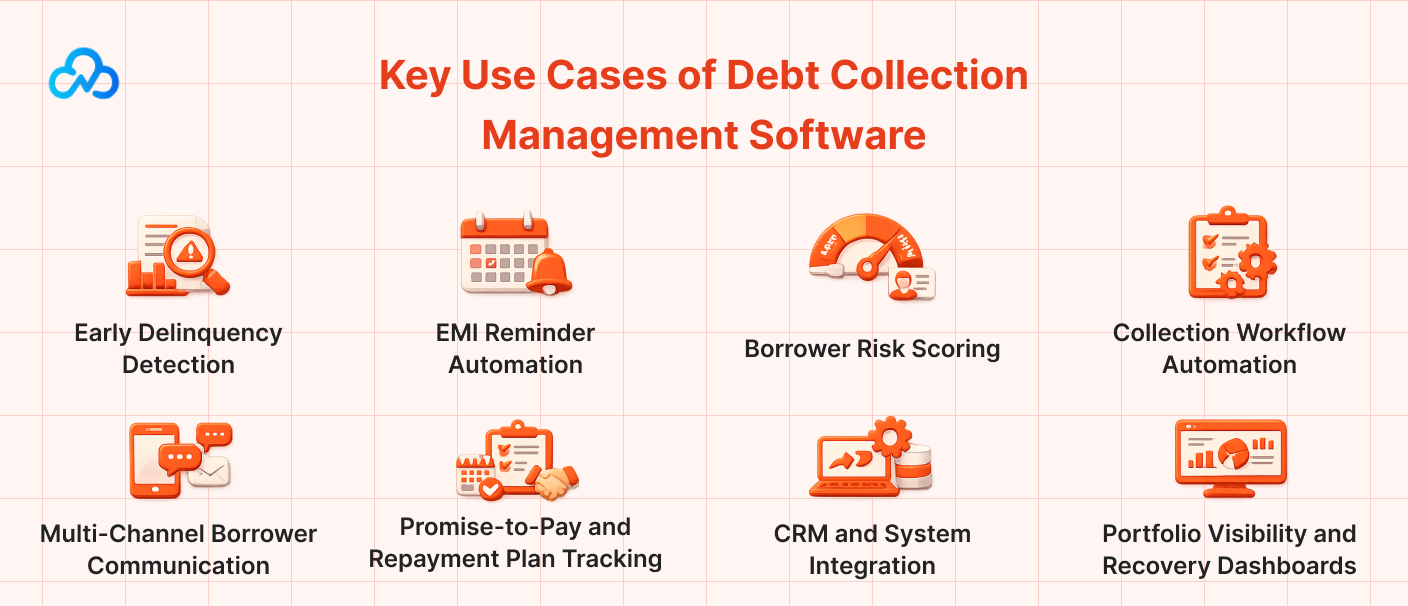
Key Use Cases of Debt Collection Management Software
1. Early Delinquency Detection
Early delinquency detection helps lenders identify borrowers who may become high-risk before the account turns into a serious default.
A borrower may show early warning signs through missed EMIs, repeated partial payments, failed auto debits, delayed responses, broken promises, or sudden changes in repayment behaviour.
Debt collection management software helps teams track these signals earlier and move accounts into the right collection workflow.
This is useful for:
- NBFCs
- Digital lenders
- Loan servicing companies
- Consumer lending platforms
- Embedded finance companies
- Banks with retail loan portfolios
The goal is simple: contact the right borrower at the right time before the account becomes harder to recover.
2. EMI Reminder Automation
Many repayment delays happen because reminders are late, inconsistent, or not personalized.
Automated debt collection software helps lenders send EMI reminders across channels such as SMS, WhatsApp, email, calls, or app notifications. These reminders can be scheduled based on due dates, borrower risk level, repayment history, and collection stage.
This reduces repetitive manual work and gives borrowers timely communication before the account becomes overdue.
For lenders, automated reminders can help reduce avoidable delays, improve repayment discipline, and free collection teams from repetitive follow up tasks.
3. Borrower Risk Scoring
Not every overdue account needs the same level of attention.
Some borrowers may only need a reminder. Some may need a repayment plan. Some may require faster escalation. Others may show signs of serious default risk.
Debt collection management software helps lenders score borrowers based on:
- Repayment history
- Missed EMI patterns
- Account age
- Delinquency stage
- Communication response
- Promise-to-pay history
- Partial payment behaviour
- Borrower segment
- Past recovery outcomes
- Portfolio risk category
This allows collection teams to prioritize high-risk borrowers instead of treating every overdue account the same way.
4. Collection Workflow Automation
Collection teams often lose time because tasks are assigned manually and updates are spread across different tools.
A debt collection platform helps automate workflows such as:
- Assigning accounts to agents
- Triggering reminders
- Escalating overdue accounts
- Tracking promise-to-pay dates
- Scheduling follow-up actions
- Updating borrower status
- Routing high-risk cases
- Generating collection reports
This creates a more organized recovery process and reduces dependency on manual tracking.
For large lending portfolios, workflow automation helps teams move faster without losing control over account-level actions.
5. Multi-Channel Borrower Communication
Borrowers do not respond through one channel only. Some respond to calls, some to WhatsApp, some to SMS, and some through self-service repayment options.
Debt collection management software helps lenders manage communication across multiple channels while keeping records in one place.
This is important because recovery teams need to know:
- When the borrower was contacted
- Which channel was used
- What response was received
- Whether a promise-to-pay was made
- Whether the borrower needs escalation
- Whether communication followed internal policy
Centralized borrower communication improves coordination and reduces repeated or inconsistent follow ups.
6. Promise-to-Pay and Repayment Plan Tracking
Many borrowers do not refuse to pay. They may need more time, a smaller repayment window, or a structured repayment plan.
Debt recovery software helps lenders track promise to pay commitments and repayment plans more clearly.
This is useful when teams need to manage:
- Partial payments
- Promise-to-pay dates
- Rescheduled payment plans
- Settlement workflows
- Hardship cases
- Escalation approvals
- Broken commitments
A structured repayment plan process helps lenders improve recovery while keeping borrower communication more controlled and transparent.
7. CRM and System Integration
One common question lenders ask is whether debt collection management software can integrate with CRM systems, lending platforms, payment systems, or existing internal tools.
This is important because collection teams need borrower data, repayment history, account status, communication notes, and payment updates to stay connected.
Good integration helps teams avoid duplicate data entry and reduces the risk of missing important borrower updates.
For lenders, integration with existing systems can improve:
- Borrower data visibility
- Agent productivity
- Payment update tracking
- Collection task accuracy
- Reporting quality
- Audit readiness
This is especially useful for lenders already using CRM, loan management systems, payment gateways, or customer support tools.
8. Portfolio Visibility and Recovery Dashboards
Collection leaders need visibility into portfolio performance, not just individual accounts.
Debt collection management software can provide dashboards for:
- Total overdue amount
- Active delinquent accounts
- Recovery rate
- Pending promise-to-pay cases
- Roll forward and roll back trends
- Agent performance
- Campaign performance
- High risk borrower segments
- Broken payment commitments
This helps collection heads and risk leaders understand where recovery is improving and where intervention is needed.
9. Compliance and Audit Tracking
Debt collection is not only about recovery. It also needs proper communication discipline, documentation, and audit visibility.
If borrower communication is not recorded properly, lenders may struggle during internal reviews, regulatory checks, or customer disputes.
Debt collection software helps maintain records of:
- Contact attempts
- Communication history
- Agent actions
- Borrower responses
- Repayment commitments
- Escalations
- Account status changes
- Recovery decisions
This makes the collection process easier to review and helps teams prove that recovery actions were handled properly.
How to Choose the Right Debt Collection Management Software
The best debt collection management software depends on the lender’s portfolio size, borrower segment, recovery process, compliance needs, and integration requirements.
Before choosing a solution, lenders should check whether the software can:
- Automate EMI reminders
- Track delinquency stages
- Prioritize high risk borrowers
- Manage promise to pay cases
- Support multi channel communication
- Integrate with CRM or loan systems
- Provide real time recovery dashboards
- Maintain audit trails
- Support compliant borrower communication
- Reduce manual collection workload
For local lenders, NBFCs, and fintech companies, the right system should be easy for collection teams to use, but strong enough to handle growing borrower volume.
What Is the Average Cost of Debt Collection Software?
The cost of debt collection management software depends on several factors, including portfolio size, number of users, workflow complexity, integrations, communication channels, reporting needs, and deployment model.
A small lender may need a simpler setup for reminders, task allocation, and basic reporting. A larger NBFC or fintech lender may need advanced automation, borrower segmentation, dashboards, compliance controls, and integrations with loan management or CRM systems.
Instead of choosing only by price, lenders should compare the cost against:
- Manual collection workload
- Recovery team efficiency
- Missed follow-up losses
- Compliance risk
- Time spent on reporting
- Portfolio visibility gaps
- Improvement in recovery rate
The better question is not only “how much does it cost?” but “how much recovery leakage does manual collection create?”
Common Debt Collection Challenges for Lenders
Manual Follow-Ups Are Too Slow
Manual follow-ups create delays and increase workload for recovery teams. As borrower volume grows, it becomes difficult to contact every overdue account on time.
Collection Data Is Scattered
Borrower details, repayment history, communication notes, agent updates, and escalation records often sit in different systems. This makes it difficult to get a complete view of recovery status.
High-Risk Borrowers Are Not Prioritized Early
When accounts are handled in a fixed order, teams may miss borrowers who need urgent attention. This can allow early delinquency to become serious default.
Borrower Communication Becomes Inconsistent
Different agents may contact borrowers with different messages or without full context. This can hurt borrower experience and create compliance risk.
Operational Costs Keep Rising
Manual collections require more agents, more coordination, and more supervision. Without automation, recovery costs increase as portfolios grow.
Compliance Records Are Incomplete
If calls, messages, promises, escalations, and decisions are not tracked properly, audit readiness becomes difficult.
What Features Should Debt Collection Management Software Have?
A strong debt collection management software platform should include:
- Borrower risk scoring
- EMI reminder automation
- Multi-channel communication
- Collection workflow automation
- Promise-to-pay tracking
- Agent task allocation
- Repayment plan management
- Portfolio dashboards
- Recovery performance reports
- Delinquency tracking
- Escalation workflows
- CRM or loan system integration
- Compliance recordkeeping
- Audit trails
- API integration
- Role-based access
- Secure data handling
For NBFCs and fintech lenders, the most important features are borrower risk scoring, automated reminders, workflow automation, portfolio visibility, compliance tracking, and recovery reportin
How DebtPulse Helps Lenders Improve Recovery
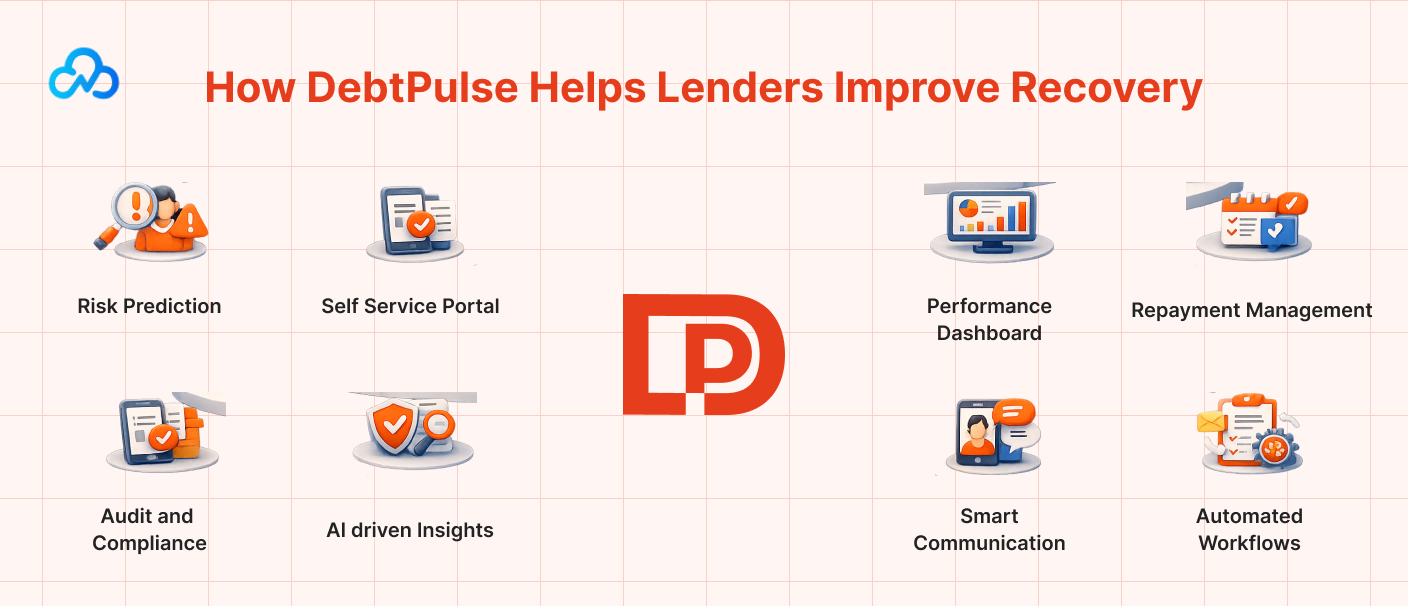
DebtPulse is an AI powered debt intelligence and recovery platform built for modern financial institutions.
It helps lenders move from reactive collection work to predictive recovery operations by using AI driven risk intelligence, borrower segmentation, automation, and portfolio insights.
DebtPulse helps teams with:
- Predicting high risk borrowers before default
- Automating multi channel collection workflows
- Prioritizing accounts using AI driven insights
- Improving borrower engagement with personalized communication
- Managing repayment plans and borrower self service
- Tracking portfolio performance through real time dashboards
- Reducing repetitive manual work
- Supporting compliance with audit tracking
- Improving recovery visibility for collection leaders
Instead of depending on spreadsheets, disconnected tools, and manual follow ups, lenders can use DebtPulse to manage recovery operations with more structure and visibility.
DebtPulse is especially useful for NBFCs, fintech lenders, banks, and loan servicing teams that want to improve recovery rates without increasing manual workload.
https://apiblog.cloudastra.co/wp-content/uploads/2026/06/How-DebtPulse-Helps-Lenders-Improve-Recovery.png
Who Should Use Debt Collection Management Software?
Debt collection management software is useful for:
- NBFCs
- Digital lending platforms
- Banks
- Fintech lenders
- Loan servicing companies
- Embedded finance platforms
- Consumer lending businesses
- Credit providers
- Recovery teams
- Collection agencies working with financial institutions
Any lender managing overdue accounts, EMI reminders, delinquency tracking, repayment follow ups, or borrower communication should consider using debt collection management software.
Do you like to read more educational content? Read our blogs at Cloudastra Technologies or contact us for business enquiry at Cloudastra Contact Us.
FAQs
1. What is debt collection management software?
Debt collection management software is a platform that helps lenders manage overdue accounts, automate borrower follow-ups, track delinquency risk, assign recovery tasks, and improve repayment collection.
2. What are the benefits of debt collection software for lenders?
The main benefits include faster follow-ups, better account prioritization, reduced manual workload, improved borrower communication, stronger recovery visibility, and better audit-ready records.
3. Can debt collection management software send automated reminders?
Yes. Automated debt collection software can send EMI reminders through SMS, WhatsApp, email, calls, or app notifications based on due dates, borrower risk, and collection stage.
4. Can debt collection management software integrate with CRM systems?
Yes. Many platforms can integrate with CRM systems, loan management systems, payment tools, and internal workflows so collection teams can see borrower data, repayment history, and communication records in one place.
5. How does DebtPulse help with debt recovery?
DebtPulse helps lenders predict high-risk borrowers early, automate collection workflows, prioritize accounts, personalize borrower communication, track recovery performance, and maintain compliance records.