AI Chatbot Development Cost in 2026: Enterprise vs Startup Budget Breakdown
AI chatbot development cost in 2026 can range from $3,000 to $300,000, depending on chatbot complexity, integrations, AI capability, conversation volume, compliance needs, and whether the business chooses a platform, custom build, or AI-first development partner.
A simple rule-based FAQ bot may cost only a few thousand dollars, while a multi-agent enterprise AI chatbot connected to CRM, helpdesk, order management, WhatsApp, website, mobile app, and compliance systems can cost hundreds of thousands. The reason the range is wide is simple: not every chatbot is the same product.
For startups, the right chatbot budget usually focuses on fast launch, user adoption, and core conversation quality. For enterprises, the budget often shifts toward integrations, security, compliance, omnichannel deployment, training data, and long-term operating cost.
What Problem Does AI Chatbot Development Cost Planning Solve?
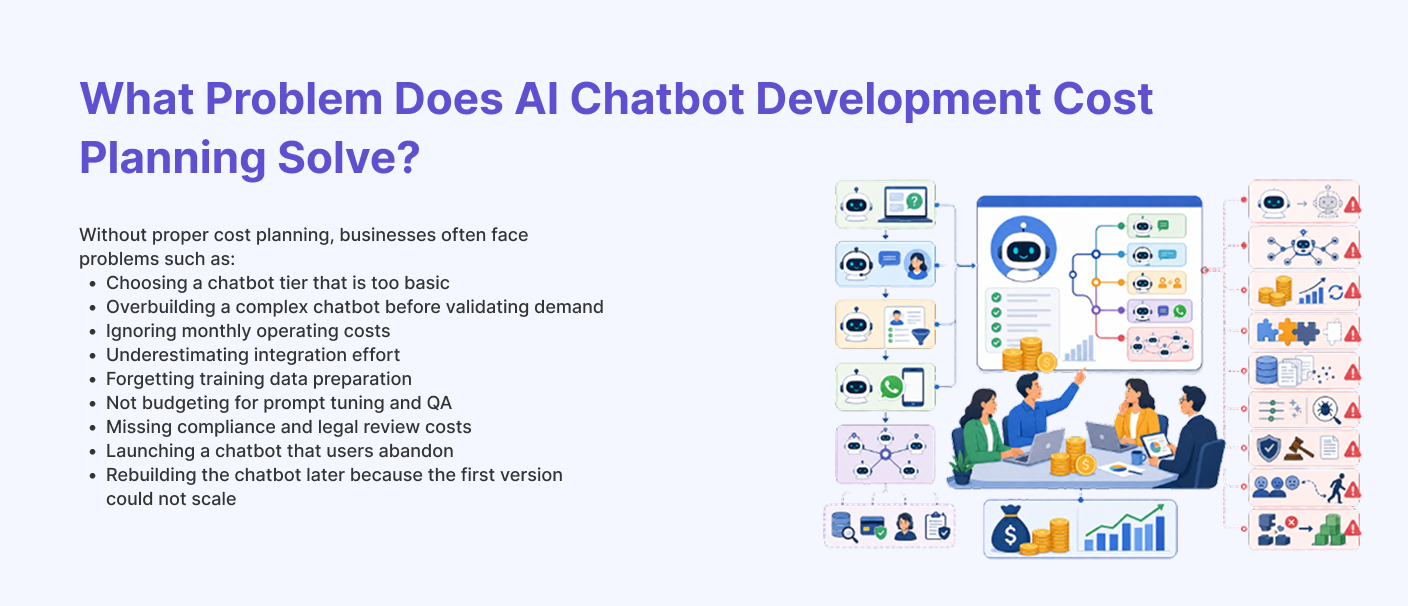
AI chatbot projects often go over budget because companies start with the wrong question.
They ask, “How much does a chatbot cost?” But a chatbot can mean many different things.
It can be a basic FAQ bot. It can be an AI support assistant. It can be a lead qualification bot. It can be a WhatsApp business bot. It can be a multi-agent conversational AI system that retrieves knowledge, performs transactions, escalates to humans, and logs compliance records.
Without proper cost planning, businesses often face problems such as:
- Choosing a chatbot tier that is too basic
- Overbuilding a complex chatbot before validating demand
- Ignoring monthly operating costs
- Underestimating integration effort
- Forgetting training data preparation
- Not budgeting for prompt tuning and QA
- Missing compliance and legal review costs
- Launching a chatbot that users abandon
- Rebuilding the chatbot later because the first version could not scale
AI chatbot development cost planning helps businesses choose the right tier, understand the real budget, compare build approaches, and avoid hidden costs after launch.
What Is AI Chatbot Development Cost?
AI chatbot development cost is the total amount required to design, build, train, test, deploy, integrate, and maintain an AI-powered chatbot or conversational AI system.
This cost may include:
- Conversation design
- AI/NLU development
- LLM integration
- Prompt engineering
- Training data preparation
- Knowledge base setup
- RAG pipeline development
- CRM or helpdesk integration
- WhatsApp, web, mobile, or app deployment
- Human handoff workflow
- Analytics dashboard
- Security and access controls
- Compliance review
- Testing and QA
- Hosting and infrastructure
- Monthly model/API usage
- Ongoing maintenance and optimization
In simple terms, AI chatbot development cost helps businesses answer questions like:
- How much should we budget for an AI chatbot?
- Which chatbot tier fits our business?
- Should we use a chatbot platform or custom build?
- What monthly operating cost should we expect?
- What hidden costs should we plan for?
- How much does an enterprise AI chatbot cost?
- How much does a startup chatbot MVP cost?
- How long will chatbot development take?
The goal is not to choose the cheapest option. The goal is to choose the right level of chatbot for the business problem.
Why AI Chatbot Development Cost Varies So Much
AI chatbot development cost varies because chatbot systems can be very different in capability.
A rule-based chatbot follows fixed conversation flows. It can answer simple FAQs or collect basic leads, but it does not understand complex language.
An AI chatbot with natural language understanding can process user messages, detect intent, extract information, and respond more naturally.
A multi-agent chatbot can use different AI agents for routing, knowledge retrieval, transaction handling, quality checks, and escalation.
An enterprise chatbot may work across web, mobile, WhatsApp, SMS, email, voice, and social channels with unified context, audit trails, security controls, and compliance logging.
These systems all get called “chatbots,” but their cost is not comparable.
The cost increases when the chatbot needs:
- Free-text understanding
- Multiple integrations
- RAG or knowledge retrieval
- Multi-agent workflows
- Transaction execution
- Human handoff
- Multiple channels
- Multi-language support
- Compliance logging
- Enterprise security
- High conversation volume
- Advanced analytics
This is why chatbot pricing should always start with use case, volume, and business requirements.
How Much Does AI Chatbot Development Cost in 2026?
AI chatbot development cost in 2026 generally ranges from $3,000 to $300,000.
A practical breakdown looks like this:
- Rule-based chatbot: $3,000–$10,000
- AI chatbot with NLU: $15,000–$40,000
- Multi-agent conversational AI: $50,000–$150,000
- Enterprise omnichannel AI chatbot: $100,000–$300,000
The uploaded Cloudastra guide also highlights that monthly operating costs vary by tier:
- Rule-based chatbot: around $220–$550/month
- NLU chatbot: around $850–$3,500/month
- Multi-agent chatbot: around $4,400–$15,300/month
- Enterprise chatbot: around $13,500–$50,000/month
These numbers show why businesses should not only budget for the build. They also need to plan for monthly LLM usage, hosting, monitoring, vector databases, analytics, maintenance, and updates.
Four Tiers of AI Chatbot Development Cost
Tier 1: Rule-Based Chatbot Cost
A rule-based chatbot usually costs $3,000–$10,000.
This is the simplest chatbot tier. It follows predefined flows and decision trees. It does not truly understand language. Instead, it matches keywords, buttons, or fixed user choices to predefined answers.
A rule-based chatbot can handle basic use cases such as:
- FAQ answers
- Lead capture
- Appointment request forms
- Simple support triage
- HR FAQ bot
- IT helpdesk triage
- Website widget flows
- Basic WhatsApp automation
This tier is best for startups and small businesses that want to validate chatbot ROI before investing in advanced AI.
It works well when customer questions are narrow, predictable, and easy to map into a decision tree.
Choose this tier if:
- Monthly conversation volume is under 500
- Questions are simple and predictable
- Budget is under $10K
- Timeline is under 3 weeks
- You do not need advanced AI understanding
- You only need one basic channel
A rule-based chatbot is affordable, but it can feel limited if users ask free-form questions.
Tier 2: AI Chatbot with NLU Cost
An AI chatbot with natural language understanding usually costs $15,000–$40,000.
This tier can understand free-text input, detect user intent, extract details, and manage multi-turn conversations.
It can handle users who type naturally instead of clicking through fixed buttons.
A Tier 2 AI chatbot can include:
- Intent classification
- Entity extraction
- Multi-turn conversation memory
- Sentiment detection
- Human escalation
- CRM integration
- Helpdesk integration
- Order tracking
- Booking workflows
- Conversation analytics
- Fallback tracking
This tier is useful for:
- SaaS companies automating Tier-1 support
- E-commerce companies handling product and order questions
- Service businesses booking appointments
- Startups qualifying leads
- Companies handling 500+ conversations per day
- Teams that need free-text support instead of button-only flows
The uploaded guide notes that NLU chatbots can reach 85–95% intent classification accuracy on trained domains when the scope and training data are strong.
Choose this tier if:
- Users ask natural language questions
- You need 2–4 integrations
- Monthly conversations are growing
- You want AI capability without full multi-agent complexity
- You need better conversation quality than rule-based flows
For many startups and SMBs, Tier 2 is the best starting point.
Tier 3: Multi-Agent Conversational AI Cost
A multi-agent conversational AI system usually costs $50,000–$150,000.
This tier uses multiple specialized AI agents that work together.
For example:
- A routing agent identifies the user’s need
- A knowledge agent retrieves information from documents or product data
- A transaction agent performs approved actions
- A quality agent monitors accuracy and compliance
- An escalation agent sends the conversation to a human with context
This type of chatbot does not only answer questions. It can take actions.
It may support:
- RAG connected to internal knowledge
- Product catalog search
- Order management
- Account updates
- Appointment scheduling
- Multi-channel support
- Human-in-the-loop escalation
- Multi-language support
- Conversation quality checks
- Advanced analytics
- Cost-per-conversation tracking
This tier is best for:
- Mid-market companies
- Contact center automation
- Companies with complex product catalogs
- Businesses needing transaction execution
- SaaS support teams with high volume
- Companies deploying across web, WhatsApp, and mobile
- Businesses that need chatbot actions, not just answers
Choose this tier if:
- The chatbot must execute transactions
- You need proprietary knowledge retrieval
- Multiple AI capabilities must work together
- You need more than one channel
- Volume exceeds 5,000 conversations/month
- You need stronger analytics and escalation workflows
Tier 3 is where chatbot development becomes a real conversational AI system.
Tier 4: Enterprise Omnichannel AI Chatbot Cost
An enterprise omnichannel AI chatbot usually costs $100,000–$300,000.
This tier is designed for large organizations that need secure, scalable, compliant, multi-channel customer experience systems.
An enterprise AI chatbot may support:
- Web chat
- Mobile app chat
- SMS
- Voice
- Social media messaging
- Unified conversation history
- SSO
- Role-based access
- Data encryption
- Audit trails
- PCI DSS, HIPAA, GDPR, or CCPA support
- Custom LLM tuning
- Real-time agent assist
- Executive dashboards
- SLA monitoring
- Revenue attribution
- Cost savings reporting
This tier is best for:
- Large enterprises
- Regulated industries
- Financial services
- Healthcare
- Insurance
- Global customer support teams
- Organizations processing 10,000+ conversations per day
- Companies needing multi-region or multi-language deployment
Choose this tier if:
- You need 4+ channels
- Compliance requirements are non-negotiable
- The chatbot is a strategic CX investment
- You need unified customer context
- Volume is very high
- Multiple teams will use the system
- The chatbot must integrate deeply with enterprise systems
Enterprise AI chatbot cost is higher because the system must be reliable, secure, scalable, and compliant.
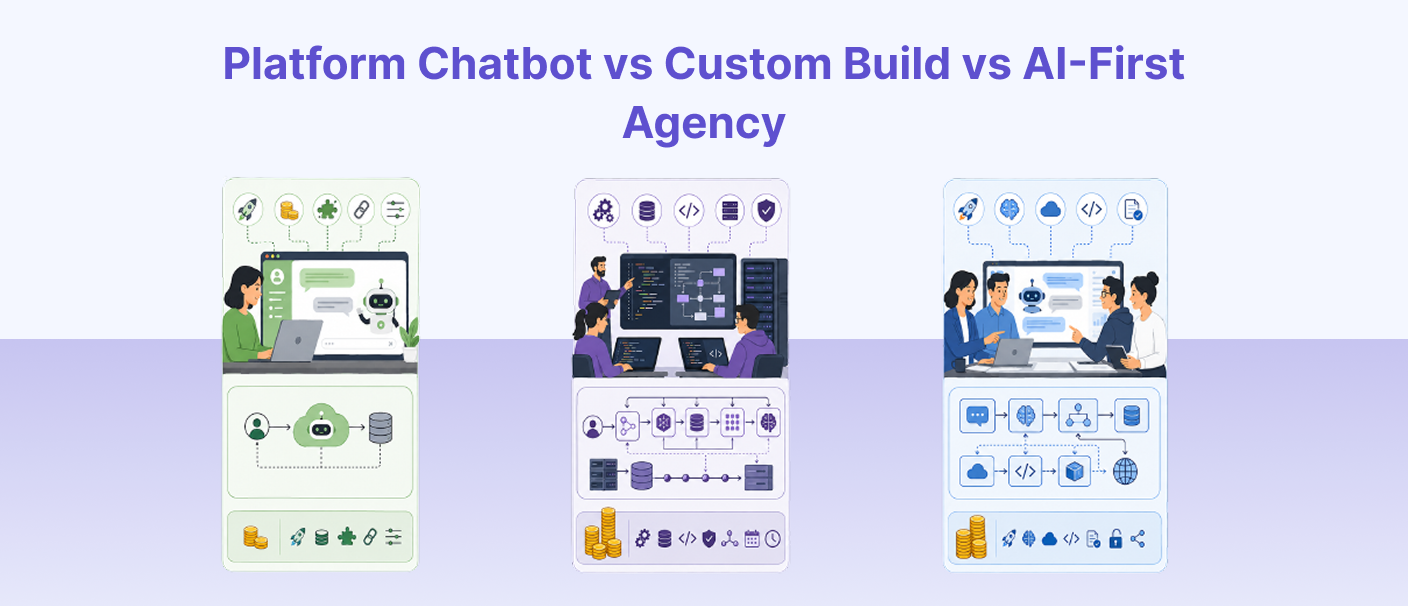
Platform Chatbot vs Custom Build vs AI-First Agency
Choosing how to build the chatbot affects cost as much as chatbot complexity.
Platform Chatbot
A platform chatbot uses tools such as Intercom, Drift, Zendesk, or similar chatbot platforms.
This approach is best when:
- Conversation volume is low
- The chatbot is basic
- Launch speed matters more than customization
- Budget is very limited
- You do not need deep AI capabilities
- You can accept platform lock-in
Platform chatbot tools may cost less upfront, but customization, data ownership, and scaling flexibility can be limited.
Custom In-House Build
A custom in-house chatbot gives full control but usually requires more time, hiring, and budget.
This approach is best when:
- You already have AI/ML engineers
- The chatbot is a core product differentiator
- You need full control over model and data pipelines
- Budget is above $200K
- Timeline flexibility is 6+ months
- Your team can maintain the system long term
The drawback is slower delivery and higher operational burden.
AI-First Agency Build
An AI-first agency can build custom chatbot systems faster using AI-first engineering workflows and reusable architecture patterns.
This approach is best when:
- You need Tier 2–4 capabilities
- You do not want to hire a full AI team
- You want code ownership
- You need a timeline of weeks, not months
- You need custom AI without vendor lock-in
- Budget is between $15K and $300K
For many startups, SMBs, and mid-market companies, an AI-first agency gives the best balance of speed, quality, and ownership.
Monthly Operating Costs by Chatbot Tier
Build cost is only the first part of the budget.
AI chatbots also have recurring monthly costs.
Monthly operating costs may include:
- LLM API usage
- Hosting
- Infrastructure
- Vector database
- Embeddings
- Monitoring
- Analytics
- Maintenance
- Prompt updates
- Bug fixes
- Model migration
- Support
A rule-based chatbot has lower monthly costs because it does not use LLM APIs heavily.
A Tier 3 or Tier 4 chatbot can have much higher monthly operating cost because it may call multiple agents, retrieve knowledge, store embeddings, process many conversations, and run monitoring systems.
Businesses should calculate:
Total first-year chatbot cost = build cost + 12 months of operating cost
For example, a chatbot that costs $40K to build and $2K/month to operate has a first-year cost of about $64K.
This gives a more realistic budget than looking only at development cost.
Startup vs Enterprise Chatbot Budget Allocation
Startup Chatbot Budget Allocation
Startups usually prioritize speed, core conversation quality, and user adoption.
For a Tier 2 or light Tier 3 chatbot, a startup budget may focus on:
- Core AI/NLU development
- Chat widget or frontend UX
- One or two key integrations
- Testing and prompt tuning
- Basic infrastructure
- User feedback loop
Startups should avoid overinvesting in enterprise-grade compliance or multi-region architecture unless they are in a regulated industry.
The goal is to launch a useful chatbot quickly, learn from real conversations, and improve.
Enterprise Chatbot Budget Allocation
Enterprises usually need deeper investment around integration, compliance, security, training, testing, and change management.
An enterprise chatbot budget may include:
- Multi-agent architecture
- CRM, ERP, CDP, and order management integrations
- Security and compliance
- Training data and knowledge base preparation
- UAT and load testing
- Change management and agent training
- Multi-region infrastructure
- Executive dashboards
- SLA monitoring
For enterprises, the chatbot itself may be only part of the budget. The surrounding infrastructure makes it usable across teams, regions, systems, and compliance environments.
Hidden Costs That Inflate AI Chatbot Budgets
1. Training Data Preparation
AI chatbots need clean training data.
This may include:
- Conversation logs
- FAQs
- Product information
- Policy documents
- Support articles
- Helpdesk tickets
- Customer journey data
- Internal SOPs
The uploaded guide notes that training data preparation can cost $2,000–$25,000 and may consume 15–25% of the total build budget for Tier 2+ chatbots.
If a company has no existing conversation logs or documentation, data preparation takes more work.
2. Prompt Engineering and Tuning
Prompt engineering is not a one-time task.
A production chatbot needs prompts that are accurate, safe, consistent, brand-aligned, and capable of handling edge cases.
This may include:
- System prompts
- Routing prompts
- Escalation prompts
- Knowledge retrieval prompts
- Guardrail prompts
- Multi-agent handoff prompts
- Fallback prompts
The uploaded guide estimates prompt engineering and tuning at $3,000–$15,000.
For multi-agent chatbots, each agent may need its own prompt design and testing cycle.
3. Conversation Testing and QA
Chatbot QA is different from normal software QA.
The team needs to test whether the chatbot understands intent, extracts the right information, remembers context, handles frustration, avoids unsafe answers, and escalates properly.
Conversation testing may include:
- Intent recognition tests
- Entity extraction tests
- Multi-turn conversation tests
- Prompt injection checks
- Fallback behavior tests
- Human handoff tests
- Tone and brand consistency checks
- Edge case testing
- Hallucination checks
The uploaded guide estimates conversation testing and QA at $3,000–$20,000.
Skipping this step can damage user trust quickly.
4. Compliance and Legal Review
If the chatbot handles personal data, payments, health records, financial advice, or regulated workflows, compliance review is important.
This may include:
- Privacy impact assessment
- Terms of service updates
- Data processing agreements
- Access controls
- Audit logs
- Encryption
- Data retention rules
- PCI DSS, HIPAA, GDPR, CCPA, or SOX checks
The uploaded guide estimates compliance and legal review at $5,000–$40,000, depending on industry and risk level.
This cost is especially important for fintech, healthcare, insurance, enterprise, and payment-related chatbots.
5. Ongoing Model Migration
LLM providers change pricing, update models, and sometimes retire older models.
When this happens, prompts and integrations may need adjustment.
Businesses should budget for model migration, prompt re-testing, and compatibility checks.
The uploaded guide estimates ongoing model migration at $2,000–$10,000/year.
This is one reason chatbot systems should be built with some abstraction instead of being tightly locked to one model provider.
Which AI Chatbot Tier Is Right for Your Business?
Choose Tier 1 if:
- Your budget is under $10K
- Your questions are predictable
- You want to validate chatbot ROI
- You need launch in under 3 weeks
- Conversation volume is under 500/month
- You only need basic FAQ or lead capture
Choose Tier 2 if:
- Users ask free-form questions
- You need natural language understanding
- You need 2–4 business integrations
- Monthly conversations are 500–5,000
- You want AI capability without multi-agent complexity
- You are a startup or SMB building a useful AI support bot
Choose Tier 3 if:
- The chatbot must take actions
- You need RAG or proprietary knowledge retrieval
- You need multiple AI capabilities
- You need web, WhatsApp, or mobile support
- Volume exceeds 5,000 conversations/month
- You need advanced analytics and human escalation
Choose Tier 4 if:
- You need omnichannel deployment
- You operate in a regulated industry
- You need PCI DSS, HIPAA, SOX, GDPR, or similar controls
- You process 10,000+ conversations/day
- You need unified customer context
- The chatbot is a strategic enterprise CX investment
Choosing the right tier saves more money than negotiating the quote.
A startup that builds Tier 3 when Tier 2 is enough wastes budget. An enterprise that builds Tier 2 when Tier 3 or Tier 4 is required may need a rebuild later.
How to Reduce AI Chatbot Development Cost Without Cutting Quality
Start With the Right Tier
Do not build an enterprise chatbot when a focused Tier 2 chatbot can validate the use case.
Start with the smallest chatbot that solves a real business problem.
Limit Integrations in Phase 1
Every integration adds cost.
Start with the most important systems first, such as CRM, helpdesk, order management, or knowledge base. Add secondary systems later.
Use Existing Knowledge Base Content
Clean and reuse existing FAQs, help docs, product guides, and support tickets.
This reduces training data preparation cost.
Use Cheaper Models for Simple Tasks
Routing, classification, and simple FAQ handling do not always need the most expensive model.
Use smaller models where quality is acceptable and reserve stronger models for complex reasoning.
Build in Phases
Launch a useful version first, then improve with real conversation data.
This helps avoid spending too much before knowing what users actually need.
Keep Human Escalation Clear
A chatbot that cannot answer everything should not pretend it can.
Clear escalation improves user trust and reduces costly failure cases.
Common AI Chatbot Budgeting Mistakes
Overbuilding Too Early
Many companies build a complex chatbot before proving that users will adopt it.
This increases cost and delays learning.
Ignoring Monthly Operating Cost
LLM API calls, hosting, vector databases, monitoring, analytics, and maintenance can become expensive as usage grows.
Underestimating Training Data Work
Poor training data creates poor chatbot answers. Data preparation should be treated as a core part of the project.
Skipping Conversation QA
A chatbot may work technically but still frustrate users if it gives vague, wrong, or repetitive answers.
Choosing a Platform Without Thinking About Lock-In
Platform chatbots can launch quickly, but custom workflows, data ownership, and migration flexibility may become issues later.
Automating Too Much Without Human Handoff
Users need human help for complex, emotional, sensitive, or high-risk situations.
A strong chatbot should know when to escalate.
How Cloudastra Helps With AI Chatbot Development
Cloudastra helps companies build AI chatbots and conversational AI systems using AI-first engineering and AI Agent Teams.
If your chatbot needs deeper automation, tool usage, or multi-step workflows, it is also useful to compare AI agent development cost before deciding the final build approach.
Cloudastra’s chatbot development approach is useful for:
- AI chatbot development
- WhatsApp business bot development
- E-commerce chatbot development
- SaaS support chatbot development
- Lead qualification chatbot development
- Multi-agent conversational AI
- RAG-based support assistants
- Enterprise omnichannel AI chatbots
- Customer service automation
- AI Sprint execution
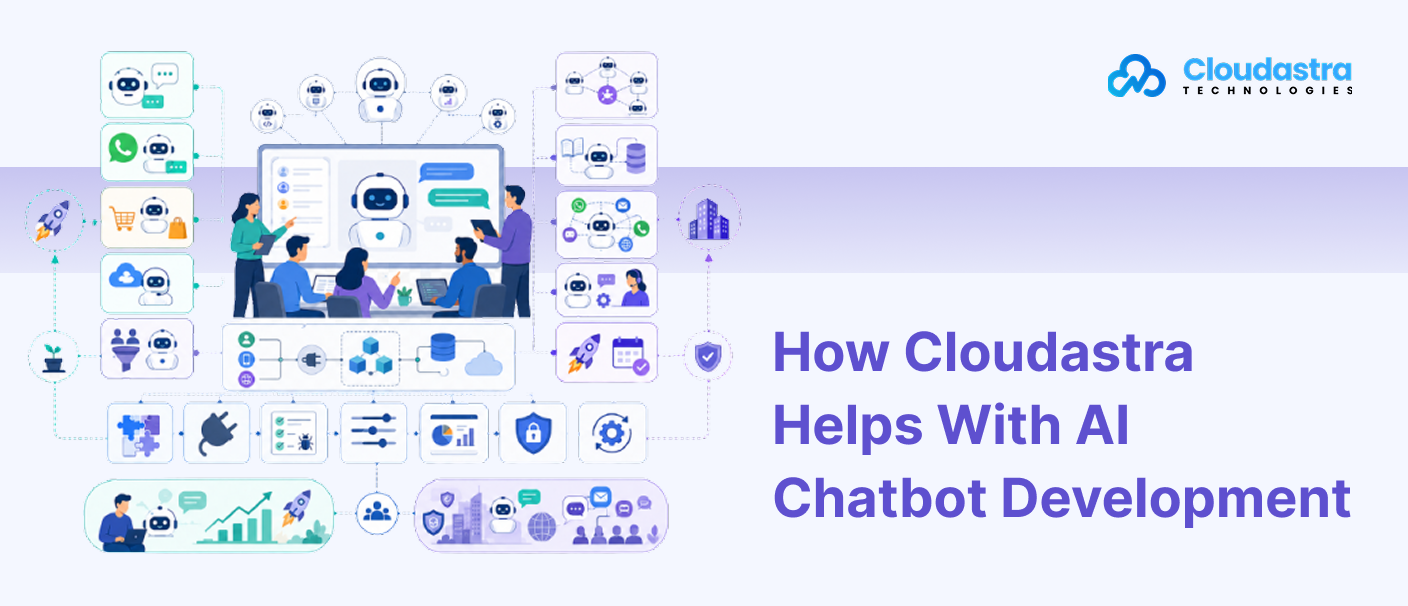
Instead of only building a demo, Cloudastra focuses on production-ready chatbot systems with clear architecture, integrations, testing, prompt tuning, analytics, security, and long-term maintainability.
For startups, Cloudastra can help build focused chatbot MVPs quickly. For enterprises, Cloudastra can help design secure, integrated, omnichannel AI chatbot systems with the right compliance and operating structure.
Who Should Read This AI Chatbot Cost Guide?
This guide is useful for:
- Startup founders
- SMB owners
- SaaS companies
- E-commerce businesses
- Enterprise CX teams
- Customer support leaders
- Product managers
- CTOs
- AI transformation teams
- Companies comparing chatbot quotes
- Businesses planning WhatsApp or website chatbots
- Teams deciding between platform and custom chatbot builds
It is especially useful for businesses that want realistic chatbot pricing before starting development or speaking with vendors.
For enterprise teams that need more control over AI usage, IntegraAI can support safer multi-model chat adoption with privacy, flexibility, and management controls.
Want to explore more practical insights on AI development, automation, and conversational AI? Read more blogs at Cloudastra Technologies or contact us for business enquiries through Cloudastra Contact Us.
FAQs
1. How much does AI chatbot development cost in 2026?
AI chatbot development cost in 2026 usually ranges from $3,000 to $300,000, depending on chatbot tier, AI capability, integrations, conversation volume, compliance needs, and build approach.
2. What is the cheapest AI chatbot development option?
The cheapest option is usually a rule-based chatbot, which costs around $3,000–$10,000. It is best for simple FAQs, lead capture, basic triage, and predictable conversation flows.
3. How much does a custom AI chatbot cost?
A custom AI chatbot usually costs $15,000–$150,000, depending on whether it needs NLU, RAG, multi-agent workflows, integrations, analytics, human escalation, or transaction capabilities.
4. How much does an enterprise AI chatbot cost?
An enterprise AI chatbot usually costs $100,000–$300,000, especially when it requires omnichannel deployment, unified customer history, security controls, compliance logging, SSO, audit trails, and high-volume support.
5. What monthly operating costs should we expect?
Monthly operating costs can range from around $220/month for a rule-based chatbot to $50,000/month for enterprise systems. Costs may include LLM API usage, hosting, vector databases, analytics, monitoring, and maintenance.
6. Should startups build a custom chatbot or use a platform?
Startups should use a platform if they need a basic chatbot quickly and have very limited customization needs. They should consider custom AI chatbot development if chatbot quality, data ownership, integrations, or differentiation matter.
7. What hidden costs should businesses budget for?
Hidden costs include training data preparation, prompt engineering, conversation testing, compliance review, model migration, monitoring, maintenance, and monthly LLM usage.
8. How does Cloudastra help with AI chatbot development?
Cloudastra helps businesses build AI chatbots and conversational AI systems using AI-first engineering, AI Agent Teams, custom integrations, prompt tuning, testing, analytics, deployment, and long-term optimization.