Third party risk management software helps fintech companies monitor the risks that come from vendors, technology partners, KYC providers, payment partners, APIs, data processors, and outsourced service providers.
For fintech companies, third-party risk is not just a procurement issue. A weak vendor, failed API, poor data control, missed compliance check, or unmanaged outsourcing partner can create customer, regulatory, operational, and reputational risk. As fintech platforms scale, manual vendor reviews become too slow and scattered to manage this properly.
That is why fintech teams use third party risk management software to review vendors, track documentation, monitor partner exposure, maintain audit records, and reduce compliance gaps before they become bigger problems.
What Problem Does Third Party Risk Management Software Solve?
Fintech companies rely on many external partners to run daily operations. A digital lender may use KYC vendors, credit data providers, payment gateways, cloud infrastructure, collection partners, fraud tools, and customer support platforms. A payment company may depend on banking partners, APIs, transaction processors, compliance databases, and security vendors.
Each partner helps the business move faster. But each partner also creates risk.
The problem starts when vendor reviews are handled manually. Documents sit in emails. Approvals happen over calls. Risk notes are stored in spreadsheets. Compliance evidence is collected only when an audit is near. Vendor ownership is unclear. And by the time a gap is found, the business may already be exposed.
Without a structured system, fintech teams often struggle with:
- Manual vendor onboarding
- Scattered compliance documents
- Unclear vendor ownership
- Delayed partner reviews
- Incomplete audit trails
- Weak visibility into vendor risk
- Poor tracking of expired documents
- No central record of third-party decisions
- Slow response during audits or regulatory reviews
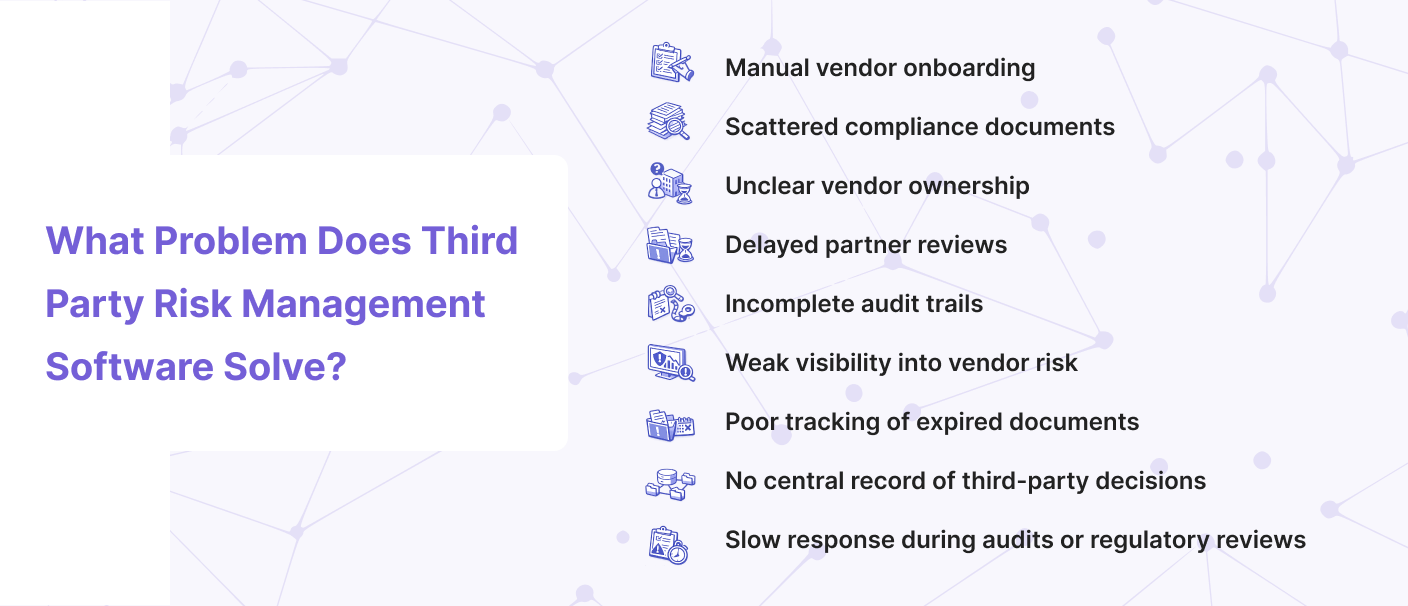
Third party risk management software solves this by giving fintech teams one place to assess vendors, track risk, monitor documentation, and maintain evidence for audits.
What Is Third Party Risk Management Software?
Third party risk management software is a platform that helps companies identify, assess, monitor, and manage risks created by external vendors, service providers, partners, and outsourced business relationships.
In fintech, it is commonly used for:
- Vendor onboarding reviews
- Compliance document tracking
- Risk scoring for vendors and partners
- Third-party due diligence
- Ongoing vendor monitoring
- Audit trail creation
- Contract and policy evidence tracking
- Risk review workflows
- Partner risk reporting
- Vendor performance visibility
- Compliance and operational risk control
In simple terms, it helps fintech teams answer practical questions like:
- Which vendors are critical to our operations?
- Which partners handle customer or financial data?
- Which vendors are overdue for review?
- Has this KYC or payment provider passed compliance checks?
- Are vendor documents updated and approved?
- Who reviewed this vendor and when?
- Can we prove our third-party review process during an audit?
- Which partners create the highest compliance or operational exposure?
For fintech companies, third party risk management software is not just about tracking vendors. It is about protecting the business from hidden risks created outside the company.
Why Do Fintech Companies Need Third Party Risk Management?
Fintech companies need third party risk management because their operations are deeply connected with external providers.
Most fintech businesses do not work alone. They depend on payment processors, banks, cloud platforms, KYC tools, AML databases, fraud monitoring systems, customer communication tools, collection partners, and data providers.
This creates a wider risk surface.
If one vendor fails, the impact may not stay with the vendor. It can affect customer onboarding, payment processing, compliance reporting, data security, loan servicing, audits, and customer trust.
A weak KYC provider may create onboarding risk. A payment partner outage may disrupt transactions. A data vendor may expose sensitive information. A compliance tool may miss a screening gap. A collection partner may create borrower communication risk.
Third party risk management gives fintech companies a structured way to review these partners before problems happen.
A clear third party risk management framework helps teams define who owns vendor reviews, what evidence is required, how risk is scored, how often vendors are reviewed, and how issues are escalated.
How Big Is the Third-Party Risk Problem?
Third-party risk is growing because companies are becoming more dependent on external providers.
Gartner’s third-party risk management guide notes that third-party networks continue to increase in number and scope, and 40% of compliance leaders say that between 11% and 40% of their third parties are high-risk. For fintech companies, this matters because vendors often touch customer data, financial workflows, compliance checks, and payment operations.
Regulators are also paying closer attention. The OCC’s interagency guidance on third-party relationships says the guidance applies to all banks with third-party relationships. The same guidance covers risk management practices across the third-party relationship lifecycle, including planning, due diligence, contract negotiation, ongoing monitoring, and termination.
The FDIC’s third-party risk guidance also highlights a risk-based approach for managing third-party relationships. This is important for financial institutions because vendor risk is not only checked once during onboarding. It must be monitored across the relationship.
Financial crime and compliance pressure are also rising. LexisNexis Risk Solutions reported that the annual cost of financial crime compliance reached around US$45 billion in APAC study countries in 2023, and compliance costs increased for 98% of APAC financial institutions surveyed.
Nasdaq Verafin’s 2026 Global Financial Crime Report estimates US$4.4 trillion in illicit financial activity globally in 2025 and US$579.4 billion in losses from fraud scams and bank fraud schemes. For fintech companies, this shows why partner controls, compliance visibility, and audit-ready risk records matter.
These numbers show why vendor and partner risk cannot be treated as a back-office checklist. As fintech companies scale through APIs, vendors, and outsourced systems, third-party exposure becomes a direct business risk.
What Are the Main Benefits of Third Party Risk Management Software?
The biggest benefit of third party risk management software is that it gives fintech teams better visibility into vendor and partner risk.
Instead of waiting for audits, vendor failures, compliance escalations, or data issues, teams can track risk earlier and keep evidence ready.
The main benefits include:
- Faster vendor onboarding reviews
- Better visibility into high-risk vendors
- Centralized vendor documentation
- Clearer ownership of partner reviews
- Stronger compliance evidence
- Easier audit preparation
- Reduced manual spreadsheet work
- Better tracking of expired documents
- More consistent third-party decisions
- Improved partner risk reporting
For fintech companies, this matters because one weak vendor can create risk across compliance, data security, payments, customer onboarding, and operations.
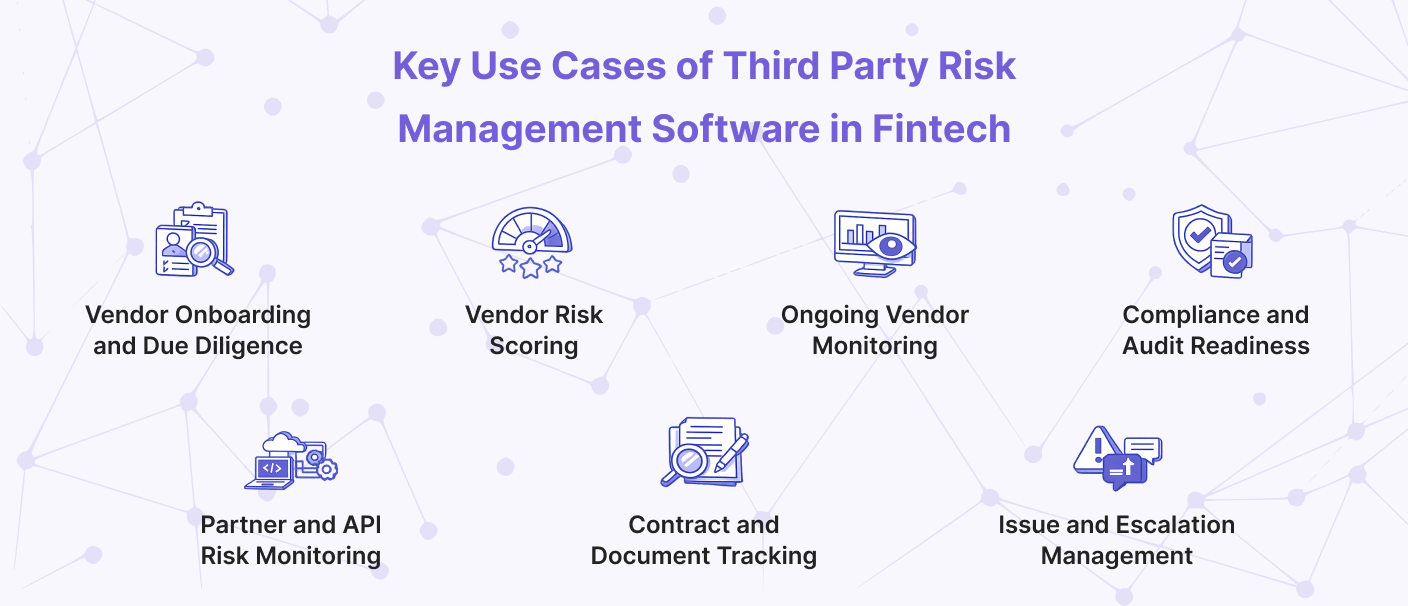
Key Use Cases of Third Party Risk Management Software in Fintech
1. Vendor Onboarding and Due Diligence
Vendor onboarding is one of the most important use cases.
Before a fintech company works with a vendor, the team needs to understand what the vendor does, what data it handles, what systems it connects with, and what risk it may create.
Third party risk management software helps teams collect and review important vendor information, such as:
- Company details
- Service scope
- Data access level
- Compliance documents
- Security policies
- Contract details
- Business continuity plans
- Risk questionnaires
- Approval history
- Internal ownership
This makes vendor onboarding more structured and reduces the chances of approving a partner without proper review.
2. Vendor Risk Scoring
Not every vendor creates the same level of risk.
A vendor that handles customer identity data is not the same as a vendor that provides basic marketing support. A payment processor is not the same as an office software provider. A KYC vendor, AML database, cloud platform, or collection partner may create higher compliance or operational exposure.
Vendor risk management software helps teams classify vendors based on factors such as:
- Data sensitivity
- Access to customer information
- Regulatory impact
- Business criticality
- Integration depth
- Security posture
- Financial stability
- Compliance history
- Service dependency
- Geographic risk
This helps fintech teams focus more attention on vendors that can create real business exposure.
3. Ongoing Vendor Monitoring
Vendor risk does not end after onboarding.
A vendor may be safe during approval but become risky later because of expired compliance documents, a security incident, service disruption, ownership change, poor performance, or regulatory concern.
Third party risk management software helps teams monitor vendors throughout the relationship.
This may include:
- Scheduled vendor reviews
- Document expiry tracking
- Policy updates
- Risk score changes
- Incident records
- Performance reviews
- Escalation tracking
- Renewal checks
- Audit evidence updates
For fintech companies, ongoing monitoring is important because regulators, auditors, and internal teams may ask for evidence at any time.
4. Compliance and Audit Readiness
Audit readiness is a major reason fintech companies need stronger third-party controls.
During an audit, teams may need to prove:
- Which vendors are active
- Which vendors are high risk
- Who approved each vendor
- What due diligence was completed
- Which documents were reviewed
- When the vendor was last assessed
- What risks were identified
- What actions were taken
- Whether issues were escalated
- Whether ongoing monitoring is happening
If this information is spread across emails, spreadsheets, and shared folders, audits become slow and stressful.
Third party risk management software keeps vendor evidence in one place, making it easier to show how decisions were made.
5. Partner and API Risk Monitoring
Fintech platforms often depend on APIs and partner integrations for onboarding, payments, data exchange, credit checks, fraud monitoring, and compliance screening.
These integrations are useful, but they can also create operational and data risks.
A partner API may fail. A payment partner may slow down. A data provider may return incorrect results. A compliance vendor may have outdated records. An integration may expose sensitive information if controls are weak.
Third party risk management helps fintech teams track which partners are connected to critical workflows and what risks they create.
This is especially useful for fintech companies working with:
- KYC providers
- Payment gateways
- Banking partners
- Credit bureaus
- AML screening providers
- Data enrichment vendors
- Cloud platforms
- Customer communication tools
- Collection partners
6. Contract and Document Tracking
A common vendor risk problem is simple but serious: documents expire, contracts are not reviewed on time, and evidence becomes hard to find.
Third party risk management software helps teams track documents such as:
- Vendor contracts
- Security certificates
- Compliance reports
- Data processing agreements
- Risk questionnaires
- Insurance documents
- Service-level agreements
- Business continuity documents
- Internal approvals
- Review notes
This helps compliance and operations teams stay ahead of renewals, audits, and vendor review cycles.
7. Issue and Escalation Management
Vendor issues need clear ownership.
If a vendor fails a review, misses a document, has a security concern, or creates operational risk, the team needs to know who is responsible and what action is required.
Third party risk management software helps teams track issues such as:
- Missing documents
- Expired compliance evidence
- Failed risk reviews
- Vendor performance issues
- Security concerns
- Service disruptions
- Contract gaps
- Audit findings
- Escalation status
This gives fintech teams a cleaner way to manage vendor issues instead of relying only on email follow-ups.
Common Third-Party Risk Challenges in Fintech
Vendor Data Is Scattered
Vendor details, contracts, risk notes, approvals, and compliance documents often sit in different folders, emails, and spreadsheets. This makes it difficult to get a complete vendor risk view.
Vendor Reviews Are Delayed
When reviews are manual, teams may miss renewal dates, document expiry dates, and scheduled risk assessments.
High-Risk Vendors Are Not Prioritized
Without proper risk scoring, every vendor may appear equal. This makes it harder to focus on critical partners that handle customer data, payment flows, or compliance operations.
Audit Evidence Is Hard to Find
When auditors ask for proof, teams may struggle to show when a vendor was reviewed, who approved it, and what risks were identified.
Third-Party Ownership Is Unclear
In many fintech companies, different teams work with different vendors. Without clear ownership, vendor risk can fall between compliance, operations, procurement, technology, and business teams.
Partner Risk Changes Over Time
A vendor that was low-risk during onboarding may become high-risk later because of service failures, regulatory issues, data changes, or operational dependency.
What Features Should Third Party Risk Management Software Have?
A strong third party risk management software platform should include:
- Vendor onboarding workflows
- Vendor risk scoring
- Due diligence questionnaires
- Document collection and tracking
- Compliance evidence management
- Ongoing monitoring
- Review reminders
- Issue and escalation tracking
- Audit trails
- Approval workflows
- Risk dashboards
- Reporting
- Role based access
- API or system integration
- Secure data handling
For fintech companies, the most important features are vendor risk scoring, document tracking, compliance records, audit trails, ongoing monitoring, and clear reporting.
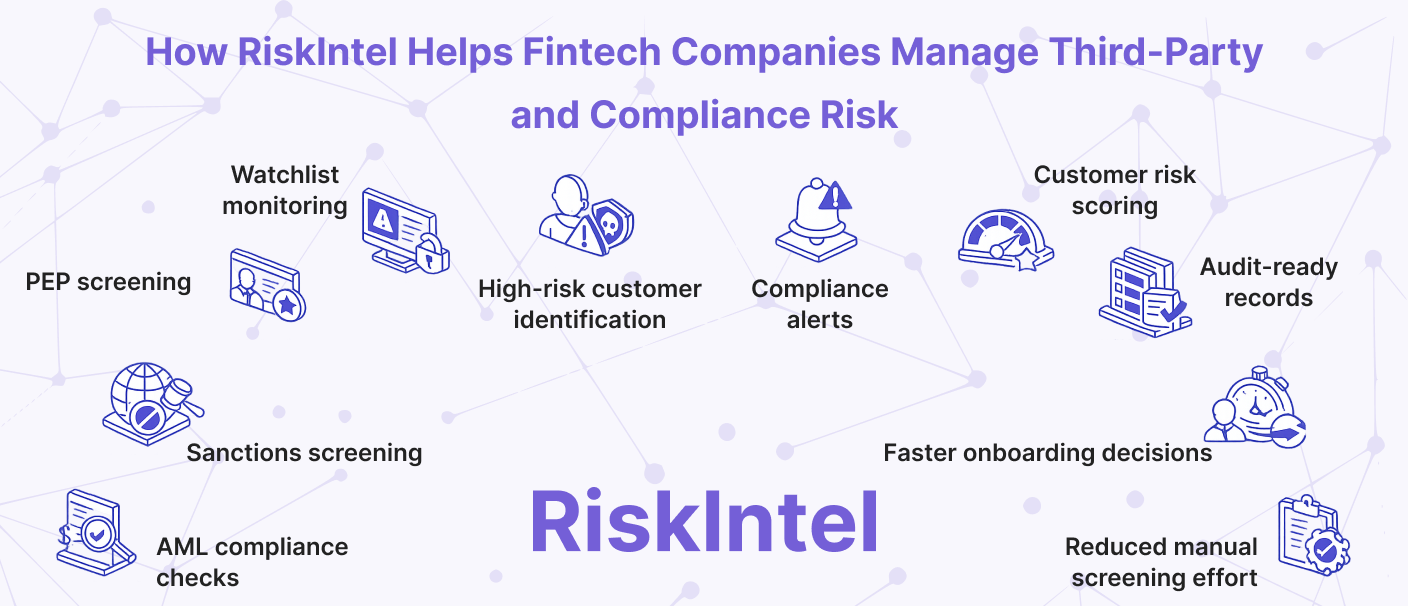
How RiskIntel Helps Fintech Companies Manage Third-Party and Compliance Risk
RiskIntel is designed for fintech companies, NBFCs, digital lenders, and financial service providers that need stronger control over compliance and risk visibility.
For third-party and vendor risk, RiskIntel can help fintech teams manage vendor exposure alongside broader compliance checks.
RiskIntel supports fintech teams with:
- AML compliance checks
- Sanctions screening
- PEP screening
- Watchlist monitoring
- High-risk customer identification
- Compliance alerts
- Customer risk scoring
- Audit ready records
- Faster onboarding decisions
- Reduced manual screening effort
For fintech companies working with vendors, partners, and external service providers, RiskIntel helps create a more structured risk view instead of depending only on spreadsheets and manual reviews.
It is especially useful for teams that want to reduce compliance gaps, improve audit readiness, and manage risk without slowing down customer onboarding or partner operations.
Who Should Use Third Party Risk Management Software?
Third party risk management software is useful for:
- Fintech companies
- NBFCs
- Digital lending platforms
- Payment companies
- Neobanks
- Embedded finance platforms
- Loan servicing companies
- Wealthtech platforms
- Insurance technology companies
- Cross-border payment providers
- Merchant onboarding platforms
- Financial institutions using multiple vendors
Any fintech company that works with KYC providers, payment partners, cloud vendors, data providers, compliance tools, APIs, or outsourced service providers should consider using third party risk management software.
Do you like to read more educational content? Read our blogs at Cloudastra Technologies or contact us for business enquiry at Cloudastra Contact Us.
FAQs
1. What is third party risk management software?
Third party risk management software is a platform that helps companies identify, assess, monitor, and manage risks created by vendors, service providers, partners, and outsourced business relationships.
2. Why do fintech companies need third party risk management software?
Fintech companies need third party risk management software because they depend on vendors for KYC, payments, data, APIs, cloud systems, compliance tools, and customer operations. If these vendors are not reviewed properly, they can create compliance, operational, data, and audit risks.
3. What is third party risk management in fintech?
Third party risk management in fintech is the process of reviewing, monitoring, and controlling risks created by external vendors and partners that support financial operations, customer onboarding, payments, compliance, and technology workflows.
4. What is the difference between third party risk management software and vendor risk management software?
Third party risk management software covers all external relationships, including vendors, partners, service providers, APIs, and outsourced functions. Vendor risk management software usually focuses more specifically on vendor onboarding, assessment, monitoring, and documentation.
5. What should a third party risk management framework include?
A third party risk management framework should include vendor identification, risk scoring, due diligence, approval workflows, document tracking, ongoing monitoring, issue escalation, audit trails, and reporting