AI agent development cost in 2026 usually ranges from $15,000 to $500,000+, depending on the type of AI system, project complexity, data requirements, integrations, compliance needs, and whether the build is handled by a traditional team or an AI-first engineering team.
A simple chatbot or single-tool AI agent can cost around $12K–$40K, while RAG systems, document analysis tools, multi-agent platforms, and enterprise AI products can cost much more. The main reason pricing varies so widely is that “AI agent development” can mean anything from a basic support chatbot to a production-grade multi-agent system connected to internal tools, workflows, databases, and compliance controls.
For startups, SMBs, and enterprise teams, the real budgeting question is not just “How much does AI cost?” It is “What level of AI capability do we actually need first, and what can we safely launch as an MVP?”
What Problem Does AI Agent Development Cost Planning Solve?
Most companies underestimate AI project cost because they think only about the model.
They ask, “How much will it cost to use GPT, Claude, or another LLM?” But the model is only one part of the project.
A real AI agent needs more than an API call. It may need product design, data preparation, prompt workflows, RAG pipelines, tool integrations, user interface, authentication, analytics, evaluation, monitoring, security controls, deployment, and ongoing optimization.
Without proper cost planning, teams often run into problems such as:
- Underestimating the real project budget
- Starting with too many AI features at once
- Choosing custom model training when API integration is enough
- Forgetting data preparation costs
- Ignoring integration complexity
- Missing compliance and security costs
- Not budgeting for post-launch operations
- Overpaying for features that are not needed in the MVP
- Building a large AI platform before validating the core use case
AI agent development cost planning solves this by helping teams decide what to build first, what to delay, what to buy, what to customize, and what budget is realistic for production-quality delivery.
What Is AI Agent Development Cost?
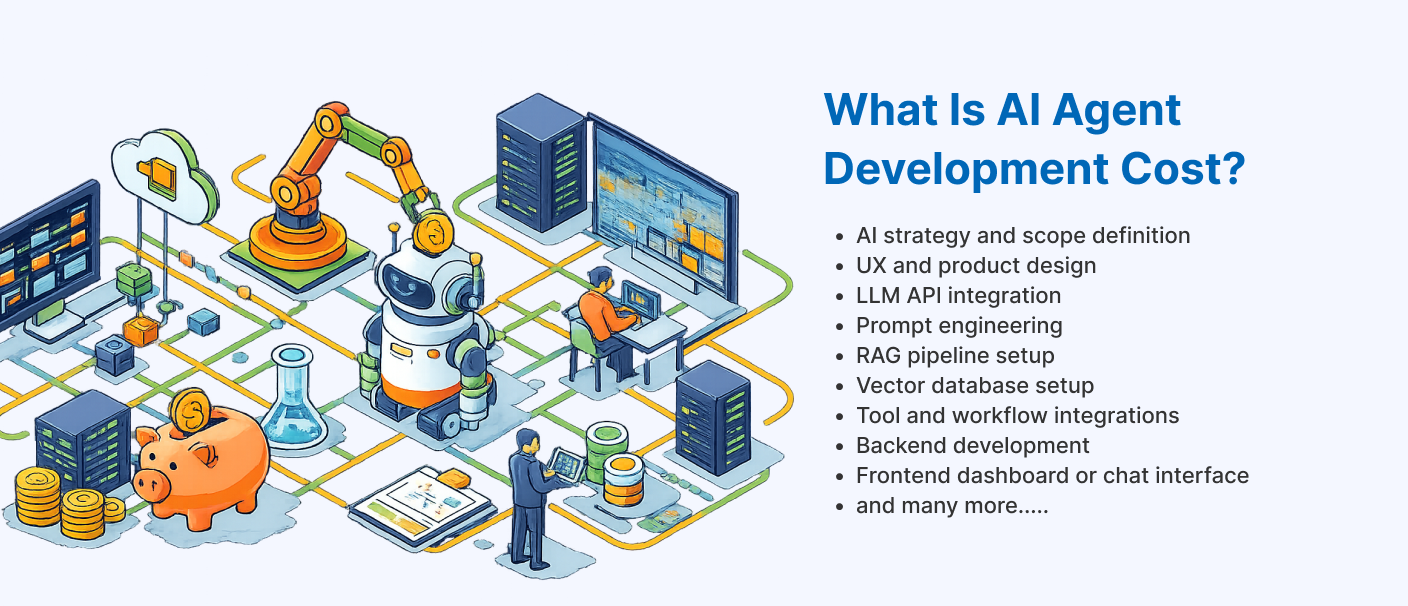
AI agent development cost is the total amount required to design, build, test, deploy, and maintain an AI agent or AI-powered system.
This can include:
- AI strategy and scope definition
- UX and product design
- LLM API integration
- Prompt engineering
- RAG pipeline setup
- Vector database setup
- Tool and workflow integrations
- Backend development
- Frontend dashboard or chat interface
- Data cleaning and preparation
- Security and access controls
- Testing and evaluation
- Deployment infrastructure
- Monitoring and analytics
- Ongoing model and prompt optimization
In simple terms, AI agent development cost helps answer questions like:
- How much should we budget for an AI chatbot?
- What does an AI agent MVP cost?
- How much does a RAG system cost?
- Is $20K enough for a working AI agent?
- When does a project move from $30K to $100K+?
- Should we build custom or buy a SaaS tool?
- What will monthly AI run-cost look like?
- How do we reduce cost without reducing quality?
For businesses, the goal is not to spend the lowest amount possible. The goal is to spend the right amount for the stage, risk, and expected business outcome.
Why AI Agent Development Cost Varies So Much
AI agent development cost varies because different AI projects require very different levels of engineering.
A simple customer support chatbot may only need one knowledge source, one channel, basic guardrails, and simple logging. A multi-agent workflow platform may need multiple agents, tool orchestration, user permissions, audit logs, dashboards, workflow state, human review, and production monitoring.
The biggest cost difference comes from scope.
A basic AI assistant may answer questions. A RAG agent may search documents and cite internal sources. A multi-agent system may coordinate tasks across sales, operations, analytics, or support. An enterprise AI platform may need governance, compliance, large-scale infrastructure, and multiple business integrations.
The more the AI system needs to do, the more cost increases.
Cost also depends on the team model. Traditional development teams usually require more manual engineering time. AI-first engineering teams can reduce cost because AI agents assist with repeatable work such as code generation, testing, documentation, and deployment, while human engineers focus on architecture, quality, and complex logic.
How Much Does AI Agent Development Cost in 2026?
AI agent development costs in 2026 generally range from $15K to $500K+, depending on project type and complexity.
Based on the uploaded Cloudastra cost guide, typical AI-first development cost ranges include:
- Simple AI chatbot: $15K–$40K
- Content generation tool: $15K–$35K
- Document analysis or extraction system: $25K–$60K
- RAG system or knowledge search: $30K–$80K
- AI-powered SaaS feature: $20K–$60K
- Multi-agent system: $50K–$150K
- AI MVP or full AI product: $40K–$120K
- Enterprise AI platform: $100K–$300K
- Custom model training: $50K–$200K+
The June 2026 cost snapshot also shows that focused agent MVPs can start lower when the scope is narrow:
- Single-tool chatbot agent MVP: $12K–$22K
- RAG agent for internal knowledge: $28K–$52K
- Multi-agent system with 3–5 agents: $60K–$120K
- Autonomous agent platform: $180K–$450K
These numbers show why scope clarity is important. A founder asking for “an AI agent” may mean a $20K MVP or a $200K platform. The cost depends on what the agent needs to do, what systems it must connect to, and how production-ready it needs to be.
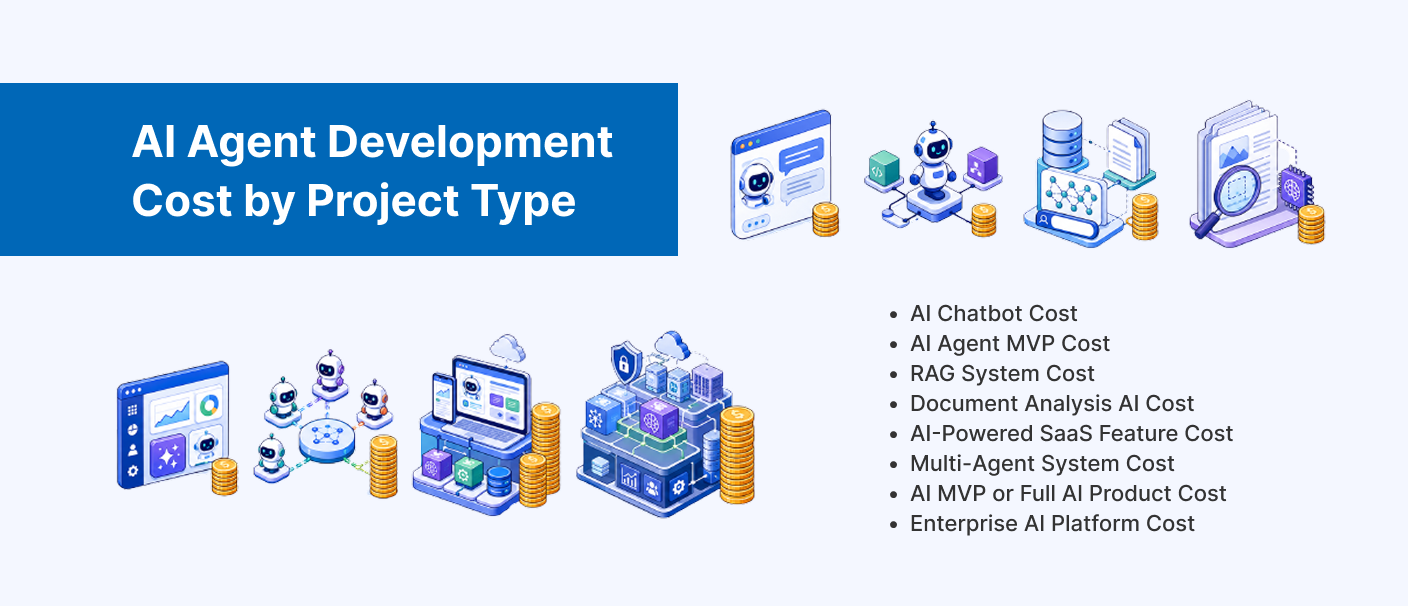
AI Agent Development Cost by Project Type
1. AI Chatbot Cost
An AI chatbot is usually the cheapest AI project to build.
It may be used for customer support, FAQs, lead qualification, internal helpdesk, or basic product guidance.
A simple AI chatbot usually costs $15K–$40K with an AI-first engineering team.
The cost depends on:
- Number of knowledge sources
- Web, Slack, WhatsApp, or app channel support
- Login and user permissions
- Conversation logging
- Human handoff
- Analytics dashboard
- Guardrails and safety checks
- CRM or support tool integration
A chatbot with one knowledge base and one channel is much cheaper than a chatbot connected to multiple tools, user accounts, support systems, and analytics workflows.
2. AI Agent MVP Cost
An AI agent MVP is a focused first version of an AI agent designed to validate the core use case.
In 2026, a realistic AI agent MVP cost is around $12K–$22K for a simple single-tool agent with one knowledge source and one channel, when built by an AI-first engineering team.
An AI agent MVP may include:
- One AI workflow
- One external tool or API
- One knowledge source
- Web or Slack interface
- Basic logging
- Basic guardrails
- Simple admin visibility
- Deployment to production
This type of MVP is useful for startups and SMBs that want to test whether AI can solve a real business problem before investing in a larger system.
The key is to keep the first version focused. A small AI agent that solves one valuable problem is better than an overbuilt platform that takes months to validate.
3. RAG System Cost
A RAG system helps users ask questions over internal documents, knowledge bases, policies, support content, contracts, or company data.
RAG system cost usually ranges from $30K–$80K, while a more focused internal knowledge RAG agent may cost around $28K–$52K.
The cost depends on:
- Number of documents
- Data cleaning requirements
- Vector database setup
- Search quality expectations
- Citation requirements
- Access control
- User roles
- Document refresh frequency
- Evaluation and testing
- Integration with tools like Google Drive, Notion, Slack, Confluence, or CRM systems
A basic RAG system is relatively affordable. A secure enterprise RAG system with role-based access, audit logs, citations, and multiple integrations costs more.
4. Document Analysis AI Cost
Document analysis AI is used for invoice processing, KYC document verification, contract review, insurance claims, medical records, financial reports, or compliance documents.
Typical cost ranges from $25K–$60K for AI-first development.
The cost increases when documents are inconsistent, handwritten, scanned poorly, multi-format, or compliance-sensitive.
Common cost drivers include:
- OCR quality
- Document type variety
- Data extraction complexity
- Accuracy requirements
- Human review workflows
- Compliance requirements
- Validation rules
- Export formats
- Integration with internal systems
Document AI projects should not be judged only by extraction ability. The real value comes from accuracy, workflow fit, exception handling, and review controls.
5. AI-Powered SaaS Feature Cost
Adding AI into an existing SaaS product usually costs $20K–$60K, depending on the feature.
Examples include:
- Smart search
- AI recommendations
- AI-generated summaries
- Personalization
- AI dashboards
- Support automation
- AI writing tools
- Forecasting features
- Auto-tagging
- Workflow suggestions
This type of project is usually cheaper than building a full AI product from scratch because the base product already exists.
However, integration complexity can increase cost. If the AI feature must connect deeply with user data, billing, permissions, analytics, or existing workflows, the budget should be higher.
6. Multi-Agent System Cost
A multi-agent system uses multiple AI agents to coordinate tasks across a workflow.
For example, one agent may collect data, another may analyze it, another may generate output, and another may review or trigger the next step.
Multi-agent system cost usually ranges from $50K–$150K, while a typical 3–5 agent system may cost around $60K–$120K in mid-2026.
The cost depends on:
- Number of agents
- Agent orchestration complexity
- Tool integrations
- Workflow state management
- Human approval steps
- Error handling
- Monitoring
- Evaluation
- Security controls
- Deployment requirements
Multi-agent systems are more expensive because the challenge is not only building each agent. The hard part is coordinating them safely.
7. AI MVP or Full AI Product Cost
A full AI-native product usually costs $40K–$120K with an AI-first engineering team.
This may include:
- Product design
- Backend system
- Frontend app
- AI workflows
- User accounts
- Payment integration
- Admin dashboard
- Analytics
- Deployment
- Monitoring
- Feedback loops
An AI MVP is best built in phases.
Instead of spending $200K at the start, teams can build a focused Phase 1 MVP, validate with real users, then expand into more advanced features.
This reduces risk and helps founders avoid building features the market does not need.
8. Enterprise AI Platform Cost
Enterprise AI platforms are the most expensive category because they need scale, governance, security, integrations, and compliance.
Typical cost ranges from $100K–$300K, and more complex platforms can go beyond that.
Enterprise AI platforms may require:
- Multi-model orchestration
- Data pipelines
- Role-based access
- Audit logs
- Admin controls
- Compliance documentation
- Security architecture
- Monitoring dashboards
- High-availability infrastructure
- Multiple business integrations
- Human-in-the-loop workflows
Enterprise AI cost is higher because the system must work reliably across teams, permissions, workflows, data sources, and compliance requirements.
What Drives AI Agent Development Cost Up?
1. Model Complexity
A simple API integration with a foundation model is usually the most affordable approach.
Cost increases when the project needs fine-tuning, custom model training, complex routing, or multiple models working together.
For most business applications, API integration with strong prompting and good architecture is enough. Custom model training should be used only when API-based quality cannot meet the requirement.
2. Data Requirements
If the AI agent needs proprietary data, cost increases.
This may include:
- Data cleaning
- Data formatting
- Annotation
- PII redaction
- Vectorization
- RAG ingestion pipelines
- Data refresh workflows
- Access control
Poor data quality can increase both development time and output risk. Good AI projects usually start with a data readiness review.
3. Integration Complexity
A standalone AI tool is cheaper than an AI agent connected to multiple business systems.
Each integration adds work.
Common integrations include:
- CRM
- ERP
- Internal database
- Authentication system
- Payment processor
- Helpdesk tool
- Slack or Teams
- Google Drive
- Notion
- Analytics tools
The uploaded cost guide notes that each integration point can add around $3K–$10K, depending on API quality and complexity.
4. Compliance Requirements
Compliance can increase AI development cost significantly.
Healthcare, fintech, payments, legal, government, and enterprise systems may require stronger controls such as:
- Audit logs
- Access controls
- Data handling rules
- Encryption
- Penetration testing
- Compliance documentation
- Monitoring
- Human review workflows
According to the uploaded guide, compliance needs such as HIPAA, PCI-DSS, SOC 2, or FedRAMP can add around 30–60% to AI development cost.
5. Scale Requirements
An AI system used by 100 users per day is very different from one used by 100,000 users per day.
High-scale systems may need:
- Load balancing
- Model caching
- Request queues
- Auto-scaling
- Rate-limit handling
- Performance monitoring
- Cost optimization
- Reliability planning
Teams should budget for expected growth, not only the first demo.
6. User Interface Requirements
An AI API with no frontend costs less than an AI product with a polished interface.
Cost increases when the product needs:
- Customer dashboard
- Admin panel
- Chat interface
- Mobile app
- Analytics screen
- Workflow builder
- Human review screen
- Settings and permissions
The more users need to interact with the AI, the more product and frontend work is required.
7. Evaluation and Testing
AI systems need testing beyond normal software tests.
Teams need to evaluate whether the AI output is useful, accurate, safe, and consistent.
Evaluation may include:
- Test datasets
- Human review workflows
- Output scoring
- Regression testing
- A/B testing
- Prompt version tracking
- Hallucination checks
- Quality dashboards
The uploaded guide notes that evaluation and testing can add around 10–20% to project cost, but it helps prevent expensive failures after launch.
8. Team Model
The team model affects cost heavily.
A traditional team may take longer because more work is done manually. An AI-first engineering partner can often deliver faster by using agent-driven development, automated testing, and parallel execution.
Typical team models include:
- In-house engineering team
- Traditional agency
- AI-first engineering partner
- Offshore development team
- Freelance AI engineers
The right choice depends on budget, timeline, internal technical oversight, and how important the AI system is to the business.
9. Post-Launch Operations
AI systems are not “build once and forget.”
After launch, teams need to monitor quality, optimize prompts, track user feedback, manage token usage, update knowledge sources, improve retrieval, and fix edge cases.
Ongoing AI operations may cost around $2K–$15K/month, depending on complexity.
Run-cost may include:
- LLM API usage
- Vector database
- Hosting
- Monitoring
- Logging
- Prompt optimization
- Data pipeline updates
- Quality improvements
- Support and maintenance
This should be included in the first-year AI budget.
How to Budget an AI Agent Project
A practical AI agent budget should include both build cost and operating cost.
A simple formula is:
First-year AI budget = development cost + 12 months of operating cost
For example, if the AI agent development cost is $50K and the operating cost is $5K/month, the first-year budget should be around $110K.
Before budgeting, teams should answer:
- What is the core AI capability?
- What is the smallest useful version?
- What data will the AI need?
- Which tools must it connect to?
- How accurate does it need to be?
- Who will review the AI output?
- What compliance requirements apply?
- How many users or requests do we expect?
- What will monthly run-cost look like?
- What should be built now vs later?
This helps avoid overbuilding and keeps the first version focused.
Build vs Buy: Which Is Better for AI Agents?
Buying a SaaS AI tool is usually better when the AI feature is generic.
Examples include:
- Basic chatbot
- Standard analytics
- Simple writing assistant
- Generic support automation
- Off-the-shelf search
Custom AI agent development is better when AI is part of the company’s competitive advantage.
Build custom when:
- The AI workflow is unique
- The agent needs proprietary data
- The AI must connect deeply with internal systems
- Output quality affects customer choice
- You need full control over data and workflows
- SaaS tools cannot match your process
- You want long-term differentiation
Buying is faster at the start. Building custom costs more upfront but can create better long-term fit, ownership, and differentiation.
For many startups, the best route is to start with a focused custom MVP rather than a large platform.
For startups and SMBs trying to reduce engineering cost without slowing delivery, agentic SDLC can help small teams use AI agents to plan, build, test, and ship software faster.
How to Reduce AI Agent Development Cost Without Cutting Quality
Start With One Core Use Case
Do not build twenty AI features in the first version.
Start with the one capability that creates the most business value. Once it works, expand.
Use API Integration Before Custom Models
For most business use cases, OpenAI, Anthropic, or other foundation model APIs are enough.
Fine-tuning or custom training should come later only if prompting, retrieval, and workflow design cannot meet quality needs.
Build in Phases
Avoid building a $200K platform in one shot.
Start with a smaller Phase 1 MVP, validate with users, then invest in Phase 2.
Cache Repeated Queries
Many production AI queries are repeated or similar.
Semantic caching can reduce repeated LLM calls and lower monthly run-cost.
Choose the Smallest Model That Works
Use smaller models where possible.
Many tasks do not need the most expensive model. Start with a lower-cost model, measure quality, then upgrade only where needed.
Keep Integrations Focused
Every integration adds cost.
Start with the systems that matter most. Add secondary integrations after the core workflow proves value.
Use AI-First Engineering
AI-first engineering can reduce cost because AI agents help with repeatable engineering work such as implementation, testing, documentation, and deployment support.
Human engineers still handle architecture, quality, security, and complex logic.
Common AI Agent Budgeting Mistakes
Starting Too Big
Many teams try to build a complete AI platform before validating one use case. This increases cost and delays learning.
Ignoring Data Quality
Poor data creates poor AI output. Data cleanup and structure should be budgeted early.
Forgetting Monthly Run-Cost
AI projects have ongoing costs after launch. LLM usage, vector databases, hosting, monitoring, and support need a monthly budget.
Overusing Expensive Models
Using the most powerful model for every task can make the system unnecessarily expensive. Smaller models may be enough for routing, classification, summaries, and basic support tasks.
Skipping Evaluation
AI output needs testing. Without evaluation, teams may not know whether the system is accurate, useful, or safe.
Underestimating Compliance
Healthcare, fintech, payment, and enterprise AI projects often need audit logs, data controls, access rules, and security documentation. These should be included in the budget early.
How Cloudastra Helps With AI Agent Development
Cloudastra helps companies build production-ready AI agents, RAG systems, multi-agent workflows, and AI-native products using AI-first engineering.
Cloudastra’s AI agent development approach is useful for:
- AI chatbot development
- RAG agent development
- Multi-agent systems
- AI MVP development
- Enterprise AI platforms
- AI-powered SaaS features
- Document intelligence tools
- Workflow automation agents
- AI product engineering
- AI Sprint execution
Instead of only building a demo, Cloudastra focuses on production readiness: architecture, integrations, evaluation, testing, deployment, monitoring, and post-launch improvement.
Cloudastra’s AI Sprint model is especially useful for startups and SMBs that want to ship a working AI product quickly without building a large internal AI team first.
Businesses planning custom AI agents can use Cloudastra’s AI-First Product Engineering service to move from AI strategy and architecture to development, testing, deployment, and post-launch improvement.
Who Should Read This AI Agent Development Cost Guide?
This guide is useful for:
- Startup founders
- SMB owners
- CTOs
- Product leaders
- SaaS companies
- Enterprise innovation teams
- AI-first startups
- Teams planning an AI MVP
- Companies comparing AI development quotes
- Businesses deciding between SaaS AI and custom AI agents
- Teams budgeting for AI product development
It is especially useful if you need realistic budget ranges before speaking to vendors or starting internal planning.
Want to explore more practical insights on AI development, automation, and software engineering? Read more blogs at Cloudastra Technologies or contact us for business enquiries through Cloudastra Contact Us.
FAQs
1. How much does AI agent development cost in 2026?
AI agent development cost in 2026 usually ranges from $15K to $500K+, depending on project type, complexity, data, integrations, compliance, and scale. A focused AI agent MVP can start around $12K–$22K, while multi-agent systems and enterprise platforms cost much more.
2. Is $20K enough to build an AI agent?
Yes, $20K can be enough for a focused single-tool AI agent MVP with one knowledge source, one channel, basic logging, and guardrails. It is not enough for a complex multi-agent platform, heavy integrations, or compliance-heavy enterprise system.
3. What is the cheapest way to add AI to a product?
The cheapest way is usually API integration with a foundation model and smart prompting. This avoids custom model training and helps teams launch faster with lower upfront cost.
4. Why is AI development expensive?
AI development becomes expensive because real systems need more than model access. They need data pipelines, integrations, testing, evaluation, security, deployment, monitoring, and ongoing optimization.
5. How much does it cost to maintain an AI system?
Ongoing AI maintenance usually costs around $2K–$15K/month, depending on system complexity, usage volume, infrastructure, monitoring, model usage, and support requirements.
6. Should I build a custom AI agent or use SaaS AI?
Use SaaS AI when the feature is generic and not a competitive advantage. Build a custom AI agent when the workflow is unique, requires proprietary data, needs deep integrations, or directly affects customer experience and business differentiation.
7. How long does AI agent development take?
AI-first engineering teams can usually deliver simple AI projects in 4–8 weeks, medium-complexity projects in 6–12 weeks, and enterprise platforms in 12–24 weeks, depending on scope and readiness.
8. How does Cloudastra help reduce AI agent development cost?
Cloudastra uses AI-first engineering, agent-driven workflows, phased MVP delivery, reusable architecture patterns, and senior human review to build production-ready AI agents faster and with lower manual engineering effort.