Borrower risk segmentation helps lenders group borrowers by repayment behavior, overdue risk, communication response, and collection priority so recovery teams can act earlier.
For NBFCs, fintech lenders, banks, and loan servicing teams, the goal is not to treat every borrower the same. Some borrowers need a soft reminder, some need structured follow-up, and some need urgent escalation. DebtPulse helps lending teams segment borrowers by risk, prioritize collection actions, and improve recovery visibility before accounts move into deeper delinquency.
Introduction
Every borrower does not carry the same recovery risk.
One borrower may miss an EMI because of a temporary salary delay. Another may repeatedly break payment promises. Another may stop responding after entering early delinquency. Another may show signs of becoming a serious recovery case even before the account reaches a higher overdue bucket.
When lenders use the same collection approach for every borrower, recovery teams waste time.
Low-risk borrowers may receive unnecessary pressure. High-risk borrowers may not get urgent attention. Collection agents may spend too much time on easy cases while accounts that need immediate action keep getting delayed.
This is where borrower risk segmentation becomes important.
It helps lenders divide borrowers into meaningful groups based on repayment behavior, risk signals, overdue status, and response history. Once borrowers are segmented properly, teams can decide who should receive automated reminders, who should be assigned to an agent, and who needs escalation.
For growing lending teams, this creates a more organized and practical recovery process.
What Is Borrower Risk Segmentation?
Borrower risk segmentation is the process of grouping borrowers based on how likely they are to miss payments, delay repayment, ignore follow ups, or move into deeper delinquency.
Instead of seeing all overdue borrowers as one group, lenders can classify them into segments such as:
- Low risk borrowers
- First time late payers
- Early delinquency borrowers
- Repeated late payers
- High value overdue accounts
- Broken promise to pay borrowers
- Non responsive borrowers
- High risk delinquency accounts
- Escalation ready cases
- Recovery sensitive borrowers
Borrower segmentation helps collection teams decide the right action for each group.
For example:
- A first-time late payer may only need a polite EMI reminder
- A borrower with repeated missed payments may need agent follow up
- A high value overdue borrower may need priority review
- A broken promise to pay case may need escalation
- A non-responsive borrower may need a different communication workflow
In simple terms, borrower risk segmentation helps lenders stop using one collection strategy for every borrower.
Why Lenders Need Borrower Risk Segmentation
Lenders need borrower risk segmentation because collection teams cannot manage growing portfolios with flat recovery workflows.
A lending company may have thousands of borrowers across different loan products, repayment schedules, geographies, overdue stages, and risk profiles. If teams only use basic due-date lists, they miss the deeper picture.
The same DPD bucket can contain very different borrower types.
For example, two borrowers may both be 10 days overdue. But one may have a clean repayment history and respond to reminders quickly. The other may have missed multiple EMIs, broken promises earlier, and stopped answering calls.
Both accounts are not equal.
Without borrower risk segmentation, lenders face problems such as:
- Agents do not know which accounts to handle first
- High-risk borrowers are contacted too late
- Low risk borrowers receive unnecessary escalation
- Promise to pay cases are not tracked properly
- Collection managers lack portfolio-level risk visibility
- Manual prioritization becomes inconsistent
- Recovery workflows depend too much on individual judgment
- Early warning signals are missed
- Delinquency risk increases before teams act
Borrower segmentation gives lenders a clearer way to prioritize recovery work.
It helps teams focus attention where it matters most.
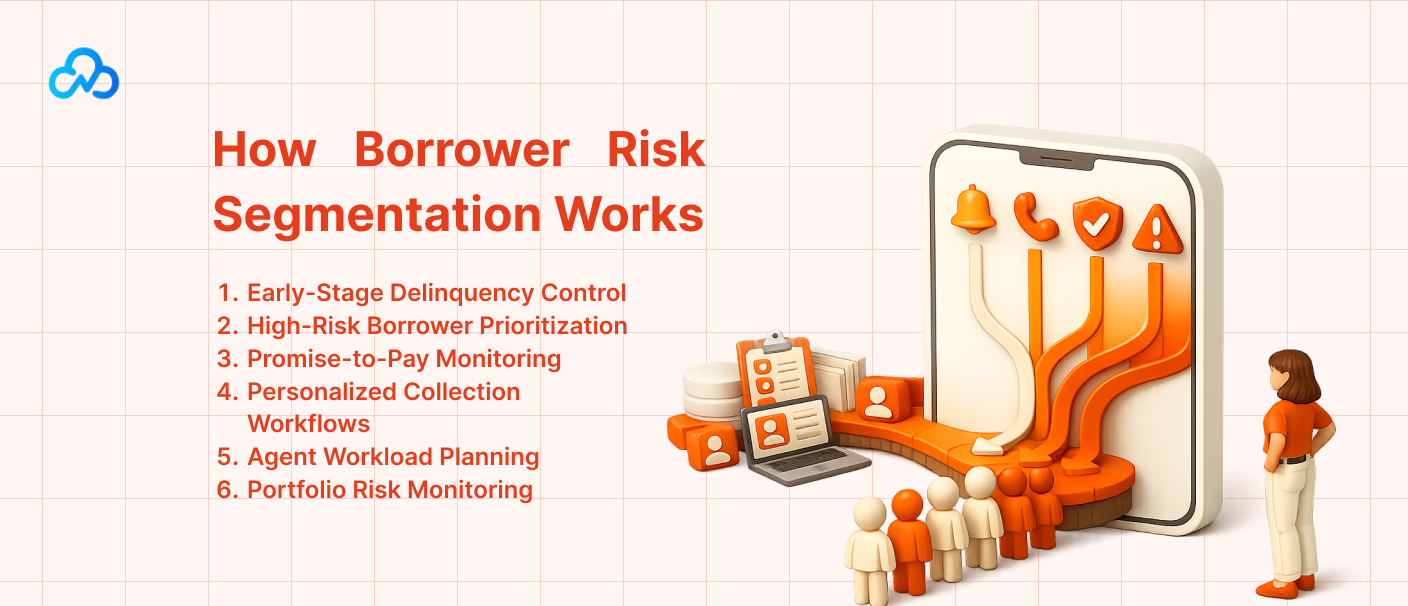
How Borrower Risk Segmentation Works
Borrower risk segmentation works by combining repayment data, borrower behavior, overdue stage, communication history, and recovery signals into risk-based borrower groups.
Here is how the process usually works.
1. Borrower and Loan Data Is Collected
The system first gathers borrower and loan information from the lender’s loan management system, CRM, repayment platform, or collection database.
This may include:
- Borrower name
- Loan account number
- Loan product
- EMI amount
- Due date
- Outstanding amount
- Payment history
- Days past due
- Last payment date
- Contact details
- Borrower location
- Previous collection activity
- Promise to pay history
- Communication response
- Agent notes
This creates the base for borrower segmentation.
Without clean and updated borrower data, risk segmentation becomes weak.
2. Repayment Behavior Is Analyzed
Next, the system looks at borrower repayment patterns.
This may include:
- On time payment history
- Missed EMI frequency
- Delayed payment pattern
- Partial payment behavior
- Repeated overdue cycles
- Broken promise to pay history
- Payment recovery after reminder
- Sudden change in repayment behavior
Repayment behavior often gives early signals of collection risk.
A borrower who has missed one EMI for the first time is different from a borrower who has repeatedly delayed payments for several months.
3. Delinquency Stage Is Mapped
Borrowers are then grouped by delinquency stage.
Common stages include:
- Due soon
- Due today
- 1–7 days overdue
- 8–30 days overdue
- 31–60 days overdue
- 61–90 days overdue
- 90+ days overdue
This supports delinquency risk management because teams can see how accounts are moving across buckets.
But DPD alone is not enough.
The system should combine DPD with borrower behavior, response history, overdue amount, and risk signals to create useful segments.
4. Communication Response Is Tracked
Borrower response is an important part of risk segmentation.
The system can track:
- Reminder delivered
- Reminder opened
- Borrower responded
- Call connected
- Call not answered
- WhatsApp response received
- Payment link clicked
- Promise to pay made
- Promise broken
- No response after multiple attempts
A borrower who responds quickly may be easier to recover from. A borrower who ignores all communication may need a different workflow.
This helps collection teams move from generic follow-up to borrower-specific action.
5. Risk Segments Are Created
After repayment behavior, delinquency stage, and communication response are analyzed, borrowers can be grouped into risk segments.
For example:
- Low risk: usually pays on time, one time delay
- Watchlist: early delay but responsive
- Medium risk: repeated late payments
- High risk: broken promises or poor response
- Critical risk: high overdue value and no response
- Escalation segment: needs manager or legal review
These segments help teams decide the next best action.
This is where borrower risk segmentation becomes useful for daily collection operations.
6. Collection Actions Are Prioritized
Once borrowers are segmented, recovery teams can prioritize actions.
For example:
- Low-risk borrowers get automated reminders
- Watchlist borrowers get reminder plus follow-up
- Medium-risk borrowers get agent assignment
- High-risk borrowers get priority calls
- Critical-risk borrowers get escalation
- Broken-promise borrowers get immediate follow-up
This improves collection prioritization because agents know where to focus first.
Instead of working from a basic overdue list, teams work from a risk-based recovery queue.
7. Portfolio Dashboards Are Updated
Managers need to see borrower risk at portfolio level.
A good segmentation system should show:
- Borrowers by risk segment
- Total overdue amount by segment
- DPD movement
- Promise-to-pay status
- Broken promise count
- Agent workload
- Segment-wise recovery rate
- Escalated accounts
- Non responsive borrowers
- High value overdue cases
This gives collection managers better visibility into recovery pressure and portfolio health.
Key Features of Borrower Risk Segmentation Software
Risk-Based Borrower Groups
The system should automatically group borrowers by repayment behavior, overdue stage, and response history.
This helps teams avoid manual guesswork.
Delinquency Risk Management
Delinquency risk management helps lenders track accounts before they move into deeper overdue buckets.
This allows early action instead of late recovery.
Collection Prioritization
Collection prioritization helps agents focus on the accounts that need attention first.
This improves team efficiency and reduces wasted follow-up effort.
Promise to Pay Tracking
Promise-to-pay tracking helps teams monitor borrower commitments.
If a borrower misses a promised date, the account can move into a higher-risk segment automatically.
Multi Channel Response Tracking
Borrowers may respond through SMS, WhatsApp, email, calls, IVR, or in-app messages.
Tracking these responses helps lenders understand which borrowers are engaged and which ones need stronger follow-up.
Case Assignment
Segmented borrowers can be assigned to agents, senior collectors, field teams, or escalation teams based on risk level.
This creates a more structured recovery workflow.
Recovery Dashboard
Managers should be able to view borrower risk segments, overdue exposure, bucket movement, and recovery performance in one dashboard.
This helps faster decision-making.
Audit Trail
Every segmentation change, reminder, agent action, borrower response, and escalation should be logged.
This keeps recovery activity reviewable and organized.
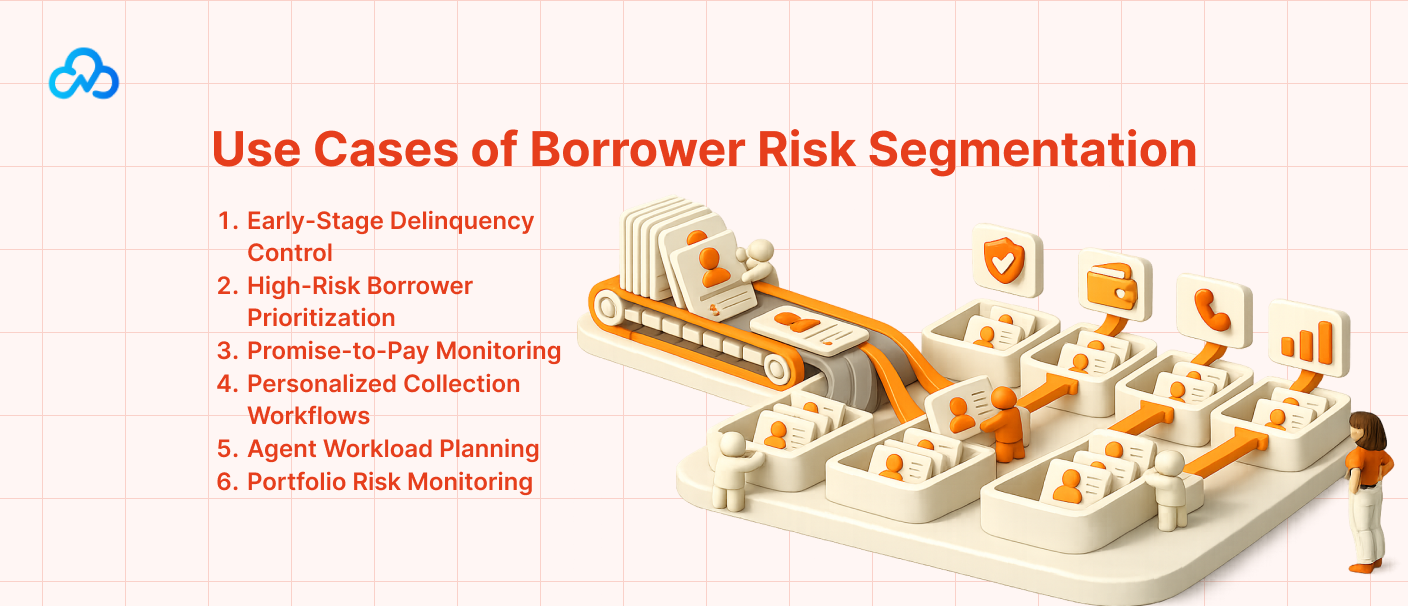
Use Cases of Borrower Risk Segmentation
1. Early Stage Delinquency Control
Borrower segmentation helps lenders identify early-stage overdue accounts before they become serious collection cases.
A borrower in the first few days of delinquency may only need a timely reminder or quick follow-up.
2. High Risk Borrower Prioritization
Collection teams can focus first on borrowers with repeated delays, high overdue value, broken promises, or poor communication response.
This improves the use of agent time.
3. Promise to Pay Monitoring
Borrowers who make promises to pay can be tracked separately.
If they miss the promised date, they can automatically move into a higher-risk segment.
4. Personalized Collection Workflows
Different borrower segments can receive different communication workflows.
For example:
- Soft reminder for first time late payers
- Agent call for repeated late payers
- Escalation for non responsive borrowers
- Manager review for high value overdue accounts
This creates a more balanced recovery process.
5. Agent Workload Planning
Managers can assign cases based on segment, bucket, geography, loan type, or risk level.
This helps distribute work more fairly across the collection team.
6. Portfolio Risk Monitoring
Borrower segmentation helps leaders see whether the portfolio is becoming riskier over time.
If more accounts are moving from low-risk to high-risk segments, managers can take action earlier.
Benefits of Borrower Risk Segmentation
Better Recovery Prioritization
Risk segmentation helps teams focus on the right borrowers first.
This prevents high-risk cases from getting buried inside large overdue lists.
Faster Early Intervention
When risky borrower behavior is detected early, teams can act before the account moves into deeper delinquency.
Early intervention usually gives collection teams more recovery options.
Reduced Manual Effort
Agents do not need to manually sort every borrower list.
The system can classify accounts and suggest the next action based on risk.
Better Borrower Experience
Not every borrower needs aggressive follow up.
Segmentation helps lenders communicate more appropriately based on borrower situation and behavior.
Improved Collection Efficiency
Agents spend more time on accounts that need human attention and less time on low risk borrowers who can be handled with automated reminders.
Stronger Manager Visibility
Managers can see which borrower groups are creating recovery pressure.
This helps with planning, escalation, and team performance review.
More Consistent Collection Decisions
Segmentation reduces dependency on individual judgment.
Teams can apply consistent workflows across borrower groups, products, and regions.
Better Audit and Review Control
Every action can be tracked by borrower segment, communication history, and recovery outcome.
This makes recovery operations easier to review.
Common Mistakes in Borrower Risk Segmentation
Using Only DPD Buckets
Days past due is important, but it is not enough.
Two borrowers in the same DPD bucket can have very different risk profiles.
Ignoring Communication Response
A borrower who responds and a borrower who ignores every message should not be treated the same.
Response behavior is a useful recovery signal.
Not Tracking Broken Promises
Broken promise to pay cases often need faster follow up.
If they are not tracked separately, recovery teams may miss important action windows.
Treating Every Borrower the Same
A single collection workflow for all borrowers creates friction for low risk borrowers and delays action on high risk cases.
No Real-Time Dashboard
If managers only get weekly or manual reports, they may not see risk movement early enough.
Real-time dashboards help teams act faster.
Manual Case Assignment
Manual assignment can create uneven workloads and missed priorities.
Risk-based assignment gives teams more structure.
No Feedback Loop
Segmentation should improve over time.
If recovery outcomes are not used to refine borrower segments, the system becomes less useful.
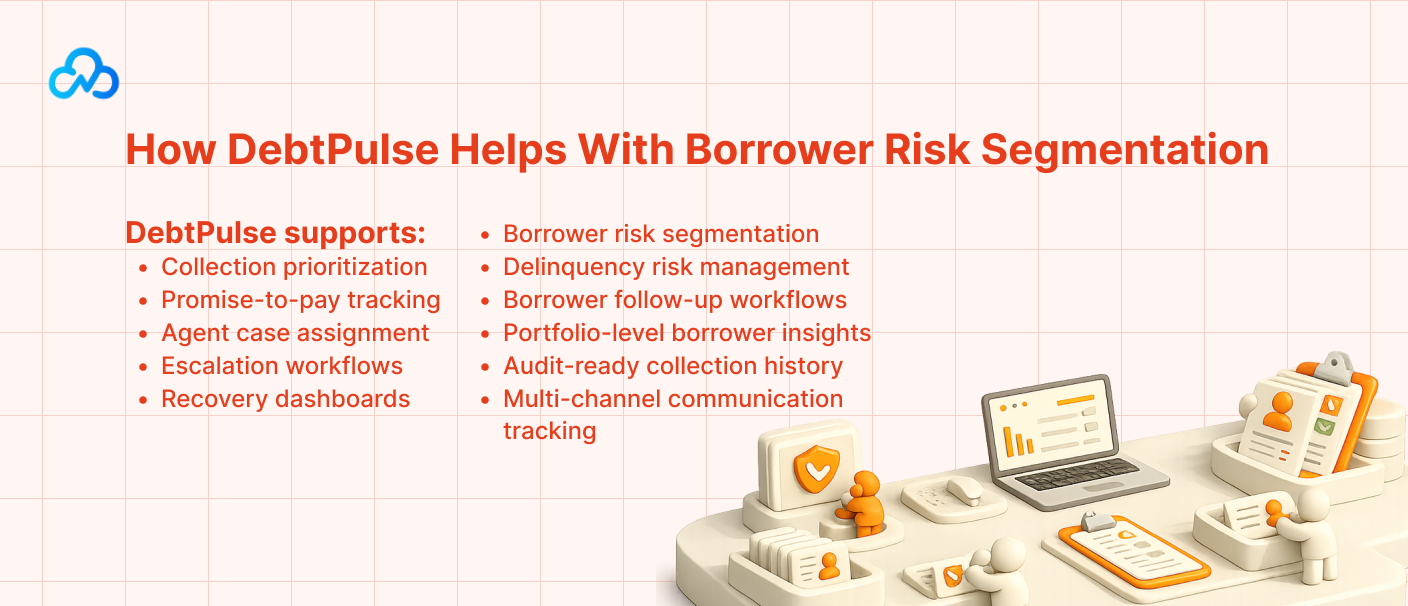
How DebtPulse Helps With Borrower Risk Segmentation
DebtPulse by Cloudastra helps NBFCs, fintech lenders, banks, and loan servicing teams segment borrowers by risk and manage recovery workflows with better visibility.
DebtPulse supports:
- Borrower risk segmentation
- Delinquency risk management
- Collection prioritization
- Promise to pay tracking
- Borrower follow up workflows
- Multi channel communication tracking
- Agent case assignment
- Escalation workflows
- Recovery dashboards
- Portfolio level borrower insights
- Audit ready collection history
Instead of working from flat overdue lists, lenders can use DebtPulse to identify which borrowers need reminders, which need agent follow up, and which need escalation.
This helps collection teams act earlier, reduce manual sorting, and manage recovery operations with more control.
For lenders trying to improve recovery without increasing collection workload, DebtPulse gives teams a practical way to organize borrowers by risk and take the right action at the right time.
Who Should Use DebtPulse?
DebtPulse is useful for:
- NBFCs
- Digital lenders
- Banks
- Loan servicing companies
- Embedded finance platforms
- Microfinance institutions
- Credit teams
- Recovery teams
- Collection managers
- Operations leaders
- Risk teams
- Lending product teams
It is especially useful for lenders managing large borrower portfolios, multiple delinquency buckets, and manual recovery workflows.
Want to explore more helpful insights on AI, automation, and enterprise technology? Read more blogs at Cloudastra Technologies or connect with us for business enquiries through Cloudastra Contact Us
FAQs
1. What is borrower risk segmentation?
Borrower risk segmentation is the process of grouping borrowers by repayment behavior, overdue risk, communication response, and recovery priority so lenders can take the right collection action.
2. Why do lenders need borrower risk segmentation?
Lenders need borrower risk segmentation because not every overdue borrower has the same risk level. Segmentation helps teams prioritize high-risk accounts and avoid unnecessary pressure on low-risk borrowers.
3. How does borrower segmentation improve collections?
Borrower segmentation improves collections by helping teams identify which borrowers need automated reminders, agent follow-up, escalation, or manager review.
4. What is delinquency risk management?
Delinquency risk management is the process of tracking accounts that may move into deeper overdue stages and taking action before recovery becomes harder.
5. What signals are used for borrower risk segmentation?
Common signals include days past due, repayment history, overdue amount, communication response, promise-to-pay status, broken promises, loan type, borrower segment, and previous collection activity.
6. How does DebtPulse help with borrower risk segmentation?
DebtPulse helps lenders segment borrowers by risk, prioritize collection actions, track promise-to-pay status, assign cases, manage escalations, and monitor recovery performance from one system.
7. Can borrower risk segmentation reduce manual collection work?
Yes. It reduces manual work by automatically grouping borrowers, prioritizing accounts, and helping agents focus on cases that need human attention.
8. Who should use borrower risk segmentation software?
Borrower risk segmentation software is useful for NBFCs, fintech lenders, banks, loan servicing companies, microfinance institutions, and recovery teams handling large borrower portfolios.