Angular vs React is not simply a question of which frontend technology is faster.
The bigger difference is how each one expects a development team to build and organise an application.
React is primarily a UI library. It gives developers a flexible component model and allows the team to choose many of the surrounding technologies.
Angular is a more comprehensive application framework. It includes more architectural conventions and built-in capabilities for common application requirements.
That difference affects:
- Architecture
- Development speed
- Performance
- Team consistency
- Hiring
- Scalability
- Mobile development
- SEO strategy
- Long-term maintenance
For a startup building an MVP, flexibility and access to a large developer ecosystem may make React attractive.
For a large enterprise team managing a complex application, Angular’s more opinionated structure may be useful.
Neither is automatically better.
The right choice depends on:
Project type + team size + existing expertise + architecture requirements + long-term maintenance
Angular vs React: Quick Comparison
|
Factor |
React |
Angular |
|
Type |
UI library |
Full application framework |
|
Primary language |
JavaScript or TypeScript |
TypeScript-oriented |
|
Architecture |
Flexible |
More opinionated |
|
Learning curve |
Lower at core level |
Steeper initially |
|
Routing |
Added through framework/library ecosystem |
Built-in routing |
|
HTTP |
Multiple options |
Built-in HTTP capabilities |
|
Forms |
Multiple libraries/options |
Built-in form approaches |
|
State management |
Multiple choices |
Multiple patterns with framework primitives/ecosystem |
|
Dependency injection |
Not built into React core |
Built in |
|
Mobile ecosystem |
Strong through React Native |
Commonly uses third-party approaches |
|
Team consistency |
Requires standards |
More conventions built in |
|
Hiring pool |
Generally larger |
Strong enterprise talent pool |
|
Best suited for |
Product teams, SaaS, startups, flexible architectures |
Enterprise applications, large teams, structured development |
The biggest distinction is simple:
React gives teams more freedom.
Angular gives teams more structure.
What Is React?
React is an open-source JavaScript library for building user interfaces using reusable components.
Applications are constructed from components that manage their own:
- UI
- Data
- State
- User interactions
React uses a declarative model.
Instead of manually telling the browser how to update each element, developers describe what the interface should look like based on the current application state.
React then manages the UI updates.
Why Is React Popular?
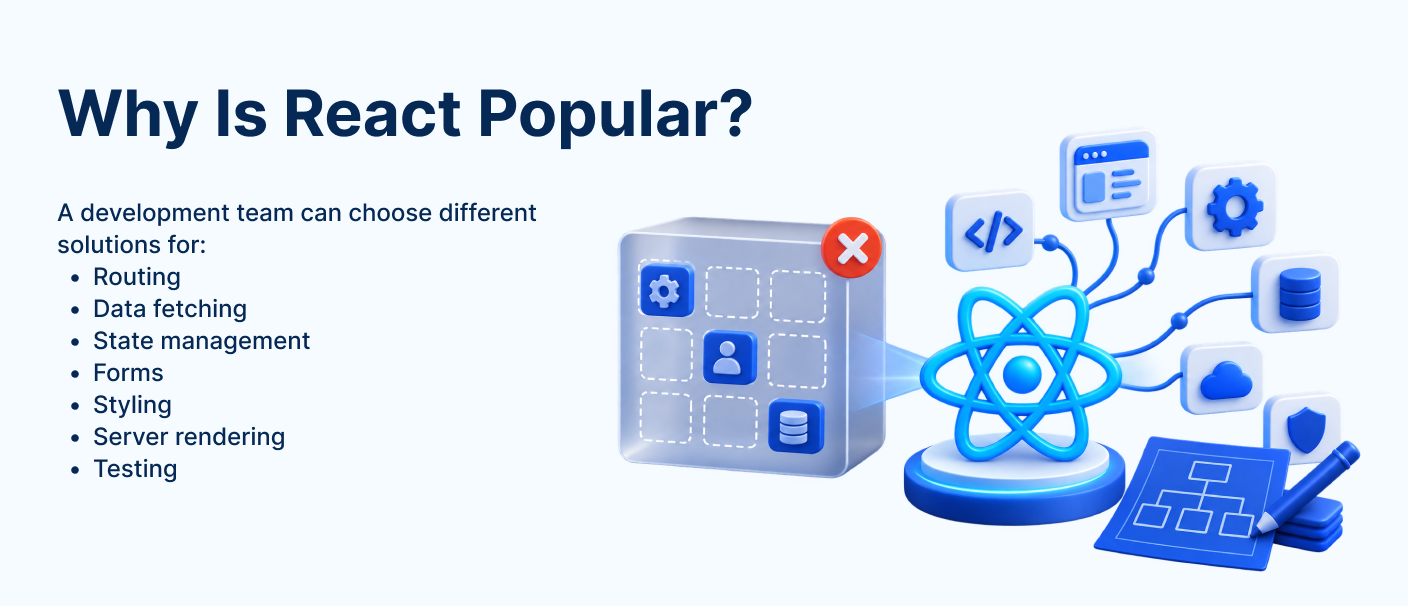
React’s core is intentionally focused.
It does not attempt to provide every application feature itself.
A development team can choose different solutions for:
- Routing
- Data fetching
- State management
- Forms
- Styling
- Server rendering
- Testing
This creates significant flexibility.
But it also means React teams need to make more architectural decisions.
Example React Stack
A modern React application may combine:
- React
- TypeScript
- Next.js
- React Query
- Zustand or another state solution
- React Hook Form
- Tailwind CSS
- Testing libraries
Another React team may choose completely different tools.
Both can still be valid React applications.
Key Strengths of React
Flexible Architecture
Teams can choose the libraries that best match their requirements.
Reusable Components
Components can be reused across multiple areas of an application.
Large Ecosystem
React has a broad ecosystem of:
- Frameworks
- Libraries
- Component systems
- Development tools
Strong Product Development Fit
React is commonly suitable for:
- SaaS
- Startups
- Dashboards
- E-commerce
- Consumer applications
- MVPs
Mobile Development
React Native gives teams a related development model for native mobile applications.
Server-Rendered Application Options
Frameworks built around React can provide:
- Server-side rendering
- Static generation
- Server Components
- Full-stack application capabilities
This makes React suitable for both highly interactive applications and public-facing websites that need stronger rendering and SEO strategies.
What Is Angular?
Angular is a TypeScript-based application framework designed to provide a more complete structure for frontend development.
Instead of requiring developers to assemble many independent libraries, Angular includes or standardises capabilities such as:
- Routing
- HTTP communication
- Forms
- Dependency injection
- Component architecture
- Reactive primitives
- Testing support
- Build tooling
Angular is intentionally more opinionated than React.
This means developers have fewer architectural decisions to make for common application concerns.
Why Do Enterprises Use Angular?
Large engineering teams frequently need consistency.
Suppose 20 developers are working on one application.
Without agreed conventions, different developers may:
- Structure components differently
- Use different data patterns
- Choose different libraries
- Handle dependencies differently
- Organise files differently
Angular reduces some of this variation by providing stronger framework conventions.
That can be useful when:
- Teams are large
- Applications are long-lived
- Code ownership changes frequently
- Multiple developers contribute to the same modules
- Consistency is more important than architectural freedom
Key Strengths of Angular
Complete Framework
Many common frontend requirements are already supported within the Angular ecosystem.
TypeScript-First Development
Angular development is strongly centred around TypeScript.
Dependency Injection
Angular provides a built-in dependency injection system for managing:
- Services
- Dependencies
- Shared functionality
Structured Architecture
The framework encourages consistent development patterns.
CLI and Tooling
Angular tooling helps teams create and manage application structure consistently.
Form Capabilities
Angular provides built-in approaches for complex forms and validation.
This can be useful for:
- Banking portals
- Admin applications
- Enterprise systems
- Workflow-heavy applications
- Internal business applications
7 Key Differences Between Angular and React
1. Angular Is a Framework; React Is a Library
This is the most fundamental difference.
React primarily handles the UI layer.
Angular provides a broader framework for application development.
With React
The team commonly decides:
- Router
- State architecture
- Data fetching approach
- Form solution
- Folder structure
- Supporting libraries
With Angular
More of these decisions are guided by framework conventions.
This creates a trade-off.
React → greater flexibility
Angular → greater standardisation
Which Approach Is Better?
For a small experienced team, React’s flexibility can be valuable.
For a large team, Angular’s conventions can reduce architectural inconsistency.
2. Angular Has a Steeper Initial Learning Curve
React’s core concepts are relatively focused.
Developers typically begin with:
- Components
- Props
- State
- Hooks
- JSX
A production React application eventually requires understanding additional technologies.
For example:
- Routing
- Data fetching
- State management
- Forms
- Server rendering
Angular introduces more framework-specific concepts earlier.
Developers may need to understand:
- TypeScript
- Components
- Services
- Dependency injection
- Reactive programming
- Routing
- Forms
- Angular tooling
- Framework-specific application patterns
This generally creates a steeper initial learning curve.
However, React’s ecosystem flexibility can create complexity later when applications become larger.
Angular vs React Learning Curve
|
Stage |
React |
Angular |
|
Getting started |
Easier |
More concepts upfront |
|
Small application |
Relatively simple |
More framework structure |
|
Large application |
Requires architectural discipline |
Conventions already established |
|
Ecosystem decisions |
Many |
Fewer |
|
Framework-specific concepts |
Fewer |
More |
|
Long-term consistency |
Team-dependent |
Framework-assisted |
3. React Provides More Architectural Flexibility
React does not prescribe one complete application architecture.
Two React applications can therefore look very different.
One team might use:
- Next.js
- Zustand
- React Query
- Tailwind
Another may use:
- React
- Redux
- React Router
- Material UI
This flexibility is useful when developers want control.
But flexibility creates responsibility.
Large React teams need clear standards for:
- Folder structure
- State management
- Component patterns
- Data access
- Error handling
- Testing
- Styling
Without these standards, the codebase can become inconsistent.
Angular Takes a More Opinionated Approach
Angular gives developers stronger conventions around:
- Services
- Components
- Dependency management
- Routing
- Application structure
For enterprise organisations, those constraints can actually be helpful.
The decision becomes:
Do you want your framework to provide more architectural direction, or do you want your team to choose?
4. Angular vs React Performance Depends More on Architecture Than the Logo
Performance comparisons between frontend frameworks are often oversimplified.
For most business applications, both technologies are capable of delivering responsive production interfaces when they are implemented correctly.
Performance can depend on:
- Bundle size
- Rendering strategy
- Component design
- Data fetching
- Network performance
- Caching
- State management
- Image optimisation
- Third-party libraries
- Developer decisions
How React Handles UI Updates
React uses a component-based rendering system and optimises how UI changes are applied.
Its modern ecosystem can also support:
- Concurrent rendering techniques
- Server rendering
- Static generation
- Server-side data fetching
- Code splitting
How Angular Handles UI Updates
Angular provides its own change-detection and reactive mechanisms.
Modern Angular development can use more fine-grained reactive patterns to update relevant parts of the interface efficiently.
Angular vs React Performance Verdict
For most:
- SaaS dashboards
- Enterprise applications
- E-commerce sites
- Internal tools
the performance difference between properly built Angular and React applications is unlikely to be the most important framework-selection factor.
Architecture quality usually matters more.
Choose based on:
- Team expertise
- Application structure
- Rendering requirements
- Ecosystem
- Maintainability
rather than assuming one framework is universally faster.
5. React Generally Offers a Larger Hiring Pool
Framework decisions affect hiring for years.
The original Cloudastra article identifies React as having a significantly larger developer pool, while Angular talent remains particularly established in enterprise environments.
This matters because talent availability affects:
- Hiring time
- Replacement risk
- Contractor availability
- Agency options
- Training
- Long-term maintenance
React Hiring Characteristics
React developers are common across:
- Startups
- SaaS
- Agencies
- Product companies
- E-commerce
- Consumer applications
Developers may also have experience with:
- Next.js
- React Native
- TypeScript
Angular Hiring Characteristics
Angular developers are frequently concentrated in:
- Large enterprises
- Financial services
- Government systems
- Internal enterprise software
- Long-lived business applications
A smaller talent pool does not automatically make Angular a poor choice.
An organisation with an experienced Angular team may gain more from retaining that expertise than switching frameworks.
Hiring Cost Estimates From the Source
The uploaded article provides these illustrative salary ranges:
|
Market |
React |
Angular |
|
United States, mid–senior |
$95K–$145K/year |
$98K–$155K/year |
|
India, source estimate |
$15K–$35K/year |
$15K–$38K/year |
These figures come from the original article and should be treated as indicative planning ranges rather than fixed 2026 market rates.
Actual compensation depends on:
- Location
- Experience
- Employment type
- Product domain
- Seniority
- Company size
- Hiring market
6. React Has a Stronger Direct Path to Native Mobile Development
React has a major ecosystem advantage when a company expects to build both web and native mobile applications.
React Native allows developers familiar with React concepts to build applications for:
- iOS
- Android
Some application logic and engineering patterns may be shared between web and mobile teams.
This can be useful for companies building:
- Consumer applications
- Marketplaces
- SaaS platforms with mobile apps
- E-commerce
- Customer-service applications
What About Angular for Mobile?
Angular can work with mobile-focused technologies and hybrid application approaches.
However, it does not have the same direct ecosystem relationship with React Native.
If native mobile development is a major product requirement, React’s ecosystem may therefore influence the decision.
7. Angular Can Be Easier to Standardise Across Large Teams
Consider a 20-person frontend engineering organisation.
In a highly flexible ecosystem, developers need organisational standards for:
- Routing
- Forms
- State
- API communication
- Testing
- Styling
- Component design
- Naming
- Folder structure
Without clear standards, different areas of the same application may develop differently.
Angular reduces some of this architectural freedom.
For smaller teams, that can feel restrictive.
For larger teams, it can create useful consistency.
This is one reason Angular often remains attractive for large enterprise applications.
Angular vs React: Detailed Feature Comparison
|
Dimension |
React |
Angular |
|
Core type |
UI library |
Full framework |
|
Language |
JavaScript / TypeScript |
TypeScript-oriented |
|
Component model |
Yes |
Yes |
|
Architecture |
Flexible |
Opinionated |
|
Routing |
Ecosystem/framework choice |
Built in |
|
HTTP tools |
Multiple choices |
Framework support |
|
Form handling |
Multiple choices |
Built-in approaches |
|
Dependency injection |
Not core |
Built in |
|
State options |
Many |
Framework primitives + ecosystem |
|
Testing |
Multiple options |
Framework tooling + multiple options |
|
SSR |
Through React frameworks |
Angular SSR capabilities |
|
Mobile |
React Native ecosystem |
Third-party/hybrid approaches |
|
Learning curve |
Easier core |
More concepts upfront |
|
Enterprise consistency |
Requires team conventions |
Strong |
|
Ecosystem flexibility |
Very high |
Moderate |
|
Talent availability |
Very high |
Strong, particularly enterprise |
Angular vs React for Startups

For many startups, React may be the more practical choice.
Why?
Faster Talent Access
A larger ecosystem can make it easier to find:
- Developers
- Freelancers
- Agencies
Rapid Product Iteration
React gives product teams significant flexibility when requirements are changing quickly.
Next.js Ecosystem
Public-facing products can use a React framework for:
- Server rendering
- Routing
- SEO
- Backend capabilities
React Native
If the startup later launches mobile applications, existing React expertise may transfer more easily.
Strong Fit for MVPs
React can work well when teams need to:
- Ship quickly
- Test demand
- Change features frequently
- Keep architecture flexible
That does not mean Angular cannot build startup products.
It means the additional structure Angular provides may create less value for a very small team.
Angular vs React for Enterprise Applications
Angular becomes particularly attractive when an organisation values standardisation.
Examples include:
- Large internal applications
- Banking portals
- Insurance platforms
- Government systems
- Complex operational dashboards
- Enterprise administration systems
- Form-heavy business software
Why Can Angular Work Well in Enterprise Teams?
Consistent Architecture
Developers follow more common framework patterns.
Built-In Capabilities
Teams make fewer decisions about foundational libraries.
Dependency Injection
Services and dependencies can be managed through a structured framework mechanism.
TypeScript-Centred Development
Strong typing can support large application development.
Tooling
Framework tooling can help maintain consistent project structure.
Is React Suitable for Enterprise?
Yes.
React can also support very large enterprise applications.
The difference is that organisations need to define more architectural conventions themselves.
A strong enterprise React setup may establish:
- Approved state-management patterns
- Component standards
- Design system
- Linting
- TypeScript configuration
- Testing requirements
- Folder architecture
- Data-fetching standards
React provides flexibility.
The enterprise must provide governance.
Angular vs React for SaaS Applications
SaaS products often need:
- Interactive dashboards
- Authentication
- Billing
- Settings
- Reporting
- Admin interfaces
- Public marketing pages
- Frequent feature releases
React can be especially attractive when:
- Product iteration is rapid
- SEO matters
- Next.js is part of the stack
- The team is relatively small
- Mobile development may follow
Angular can be attractive when:
- The application is highly structured
- Forms dominate the UI
- There is a large frontend team
- Enterprise consistency matters
- The organisation already uses Angular
Angular vs React for Complex Forms
Angular has historically been particularly strong for form-heavy applications because the framework includes structured form capabilities.
Examples include:
- Financial applications
- Insurance portals
- Government systems
- Enterprise admin tools
- Multi-step application workflows
React can also build complex forms using mature form libraries.
The difference is again architectural philosophy.
Angular provides more capability through the framework.
React teams choose the form solution they prefer.
Angular vs React for SEO
SEO should not be treated as simply:
Angular bad / React good
or vice versa.
The important issue is rendering.
A purely client-rendered application may require additional planning for:
- Search engine crawling
- Initial content delivery
- Metadata
- Performance
React SEO
React applications commonly use frameworks such as Next.js for:
- Server-side rendering
- Static generation
- Metadata
- Routing
- Performance optimisation
For public-facing sites where search visibility matters, this architecture should be planned early.
Angular SEO
Angular applications can also use server-rendering approaches.
If organic search is important, rendering strategy should be part of architecture planning from the beginning regardless of framework.
SEO Verdict
Do not choose React solely because of SEO.
Instead ask:
- Is the product public or authenticated?
- How much content must rank?
- What rendering strategy will be used?
- Is SEO central to customer acquisition?
For an authenticated enterprise dashboard, SEO may barely matter.
For a content-heavy SaaS website, it matters significantly.
Angular vs React State Management
State management is another area where the development philosophy differs.
React
Teams can use:
- Local component state
- Context
- Dedicated state libraries
- Server-state libraries
- Framework capabilities
This flexibility lets teams choose based on application complexity.
Angular
Teams can combine:
- Component state
- Services
- Reactive primitives
- RxJS
- Dedicated state-management libraries
Angular’s service and dependency-injection architecture can make application-level state organisation more structured.
Neither approach automatically produces better state management.
Poor architecture can become complex in either framework.
Angular vs React Developer Experience
Developer experience depends heavily on personal and team preference.
React Developers Often Value
- Smaller core API
- Ecosystem freedom
- Large community
- Flexible architecture
- Rapid experimentation
Angular Developers Often Value
- Consistent project structure
- Integrated tooling
- Built-in dependency injection
- Framework conventions
- Fewer foundational technology decisions
A startup engineer may see Angular conventions as unnecessary overhead.
An enterprise architect may see React’s flexibility as architectural risk.
Both perspectives can be valid.
What Companies Use React and Angular?
The uploaded source lists examples of large organisations associated with both ecosystems.
React Examples Listed in the Source
- Meta
- Netflix
- Airbnb
- The New York Times
- Dropbox
Angular Examples Listed in the Source
- PayPal
- Upwork
- Deutsche Bank
- Microsoft-related applications
Large-company usage should not be the primary framework-selection criterion.
A technology that works for a global platform does not automatically match a 5-person startup or a specific enterprise application.
Use cases, architecture and team capability matter more.
When Should You Choose React?
React is usually worth considering when:
- You are building a SaaS product
- You are building an MVP
- Your team is relatively small
- Product requirements change frequently
- You want architectural flexibility
- Hiring speed matters
- You expect to use Next.js
- SEO is important to public-facing product pages
- React Native mobile development is planned
- Your team already has React expertise
React is especially strong for product organisations where rapid UI development and ecosystem flexibility are important.
When Should You Choose Angular?
Angular is usually worth considering when:
- You are building a large enterprise application
- The frontend team is large
- Codebase consistency is a high priority
- The application is form-heavy
- Your team already has Angular expertise
- You prefer framework conventions
- You want more capabilities included in the core framework
- Multiple teams will maintain the application for years
Angular is especially strong when organisational consistency creates more value than architectural freedom.
| Requirement | React | Angular |
|---|---|---|
| Startup MVP | Usually easier to get started with and iterate quickly | Works well, but can add more structure than an early MVP needs |
| SaaS product | A practical choice for products that need to evolve quickly | Well suited to larger SaaS products with clearly defined architecture |
| Large enterprise portal | Works well when the team has established coding and architecture standards | Particularly useful for large applications that benefit from consistent conventions |
| Very large frontend team | Scales well, although teams need to agree on architecture and development standards | Its built-in conventions can make consistency easier across larger teams |
| Rapid experimentation | Flexible and convenient when features or requirements change frequently | Better suited to teams that prefer a more structured development process |
| Complex forms | Handles complex forms well, often with additional libraries | Provides mature form-handling capabilities as part of the framework |
| Native mobile roadmap | React Native provides a natural option for teams already working with React | Mobile development generally relies on separate or third-party approaches |
| Architectural flexibility | Gives developers considerable freedom in choosing supporting libraries and architecture | Provides more decisions and conventions out of the box |
| Built-in conventions | Teams usually establish their own preferred patterns and supporting tools | Comes with stronger conventions for project structure and development |
| Developer availability | React developers are widely available in the market | Angular also has an established developer ecosystem, particularly in enterprise development |
| Existing Angular organisation | Switching to React may create unnecessary migration and retraining work | Staying with Angular can make sense when the existing team and application already use it |
| Existing React organisation | Staying with React avoids introducing another frontend stack without a clear reason | Moving to Angular should have a specific technical or organisational benefit |
Should You Migrate From Angular to React?
Not simply because React is more popular.
Framework migration is expensive.
A migration may require:
- Component rewrites
- Routing changes
- Form rewrites
- State-management changes
- Test rewrites
- Build changes
- Developer retraining
- Regression testing
The correct question is:
What business or engineering problem will the migration solve?
Valid reasons might include:
- Severe hiring problems
- Architectural limitations
- Product strategy change
- Mobile strategy
- Long-term platform consolidation
- Unsustainable maintenance
Weak reasons include:
- Another framework is currently fashionable
- Developers personally prefer another framework
- Competitors use React
If the existing Angular system performs well and the team knows how to maintain it, migration may create cost without enough business value.
Should You Migrate From React to Angular?
The same principle applies.
Moving to Angular may make sense when:
- The application has become very large
- Multiple teams struggle with inconsistent architecture
- The organisation is standardising on Angular
- Enterprise tooling and conventions are valuable
But rewriting a healthy React application solely to gain framework structure may not justify the cost.
Sometimes the cheaper solution is simply to introduce stronger engineering standards.
Can Angular and React Be Used Together?
Technically, yes.
For example, organisations can use:
- Micro-frontends
- Separate applications
- Incremental migration
- Strangler-style replacement
A legacy Angular application could continue handling existing functionality while new areas are developed separately.
But running two frontend technologies creates additional complexity.
Teams may need to manage:
- Two build systems
- Two ecosystems
- Duplicate dependencies
- Different engineering skills
- Shared authentication
- Design consistency
- Routing
- Deployment
Using both should therefore solve a specific migration or organisational problem rather than becoming the default architecture.
Common Angular and React Mistakes
Choosing Based Only on Popularity
Popularity does not tell you whether the framework fits your team.
Ignoring Existing Expertise
A highly experienced Angular team may outperform an inexperienced React team.
And vice versa.
Using React Without Architecture Standards
Large React projects need conventions.
Define:
- State patterns
- Component patterns
- TypeScript rules
- Testing
- Folder structure
- Data access
- Styling
Using Angular for a Tiny Project Without a Reason
Small projects may not benefit from all of Angular’s structure.
Ignoring Rendering and SEO Until Launch
Plan rendering early for public-facing applications.
Changing Framework Mid-Project
Framework migrations consume significant engineering time.
Choose carefully before the application becomes large.
Comparing Framework Benchmarks Instead of Product Performance
A fast framework cannot compensate for:
- Poor API design
- Huge images
- Excessive JavaScript
- Inefficient queries
- Bad caching
- Slow backend systems
Measure the complete application.
Angular vs React Best Practices
For React Projects
- Use TypeScript for larger production applications
- Define architectural conventions early
- Choose libraries deliberately
- Avoid unnecessary global state
- Establish a component design system
- Plan rendering strategy before development
- Use automated testing and linting
- Document key patterns
For Angular Projects
- Keep components focused
- Use services appropriately
- Define clear feature boundaries
- Standardise project structure
- Use framework tooling consistently
- Avoid unnecessary complexity
- Establish state-management conventions
- Keep performance and bundle size measurable
For Both
- Use TypeScript appropriately
- Automate tests
- Monitor performance
- Maintain dependency hygiene
- Use CI/CD
- Document architecture
- Review accessibility
- Measure real-user performance
- Avoid framework-specific complexity without business value
Angular vs React: Which Is Better in 2026?
For many startups, SaaS companies and product teams, React is likely to be the more practical default choice because of its flexible ecosystem, broad talent pool and strong surrounding frameworks.
Angular remains highly relevant when:
- Teams are large
- Application structure is complex
- Enterprise consistency matters
- The organisation already has Angular expertise
- Built-in framework conventions create operational value
The decision is therefore not:
React good, Angular bad
or:
Angular enterprise, React startup
The real decision is:
Which technology better matches the way your team needs to build and maintain the product?
How Should You Choose Between Angular and React?
Use this process.
Step 1: Look at the Existing Team
Which framework does your team already understand?
Existing expertise can outweigh theoretical framework advantages.
Step 2: Consider Team Size
Small product teams may value flexibility.
Large teams may benefit from more structural consistency.
Step 3: Define the Product Type
Is it:
- SaaS
- Public website
- Enterprise portal
- Internal application
- Marketplace
- Dashboard
- Form-heavy business software
Different products favour different architectures.
Step 4: Consider Mobile Requirements
If native mobile development is important, evaluate how much React Native would benefit your engineering strategy.
Step 5: Consider SEO Requirements
Determine whether public content needs:
- Server rendering
- Static generation
- Strong metadata
- Fast initial rendering
Step 6: Evaluate Hiring
Check talent availability in the markets where you actually recruit.
Step 7: Consider Maintenance
Ask:
Who will maintain this system three years from now?
Framework choice should optimise for the product lifecycle, not just the first six weeks of development.
How Cloudastra Approaches Angular vs React Projects

Cloudastra Technologies works with modern frontend architectures across React, Next.js, Angular and TypeScript-based applications.
Rather than selecting a framework based only on popularity, the engineering decision should consider:
- Product requirements
- Existing codebase
- Team size
- Engineering expertise
- Rendering requirements
- Mobile roadmap
- Integration complexity
- Long-term maintenance
For a small product team building a SaaS platform, React with a suitable application framework may provide a strong balance of speed and flexibility.
For a large enterprise team working on a structured internal system, Angular may provide stronger architectural consistency.
The appropriate choice should be made at the architecture stage rather than after implementation has already started.
Want to explore more practical insights on AI development, automation, and conversational AI? Read more blogs at Cloudastra Technologies or contact us for business enquiries through Cloudastra Contact Us.
Frequently Asked Questions
1. What is the main difference between Angular and React?
React is primarily a UI library with a flexible ecosystem, while Angular is a more comprehensive framework that provides stronger architectural conventions and more built-in functionality.
2. Which is better, Angular or React?
Neither is universally better. React is often attractive for startups, SaaS and flexible product development, while Angular can be particularly useful for large enterprise teams that value standardisation.
3. Is React easier to learn than Angular?
React’s core concepts are generally easier to learn initially. Angular introduces more framework-specific concepts upfront.
4. Is Angular better for enterprise applications?
Angular can be a strong enterprise choice because of its structured architecture and built-in conventions. React is also widely capable of supporting enterprise applications when teams enforce strong architectural standards.
5. Is React faster than Angular?
There is no universal performance winner. Application architecture, rendering strategy, bundle size, data fetching and developer implementation usually matter more than framework choice alone.
6. Which has more developers, React or Angular?
The uploaded article identifies React as having the larger talent pool, while Angular remains strongly represented in enterprise development.
7. Which is better for startups?
React is often the more practical choice for startups because of ecosystem flexibility, talent availability and suitability for rapid product iteration.
8. Which is better for large teams?
Angular’s stronger conventions can be valuable for large development teams. React can also work well when the organisation establishes strong architecture and coding standards.
9. Is React better for mobile development?
React has a strong advantage through the React Native ecosystem when native mobile development is part of the product roadmap.
10. Which is better for SEO?
Both can support search-friendly rendering architectures. React applications commonly use frameworks such as Next.js, while Angular also supports server-rendered application strategies.
11. Can React and Angular be used in the same application?
Yes, approaches such as micro-frontends can support both, particularly during migration. However, the additional architecture and operational complexity should be justified.
12. Should I migrate Angular to React?
Only if migration solves a meaningful business or engineering problem such as hiring, maintainability, product architecture or platform strategy. Popularity alone is not a good reason.
13. Is Angular still suitable for new applications?
Yes. Angular remains suitable for applications where structured architecture, TypeScript-based development and enterprise consistency are important.
14. How should a company choose between React and Angular?
Evaluate existing expertise, team size, product type, mobile requirements, rendering needs, talent availability and long-term maintenance before choosing.