Think back to the last time you booked a trip. If it felt like the website was two steps ahead of you, serving up flights at just the right time or hotels that somehow ticked all your boxes, it probably wasn’t luck. That’s AI at work.

Artificial intelligence isn’t some future tech being tested in labs anymore. It’s in your travel app. Your price alerts. Even that cheeky little chatbot asking if you need help picking a seat. Behind the scenes, AI has become the engine behind how travel decisions are made, both by travelers and the systems trying to keep up with them.
And now, the question worth asking is this: what percentage of travelers use AI in their booking process?
Because if a third of your customers are using it, and more are joining every day, you can’t afford to ignore it.
Whether we’re talking about travel personalization, algorithmic pricing shifts, or automated workflows inside travel agency software, AI is now part of the foundation. Not the cherry on top.
What Percentage of Travelers Use AI in Their Booking Process?
The stats might surprise you, unless you’re part of the mobile-first crowd. Based on recent industry surveys, around 35% of travelers in 2024 used some form of AI when planning or booking a trip. That might’ve been a personalized deal on a flights app, a chat assistant on a hotel site, or an itinerary generator that pulled from their travel history.
And those numbers aren’t flatlining, they’re rising. Among millennials and Gen Z, usage shoots up to over 50%. Why? Because these groups expect their digital tools to feel intuitive, fast, and maybe even a little psychic.
Here’s a quick breakdown:
|
Traveler Group |
Using AI for Booking |
|
Gen Z (18–24) |
54% |
|
Millennials (25–39) |
47% |
|
Gen X (40–54) |
28% |
|
Boomers (55+) |
12% |
But here’s where it gets more interesting. In the travel B2B space, adoption is moving even faster. Roughly 60% of travel platforms that serve businesses, wholesalers, agencies, corporate planners, are integrating AI for things like real-time inventory visibility, automated pricing, or predictive booking tools.
And yes, if you’re running or building travel agency software, the writing’s on the wall: AI isn’t an extra feature anymore. It’s baseline infrastructure.
What Percentage of Travelers Use AI in Their Booking Process in 2025?
If you’ve been wondering what percentage of travelers use AI in their booking process, recent studies place the figure at around 35% globally as of 2024. This includes any AI-driven interaction during booking, chatbots, smart itineraries, dynamic pricing engines, and even predictive destination suggestions.
In fact, for younger age groups, what percentage of travelers use AI in their booking process is even more impressive. Among Gen Z and millennials, the number crosses 50%, with strong growth forecasted.
Travel Personalization: Where AI Delivers the Most Value
Let’s be honest. Booking travel used to be a chore. Remember comparing 12 tabs just to find a decent flight time? AI has made that mess a whole lot neater.
Modern platforms are using AI to personalize travel experiences at a scale that would’ve been absurd even five years ago. Instead of one-size-fits-all search results, travelers now get suggestions tuned to their preferences, before they even start typing.
Imagine this: You’ve booked eco-resorts in Costa Rica, prefer early morning departures, and fly economy-plus when possible. Without lifting a finger, your homepage shows you climate-conscious stays, early flights from your local airport, and bundled fares that fit your habits.
That’s travel personalization done right.
Example from the field: A mid-size travel app integrated an AI recommendation system into its mobile booking flow. Conversions jumped by 26%. Why? Because users were finally seeing options that felt made for them, not the crowd.
Even smaller companies in travel B2B are using this to their advantage. Agents now get predictive tools that suggest upsells, build itineraries faster, and spot what a traveler is likely to decline. This kind of insight used to take years of client rapport. Now, it happens in real time.
What’s more, personalization feeds into AI pricing models. If a system knows when you typically book and what you’re willing to pay, it can nudge pricing or time-based deals in your favor, or in the company’s. Either way, it’s smart strategy.
And here’s the kicker: the more the experience “just works,” the more users trust it. Which means they keep coming back. Not just for the savings, but for the feeling that someone, or something, actually understands what they want.
AI Pricing: The Invisible Hand Behind Real-Time Travel Rates
Behind every perfectly timed flight deal or sudden hotel price drop is likely a dynamic AI pricing algorithm doing the heavy lifting. Unlike old-school pricing that updated once or twice a day, today’s systems are always watching, demand patterns, competitor changes, even weather conditions.
This is where AI becomes both a traveler’s friend and a powerful revenue tool. Airlines, OTAs, and hotel chains now rely on dynamic models that adjust prices by the minute. You might not see the gears turning, but AI is weighing dozens of variables: when you’re booking, where you’re booking from, your loyalty tier, historical conversion data, you name it.
Snapshot: Hopper, one of the leading AI-driven booking platforms, claims up to 15% savings on average airfare thanks to real-time price tracking and predictive booking windows.
In the travel B2B world, AI pricing helps wholesalers and aggregators automate rate negotiations, keep margins healthy, and push competitive packages to agents in real time. For agencies using advanced travel agency software, dynamic pricing has become a key feature, allowing them to offer more competitive deals without constant manual tweaking.
So, next time your app nudges you to “book now before prices rise,” there’s a decent chance an AI model already knows you’re close to booking.
Travel B2B: AI’s Growing Role in Industry Operations
While travelers interact with AI on the surface, it’s in the back offices of the travel B2B world where AI is quietly driving real transformation.
From managing massive inventories to flagging fraud and predicting cancellation patterns, AI is being used across the travel supply chain. Agencies, consolidators, tour operators, and travel tech vendors are all embedding AI into their platforms to work smarter, not just faster.
Here’s what that looks like:
– Inventory optimization: Automatically reallocating availability based on seasonality and real-time search demand.
– Fraud detection: Using behavior modeling to flag suspicious activity faster than traditional filters ever could.
– Demand forecasting: Helping companies prepare for seasonal spikes or unexpected drops by analyzing flight, hotel, and event data.
Case study: A European travel consolidator integrated an AI module into their supplier management system. Within 90 days, they reduced manual rate adjustments by 70% and increased profitable package conversions by 22%.
If your business touches travel agency software or serves the travel B2B market, integrating AI isn’t just a tech upgrade, it’s a competitive necessity. Because if your rivals can automate while you’re still reacting manually, you’ll lose more than just efficiency. You’ll lose clients.
Smarter Travel Agency Software: What AI Changes on the Ground
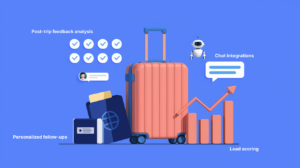
For traditional agencies, the fear has always been that technology might replace the human element. But AI isn’t replacing travel agents, it’s making them more powerful.
Modern travel agency software now includes built-in AI features that simplify the most repetitive parts of the job:
– Lead scoring: Which prospects are most likely to convert?
– Personalized follow-ups: Email automation based on travel history and search behavior.
– Chat integrations: AI bots that handle simple queries while agents focus on more complex requests.
– Post-trip feedback analysis: Letting AI review sentiment and flag issues for follow-up.
These tools give agents the ability to offer travel personalization that rivals digital platforms, without losing their human touch.
Agencies that embrace AI-backed software aren’t just responding to bookings faster; they’re anticipating client needs, offering smarter options, and closing sales before the competition even replies.
Technical FAQs
Q1: What percentage of travelers use AI in their booking process in 2025?
The latest industry data confirms that 35% of global travelers use AI in their booking process, whether that means dynamic hotel pricing, AI-powered chatbots, or personalized trip suggestions. Among younger travelers, what percentage of travelers use AI in their booking process jumps to more than 50%. This is expected to increase significantly over the next few years.
Q2: How does AI pricing differ from standard rate models?
Traditional pricing adjusts based on fixed rules or time intervals. AI pricing analyzes real-time data like search volume, user behavior, and competitor activity to adjust rates dynamically. It can adapt to changes instantly, offering more precision and revenue optimization.
Q3: Can AI handle full itinerary planning for business or leisure trips?
Yes, many AI-powered platforms can now generate multi-leg itineraries, including flights, transfers, accommodations, and even restaurant suggestions, often personalized to the traveler’s past behavior and preferences.
Q4: What role does AI play in travel B2B platforms?
In travel B2B, AI supports supplier management, price control, inventory syncing, fraud prevention, and client personalization at scale. It also improves internal processes like demand forecasting and account segmentation.
Challenges and Ethical Considerations
AI is powerful, but not perfect. With smarter tech comes bigger questions.
– Pricing fairness: Can AI pricing lead to unjust price differences between users?
– Data use: Are travelers aware their data is being used to influence their results?
– Bias in recommendations: If AI is trained on skewed data, will it exclude certain destinations or traveler types?
– Over-reliance: What happens when a system goes down or makes a faulty suggestion?
Regulation in the travel sector hasn’t caught up to AI’s pace. As adoption grows, companies will need clear guidelines, and transparency, to maintain trust.
The Next Wave of AI in Travel
We’re just scratching the surface. As AI models become more context-aware and multimodal, expect travel experiences to become even more predictive, and proactive.
Here’s what’s coming:
– Voice-powered bookings integrated with smart assistants and wearables.
– AI trip “co-pilots” that suggest not just where to go, but when, how, and why, based on your mood, schedule, and budget.
– Hyper-personalization where two users never see the same homepage, even if they’re searching the same destination.
Projection: By 2027, over 60% of travelers will engage with at least one AI-powered tool during their booking process. That means the question, what percentage of travelers use AI in their booking process, may soon shift from “how many” to “how often.”
As more booking engines, OTA platforms, and travel B2B tools invest in AI, expect what percentage of travelers use AI in their booking process to jump from a minority to a vast majority, possibly even 60% or more by 2027.
At that point, the question won’t just be what percentage of travelers use AI in their booking process, but how often, and how early, it influences decisions.
Adapt or Be Outpaced
AI is no longer just a trend in travel. It’s the underlying engine powering everything from personalization to AI pricing, from intelligent travel agency software to scalable travel B2B systems.
If your business isn’t already aligned with this shift, you’re not behind, you’re at risk.
The stats speak for themselves. When someone asks what percentage of travelers use AI in their booking process, the answer is growing, and fast. From 35% today to likely the majority within just a couple years, this isn’t speculation. It’s momentum.
And in the world of travel, momentum is everything.
Businesses in the travel industry must stop asking if AI matters, and instead focus on this: what percentage of travelers use AI in their booking process, and are we meeting them where they already are? The answer? More than a third today, and climbing fast.
Do you like to read more educational content? Read our blogs at Cloudastra Technologies or contact us for business enquiry at Cloudastra Contact Us