Corporate travellers increasingly expect consumer‑grade experiences when booking flights, hotels and ground transport. Traditional portals have relied on static search parameters and generic lists of options. In 2025 the landscape has changed: AI personalisation uses machine learning and natural‑language models to analyse travellers’ past bookings, preferences and company policies and then present tailored itineraries in real time. A survey highlighted that 61 % of customers feel they are treated like numbers, and companies leveraging AI can turn first‑party data into personalised omnichannel experiences. This demand for relevance means that AI personalisation is no longer optional, it is a competitive requirement for modern corporate travel software.
With increasing need for these systems the development of travel booking software is in an acceleration mode as well as many new travel booking software are now using advanced AI technology, where it has evolved from just simply processing transactions, to transforming the entire corporate travel software system into a strategic tool that will drive traveler satisfaction, compliance and efficiency.
How AI personalisation works in travel booking software
AI‑powered travel agents ingest large volumes of booking data, corporate policies and user preferences. They predict which flight combinations align with a traveller’s goals and automatically enforce corporate rules such as preferred airlines or budget caps. For instance, Navan’s AI travel assistant analyses hundreds of variables – destination, traveller status, policy constraints – and surfaces options that fit within policy while maximising traveller satisfaction. Behind the scenes, models process user behaviour, previous bookings and real‑time pricing to deliver personalised itineraries. This goes beyond simple filtering – the system can anticipate whether a traveller values loyalty points, shorter layovers or cost savings and adapt recommendations accordingly.
Machine‑learning pipelines also cluster travellers with similar preferences, enabling portals to pre‑select amenities, seat types or room categories. By continuously retraining models on new bookings and feedback, the portal improves over time. Data privacy and compliance remain paramount; anonymised training data and strict access controls are essential to maintain trust while harnessing behavioural insights.
Key features redefining B2B travel booking software and corporate travel software
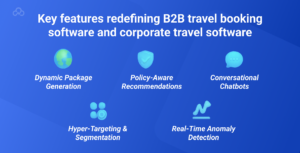
AI personalisation manifests through several technical capabilities:
1. Dynamic package generation – AI engines can assemble complete travel packages in seconds. SoftCloudTec’s 2025 guide notes that AI‑powered dynamic packaging generates personalised travel packages rapidly, replacing manual bundling of flights, hotels and car rentals.
2. Policy‑aware recommendations – Models apply corporate policies automatically, ensuring that travellers only see compliant options while still catering to their personal preferences.
3. Conversational chatbots – Integrated chatbots use natural‑language processing to answer questions, suggest alternatives and book travel. They can integrate with expense‑management systems, making reimbursements seamless.
4. Hyper‑targeting and segmentation – Contentstack reports that AI personalisation allows hyper‑targeting based on granular audience data; segments are defined by behaviour, firmographic attributes and travel patterns, enabling one‑to‑one marketing.
5. Real‑time anomaly detection – Models monitor booking patterns and flag unusual behaviour (e.g., last‑minute expensive flights) that may indicate misuse or fraud.
The table below summarises how these features map to business benefits:
|
AI personalisation feature |
Technical description |
Business benefit |
|
Dynamic packaging |
Models assemble flights, hotels and transport into a single package based on traveller preferences and corporate policies |
Reduces planning time and increases conversion by offering ready‑made itineraries |
|
Policy‑aware recommendations |
Algorithms factor in travel policies and user profiles to suggest compliant options |
Lowers policy violations and administrative overhead |
|
Conversational chatbots |
NLP engines handle booking requests and integrate with expense systems |
Enhances support and improves traveller satisfaction |
|
Hyper‑targeting |
Segmentation based on first‑party data and behavioural analytics |
Drives targeted upselling and cross‑selling |
|
Anomaly detection |
ML models flag unusual booking patterns and potential fraud |
Prevents misuse and ensures budget control |
Why AI personalisation matters for ROI
AI‑driven personalisation isn’t just a feel‑good feature; it delivers measurable returns. Automated itinerary creation within the corporate travel software reduces the time travellers and travel managers spend searching, while adherence to policies lowers travel costs. Contentstack highlights that AI‑powered personalisation increases engagement and conversions while improving efficiency. Because models can prioritise cost‑efficient options that still satisfy travellers, companies experience direct savings without compromising employee satisfaction. Over time, the system learns which incentives – loyalty points, lounge access or flexible tickets – encourage compliance, further enhancing ROI.
Case examples and emerging trends
Case 1: Fintech startup – A small fintech firm integrated an AI‑driven travel booking software. Within three months, 80 % of bookings adhered to policy without manual intervention, and the average booking time dropped from 25 minutes to 6 minutes. Personalised recommendations increased employee satisfaction scores.
Case 2: Global consulting company – The consultancy deployed chatbots for travel booking solutions and expense integration. Automated classification of receipts through AI reduced reimbursement cycles by 40 %. Dynamic packages offered balanced itineraries for multi‑city trips.
Case 3: Manufacturing firm – By applying hyper‑targeting, the portal recommended off‑peak flights and hotels near clients. The company saw a 12 % reduction in travel costs and improved on‑time arrivals for client meetings.
Looking ahead, AI personalisation will leverage reinforcement learning to fine‑tune offerings based on real‑time feedback. Integration with predictive analytics will allow the portal to anticipate travel disruptions and proactively rebook travellers. Hyper‑personalised offers may even bundle experiences such as local tours or conference tickets, turning corporate travel into a curated experience.
Technical FAQs
1. How does AI personalisation handle complex corporate policies?
Models encode policy rules as constraints during recommendation generation. By representing budgets, preferred suppliers and approval workflows in a structured format, the recommendation engine filters out non‑compliant options and explains why certain itineraries are excluded.
2. What machine‑learning techniques are used for personalisation?
Collaborative filtering and content‑based filtering are common. More advanced systems employ deep neural networks to model user–item interactions and transformers to process natural‑language inputs. Continuous learning pipelines ensure the models adapt to new travel booking solutions.
3. How can travel portals protect user privacy?
Personalisation requires sensitive data, so anonymisation, data‑minimisation and strict access controls are essential. Differential privacy techniques can be applied to aggregated datasets to protect individual identities while still allowing pattern analysis.
4. Can AI personalisation scale to enterprises with thousands of travellers?
Yes. Cloud‑native architectures allow the recommendation engine to scale horizontally. Microservices separate policy enforcement, user modelling and search functions, enabling parallel processing and high throughput.
5. How is personalisation measured?
Key metrics include recommendation click‑through rates, booking completion rates, traveller satisfaction surveys, policy compliance rates and cost‑per‑booking. A/B testing of personalised versus generic recommendations provides empirical evidence of impact.
Conclusion
AI personalisation for B2B travel portals and travel booking solutions combines sophisticated machine‑learning models with robust policy enforcement to offer travellers the right options at the right time. By treating every booking as a data point, portals can learn continuously, improve the traveller experience and deliver measurable cost savings. For businesses seeking to differentiate, investing in AI personalisation is rapidly moving from optional to essential.
This shift represents a fundamental evolution from transactional booking engines to strategic, traveller-centric platforms. The continuous feedback loop of machine learning not only refines recommendations but also provides travel managers with granular insights into compliance drivers and cost-saving opportunities. Future developments will see this intelligence become even more proactive, leveraging predictive analytics to handle trip disruptions and integrate with the broader enterprise technology ecosystem. Ultimately, the successful corporate travel software of tomorrow will be defined by its capacity to deliver a hyper-personalised, compliant, and friction-free experience, turning corporate travel from a necessary chore into a value-adding, curated journey.
Do you like to read more educational content? Read our blogs at Cloudastra Technologies or contact us for business enquiry at Cloudastra Contact Us.