If you’ve worked as a devops engineer in the last few years, you’ve probably felt it: more tools, more clouds, more responsibility without more hours in the day. At some point, it stops being “automation” and starts feeling like chaos with YAML.
Platform engineering is one way out of that overload.
Platform teams build a reusable devops platform that gives developers self-service infrastructure, guardrails, and paved roads to production. That shift doesn’t kill DevOps. It changes what a DevOps engineers actually does.
In this article, we’ll see how platform engineering is reshaping the role, where managed services for DevOps fit in, and what skills today’s DevOps engineers need with two short case studies.
What Do We Actually Mean by Platform Engineering?
Platform engineering is the practice of building and operating internal developer platforms (IDPs) that standardize how teams ship software. Think of it as creating a product for your own engineers: a layer that hides cloud complexity behind simple, safe interfaces.
Analysts now list platform engineering as a top strategic technology trend because it reduces cognitive load on development teams and speeds up delivery. A modern IDP usually bundles:
- Infrastructure-as-code and security policies
- Standard CI/CD
- Environment templates (dev, staging, prod)
- Shared observability and incident tooling
Instead of every devops engineer wiring these parts by hand for each team, the platform team builds the golden paths once. Product teams then use the devops platform like they’d use any managed service.
How the DevOps Engineer Job Used to Look
Before platform engineering became mainstream, the devops engineer was often:
- The person who knew “how everything works in production”
- The human Jenkins admin, Kubernetes wrangler, and cloud helpdesk
- The one paged at 2 a.m. because no one else understands the pipeline
That model doesn’t scale. Tooling sprawl and multi-cloud complexity keep growing faster than any single DevOps engineer can keep up.Platform engineering changes the shape of the work.
Traditional DevOps vs Platform-Era DevOps Engineer
Here’s how the shift usually feels from the inside:
|
Aspect |
Traditional DevOps Engineer |
Platform-Era DevOps Engineer |
|
Main focus |
“Keep production alive” |
“Design and evolve the DevOps platform” |
|
Typical work |
Tickets, custom scripts, ad-hoc pipelines |
Productizing workflows into reusable building blocks |
|
Relationship with developers |
Gatekeeper / fixer |
Partner and internal product owner |
|
Key metric |
Uptime, MTTR |
Developer experience, lead time, platform adoption |
|
Tooling |
One-off tool choices per team |
Curated stack and standards across the company |
|
Collaboration |
Ops-heavy, often reactive |
Cross-functional, proactive, closer to product and security |
The devops engineer doesn’t disappear. The role moves from “heroic firefighter” to “platform partner” who builds the roads everyone else drives on.
How Platform Engineering Changes the DevOps Engineer Day-to-Day
1. From Ticket Taker to Product-Minded DevOps Engineer
In a platform world, a DevOps engineer spends less time closing tickets and more time listening to users: the developers. The job looks a bit like product management mixed with engineering:
- Understanding developer pain points
- Turning those pains into platform features and templates
You still need deep technical knowledge, but you also need empathy and clear communication.
2. From Snowflake Setups to a Shared DevOps Platform
Instead of building many different pipelines and clusters, the devops engineer helps design standard paths:
- One way to deploy containers
- One way to manage secrets
- One way to set up monitoring and alerts
Teams with a strong IDP significantly reduce their “toolchain tax” and cognitive burden. For the DevOps engineer, that means fewer one-off exceptions and more time to improve the core devops platform.
3. From “Keeping the Lights On” to Managed Services for DevOps
As platforms mature, a lot of undifferentiated heavy lifting moves into devops managed services. Instead of hand-running backups or patching every node, a DevOps engineer can offload:
- Managed Kubernetes, databases, and observability
- Managed services for DevOps security and compliance
- Third-party devops consulting and managed cloud services for specialist areas
That frees you to focus on design, reliability, and enabling teams rather than caretaking infrastructure all day.
Case Study 1: SaaS Scale-Up Building Its First Internal DevOps Platform
This first example is a composite of several fast-growing SaaS companies.
The situation
A product-led SaaS startup had 10+ microservices across two clouds. Each team owned its own CI/CD and monitoring. One senior DevOps engineer acted as the “glue” for everything in production.
Deployments broke for surprising reasons. Infrastructure drifted. Onboarding a new service took weeks because every team reinvented the same patterns.
What changed
They formed a small platform team: two DevOps engineers and one backend engineer. Over six months they:
- Defined a single devops platform on top of Kubernetes and Terraform
- Created golden templates for new services (pipeline + infra + observability)
- Introduced a self-service portal for environments
- Used a few devops managed services to reduce maintenance
The new DevOps engineer role
The senior DevOps engineer stopped building custom pipelines for each team. Instead, they owned the platform roadmap, ran internal “office hours” to help developers adopt the platform, and worked with security to bake policies into the platform.
Onboarding a new service dropped from weeks to days, and deployment-related incidents fell noticeably.
Case Study 2: Enterprise Using DevOps Consulting and Managed Cloud Services
The second example mirrors what many large enterprises are doing today.
The situation
A global retailer ran most workloads on-prem, with pockets of cloud. They had siloed ops teams, monthly release cycles, and a small group of DevOps engineers trying to modernize pipelines while also running legacy systems.
They wanted a modern devops platform but didn’t have the capacity to design everything in-house.
What changed
They brought in devops consulting and managed cloud services to design the initial platform architecture on a major cloud provider, set up a multi-tenant internal developer platform, and migrate core workloads to managed Kubernetes and databases. Internal DevOps engineers were embedded in the project from day one.
The new DevOps engineer role
After the build-out, the external partner shifted to a lighter devops managed services model. Internal DevOps engineers took over platform evolution and cost optimization, helped product teams migrate to the new pipelines, and set SLOs and error budgets with application teams.
Instead of firefighting legacy systems full-time, the devops engineer became a platform owner and reliability coach.
Skills a Modern DevOps Engineer Needs in the Platform Era
So what should a DevOps engineer focus on if platform engineering is the future?
- Systems thinking – See the whole value stream from commit to customer.
- Platform design – Turn recurring patterns into reusable building blocks.
- Developer experience (DX) – Make it easy and safe for developers to ship.
- Cloud and Kubernetes fundamentals – Strong basics to design a solid devops platform.
- Observability and reliability – SLOs, tracing, incident response, and postmortems.
Teams that invest in IDPs and DX consistently ship faster and with more confidence. That is the world a modern DevOps engineer is stepping into.
Where Managed Services for DevOps Fit In
Not every company can hire a large platform team on day one. That’s where managed services for DevOps and devops consulting and managed cloud services come in. You can lean on managed CI/CD, observability, and security tooling instead of running your own, and keep a strategic devops managed services relationship for upgrades and reviews.
For an in-house DevOps engineer, these partners are not a threat. They are leverage.
How to Evolve Your DevOps Engineer Role Today
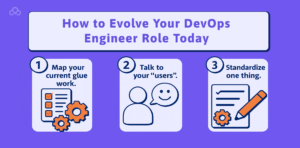
If you’re a DevOps engineer and this all feels both exciting and a bit intimidating, here are three practical first steps:
- Map your current glue work. List the repetitive tasks you do for multiple teams—pipelines, IAM, monitoring. That’s raw material for your future devops platform.
- Talk to your “users”. Ask developers what slows them down the most. You’ll hear patterns that point directly to platform features.
- Standardize one thing. Pick a single workflow—say, creating a new service—and turn it into a template everyone can use.
The future DevOps engineer is less about heroics and more about building reliable systems that let everyone move faster with less stress.
FAQs
1. Is platform engineering replacing the DevOps engineer role?
No. Platform engineering changes the focus of a DevOps engineer from manual operations to designing and running the platform that developers use.
2. Do small teams really need a DevOps platform?
Even small teams benefit from a lightweight devops platform, especially as they add more services or a second cloud.
3. How do managed services for DevOps affect in-house teams?
Devops managed services take away undifferentiated heavy lifting so in-house DevOps engineers can focus on higher-value work.
4. What’s the first skill a DevOps engineer should build for the platform era?
Start with understanding developer experience and internal product thinking, then layer deeper platform and cloud skills on top.
Do you like to read more educational content? Read our blogs at Cloudastra Technologies or contact us for business enquiry at Cloudastra Contact Us.