Organisations often adopt multiple cloud providers and multi cloud cost optimization to avoid vendor lock-in, access specialised services or optimise latency. However, the complexity of multi-cloud architectures can obscure spending patterns. Nucamp notes that 92 % of companies use multiple clouds, and multi-cloud strategies deliver significant cost and efficiency benefits. To realise these benefits, teams must monitor spending closely and respond quickly to unexpected cost spikes. Effective cloud spend analysis is the foundation for achieving true multi cloud cost optimization.
Defining Cost Anomalies
The FinOps Foundation defines a cost anomaly as an unpredicted variation in cloud spending that is larger than expected given historical patterns. Cost anomalies may indicate infrastructure misconfigurations, runaway workloads, denial-of-service attacks or pricing changes. Detecting anomalies promptly helps organisations avoid financial surprises and underlying performance issues.
Ternary’s framework describes three layers in anomaly detection: data collection, analysis and modelling, and response. Usage logs and cost metrics are collected, machine-learning models compare current behaviour to historical trends, and a response layer triggers alerts, auto-shutdowns or throttling. The response can be tuned to the severity and context of the anomaly.
Types of Anomalies in Multi-Cloud Billing
Different patterns require different detection strategies, all of which benefit from rigorous cloud spend analysis. Common anomaly types include:
|
Anomaly type |
Description |
Detection method |
Impact |
|
Usage‑driven cost spikes |
Sudden surges in compute, storage or network usage (e.g., unoptimised batch jobs) |
Time‑series analysis, moving averages |
Unexpected bills and potential throttling |
|
Drops in unit economics |
Reduced efficiency (e.g., cost per transaction increases) due to misconfigured resources |
Regression models monitoring cost‑per‑unit metrics |
Hidden inefficiencies and profitability erosion |
|
Cost per usage spikes |
Cost per GB or per API call increases due to pricing changes or region misalignment |
Anomaly detection on derived metrics |
Budget overruns and inaccurate forecasting |
|
Configuration issues |
Orphaned resources, unattached volumes, idle instances |
Rule‑based checks and heuristics |
Wasteful spending |
|
External pricing fluctuations |
Cloud provider price changes or currency swings |
External monitoring and vendor alerts |
Profitability risks |
Architecting an Anomaly-Detection System
A typical multi-cloud cost and multi cloud cost optimization anomaly detection pipeline includes:
1. Data ingestion – Collect cost and usage data via APIs (e.g., AWS Cost Explorer, Azure Cost Management, Google Cloud Billing). Normalise data into a common schema for cross-cloud comparison, which is a key step supported by managed cloud services.
2. Feature engineering – Derive metrics such as cost per user, cost per GB and per-service spend. Align usage with business dimensions (teams, projects) for enhanced cloud spend analysis.
3. Model selection – Choose time-series models (ARIMA, Prophet), unsupervised learning (k-means, isolation forest) or deep-learning techniques (LSTM, autoencoders) to detect anomalies based on historical patterns.
4. Alerting and automation – Define thresholds and notification channels (email, Slack, SMS). For critical anomalies, integrate with infrastructure automation to shut down or scale resources automatically. This automation is often built using cloud DevOps services.
5. Feedback loop – Incorporate human review of flagged anomalies to reduce false positives. Retrain models with confirmed incidents to improve accuracy.
Integrating Anomaly Detection into FinOps Practices
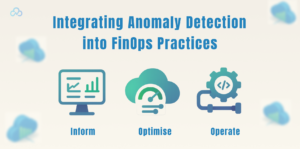
Financial operations (FinOps) provide a cultural and process framework for managing cloud costs. Anomaly detection fits naturally within FinOps cycles:
– Inform – Collect and share spending data across engineering, finance and business units. Provide dashboards that show current costs, forecasts and anomalies. Cloud savings platforms are instrumental in aggregating this critical data.
– Optimise – Use anomaly insights to right-size resources, negotiate discounts and adjust architectural decisions. Apply rightsizing, scheduling and instance reservations to reduce recurring anomalies. Devops consulting and managed cloud services often advises on the most effective multi cloud cost optimization strategies.
– Operate – Embed anomaly detection into CI/CD pipelines. Use policy-as-code to prevent deployments that violate budget thresholds. Automate remediation for well-understood anomalies. This operational efficiency is a core offering of cloud DevOps services.
Key Challenges in Multi-Cloud Anomaly Detection
While the potential benefits of automating anomaly detection are clear, implementing a robust solution in a multi-cloud environment in multi cloud cost optimization presents several significant challenges. The first major hurdle is data normalization and unification. Each cloud provider (AWS, Azure, Google Cloud, etc.) uses different terminology, data schemas, and APIs for reporting cost and usage. Creating a unified data model that accurately represents spending across all platforms is essential for cross-cloud analysis but requires extensive feature engineering and ongoing maintenance to handle provider changes. This is a complex area where managed cloud services can provide continuous oversight.
A second challenge is managing the volume and velocity of data. Modern cloud environments generate massive amounts of granular usage logs in real-time, making traditional batch processing models inadequate. The anomaly detection system must be highly scalable to ingest, process, and model this continuous stream of data efficiently.
Furthermore, the complexity of resource tagging across multiple clouds often hinders accurate cost attribution. Inconsistent tagging strategies across different engineering teams and providers can obscure which business units or projects are responsible for cost spikes, delaying remediation.
Finally, dealing with a high rate of false positives is a constant struggle. Overly sensitive models trigger unnecessary alerts, leading to “alert fatigue” and causing teams to ignore genuine incidents. Reducing false positives requires a continuous feedback loop and the integration of domain-specific knowledge to validate unusual patterns. Expert DevOps consulting and managed cloud services help tune these systems to reduce noise and improve fidelity for effective cloud spend analysis.
Future Trends and Advanced Best Practices for FinOps
The field of cloud cost management is rapidly evolving, driven by the need for greater financial predictability and efficiency. One major emerging trend is the integration of AIOps (Artificial Intelligence for IT Operations), which goes beyond simple anomaly detection to predict future cost fluctuations and provide prescriptive actions, rather than just descriptive alerts. This involves training models not only on billing data but also on operational metrics, code deployment velocity, and infrastructure health to find deeper correlations. These predictive capabilities are becoming standard features in advanced cloud savings platforms.
Another key trend is the focus on sustainability in cloud spending. Future anomaly detection will increasingly incorporate metrics related to the carbon footprint of cloud usage, allowing FinOps teams to meet both cost and environmental goals. For best practices, FinOps teams should evolve their approach to automation. They should move toward proactive policy-as-code implementation, where cost guardrails are integrated directly into CI/CD pipelines to prevent anomalous spending before deployment. This is a core competency of cloud DevOps services and devops consulting and managed cloud services.
This includes automated resource decommissioning checks and mandatory tagging enforcement. Managed cloud services providers are increasingly offering these policy-as-code implementations as part of their service catalog, enabling clients to achieve optimal multi cloud cost optimization. Additionally, fostering a culture of shared ownership is paramount; embedding small, cross-functional teams (e.g., Finance, Engineering, Product) to own the cost of specific microservices ensures that cost optimisation is a continuous, decentralized effort rather than a centralized, reactive function.
Conclusion

Optimizing cloud cost management requires automation in detecting billing irregularities across all cloud environments. Machine-based learning models have the capability to identify billing irregularities which may otherwise be overlooked by human analysts.
The use of automated responses enables organizations to avoid costly billing irregularities, thus enabling the organization to continue to have flexible budgets across multi cloud cost optimization environments.
The integration of anomaly detection into an organization’s overall FinOps (Finance + Operations) frameworks enables the organization to continually optimize their expenses while maintaining their ability to respond rapidly to changing market conditions across multiple cloud environments.
Implementation of automated anomaly detection systems within an organization’s FinOps frameworks allows organizations to transition from reactive cost management practices to active financial governance. The end result of this implementation will provide engineering, finance, and business teams with transparent and actionable information allowing for the development of a shared ownership culture necessary to achieve long-term multi cloud cost optimization.
Ultimately, the objective of using advanced techniques such as AIOps and integrated cloud savings platforms is to convert the process of analyzing complex, high volume cloud spend into a routine and automated process that will ensure predictable financial results and maximize cloud value in all environments.
Technical FAQs
1. What data sources are needed for anomaly detection?
Cost and usage data from each cloud provider, normalised into a unified schema. Additional context such as deployment pipelines, tagging, business unit mapping and currency rates improves model performance.
2. Which machine‑learning algorithms are most effective?
Seasonal decomposition of time series works well for predictable patterns; isolation forests and autoencoders handle complex, non‑linear anomalies. Ensemble approaches combining statistical and ML techniques often yield better results.
3. How do you reduce false positives?
Incorporate domain knowledge into feature engineering, use feedback loops to retrain models on confirmed anomalies and implement multi‑stage alerting. Provide contextual information (tags, owner, service) so teams can quickly verify anomalies.
4. Can anomaly detection be applied to on‑premises costs?
Yes. As long as resource utilisation and cost data are available, the same techniques apply. Normalisation is crucial when comparing on‑premise and cloud costs.
5. What’s the difference between anomaly detection and budget alerts?
Budget alerts trigger when spending exceeds a predefined threshold, whereas anomaly detection identifies unusual patterns relative to historical behaviour, even if overall spend remains within budget.
Do you like to read more educational content? Read our blogs at Cloudastra Technologies or contact us for business enquiry at Cloudastra Contact Us.