Payments are made in seconds in today’s digital economy. Customers demand speedy approvals, smooth checkouts, and no issues at all. But scammers are also moving swiftly. So, they can’t rely on old-fashioned manual reviews or systems that take too long to check anymore. They need to be able to think quickly and make good choices. At this time, risk scoring is quite critical. With real-time risk rating, businesses may see transactions immediately away. Because of this, businesses can quickly approve actual customers and stop suspicious conduct before it costs them money.
This blog will explain how risk scoring works, why it matters, and how AI is transforming the way payments are protected.
Why it’s necessary to make judgments on payments in real time
Digital payments have grown a lot. We use digital wallets, purchase online, sign up for services, and send money across borders every day. But when this growth happens, more people try to trick others.
After processing, traditional systems usually check transactions. Unfortunately, the damage has already been done by then. Chargebacks go rise, business costs go up, and customers lose trust.
On the other hand, real-time risk assessment looks at transactions immediately away. It checks a number of data points in only a few milliseconds and generates a score that illustrates how likely it is that fraud will happen. This way, businesses and risk enterprise management strategy may quickly decide whether to approve, refuse, or flag something for review.
What does it mean to score risk in payments?
Risk rating is the process of looking at transaction data to see how risky a payment might be. The system thinks about items like:
- How users tend to act
- Details about the gadget
- Place
- The amount of the deal
- How often you buy
- History of payments
How AI Risk Scoring Makes Payments Safer
Artificial intelligence has revolutionized the way we stop fraud for good. There are no set rules for AI. Instead, it uses machine learning models to look at millions of transactions and discover behavior that is unusual. For example, imagine a customer who usually buys products in Mumbai but suddenly wants to buy a lot of things from another country. This could be true, but it also makes me suspicious. An AI-powered algorithm looks at this action and compares it to historical patterns to swiftly give it a risk score.
AI risk rating also makes things more accurate by cutting down on the quantity of false positives. This means that actual clients are less likely to be turned down for no good reason. This improves the customer experience and makes more money.
Real-Time Risk Scoring’s Most Important Parts
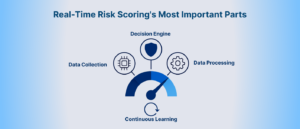
Let’s look at the most significant sections one by one so we can see how it works in real life.
- Collecting Information
To begin with, the system collects transaction data in real time. This includes details about payments, device fingerprints, IP addresses, browsing histories, and past purchases.
- Working with Data
After that, strong algorithms look over the data that was gathered in a matter of milliseconds. This is where risk scoring engines work out the odds and offer a score.
- Machine for Making Choices
Then, a decision engine checks the score against the constraints that have been set. The result will either allow the transaction, deny it, or send it in for review.
- Always learning
Lastly, feedback loops enable the model learn from real-life cases of fraud. Because of this, risk scoring gets better with time.
Benefits of Real-Time Risk Scoring
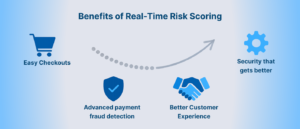
Real-time risk rating can help businesses of all sizes in many ways.
- Faster approvals
Customers have easy checkouts because decisions are made on their own. This means that fewer individuals leave their carts.
- Less money lost to scams
Advanced payment fraud detection stops dodgy deals before money is lost.
- A Better Experience for Customers
Businesses build trust and loyalty by lowering the number of false declines.
- Security that can get better
Companies can utilize AI as a service to offer smart fraud protection without having to spend a lot of money on infrastructure. So, even little firms can get protection like big enterprise risk management strategy do.
- Part of the plan for dealing with business risk
Stopping fraud is simply one part of keeping people safe. It is part of a wider approach to deal with business hazards.
Real World Examples of Use
- Platforms for online shopping
Risk scoring helps internet stores look at thousands of transactions every day in a matter of seconds. So, they stop phoney purchases while still keeping the approval rates high. Companies in the Fintech Industry
- Companies that provide subscriptions
Tools are used in recurring billing models to look for payment fraud and keep an eye on abnormal subscription patterns and account takeovers.
- Issues with putting risk scoring into practice
It’s clear that there are benefits, but they need to be carefully planned out to happen.
First, the data needs to be good. A model may not work as well if it has missing or incorrect data.
Second, companies need to achieve a balance between safety and how easy it is for users to utilize their products. Standards that are too strict could cause more false declines.
Risk Scoring in Payments: What’s Next?
Risk scoring is growing better at figuring out what will happen in the future. Instead of reacting to attempts at fraud, systems will hunt for risk before transactions happen. For instance, behavioral biometrics and real-time identification verification will help discover payment fraud more easily. Also, predictive analytics will help you spot new threats before they happen.
AI will also be more personalised for each person. The risk profile of each customer will alter over time dependent on how they act. This means that judgments will be made more quickly and correctly than ever before. Companies who buy advanced risk scoring systems will be able to stay one step ahead of scammers as digital payments become more common.
Final Thoughts
You need to score risks in real time now. It is a basic need to have safe and easy ways to pay. AI risk rating and better payment fraud detection tools let businesses make quick, data-driven decisions.
Also, AI as a service can help even small firms receive better protection without having to spend a lot of money on infrastructure. When employed as part of a bigger company risk management plan, risk scoring could be a useful way to enhance resilience and growth.
In conclusion, businesses that put smart risk scoring first today will not only combat fraud, but they will also acquire approvals faster, develop trust, and be successful in the long run in the digital economy.
Questions and Answers
-
What does it mean to give payments a risk score?
Risk scoring lets you look at transactions in real time to assess how likely they are to be fake before you accept or reject a payment.
-
How does AI risk scoring help reduce fraud?
AI risk scoring looks at trends and behavior right away. This makes it easier to spot suspicious conduct and cuts down on false declines.
-
Do small businesses really need to know their risk score in real time?
Yes, because even small businesses may be scammed, and real-time monitoring helps protect customers and money.
-
How can risk scoring help locate people who cheat on their payments?
It assigns each transaction a risk value, which allows businesses stop payments that are too risky before they lose money.
-
Can risk scoring be used with the payment methods we have now?
Yes, most modern technologies are designed to operate nicely together through AI as a service models and cloud platforms.
Do you like to read more educational content? Read our blogs at Cloudastra Technologies or contact us for business enquiry at Cloudastra Contact Us