Travel is no longer shaped by instinct alone. It is increasingly shaped by data, traveler behavior signals, AI-assisted planning and the speed at which people move from inspiration to booking. For marketing and product leaders, this shift is not a side story. It is the main story.
What makes the current moment especially important is that several changes are happening at once. The online travel market continues to expand. AI is changing how people research and plan trips. Personalization is no longer just a nice feature; it is directly influencing revenue. And the way travelers discover brands is shifting away from static search behavior toward dynamic, recommendation-led experiences.
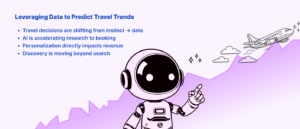
The scale of change is hard to ignore. Online bookings are projected to reach $1.07 trillion in 2025, while the broader travel sector is generating roughly $11.7 trillion in global GDP. At the same time, nearly 58% of active US travelers are using AI tools for travel-related decisions and 94% of those users trust AI recommendations as much as or more than traditional sources. For travel businesses, this means the conversation is no longer only about visibility in search. It is about visibility everywhere travelers now look for answers.
For leaders working across brand, demand generation, product and revenue, the real opportunity lies in reading these travel trends correctly and responding before the market fully resets around them.
The travel market is growing, but so is the complexity behind it
The travel industry remains one of the fastest-growing parts of the global economy, but growth is no longer simple. Behind every booking sits a mix of digital behavior, pricing sensitivity, channel preference and expectation for personalization.
The global business travel market, valued at $1,372.80 billion in 2023, is projected to reach $2,749.46 billion by 2030, growing at a 9.1% CAGR. The online travel market is also expanding sharply, moving from $354.2 billion in 2021 to a projected $1,835.6 billion by 2030, with a 14.8% CAGR. These numbers point to more than recovery or expansion. They show a structural change in how travel is researched, purchased and experienced.
Regional behavior matters here. The Asia Pacific region accounts for 36% of online travel agency sales globally and markets such as India are showing how modern travel platforms are evolving into full-service ecosystems. The rise of superapps that combine rail, hotels, buses and financial services shows how travel technology is becoming more integrated, more local and more responsive to user needs.
For marketing leaders, this matters because channel behavior is not the same across markets. North America has a more balanced mix of OTAs, direct bookings and offline channels. Europe leans more strongly toward supplier-direct bookings. Asia Pacific continues to show strong OTA dominance. The lesson is simple: one acquisition strategy will not work everywhere.
Travel discovery is being rewritten by AI
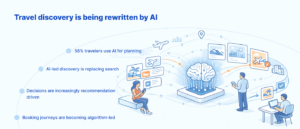
One of the most important travel trends today is not only where people book, but how they decide.
By the second half of 2025, 58% of active US travelers were using AI for something related to travel and 39% were using it specifically for planning trips. That includes tools such as ChatGPT, Google Gemini and AI-powered search experiences. This level of adoption represents a dramatic jump from 2022 and signals a deeper change in traveler behavior.
What is especially striking is that AI usage is not just about novelty. Among millennials, adoption appears to be driven heavily by efficiency. These are users trying to reduce research fatigue, compare options faster and make decisions with less friction. That makes AI useful not because it feels futuristic, but because it saves time and reduces overload.
At the same time, traditional discovery behavior is changing fast. Search engines dropped from 51% of travel research sources in late 2024 to 36% by mid-2025. In that same period, generative AI platforms rose from 6% to 15%. Social platforms held relatively steady, while travel review websites saw decline.
This is a major shift for both marketing strategy and product design.
Travel brands used to compete mainly for rankings, reviews and ad visibility. Now they also need to be understandable and recommendable inside AI systems. That means content, pricing information, brand messaging and inventory visibility all need to work in environments where an AI assistant may become the first point of contact.
A growing share of travelers is also open to letting AI do more than research. Around a quarter to a third of travelers across geographies say they are interested in booking travel inside a generative AI platform or delegating the process to an AI assistant. That changes the customer journey in a meaningful way. It reduces direct interaction. It increases algorithmic mediation. And it puts pressure on brands to build trust before the customer ever lands on their site.
Trust in AI is high, but travelers still verify
The strong adoption of AI in travel would matter less if travelers did not trust it. But the trust numbers are unusually high.
Research from 2026 showed that 94% of AI users trust AI recommendations at least as much as traditional sources and 78% have booked travel based primarily on AI recommendations. That does not mean travelers are acting blindly. The behavior pattern is more layered.
Many travelers are using AI as a first filter. It helps them narrow choices, frame options and simplify planning. They then use OTAs, reviews and other familiar channels as a way to confirm the decision. In other words, AI is becoming the front end of travel research, while traditional platforms still play an important validation role.
For travel brands, this creates a new two-step challenge:
- Be visible when AI is helping travelers narrow options
- Maintain trust when travelers move into the verification phase
That is where travel data analytics becomes especially valuable. The better a company understands where people discover, compare, hesitate and finally book, the easier it becomes to design experiences that support both stages.
The numbers behind travel trends tell a clear story
Several market signals stand out for teams working in B2B travel, travel marketing and product strategy.
The business travel segment continues to show strong momentum. The Asia Pacific region accounted for around 32% of business travel revenue in 2023. Solo business travelers represented 51% of business travel revenue, while corporate travel made up 66% of business travel activity. Travel for marketing purposes alone accounted for 37% of business travel revenue in 2023.
The United States business travel market is expected to grow at 9.1% CAGR from 2024 to 2030, with notable momentum in technology, finance and pharmaceuticals. Europe is projected to grow even faster at 10.6% CAGR and 67% of Europeans expect to travel the same or more in 2025 compared with 2019.
Another major area to watch is sustainable tourism. This market is estimated at $1.9 trillion in 2025 and is projected to reach $14.4 trillion by 2035, growing at 22.6% CAGR. That is not a niche signal. It is a large commercial shift tied to changing traveler values. Growth is especially visible in China and India, showing how sustainability-linked demand is growing across very different markets.
At the same time, marketing teams are under more pressure to prove results. Marketing budgets reached 9.4% of company revenues in 2025, up from 7.7% in 2024, yet much of that increase comes with expectations of greater efficiency. Organizations using AI in sales and marketing report average revenue increases of 41%, customer acquisition cost reductions of 32% and marketing overhead reductions of 10.8%. Teams also report 44% higher productivity, with average time savings of 11 hours per week per team member.
The message is straightforward: budget conversations in travel are now tied directly to performance and predictive analytics in travel is becoming part of that performance story.
Personalization is no longer optional because it affects revenue directly
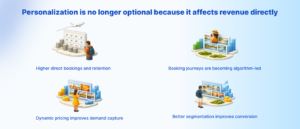
One of the clearest patterns in the current market is that data-led personalization is delivering measurable returns.
Hilton used AI to refine customer segmentation and dynamic pricing by analyzing booking behavior and loyalty data, leading to a 5% to 8% revenue increase along with better guest satisfaction. Marriott used machine learning in group pricing, generating an 8% to 10% boost in RevPAR and improving occupancy in lower-demand periods. Hyatt achieved a $40 million revenue boost within six months through AI-powered personalization efforts.
These examples matter because they move personalization out of the “nice experience” category and place it firmly inside revenue strategy.
The commercial upside does not stop there. AI-powered approaches have been linked to:
- 10% to 15% increases in RevPAR
- 20% to 35% growth in ancillary revenue
- 25% average increase in direct bookings
- Administrative cost reductions up to 20%
- Labor cost reductions of 12%
- Maintenance expense reductions up to 40% in some cases
- 15% to 25% higher guest satisfaction scores
- 20% to 40% improvements in loyalty metrics
These numbers explain why travel management software, pricing systems and CRM layers are becoming more tightly connected. When behavioral data, loyalty information, booking patterns and pricing logic work together, travel companies can create more relevant offers and reduce waste across both marketing and operations.
Predictive analytics in travel is changing planning before demand even appears
Real-time personalization gets attention, but predictive analytics in travel may be even more important strategically.
By analyzing historical behavior and current signals, travel businesses can forecast demand, allocate inventory more effectively and place marketing spend where it is most likely to perform. Hotels are already using predictive models to improve seasonal forecasting. Airlines use them to estimate passenger demand and delays. Destination marketers are using them to tailor campaigns and respond to shifts in interest while those shifts are still forming.
This matters because demand is often won before it becomes visible in a booking dashboard.
A strong example comes from the FIFA World Cup 2026 booking pattern. Once the schedule was released, several US host markets saw year-over-year booking increases of more than 1,000%, with booking windows stretching 60 to 120+ days in advance. That kind of early movement is exactly where predictive systems create an advantage. They allow teams to plan inventory, pricing, messaging and acquisition strategy before competitors react.
The last 6 to 12 months have changed the travel stack
Recent developments make one thing very clear: AI is moving from assistant to active participant in travel planning.
Large technology players launched agentic systems during 2025 that can plan, compare and act on behalf of users. In travel, this means AI is beginning to move from helping travelers research to helping them complete actions. Airbnb’s AI-native app is a visible sign of this direction, using multiple models to support customer service and trip planning. Lufthansa’s AI assistant shows how travel companies can use AI operationally as well, planning routes with efficiency and emissions in mind.
Revenue management is also evolving. By 2025, AI was rated 4.5 out of 5 in importance by global hoteliers and 86.1% were using it to predict market trends and demand. 69.4% used it for real-time pricing adjustments, while 58.3% used it to monitor competitor pricing.
There is also a growing connection between digital identity, payments and autonomous booking. With digital ID wallets expected to reach half a billion smartphone users by 2026, the infrastructure for agent-led transactions is becoming more realistic. Crypto payment interest is also rising, with 22% of US travelers showing interest in paying this way.
At the same time, the industry is dealing with a workforce gap. Travel and tourism supported 357 million jobs worldwide in 2024 and is projected to support 371 million in 2025, yet global worker demand is expected to outpace supply by more than 43 million by 2035. That affects service delivery, AI adoption and data quality, because strong systems still depend on skilled teams.
What CMOs and product leaders should do next
The most practical response to these travel trends is not to chase every new tool. It is to build stronger foundations.
Here are the priorities that stand out most clearly from the market:
- Strengthen data governance so pricing, loyalty, campaign and behavioral data can actually work together
- Invest in predictive analytics to forecast demand earlier and spend smarter
- Prepare content for AI-led discovery, not just traditional search visibility
- Focus on direct relationships and loyalty, because strong brand preference offers protection against AI-driven disintermediation
- Use full-funnel measurement, especially as journeys increasingly span AI, reviews, direct channels and OTAs
- Segment audiences by decision style, including how and when they use AI
- Integrate sustainability into positioning where it aligns with traveler expectations and booking behavior
- Train teams to work with AI effectively, rather than treating AI as a separate layer disconnected from operations
The common thread across all of this is simple: the companies that win will not be the ones with the most data. They will be the ones that can turn that data into decisions faster, more clearly and more consistently.
What This Means for Travel Leaders
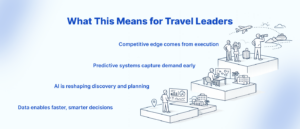
The biggest shift in travel right now is not just digital growth. It is the move toward intelligent, data-backed decision-making across discovery, personalization, pricing and loyalty. That is why travel trends matter far beyond market reports. They are now shaping how travel brands build demand, how products are designed and how revenue is captured.
For marketing and product leadership teams, the direction is becoming clearer. Travelers are using AI more often. Discovery is becoming less dependent on old search behavior. Personalization is proving its financial value. Sustainability is becoming commercially relevant. And predictive analytics in travel is giving companies a better chance to act before the market fully moves.
The brands that adapt well will be the ones that pair strong travel data analytics with human judgment, clear brand positioning and better customer understanding. They will not just react to change. They will be better prepared for it. And if your team is rethinking how to respond to these travel trends across marketing, product or travel management software strategy, this is the right moment to Book a call and turn the data into a sharper plan.