A fraud detection system helps fintech companies, banks, NBFCs, and payment platforms identify suspicious transactions, risky accounts, mule activity, and abnormal payment behaviour before financial losses increase.
For fintech teams, fraud is no longer limited to fake accounts or stolen cards. It now appears through account takeover, mule rings, scam-led payments, synthetic identities, velocity abuse, smurfing patterns, and suspicious activity across UPI, IMPS, RTGS, SWIFT, ISO 20022, and cross-border payment flows.
That is why modern fintech companies need a fraud detection system that can monitor payments in real time, score transaction risk, flag suspicious activity, and help teams stop fraud before funds move.
What Problem Does a Fraud Detection System Solve?
Fintech companies face one major problem: payments need to move fast, but fraud also moves fast.
A payment platform may need to stop a suspicious UPI transaction before it settles. A bank may need to detect account takeover behaviour before money leaves the account. An NBFC may need to identify mule-linked activity before it becomes part of a wider fraud network. A cross-border payment provider may need to detect unusual behaviour across different rails, currencies, and transaction formats.
The problem becomes harder when fraud checks are manual or delayed.
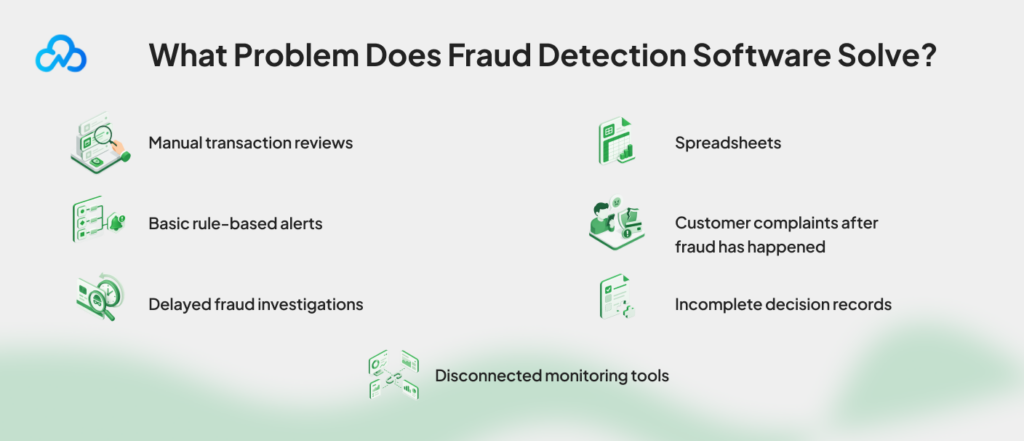
Without a proper fraud detection system, teams often depend on:
- Manual transaction reviews
- Basic rule-based alerts
- Delayed fraud investigations
- Disconnected monitoring tools
- Spreadsheets
- Customer complaints after fraud has happened
- Incomplete decision records
These methods may work when payment volume is low. But once a fintech platform starts processing thousands or millions of transactions, fraud signals become harder to catch manually.
A fraud detection system solves this by helping teams monitor payment activity, score transaction risk, detect unusual patterns, and decide whether a payment should pass, be flagged, or be blocked.
What Is a Fraud Detection System?
A fraud detection system is a technology platform that helps financial companies identify suspicious activity, detect risky transaction patterns, and reduce fraud losses across payments, customer accounts, onboarding journeys, and digital financial workflows.
In fintech and banking, a fraud detection system is commonly used for:
- Real-time payment monitoring
- Suspicious transaction detection
- Payment risk scoring
- Account takeover detection
- Mule account detection
- Velocity pattern detection
- Customer behaviour monitoring
- Alert prioritization
- Fraud case management
- Audit trail creation
- Fraud reporting
In simple terms, it helps risk and compliance teams answer questions like:
- Is this payment normal or suspicious?
- Is this account behaving differently than usual?
- Is this transaction linked to mule activity?
- Is the payment velocity unusual?
- Should this transaction pass, be flagged, or be blocked?
- Can we prove why a fraud decision was made?
- Are high-risk alerts being reviewed on time?
For fintech companies, a fraud detection system is not just a security tool. It is a payment risk control layer that helps teams move fast without losing visibility.
Why Do Fintech Companies Need a Fraud Detection System?
Fintech companies need a fraud detection system because financial activity is now instant, digital, and high-volume.
Customers expect quick onboarding, instant transfers, real-time payment confirmation, and smooth digital experiences. Fraudsters take advantage of the same speed. They test weak controls, create mule accounts, use stolen credentials, manipulate payment flows, and move funds quickly before teams can respond.
This makes fraud difficult to manage through manual review alone.
A suspicious payment may pass before it is checked. A risky account may stay active. A mule network may spread across multiple accounts. A scam-led transaction may only be detected after the customer reports a loss.
A fraud detection system reduces these gaps by monitoring payment activity continuously, identifying suspicious behaviour earlier, and giving risk teams faster decision support.
For fintech companies that want to scale safely, fraud control cannot depend only on after-the-fact investigation. It needs real-time scoring, strong fraud detection tools, clear workflows, and proper audit records.
How Big Is the Fraud Problem in Financial Services?
Fraud is increasing because digital financial activity is growing quickly.
According to the Federal Trade Commission, consumers reported losing more than US$12.5 billion to fraud in 2024, a 25% increase from the previous year.
The FBI’s 2024 Internet Crime Report reported that internet crime losses exceeded US$16 billion in 2024, with phishing, spoofing, extortion, and personal data breaches among the most reported categories.
The global picture is even larger. Nasdaq’s 2024 Global Financial Crime Report reported around US$485.6 billion in projected global losses from fraud scams and bank fraud schemes in 2023, along with US$3.1 trillion in illicit funds moving through the global financial system.
Nasdaq Verafin’s 2026 Global Financial Crime Report also estimates US$579.4 billion in losses from fraud scams and bank fraud schemes, along with US$4.4 trillion in illicit financial activity globally in 2025.
These numbers show why fintech companies, banks, NBFCs, and payment platforms need stronger fraud monitoring. As payment volume grows, delayed fraud detection can quickly become expensive.
What Are the Benefits of a Fraud Detection System?
The biggest benefit of a fraud detection system is that it helps financial teams detect risky activity before losses grow.
Instead of waiting for chargebacks, customer complaints, internal escalations, or post-settlement investigations, teams can monitor risk signals earlier and take action faster.
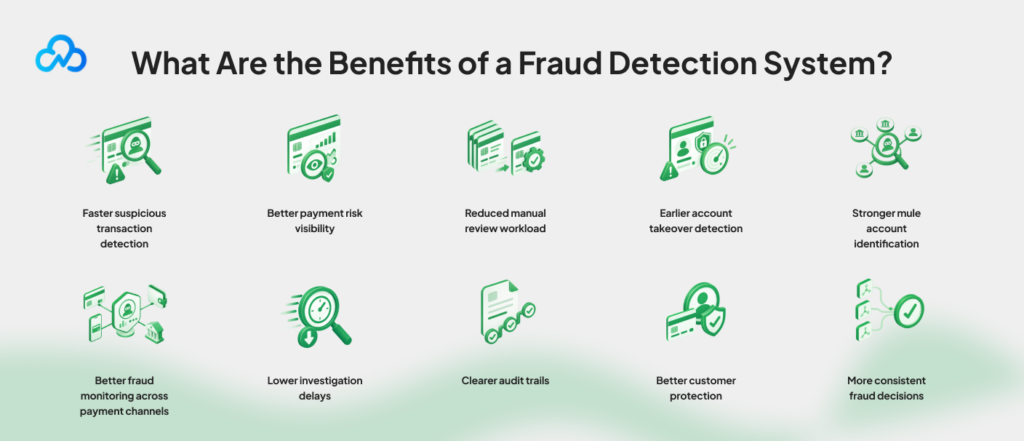
The main benefits include:
- Faster suspicious transaction detection
- Better payment risk visibility
- Reduced manual review workload
- Earlier account takeover detection
- Stronger mule account identification
- Better fraud monitoring across payment channels
- Lower investigation delays
- Clearer audit trails
- Better customer protection
- More consistent fraud decisions
For fintech companies, this matters because fraud is not only a financial loss problem. It also affects customer trust, compliance, operational stability, and brand reputation.
Key Use Cases of a Fraud Detection System in Fintech
1. Real-Time Payment Monitoring
Real-time payment monitoring helps fintech teams detect suspicious activity while the transaction is still active.
This is important because many fraud attempts happen within seconds. A fraudster may move money through multiple accounts, test small transactions, or complete several transfers before a manual review team can react.
A fraud detection system can flag patterns such as:
- Sudden high-value payments
- Multiple failed payment attempts
- Transactions from unusual locations
- Rapid fund movement
- Multiple accounts using similar details
- New accounts making large payments
- Behaviour that does not match normal customer activity
For banks, wallets, and payment platforms, real-time monitoring is important because the best time to stop fraud is before funds move.
2. Payment Risk Scoring
Payment risk scoring helps fintech teams decide whether a transaction should pass, be flagged, or be blocked.
Instead of treating every transaction the same way, a fraud detection system can score payments based on risk signals such as:
- Transaction amount
- Payment velocity
- Customer history
- Device details
- Location
- Account age
- Linked accounts
- Failed attempts
- Beneficiary behaviour
- Previous suspicious activity
This helps genuine payments move faster while risky payments get reviewed or stopped.
For payment platforms, risk scoring is especially useful because decisions often need to happen before settlement.
3. Mule Account Detection
Mule accounts are used to receive, transfer, or hide illegally obtained funds.
At first, mule accounts may look normal. They may be opened with real identities, low transaction history, and regular-looking activity. The risk becomes visible when funds start moving quickly through the account.
A fraud detection system can help identify mule signals such as:
- Rapid incoming and outgoing transfers
- Multiple accounts linked to the same device or identity pattern
- Sudden activity after a dormant period
- Small test transactions followed by larger transfers
- Repeated movement between connected accounts
- Unusual beneficiary patterns
- Pass-through transaction behaviour
For fintech companies, detecting mule accounts early is important because mule activity can connect the platform to wider fraud and financial crime networks.
4. Account Takeover Detection
Account takeover happens when a fraudster gains access to a real customer account and uses it to move money, change details, or commit fraud.
This can be difficult to detect because the account already exists. The customer profile may look legitimate, and basic identity checks may not catch the takeover once the fraudster is inside.
A fraud detection system can identify account takeover signals such as:
- New device login
- Sudden password reset
- Unusual location change
- Abnormal transaction behaviour
- New beneficiary added quickly
- Large transaction after account changes
- Multiple failed login attempts
For banks, wallets, neobanks, and lending platforms, account takeover detection is important because the financial and trust impact can be high.
5. Velocity Abuse Detection
Velocity abuse happens when fraudsters use speed and volume to bypass weak controls.
This may include repeated small transactions, multiple failed attempts, rapid beneficiary changes, frequent account activity, or sudden fund movement across connected accounts.
A fraud detection system can help detect velocity patterns such as:
- Too many transactions in a short period
- Repeated failed payment attempts
- Fast movement from new accounts
- Multiple small transfers before a large payment
- Sudden rise in transaction frequency
- Multiple accounts using similar behaviour
Velocity monitoring is important because fraudsters often test controls before attempting larger fraud.
6. Fraud Analytics and Reporting
Fraud teams need more than alerts. They also need to understand where fraud is coming from, which patterns are growing, and which controls need improvement.
This is where fraud analytics software becomes useful.
It helps teams analyze:
- Fraud trends
- High-risk payment corridors
- Suspicious user segments
- Mule account patterns
- Alert volumes
- False positive trends
- Case outcomes
- Rule performance
- Recovery and loss patterns
Better analytics helps risk leaders make stronger decisions about rules, monitoring, staffing, investigation priorities, and fraud controls.
7. AI-Based Fraud Detection
Fraud patterns keep changing. A rule that works today may not catch the next fraud pattern tomorrow.
That is why many financial institutions are exploring anti fraud ai to detect suspicious behaviour that may not fit basic rule-based checks.
AI-driven models can help detect hidden patterns across transactions, devices, accounts, payment flows, and user behaviour. This is useful when fraudsters change tactics, create new mule networks, or use different transaction patterns to avoid traditional rules.
AI should not replace fraud teams completely. But it can help teams reduce noise, find hidden signals earlier, and focus investigation time on cases that need attention.
8. Fraud Case Management
Detecting fraud is only one part of the process. Teams also need to investigate alerts, assign cases, record actions, and close reviews properly.
A fraud detection system can support case management by keeping important details in one place, such as:
- Alert information
- Customer profile
- Transaction history
- Risk score
- Reviewer notes
- Escalation status
- Decision history
- Supporting evidence
This is useful for fraud teams, compliance teams, internal reviews, audits, and reporting.
Common Fraud Detection Challenges in Fintech
Manual Reviews Are Too Slow
Manual fraud reviews can delay decisions and create backlogs. As customer and payment volume grows, manual review becomes harder to scale.
Rule-Based Alerts Miss New Fraud Patterns
Basic rules can catch known fraud patterns, but fraudsters often change behaviour to avoid detection. This makes rule-only systems less reliable over time.
False Positives Hurt Customer Experience
If too many genuine payments are flagged, customers may face unnecessary delays. This can affect trust, conversion, and customer experience.
Fraud Data Is Scattered
Customer details, transaction history, login behaviour, device data, payment events, and fraud alerts often sit in different systems. This makes it difficult to see the full risk picture.
Fraud Is Detected Too Late
When fraud is detected after funds have moved, recovery becomes harder. Early detection gives teams a better chance to reduce losses.
Teams Lack Clear Decision Trails
If fraud decisions are not recorded clearly, it becomes difficult to explain why a payment was passed, flagged, or blocked during internal reviews or audits.
What Features Should a Fraud Detection System Have?
A strong fraud detection system should include:
- Real-time transaction monitoring
- Payment risk scoring
- Suspicious payment alerts
- Mule account detection
- Account takeover detection
- Velocity pattern detection
- Device and behaviour analysis
- Custom rule engine
- AI-based pattern detection
- Alert prioritization
- Fraud case management
- Reporting dashboard
- API integration
- Audit trails
- Role-based access
- Secure data handling
For fintech companies, the most important features are real-time monitoring, intelligent alerts, risk scoring, investigation workflows, audit trails, and clear reporting.
How SecureFlow Helps Fintech Companies Detect Payment Risk Faster
SecureFlow is built for fintech companies, banks, NBFCs, payment platforms, and financial service providers that need to detect payment risk before money settles.
According to the SecureFlow product page, the platform scores UPI, IMPS, RTGS, SWIFT, ISO 20022, and cross-border payments against configured rules, sanctions signals, velocity patterns, mule signals, and other risk indicators when a payment is initiated.
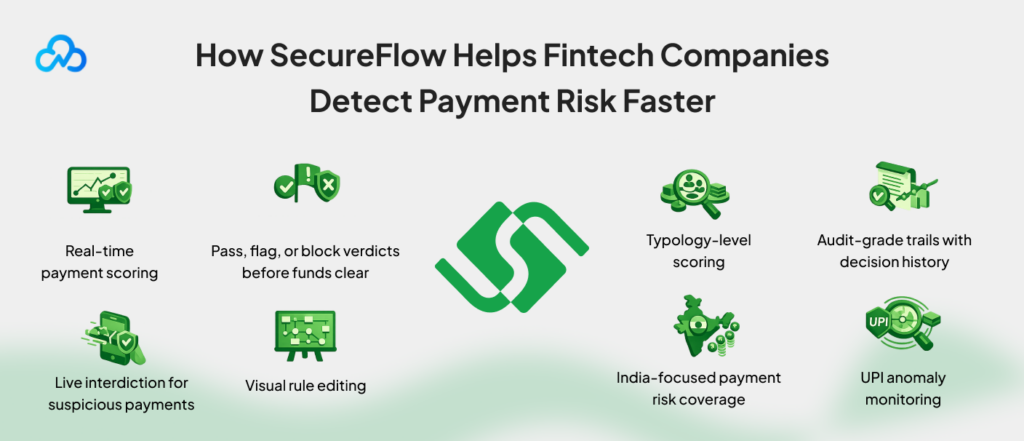
SecureFlow helps teams with:
- Real-time payment scoring
- Pass, flag, or block verdicts before funds clear
- Live interdiction for suspicious payments
- Visual rule editing for risk and compliance teams
- Typology-level scoring for mule rings, smurfing, account takeover, and velocity abuse
- Audit-grade trails with decision history
- India-focused payment risk coverage
- UPI anomaly monitoring
- Native ISO 20022 support
- Faster fraud investigation workflows
Instead of waiting until after settlement, SecureFlow helps teams detect suspicious payment activity earlier and take action at the payment rail level.
For fintech companies that want stronger fraud monitoring without slowing genuine customers, SecureFlow gives risk and compliance teams a structured way to monitor payments, tune rules, and act before fraud becomes a recovery problem.
Who Should Use a Fraud Detection System?
A fraud detection system is useful for:
- Fintech companies
- Banks
- NBFCs
- Digital lenders
- Payment platforms
- Neobanks
- Wallet companies
- Embedded finance platforms
- Merchant payment platforms
- Loan servicing companies
- Insurance technology companies
- Cross-border payment providers
Any company handling digital payments, onboarding, lending, customer accounts, or financial transactions should consider using a fraud detection system.
Do you like to read more educational content? Read our blogs at Cloudastra Technologies or contact us for business enquiry at Cloudastra Contact Us.
FAQs
1. What is a fraud detection system?
A fraud detection system is a platform that helps companies identify suspicious transactions, risky accounts, unusual behaviour, and possible fraud before it causes financial loss or customer harm.
2. Why do fintech companies need a fraud detection system?
Fintech companies need a fraud detection system because they process high volumes of digital payments, customer data, onboarding requests, and financial activity. Manual checks are often too slow to detect fraud at scale.
3. What are the main use cases of a fraud detection system in fintech?
The main use cases include real-time payment monitoring, payment risk scoring, mule account detection, account takeover detection, velocity abuse detection, fraud analytics, and case management.
4. How does SecureFlow help with payment fraud detection?
SecureFlow helps fintech teams score payments, detect suspicious activity, generate pass, flag, or block verdicts before funds settle, support live interdiction, and maintain audit-grade trails for fraud decisions.
5. What features should fintech companies look for in a fraud detection system?
Fintech companies should look for real-time transaction monitoring, payment risk scoring, mule account detection, account takeover detection, velocity monitoring, AI-based pattern detection, case management, audit trails, and API integration.