RiskIntel is a customer risk and compliance platform that helps fintech companies, NBFCs, digital lenders and banks centralise customer screening, risk scoring and compliance decisions.
It brings AML checks, sanctions screening, PEP screening, watchlist monitoring, high-risk customer identification, compliance alerts and audit-ready records into one structured workflow.
Financial institutions often complete these checks through separate tools, spreadsheets, emails and manual approvals. This creates gaps between customer information, screening results, risk scores and final onboarding decisions.
RiskIntel helps teams connect these activities so they can identify risky customers faster, prioritise high-risk cases and reduce unnecessary delays for legitimate applicants.
In simple terms, RiskIntel helps financial institutions answer one important question:
Is this customer safe enough to onboard and continue serving?
What Problem Does RiskIntel Solve?
Fintech companies need to onboard customers quickly while meeting AML, KYC and financial crime compliance requirements.
As customer volume increases, compliance teams must review more identity records, sanctions results, PEP matches, watchlist alerts, business information and customer risk factors.
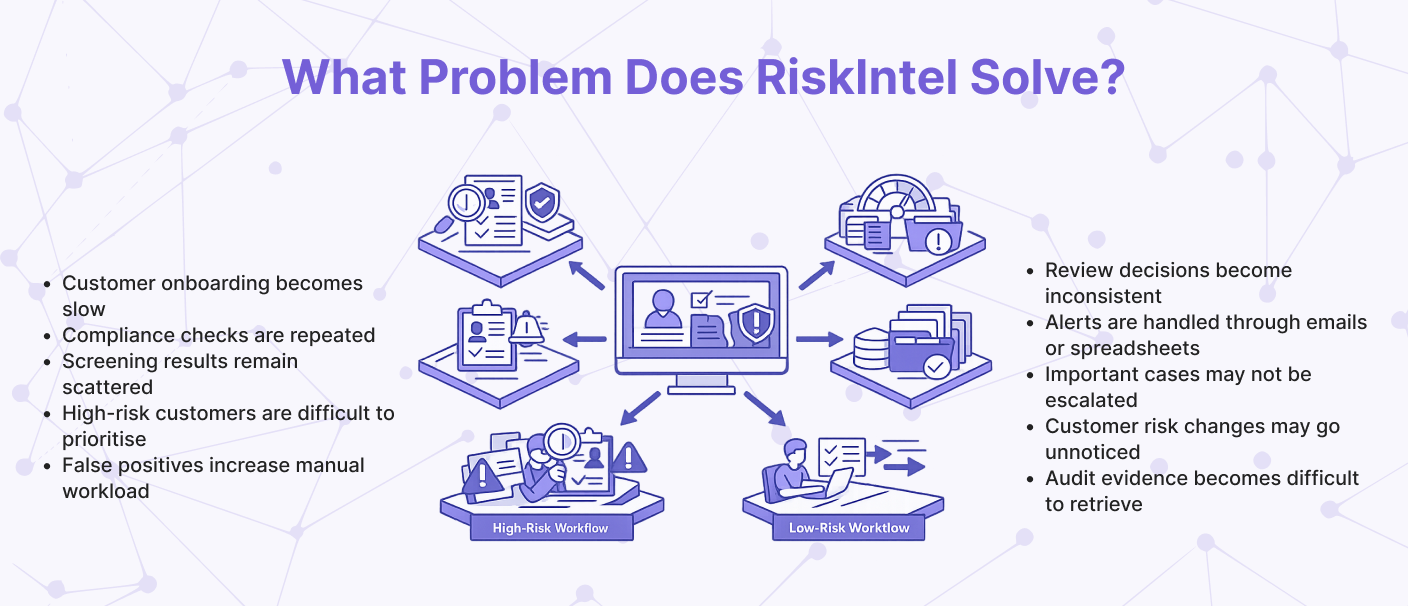
When these checks are handled manually or through disconnected systems, several problems can occur:
- Customer onboarding becomes slow
- Compliance checks are repeated
- Screening results remain scattered
- High-risk customers are difficult to prioritise
- False positives increase manual workload
- Review decisions become inconsistent
- Alerts are handled through emails or spreadsheets
- Important cases may not be escalated
- Customer risk changes may go unnoticed
- Audit evidence becomes difficult to retrieve
These processes may work when a company handles a small number of customers.
However, they become difficult to manage when a fintech platform starts onboarding thousands or millions of users.
RiskIntel solves this problem by centralising customer screening, risk assessment, alert management and compliance decision records.
Instead of reviewing every customer in the same way, teams can use risk-based workflows to apply more attention to high-risk cases and allow lower-risk customers to move through onboarding faster.
What Is RiskIntel?
RiskIntel is a compliance risk platform designed for fintech companies and financial institutions.
It helps compliance and risk teams identify, evaluate and monitor customer-related financial crime risks.
The platform can support:
- AML compliance checks
- Sanctions screening
- PEP screening
- Watchlist monitoring
- Customer risk scoring
- High-risk customer identification
- Customer due diligence
- Enhanced due diligence
- Compliance alert generation
- Risk-based onboarding
- Ongoing customer monitoring
- Compliance case review
- Audit-ready recordkeeping
- Compliance reporting
RiskIntel brings these activities together so teams can see a more complete customer-risk profile.
It helps compliance teams answer practical questions such as:
- Is the customer present on a sanctions list?
- Is the customer a politically exposed person?
- Does the customer appear on a relevant watchlist?
- Does the customer require enhanced due diligence?
- Is the customer low, medium or high risk?
- Are important customer records missing?
- Has the customer’s risk changed after onboarding?
- Should the customer be approved, reviewed or rejected?
- Who reviewed the alert?
- Why was the final decision made?
- Can the institution prove its process during an audit?
RiskIntel is not only a customer screening tool.
It is a structured system for connecting screening results with customer risk and compliance decisions.
Why Do Fintech Companies Need RiskIntel?
Fintech companies operate in a fast-moving environment.
Digital lenders may process applications from customers across multiple locations. Payment companies may onboard individuals, merchants and businesses. NBFCs may need to assess borrowers, directors, beneficial owners and related parties.
Every new customer can introduce financial crime, regulatory and reputational risk.
A customer may appear low risk during basic identity verification but present additional concerns during sanctions, PEP or watchlist screening.
A business customer may have complex ownership relationships that require deeper review.
An existing customer’s risk may also change after onboarding.
For example:
- The customer may become a PEP
- A new sanctions match may appear
- The customer’s business activity may change
- New adverse information may become available
- Transaction behaviour may become unusual
- A related entity may be flagged
- Required documents may expire
- The customer may move into a higher-risk geography
This is why customer screening should not be treated as a one-time onboarding activity.
RiskIntel helps financial institutions manage customer risk throughout the relationship.
Why Are Manual Compliance Checks Difficult to Scale?
Manual compliance checks require teams to search different databases, review documents, compare names and record decisions.
This process becomes difficult when customer volume increases.
Screening Data Is Scattered
Sanctions results, PEP information, customer documents, watchlist alerts and risk notes may exist in different systems.
Compliance analysts must move between these systems to understand the complete customer profile.
Too Many False Positives Are Generated
Name screening can produce possible matches that are not connected to the customer.
Common names, spelling variations, incomplete dates of birth and transliteration differences may create unnecessary alerts.
When every alert receives the same priority, compliance teams spend too much time reviewing low-risk cases.
Customer Risk Is Assessed Inconsistently
Different analysts may interpret the same risk factors differently.
One analyst may classify a customer as medium risk, while another may classify a similar customer as high risk.
A structured scoring process helps reduce this inconsistency.
Onboarding Becomes Slow
When compliance checks require several manual approvals, legitimate customers may wait days for a decision.
This can increase onboarding abandonment and affect customer experience.
Audit Evidence Is Difficult to Find
Compliance teams must be able to show:
- Which checks were performed
- When the customer was screened
- Which alerts were generated
- Who reviewed the alert
- What evidence was considered
- Why the decision was made
- Whether the case was escalated
- What the final outcome was
When this information is stored across spreadsheets, emails and separate tools, audit preparation becomes difficult.
How Does RiskIntel Work?
RiskIntel works by collecting customer information, performing compliance checks, combining risk signals, calculating a customer risk score and recording the final decision.
1. Customer Information Is Collected
The process begins with customer and onboarding information.
This may include:
- Full name
- Date of birth
- Address
- Nationality
- Country of residence
- Identification number
- PAN details
- Business type
- Occupation
- Source of funds
- Expected account activity
- Customer category
- Business registration information
- Directors
- Beneficial owners
- Related entities
- Geographic exposure
- Products requested
- Previous compliance history
The available information depends on whether the customer is an individual or a business.
Complete and accurate data improves the quality of screening and risk scoring.
2. AML and Compliance Checks Are Performed
RiskIntel can help compliance teams perform the required customer-risk checks.
These may include:
- Identity-related risk checks
- Sanctions screening
- PEP screening
- Watchlist monitoring
- High-risk geography checks
- Business-type risk checks
- Customer category checks
- Related-party screening
- Beneficial ownership review
- Existing alert review
These checks help identify whether the customer presents additional financial crime or regulatory risk.
3. Sanctions Results Are Analysed
Sanctions screening helps determine whether a customer, business or related party may be connected to a restricted person or entity.
A possible match may be evaluated using:
- Full name
- Name variations
- Date of birth
- Nationality
- Address
- Identification details
- Organisation name
- Associated entities
- Sanctions programme
- Match confidence
A possible sanctions match should not automatically be treated as a confirmed match.
Compliance teams need enough information to distinguish between a true match and a false positive.
RiskIntel helps organise this review process and maintain the reasoning behind the decision.
4. PEP Results Are Analysed
A politically exposed person is someone who holds or has held a prominent public position.
PEP status does not automatically mean that a customer is involved in criminal activity.
However, PEPs may require additional review because their role can create greater exposure to corruption, bribery or misuse of public funds.
PEP screening may consider:
- Current public position
- Previous public position
- Country
- Level of political influence
- Close associates
- Family relationships
- Source of funds
- Source of wealth
- Customer activity
- Other risk indicators
RiskIntel helps route possible PEP cases for enhanced due diligence instead of treating every customer as equally risky.
5. Watchlist Results Are Reviewed
Watchlist monitoring helps compare customers and related parties with relevant risk databases.
These may include:
- Regulatory watchlists
- Enforcement lists
- Criminal watchlists
- Internal blacklists
- High-risk entity lists
- Adverse information databases
- Sanctions lists
- PEP databases
Possible matches can be prioritised based on the strength and relevance of the available information.
6. Customer Risk Signals Are Combined
A single risk signal may not be enough to classify a customer as high risk.
For example, a customer living in a higher-risk location may still have a legitimate profile.
However, several signals appearing together may require deeper review.
For example:
High-risk geography + complex ownership + sanctions-related entity match
This combination may require enhanced due diligence.
Another example may be:
PEP status + unexplained source of wealth + high-risk business activity
This may require senior compliance approval.
Another example may be:
Incomplete documentation + inconsistent business information + previous compliance alert
This may indicate onboarding risk.
RiskIntel combines relevant signals to create a more complete customer-risk view.
7. A Customer Risk Score Is Created
RiskIntel can help classify customers according to risk.
The customer may be classified as:
- Low risk
- Medium risk
- High risk
- Prohibited or unacceptable risk
The score may be based on factors such as:
- Customer type
- Nationality
- Country of residence
- Business activity
- Product risk
- Delivery channel
- Transaction expectations
- Sanctions results
- PEP status
- Watchlist matches
- Beneficial ownership
- Source of funds
- Source of wealth
- Related entities
- Previous alerts
- Documentation quality
The institution can configure the importance of each factor according to its risk policy.
8. A Compliance Decision Is Returned
Based on screening results and risk level, the customer may be:
- Approved
- Approved with monitoring
- Sent for manual review
- Sent for enhanced due diligence
- Escalated to a senior reviewer
- Asked to provide additional documents
- Temporarily placed on hold
- Rejected
- Restricted from a particular product
Low-risk customers may move through onboarding faster.
Medium-risk customers may require additional verification.
High-risk customers may require enhanced due diligence and senior approval.
9. The Decision Is Recorded
RiskIntel can maintain a complete compliance decision trail.
This may include:
- Customer details
- Screening date
- Data sources checked
- Possible matches
- Customer risk score
- Risk factors
- Analyst notes
- Documents reviewed
- Escalation history
- Reviewer information
- Final decision
- Decision reason
- Approval timestamp
- Future review date
This creates an audit-ready record for each customer.
What Compliance Risks Can RiskIntel Help Identify?
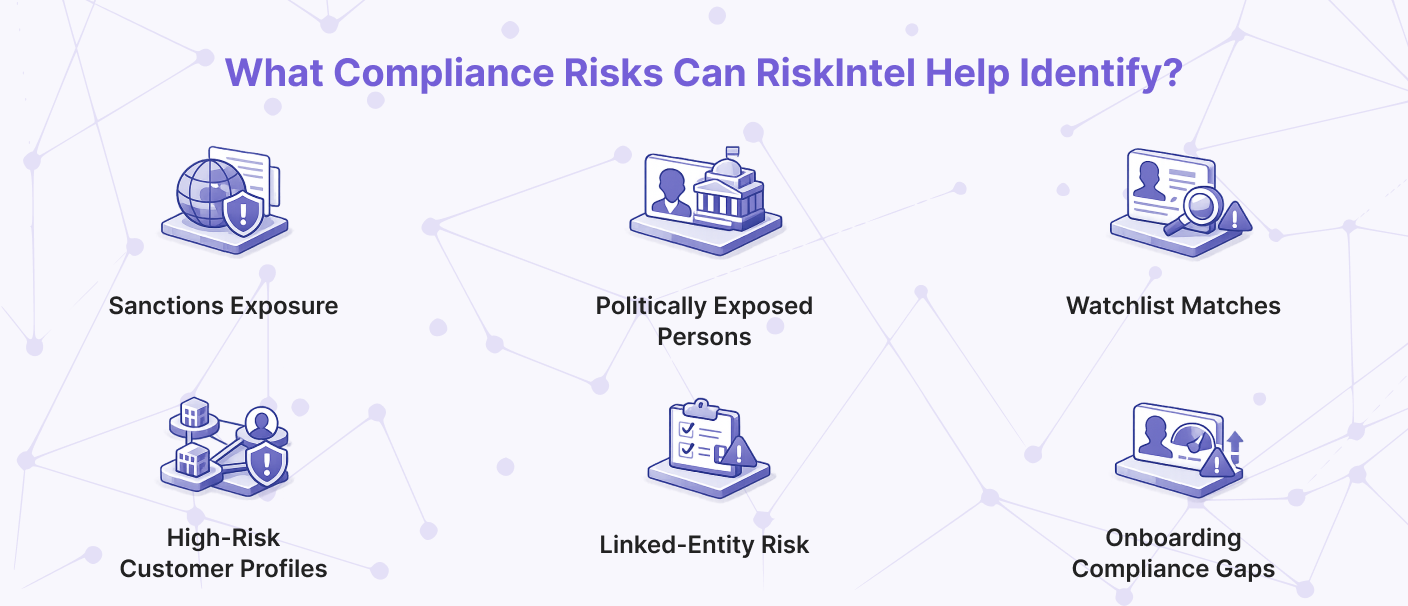
Sanctions Exposure
RiskIntel can help identify customers or related entities that may match relevant sanctions records.
Possible matches can be routed to compliance teams for proper investigation before onboarding or continued service.
Politically Exposed Persons
The platform can help identify customers who may be politically exposed or connected to a politically exposed person.
These customers may require enhanced due diligence and stronger ongoing monitoring.
Watchlist Matches
RiskIntel can help compare customers with relevant watchlists and prioritise possible matches for review.
High-Risk Customer Profiles
A customer may be considered high risk because of:
- Geography
- Business activity
- Product use
- Ownership structure
- Source of funds
- Sanctions exposure
- PEP status
- Previous alerts
- Connected entities
- Expected transaction activity
RiskIntel helps bring these factors together into one customer-risk profile.
Linked-Entity Risk
A customer may appear low risk individually but have connections to higher-risk directors, beneficial owners, businesses or related parties.
RiskIntel can support screening across these relationships.
Onboarding Compliance Gaps
The platform can help identify:
- Missing documents
- Incomplete customer information
- Unresolved alerts
- Expired records
- Missing approvals
- Inconsistent risk classifications
- Cases requiring enhanced due diligence
Changes in Customer Risk
Customer risk does not remain static.
RiskIntel can support ongoing monitoring when:
- New screening results appear
- Customer information changes
- A customer becomes politically exposed
- New sanctions data becomes available
- Business activity changes
- A customer moves to another geography
- New risk information is discovered
Key Use Cases of RiskIntel
AML Compliance Screening
RiskIntel helps compliance teams structure AML-related customer checks and maintain records of screening and review decisions.
This can support fintech companies, NBFCs, digital lenders, banks and payment platforms.
Sanctions Screening
The platform helps screen individuals, businesses, beneficial owners and related parties against relevant sanctions data.
Possible matches can be prioritised and reviewed before a final decision is made.
PEP Screening
RiskIntel helps identify politically exposed customers and route them for enhanced due diligence.
This allows compliance teams to apply deeper review only where required.
Watchlist Monitoring
The platform helps compare customers against multiple risk lists and centralise the resulting alerts.
Customer Risk Scoring
RiskIntel combines customer information and screening results to classify customers according to risk.
This helps teams determine the appropriate level of due diligence.
High-Risk Customer Identification
The platform helps highlight customers who require:
- Additional documents
- Enhanced due diligence
- Senior approval
- More frequent monitoring
- Product restrictions
- Further investigation
Risk-Based Customer Onboarding
RiskIntel helps fintech companies avoid applying the same onboarding process to every customer.
Low-risk customers may receive a faster journey, while high-risk customers receive deeper review.
Ongoing Customer Monitoring
Customer risk can change after onboarding.
RiskIntel can support continued screening and scheduled reviews so teams can respond when new risk information appears.
Compliance Alert Management
The platform helps organise alerts and assign them to the appropriate analyst or reviewer.
Alerts can be prioritised according to:
- Severity
- Match strength
- Customer risk
- Regulatory importance
- Review deadline
- Previous case history
Audit-Ready Recordkeeping
RiskIntel helps maintain evidence of customer screening, risk scoring, alert review and final decisions.
What Features Should a Customer Risk Platform Have?
A strong customer risk and compliance platform should include:
- AML compliance checks
- Sanctions screening
- PEP screening
- Watchlist monitoring
- Customer risk scoring
- High-risk customer identification
- Customer due diligence workflows
- Enhanced due diligence workflows
- Ongoing customer monitoring
- Compliance alerts
- Case assignment
- Analyst notes
- Escalation workflows
- Approval workflows
- Audit trails
- Compliance reporting
- API integration
- Role-based access
- Configurable risk rules
- Secure data handling
- Customer review scheduling
- Document tracking
For fintech companies, the most important features are centralised screening, consistent risk scoring, prioritised alerts, explainable decisions and audit-ready records.
Manual Compliance Screening vs RiskIntel
|
Capability |
Manual Compliance Process |
RiskIntel |
|
Customer screening |
Completed through separate tools |
Centralised screening workflow |
|
Sanctions screening |
Manually searched or reviewed separately |
Connected to the customer-risk process |
|
PEP screening |
Completed as a separate check |
Included in the screening workflow |
|
Watchlist monitoring |
Information scattered across sources |
Structured monitoring and alerts |
|
Customer risk scoring |
Spreadsheet-based or subjective |
Consistent risk classification |
|
Alert management |
Emails and manual follow-ups |
Centralised alert review |
|
High-risk case review |
Difficult to prioritise |
Risk-based prioritisation |
|
Decision records |
Stored across files and emails |
Audit-ready decision trail |
|
Onboarding speed |
Slowed by repeated checks |
Faster risk-based decisions |
|
Ongoing monitoring |
Often completed periodically and manually |
Structured customer review process |
|
Reporting |
Manually compiled |
Centralised compliance records |
How Does RiskIntel Improve Customer Onboarding?
RiskIntel helps improve onboarding by allowing teams to apply different review levels according to customer risk.
Low-Risk Customers
Low-risk customers may have:
- Complete documentation
- No significant sanctions or PEP results
- Low-risk geography
- Simple ownership
- Clear source of funds
- Expected account activity
- No previous compliance alerts
These customers may move through onboarding with fewer manual steps.
Medium-Risk Customers
Medium-risk customers may have:
- A possible screening match
- Higher-risk geography
- Less common business activity
- More complex ownership
- Unusual expected transactions
- Minor information inconsistencies
These cases may require additional documents or analyst review.
High-Risk Customers
High-risk customers may have:
- Strong sanctions or watchlist indicators
- PEP exposure
- Complex or unclear ownership
- High-risk business activity
- Unclear source of wealth
- Links to flagged entities
- Previous financial crime concerns
These customers may require enhanced due diligence, senior approval or rejection.
This risk-based approach helps reduce unnecessary delays while maintaining stronger controls for higher-risk cases.
How Does RiskIntel Reduce Manual Compliance Work?
RiskIntel reduces manual work by centralising customer-risk activities.
Instead of searching several systems and manually combining results, teams can review customer information, screening alerts, risk scores and decision history within one workflow.
It can help reduce manual work by:
- Automating customer screening
- Centralising sanctions and PEP results
- Combining risk factors
- Calculating consistent risk scores
- Prioritising high-risk alerts
- Routing cases to the correct reviewer
- Recording analyst actions
- Scheduling future reviews
- Maintaining decision histories
- Supporting compliance reporting
The objective is not to remove human judgement.
The objective is to help compliance professionals spend less time collecting information and more time investigating meaningful risks.
How Does RiskIntel Help Fintech Companies Manage Customer Risk?
RiskIntel is designed for fintech companies, NBFCs, digital lenders, banks and financial service providers that need stronger control over customer compliance risk.
It helps teams with:
- AML compliance checks
- Sanctions screening
- PEP screening
- Watchlist monitoring
- Customer risk scoring
- High-risk customer identification
- Risk-based onboarding
- Compliance alerts
- Enhanced due diligence workflows
- Ongoing customer monitoring
- Analyst review processes
- Audit-ready decision records
- Faster onboarding decisions
- Reduced manual screening effort
Instead of relying on spreadsheets or disconnected tools, compliance teams can use RiskIntel to bring customer screening, risk scoring and decisions into one process.
The platform helps teams understand not only whether a customer presents risk, but also which factors contributed to that risk.
This supports more consistent and explainable compliance decisions.
Benefits of RiskIntel for Fintech Companies
Faster Customer Onboarding
RiskIntel helps lower-risk customers move through onboarding without unnecessary manual delays.
Better High-Risk Customer Identification
The platform combines multiple screening and customer-risk signals to highlight cases that require deeper review.
Reduced Manual Screening Effort
Compliance analysts spend less time switching between tools and compiling information.
More Consistent Risk Scoring
Configured risk factors help reduce differences between analyst decisions.
Improved Alert Prioritisation
High-risk and high-confidence alerts can receive attention before lower-priority cases.
Better False-Positive Management
Compliance teams can use additional customer information to distinguish possible matches from genuine matches.
Stronger Ongoing Monitoring
The platform can support continued customer reviews after onboarding.
Explainable Compliance Decisions
RiskIntel can maintain the screening results, risk factors and review notes behind each decision.
Improved Audit Readiness
Customer checks, alerts, reviewer actions and decisions can be stored in one audit-ready record.
Better Customer Experience
Legitimate low-risk customers can receive a faster and more proportionate onboarding journey.
How Can Fintechs Implement RiskIntel?
Define the Customer Risk Framework
The institution should define the factors used to classify customers.
These may include:
- Customer type
- Geography
- Business activity
- Products used
- Delivery channel
- Expected transactions
- Sanctions results
- PEP status
- Watchlist matches
- Beneficial ownership
- Source of funds
- Source of wealth
Connect Customer Data Sources
RiskIntel should receive relevant information from:
- Customer onboarding systems
- KYC systems
- Customer databases
- Document verification platforms
- Core banking systems
- Lending systems
- Payment platforms
- Compliance databases
- Case management systems
Configure Screening Rules
Teams should define:
- Matching thresholds
- Risk weights
- Alert priorities
- Escalation rules
- Approval requirements
- Review deadlines
- Customer review frequency
Test the Risk Model
Before full implementation, teams should test the configured process using historical or controlled customer records.
They should review:
- Alert volume
- False-positive rate
- High-risk case detection
- Risk-score consistency
- Analyst workload
- Missing data
- Escalation accuracy
Train Compliance Teams
Users should understand:
- How risk scores are calculated
- How alerts are prioritised
- How to review possible matches
- When enhanced due diligence is required
- How to document a decision
- How to escalate high-risk cases
Review Performance Regularly
Risk rules and workflows should be reviewed as:
- Customer behaviour changes
- New products are launched
- Regulations change
- New fraud or financial crime risks emerge
- False-positive patterns are identified
- Screening data changes
Common Customer Risk Management Challenges
Too Many False Positives
Possible name matches can create large alert queues.
Teams need enough customer information and structured review processes to resolve these cases efficiently.
Customer Data Is Incomplete
Missing dates of birth, identification numbers, addresses or ownership information can reduce screening accuracy.
Risk Scoring Is Inconsistent
If analysts rely only on individual judgement, similar customers may receive different risk classifications.
High-Risk Cases Are Not Prioritised
When every alert receives the same priority, serious cases may remain in the queue too long.
Customer Risk Is Reviewed Only Once
A customer’s risk may change after onboarding.
Ongoing monitoring and scheduled reviews are necessary.
Compliance Decisions Are Difficult to Explain
A risk score alone is not enough.
Teams need the risk factors, screening results and reviewer notes supporting the decision.
Audit Records Are Scattered
Emails, spreadsheets and separate systems make it difficult to reconstruct the full customer review.
Who Should Use RiskIntel?
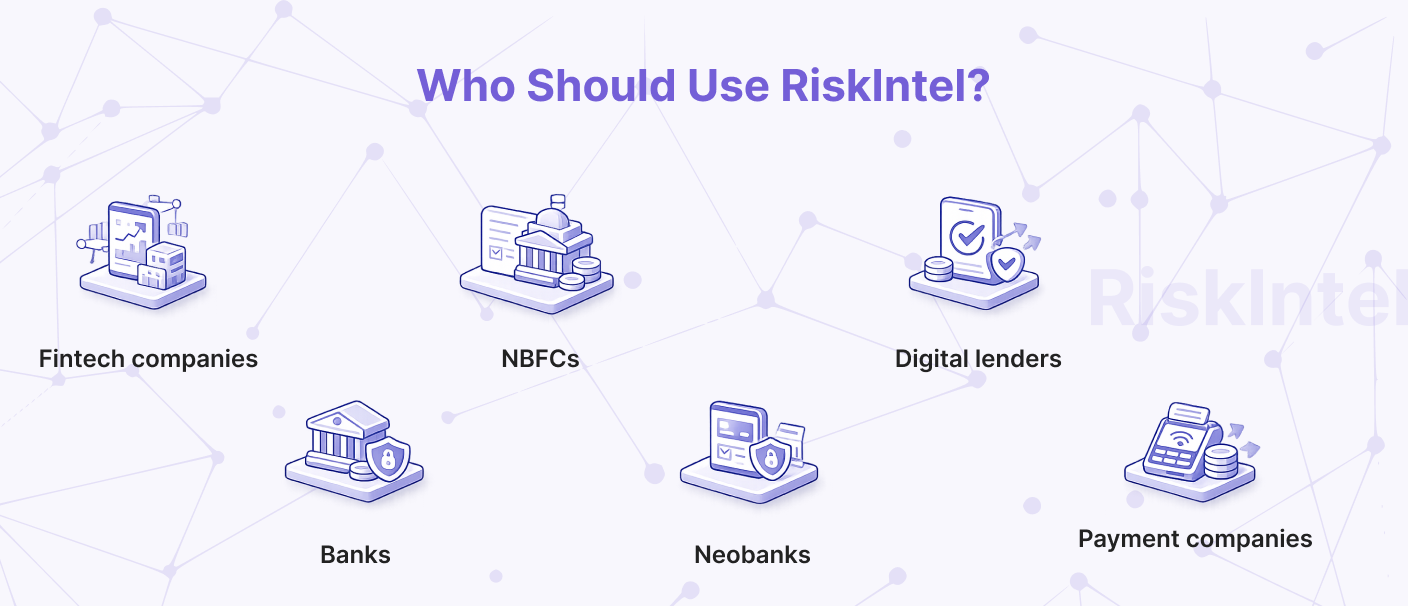
RiskIntel is useful for:
- Fintech companies
- NBFCs
- Digital lenders
- Banks
- Neobanks
- Payment companies
- Payment aggregators
- Embedded finance platforms
- Wealthtech companies
- Insurtech companies
- Merchant onboarding platforms
- Loan servicing companies
- Cross-border payment providers
- Compliance teams
- AML teams
- Risk teams
- Customer onboarding teams
- Financial crime investigation teams
Any financial institution that screens customers, assesses customer risk or maintains AML compliance records should consider using a centralised customer-risk platform.
Want to explore more practical insights on AI development, automation, and conversational AI? Read more blogs at Cloudastra Technologies or contact us for business enquiries through Cloudastra Contact Us.
Frequently Asked Questions
1. What is RiskIntel?
RiskIntel is a customer-risk and compliance platform that helps fintech companies perform AML checks, sanctions screening, PEP screening, watchlist monitoring and customer risk scoring.
2. What problem does RiskIntel solve?
RiskIntel replaces disconnected customer screening and manual risk-assessment processes with a centralised workflow for identifying risk, reviewing alerts and recording compliance decisions.
3. How does RiskIntel support AML compliance?
RiskIntel helps teams screen customers, identify financial crime risk indicators, generate compliance alerts, calculate risk scores and maintain records for audits and reviews.
4. Can RiskIntel perform sanctions screening?
Yes. RiskIntel can help screen customers and related parties against relevant sanctions data and route possible matches for compliance review.
5. Does RiskIntel support PEP screening?
Yes. RiskIntel helps identify customers who may be politically exposed and require enhanced due diligence.
6. What is customer risk scoring?
Customer risk scoring is the process of classifying a customer according to factors such as geography, business activity, sanctions results, PEP status, ownership, source of funds and expected account activity.
7. How does RiskIntel improve customer onboarding?
RiskIntel helps teams prioritise high-risk cases and allows lower-risk customers to move through onboarding with fewer unnecessary delays.
8. Can RiskIntel reduce false positives?
RiskIntel can help teams use additional customer information and risk context to review possible screening matches more accurately.
9. Does RiskIntel support watchlist monitoring?
Yes. RiskIntel can support customer screening against relevant watchlists and organise possible matches for review.
10. Is RiskIntel only used during onboarding?
No. RiskIntel can support ongoing customer monitoring, scheduled risk reviews and the investigation of changes in customer risk.
11. Does RiskIntel maintain audit-ready records?
Yes. RiskIntel can maintain records of screening checks, alerts, risk scores, reviewer actions, escalation history and final decisions.
12. Who should use RiskIntel?
RiskIntel is suitable for fintech companies, NBFCs, digital lenders, banks, neobanks, payment companies and other financial service providers.