Fraud management for banks and fintechs is the process financial institutions use to detect suspicious activity, evaluate transaction risk, decide what action to take, investigate risky payments and continuously improve fraud controls.
For banks and fintech companies, detecting fraud is only one part of the problem.
A fraud system may identify hundreds or thousands of suspicious payments.
But fraud teams still need to answer:
- Which transactions are genuinely dangerous?
- Which alerts should receive attention first?
- Should a payment pass, be flagged or be blocked?
- Which fraud pattern triggered the decision?
- Does the transaction show mule-account behaviour?
- Is payment velocity unusual?
- Is the beneficiary suspicious?
- Does the activity indicate account takeover?
- Should existing fraud rules be changed?
- Can the institution explain why a payment was stopped?
- Is the decision history available for audit or investigation?
This is where fraud management becomes important.
Instead of treating fraud detection, risk scoring, payment decisions, fraud rules and investigations as disconnected activities, fraud management connects them into one structured process.
SecureFlow supports this approach by helping banks, fintech companies, NBFCs and payment platforms score payments when they are initiated, evaluate configured fraud signals and return clear payment-risk decisions before funds settle.
In simple terms, fraud management helps financial institutions move from:
“We detected something suspicious.”
to:
“We understand the risk, know what action to take and can explain why the decision was made.”
What Problem Does Fraud Management Solve?
Digital payments move quickly.
UPI, IMPS, RTGS, SWIFT, ISO 20022 and cross-border payment systems allow customers and businesses to move money with very little delay.
This improves customer experience.
It also reduces the amount of time fraud teams have to identify suspicious activity.
Consider a simple account-takeover scenario.
A fraudster gains access to a genuine customer account.
They add a new beneficiary.
Several payments are initiated within a short period.
If the institution identifies the activity only after funds settle, fraud management becomes a recovery problem.
The team may then need to:
- Trace the payment
- Contact the customer
- Investigate the beneficiary
- Coordinate with another institution
- Attempt recovery
- Review the fraud rules that failed
- Document what happened
A stronger fraud management process attempts to identify and act on the risk earlier.
Without structured fraud management, financial institutions may rely on:
- Static transaction rules
- Disconnected fraud tools
- Manual payment reviews
- Large alert queues
- Spreadsheet-based investigations
- Delayed rule changes
- Limited decision explanations
- Post-settlement fraud investigation
- Incomplete fraud records
These methods make it difficult to manage payment fraud consistently at scale.
What Is Fraud Management?
Fraud management is the complete operational process used to identify, assess, control and review fraudulent or suspicious financial activity.
It may include:
- Transaction monitoring
- Fraud detection
- Risk scoring
- Behaviour analysis
- Velocity checks
- Mule-account indicators
- Account-takeover signals
- Fraud-rule evaluation
- Payment decisioning
- Transaction interdiction
- Investigation support
- Decision explanation
- Audit records
- Fraud-rule optimisation
Fraud management is therefore broader than fraud detection.
Fraud detection answers:
“Does this transaction look suspicious?”
Fraud management continues with:
“How risky is it, what should we do, why did we make that decision and what should we learn from the outcome?”
Fraud Detection vs Fraud Prevention vs Fraud Management
These terms are often used interchangeably, but they describe different parts of the fraud-control process.
|
Area |
Fraud Detection |
Fraud Prevention |
Fraud Management |
|
Main objective |
Identify suspicious activity |
Stop fraudulent activity |
Manage the complete fraud lifecycle |
|
Main question |
Is this suspicious? |
Can we stop it? |
What is the risk and what should happen next? |
|
Typical output |
Alert |
Block or intervention |
Score, decision, action and record |
|
Focus |
Detection signals |
Preventing loss |
Detection + prioritisation + decision + learning |
|
Fraud rules |
Used for detection |
Used for prevention |
Continuously managed |
|
Investigation |
Usually after alert |
Sometimes |
Connected to decision history |
|
Auditability |
Depends on system |
Depends on system |
Important part of workflow |
|
Best for |
Finding risk |
Stopping fraud |
Managing fraud operations at scale |
Banks and fintech companies generally need all three.
Detection identifies the potential problem.
Prevention attempts to stop the loss.
Fraud management connects those actions into a controlled operating model.
Why Do Banks and Fintechs Need Fraud Management?
Financial institutions process large volumes of transactions.
Manual review cannot scale at the same speed.
Fraud management helps teams apply structured controls across payment activity instead of relying entirely on analysts checking individual transactions.
Several challenges make this important.
Fraud Patterns Change
Fraudsters adapt when institutions introduce new controls.
If one fraud method becomes difficult, attackers may change:
- Transaction amount
- Payment timing
- Beneficiaries
- Device usage
- Account behaviour
- Number of transactions
- Payment rail
Fraud rules therefore need continuous review.
Genuine Customers Also Behave Differently
Not every unusual transaction is fraudulent.
A customer may:
- Make an unusually large purchase
- Travel internationally
- Add a new beneficiary
- Make several payments quickly
- Use a different device
Fraud management needs context so legitimate activity is not unnecessarily blocked.
Different Payment Rails Carry Different Risk
UPI, IMPS, RTGS and cross-border payments do not always behave the same way.
The fraud controls applied to one payment type may be inappropriate for another.
Fraud Alerts Can Become Too Large to Review
Broad detection rules can generate large numbers of alerts.
If analysts spend most of their time reviewing low-risk activity, genuinely dangerous payments may not receive attention quickly enough.
Fraud Decisions Need to Be Explainable
When a payment is held or blocked, the institution should understand which risk factors contributed to that action.
This matters for:
- Internal investigation
- Customer complaints
- Fraud-rule tuning
- Compliance review
- Audit evidence
How Does Fraud Management Work?
A strong fraud management process follows a payment from initiation through risk evaluation, decision and review.
1. Payment Data Enters the Fraud System
The process begins when a transaction is initiated.
Relevant information may include:
- Customer
- Account
- Payment amount
- Beneficiary
- Payment rail
- Device
- Location
- Transaction timing
- Recent payment activity
- Customer behaviour
- Beneficiary history
- Sanctions information
- Previous fraud signals
The system evaluates this information before deciding what should happen.
2. Fraud Signals Are Evaluated
Fraud risk rarely depends on one signal.
A modern fraud management process may consider several indicators.
Transaction Amount
Is the amount normal for the customer?
Payment Velocity
How many payments have occurred within a short period?
New Beneficiary
Has this destination received payments from the customer before?
Customer Behaviour
Does the payment differ from normal account behaviour?
Device Information
Is the transaction coming from an unfamiliar device?
Account Activity
Has there been unusual activity before the payment?
Mule Indicators
Does the beneficiary behave like an account receiving and rapidly redistributing suspicious funds?
Sanctions Signals
Does the payment involve a restricted or higher-risk party?
Fraud Rules
Does the payment trigger a known fraud pattern?
These signals can be evaluated together instead of independently.
3. The Transaction Receives a Risk Score
Payment risk scoring converts several signals into a structured risk assessment.
For example, a payment could be classified as:
- Low risk
- Medium risk
- High risk
- Critical risk
The institution determines its own thresholds and policies.
Risk scoring helps fraud teams avoid treating every alert equally.
A weak signal may not require intervention.
Several strong signals appearing together may justify immediate action.
4. Fraud Typologies Are Evaluated
Fraud typologies describe recognisable patterns of fraudulent behaviour.
Examples may include:
- Account takeover
- Mule-account activity
- Smurfing
- Transaction splitting
- Velocity abuse
- Suspicious beneficiary behaviour
- Scam-driven payments
Typology-level analysis provides more context than a generic fraud score.
Instead of only knowing:
Risk score: 85
the analyst may understand:
High account-takeover risk + unusual beneficiary + high payment velocity.
That creates a more explainable fraud decision.
5. A Payment Decision Is Generated
After the risk is evaluated, the system needs to determine what should happen.
Possible outcomes may include:
Pass
The transaction continues normally.
Flag
The payment requires additional attention or investigation.
Hold
The payment may require further review according to the institution’s workflow.
Block
The transaction is prevented from continuing when the institution’s integration and policy support that action.
The decision should reflect both the risk score and configured business rules.
6. High-Risk Payments Can Be Interdicted
Fraud detection after settlement is useful for investigation.
Fraud detection before settlement can potentially prevent financial loss.
Live payment interdiction allows a financial institution to act while the payment is still being processed.
For example:
A customer who normally makes small domestic payments suddenly initiates several high-value transfers to newly added beneficiaries.
The activity may trigger:
- Velocity rule
- Behaviour anomaly
- New-beneficiary rule
- Account-takeover signal
If the combined risk exceeds the institution’s threshold, the payment can be flagged or blocked before settlement.
7. The Decision Is Recorded
Every fraud decision should create a record.
That record may include:
- Transaction
- Risk score
- Rules triggered
- Typology signals
- Decision
- Timestamp
- Payment status
- Review activity
- Final action
This becomes important during investigation and audit.
8. Fraud Outcomes Feed Back Into Controls
Fraud management should operate as a feedback loop.
If investigators repeatedly identify a new fraud pattern, risk teams may need to:
- Create a new rule
- Adjust an existing threshold
- Change a risk weight
- Add another signal
- Introduce a rail-specific condition
This is how fraud controls improve over time.
What Is Real-Time Fraud Management?
Real-time fraud management means assessing payment risk and generating a decision while the transaction is being processed rather than reviewing it only after settlement.
This matters because modern payment systems leave very little time for intervention.
A simplified real-time workflow looks like:
Payment initiated → Fraud signals evaluated → Risk score generated → Rules applied → Decision returned → Payment passes, flags, holds or blocks
The entire process needs to happen fast enough that fraud controls do not create unnecessary payment delays.
Why Is Payment Risk Scoring Important in Fraud Management?
Risk scoring helps institutions prioritise fraud risk instead of treating suspicious activity as a simple yes-or-no decision.
Consider two payments.
Payment A
- Known beneficiary
- Normal device
- Expected amount
- Normal transaction velocity
- No suspicious signals
Payment B
- New device
- New beneficiary
- Unusual amount
- Multiple transfers within minutes
- Mule-account indicator
Both may technically trigger a rule.
But Payment B contains a much stronger combination of risk signals.
Risk scoring helps the system distinguish between the two.
This can improve:
- Fraud prioritisation
- Decision consistency
- Analyst efficiency
- Customer experience
What Role Does Fraud Analytics Play in Fraud Management?
Fraud analytics helps institutions understand patterns across payment activity instead of evaluating only individual transactions.
Fraud analytics may help teams identify:
- Repeated beneficiary patterns
- High-risk transaction sequences
- Sudden changes in payment behaviour
- Fraud concentration by payment type
- Velocity patterns
- Repeated mule indicators
- Rules creating excessive alerts
- Fraud typologies increasing over time
This information can help fraud teams improve their controls.
Fraud analytics is therefore not only about producing dashboards.
It should help answer:
- Which fraud patterns are increasing?
- Which rules are performing poorly?
- Which payment rails show higher risk?
- Which signals frequently appear together?
- Where are analysts spending the most time?
- Which patterns should receive stronger controls?
What Is Payment Fraud Analytics?
Payment fraud analytics focuses specifically on analysing transaction data to identify suspicious payment behaviour and emerging fraud patterns.
It can involve:
- Payment amount
- Timing
- Velocity
- Beneficiary behaviour
- Customer behaviour
- Payment rail
- Device signals
- Fraud-rule outcomes
- Typology scores
The objective is to help financial institutions understand risk patterns before those patterns create larger losses.
Payment fraud analytics can also support fraud-rule improvement by showing where existing controls are:
- Too broad
- Too narrow
- Generating excessive alerts
- Missing suspicious behaviour
How Do Fraud Rules Fit Into Fraud Management?
Fraud rules translate known fraud patterns into automated controls.
A rule may say:
If payment amount exceeds a threshold AND beneficiary is new AND device is unfamiliar → increase risk score.
Another rule may focus on:
- Transaction velocity
- Beneficiary behaviour
- High-risk geographies
- Repeated failed payments
- Payment splitting
- Mule patterns
Rules should not remain static forever.
Fraud management requires teams to continuously evaluate whether each rule is effective.
Common Problems With Fraud Rules
Rules Are Too Broad
A rule may generate too many false alerts.
Rules Are Too Narrow
A fraudster may avoid detection by staying just below the configured threshold.
The Same Rule Is Used Everywhere
A rule suitable for UPI may not make sense for RTGS or cross-border payments.
Rules Become Outdated
Fraud patterns change.
Rule Changes Depend on Engineering
If fraud teams need developers for every minor rule update, controls may change too slowly.
Visual rule management can help risk and compliance teams update fraud controls more efficiently.
What Is Typology-Level Fraud Scoring?
Typology-level fraud scoring evaluates how closely a transaction resembles specific fraud patterns rather than returning only one overall score.
For example, a payment might receive separate indicators for:
- Account takeover
- Mule activity
- Smurfing
- Velocity abuse
This helps analysts understand the nature of the risk.
A transaction may have:
Overall risk: High
but also:
- Account takeover: Very high
- Mule activity: Medium
- Velocity abuse: High
- Smurfing: Low
This makes the decision easier to interpret.
How Can Fraud Management Reduce False Positives?
A false positive occurs when legitimate activity is classified as suspicious.
Too many false positives create several problems:
- Analysts waste time
- Customers face unnecessary payment friction
- Genuine transactions may be delayed
- High-risk alerts receive less attention
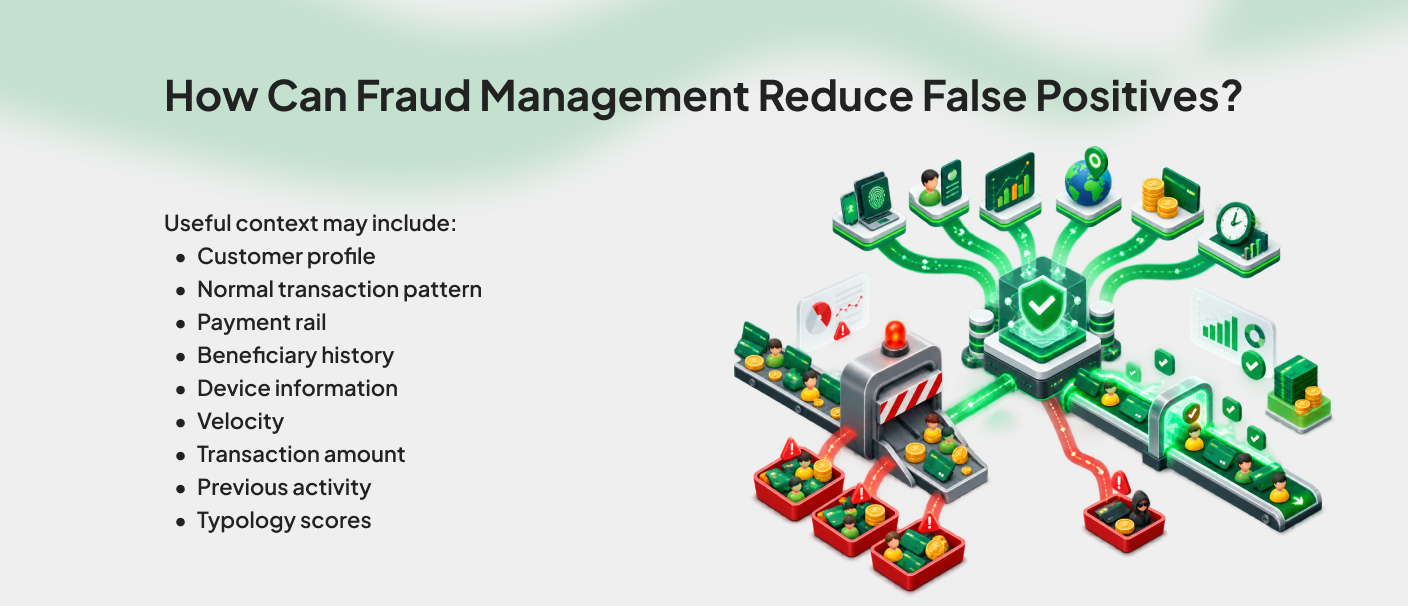
Fraud management can reduce false positives by combining several signals rather than relying on one broad rule.
Useful context may include:
- Customer profile
- Normal transaction pattern
- Payment rail
- Beneficiary history
- Device information
- Velocity
- Transaction amount
- Previous activity
- Typology scores
A new device alone may not justify blocking a payment.
But:
New device + unusual beneficiary + high amount + abnormal velocity
may create a much stronger risk signal.
How Should Fraud Teams Prioritise Suspicious Payments?
Fraud analysts cannot investigate every payment manually.
Risk-based prioritisation helps focus attention.
A suspicious payment may be prioritised according to:
- Overall risk score
- Typology score
- Transaction value
- Customer behaviour
- Beneficiary risk
- Number of triggered rules
- Payment velocity
- Fraud history
- Payment rail
Higher-risk transactions can receive faster review while low-risk activity continues normally.
Fraud Management Across Different Payment Rails
Payment behaviour differs by rail.
UPI
Risk controls may need to consider:
- High transaction frequency
- New beneficiaries
- Rapid fund movement
- Mule-account activity
- Account takeover
- Scam-related transfers
IMPS
Immediate transfers make early fraud detection particularly important.
RTGS
Transaction value may be significantly higher, making individual payment risk especially important.
SWIFT and Cross-Border Payments
Risk evaluation may include:
- Beneficiary information
- Geography
- Sanctions signals
- Payment context
- Cross-border risk
ISO 20022 Payments
Structured payment data can provide additional information that fraud systems may use during risk evaluation.
Fraud policies should therefore consider the payment rail rather than applying identical thresholds everywhere.
Fraud Management vs Transaction Monitoring
Transaction monitoring observes financial activity to identify unusual or suspicious behaviour.
Fraud management includes transaction monitoring but continues beyond detection.
|
Capability |
Transaction Monitoring |
Fraud Management |
|
Monitor transactions |
Yes |
Yes |
|
Detect anomalies |
Yes |
Yes |
|
Generate alerts |
Yes |
Yes |
|
Risk scoring |
Sometimes |
Core capability |
|
Payment decision |
Limited |
Important |
|
Pass/flag/block |
Not always |
Yes, depending on system |
|
Rule management |
Sometimes |
Important |
|
Typology scoring |
Varies |
Can be included |
|
Interdiction |
Usually limited |
Important for payment fraud |
|
Audit decision history |
Varies |
Important |
|
Feedback loop |
Limited |
Core operating concept |
Transaction monitoring asks:
“What looks unusual?”
Fraud management asks:
“What looks risky, how risky is it and what should we do?”
Manual Fraud Management vs Automated Fraud Management
|
Area |
Manual Fraud Management |
Automated Fraud Management |
|
Transaction review |
Analyst-driven |
Automated scoring first |
|
Fraud rules |
Often static |
Configurable |
|
Prioritisation |
Manual queues |
Risk-based |
|
Decisioning |
Analyst dependent |
Structured verdicts |
|
Payment intervention |
Often delayed |
Can occur before settlement |
|
Pattern detection |
Manual analysis |
Signal and typology based |
|
Decision explanation |
Analyst notes |
Structured risk factors |
|
Audit history |
May be scattered |
Centralised decision trail |
|
Scale |
Limited by analyst capacity |
Higher transaction scalability |
|
Rule improvement |
Periodic |
Continuous feedback possible |
What Features Should Fraud Management Software Have?
A strong fraud management platform should include:
- Real-time payment monitoring
- Fraud risk scoring
- Transaction behaviour analysis
- Velocity monitoring
- Mule-account indicators
- Account-takeover signals
- Configurable fraud rules
- Rail-specific fraud controls
- Typology-level scoring
- Pass, flag, hold or block decisions
- Live payment interdiction
- Fraud alert prioritisation
- Explainable decisions
- Decision history
- Investigation support
- Audit trails
- Reporting
- API integration
- Role-based access
- Secure data handling
The most important feature is not any one capability.
The platform should connect detection, scoring, decisioning, action and review into one fraud management workflow.
What Metrics Should Fraud Teams Track?
Fraud management should be measured using both fraud outcomes and operational efficiency.
Fraud Detection Rate
How much confirmed fraudulent activity is identified by the controls?
False-Positive Rate
How often is genuine activity incorrectly flagged?
Block Rate
How many payments receive a blocking decision?
Flag Rate
How many transactions require additional review?
Fraud Loss
How much financial loss is linked to fraudulent transactions?
Rule Trigger Volume
Which fraud rules generate the most activity?
Rule Effectiveness
Which rules frequently identify genuine fraud?
Alert Review Time
How long do analysts take to resolve suspicious activity?
Payment Risk Distribution
What percentage of payments fall into low, medium and high-risk categories?
Fraud Typology Distribution
Which fraud patterns appear most frequently?
Examples may include:
- Mule activity
- Account takeover
- Velocity abuse
- Smurfing
Payment Rail Risk
How does fraud activity differ across UPI, IMPS, RTGS or cross-border payments?
Decision Explainability
Can analysts identify the signals behind each major fraud decision?
These metrics help fraud teams understand whether controls are actually reducing risk or simply generating more alerts.
Common Fraud Management Challenges
Too Many False Positives
Broad rules may create large analyst queues.
Controls should combine customer context and multiple fraud signals.
Fraud Detected Too Late
Post-settlement detection may identify fraud only after financial loss has occurred.
Real-time evaluation allows earlier intervention.
Fraud Systems Are Disconnected
Signals, alerts, payment data and decision records may exist in different tools.
This makes investigation slower.
Fraud Rules Become Outdated
Controls need to change as fraud behaviour evolves.
Analysts Cannot Explain Decisions
A high risk score without supporting context makes investigation difficult.
The Same Controls Are Applied to Every Payment
Payment rails and customer types behave differently.
Rule Changes Take Too Long
Risk teams may identify a problem but wait for engineering resources before changing the control.
Fraud Data Is Difficult to Audit
Decision history should be recorded consistently.
How SecureFlow Supports Fraud Management
SecureFlow is a real-time payment risk and fraud detection platform designed for banks, fintech companies, NBFCs, payment platforms and financial service providers.
The platform evaluates payments when they are initiated so fraud teams can identify risk before funds settle.
SecureFlow can score payment environments including:
- UPI
- IMPS
- RTGS
- SWIFT
- ISO 20022
- Cross-border payments
The platform evaluates configured fraud rules and risk signals such as:
- Velocity patterns
- Mule-account indicators
- Sanctions signals
- Customer and transaction behaviour
- Other configured risk indicators
SecureFlow supports:
- Real-time payment scoring
- Pass, flag or block verdicts
- Live interdiction for suspicious payments
- Visual fraud-rule editing
- Typology-level scoring
- Explainable payment decisions
- Audit-grade decision trails
This allows fraud teams to connect detection with action.
Instead of generating an alert and waiting for someone to manually decide what should happen, the system can evaluate the payment during processing and return a clear risk decision.
How SecureFlow Fits Into the Fraud Management Lifecycle
Stage 1: Payment Initiation
The transaction enters SecureFlow for evaluation.
Stage 2: Signal Analysis
Configured rules, velocity patterns, mule indicators, sanctions signals and other risk information are evaluated.
Stage 3: Risk Scoring
The payment receives a risk assessment.
Stage 4: Typology Analysis
The system can evaluate whether the transaction resembles specific fraud patterns.
Stage 5: Payment Decision
SecureFlow can return a pass, flag or block verdict according to the institution’s configuration.
Stage 6: Interdiction
Suspicious payments can be stopped before funds clear when the integration and institutional policy support that action.
Stage 7: Decision Record
The factors behind the transaction outcome can be maintained in an audit-grade history.
Stage 8: Fraud-Control Improvement
Fraud teams can use decision outcomes and observed behaviour to refine rules and controls.
This creates a continuous fraud management loop.
Benefits of Fraud Management With SecureFlow
Faster Fraud Decisions
Risk is evaluated while the payment is being processed.
Earlier Fraud Intervention
Suspicious transactions can be identified before settlement.
Better Analyst Prioritisation
Risk scoring helps teams focus on more important cases.
More Explainable Decisions
Analysts can understand which rules or signals contributed to the outcome.
Better Fraud-Rule Control
Visual rule editing allows authorised risk and compliance teams to manage fraud logic more directly.
More Contextual Fraud Detection
Multiple signals can be evaluated together instead of relying on one simple threshold.
Rail-Specific Risk Management
Controls can account for differences across payment types.
Improved Auditability
Decision histories provide a stronger record of why fraud actions were taken.
Stronger Fraud Operations
Detection, decisioning and rule management become part of one connected process.
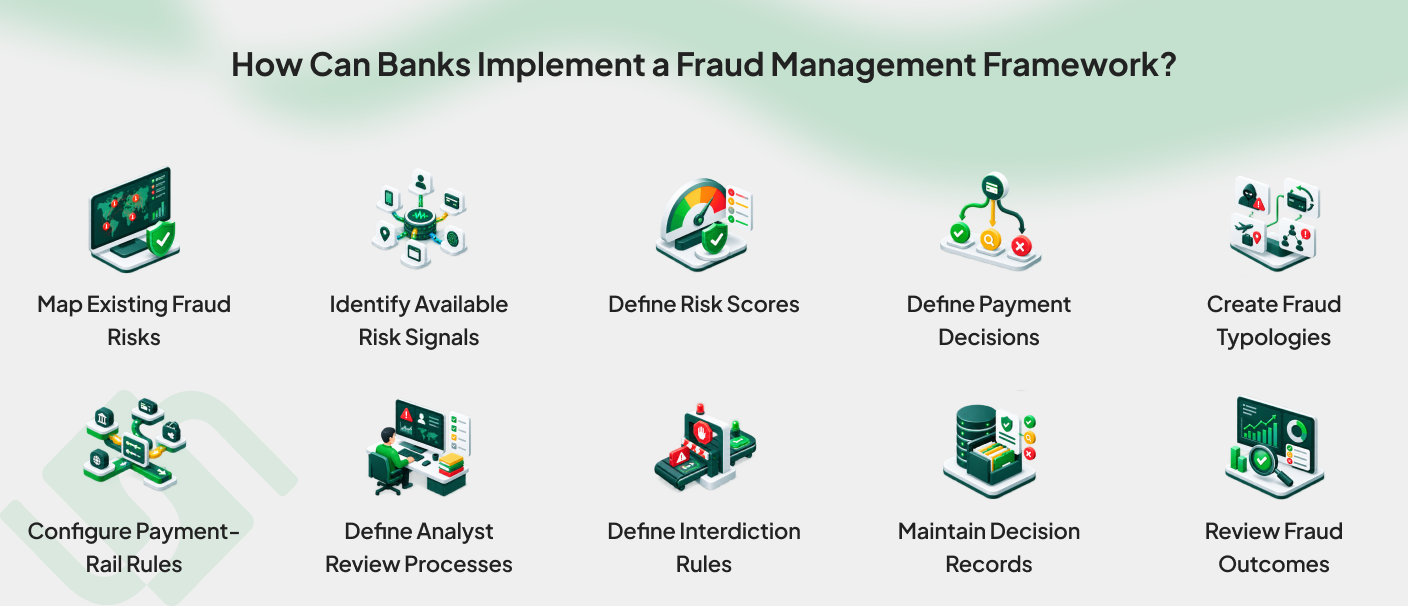
How Can Banks Implement a Fraud Management Framework?
1. Map Existing Fraud Risks
Identify the fraud patterns affecting the institution.
Examples may include:
- Account takeover
- Mule activity
- Velocity abuse
- Transaction splitting
- Scam payments
- Suspicious beneficiaries
2. Identify Available Risk Signals
Map the data available during payment initiation.
Examples include:
- Customer
- Transaction
- Beneficiary
- Device
- Behaviour
- Velocity
- Payment rail
3. Define Risk Scores
Determine how fraud signals contribute to transaction risk.
4. Define Payment Decisions
Decide what happens at different risk levels.
For example:
- Pass
- Flag
- Hold
- Block
Policies should reflect the institution’s risk appetite and operational model.
5. Create Fraud Typologies
Group related signals into recognisable fraud patterns.
6. Configure Payment-Rail Rules
Avoid applying identical thresholds to every payment environment.
7. Define Analyst Review Processes
Determine which payments require human investigation.
8. Define Interdiction Rules
Specify when a transaction should be stopped before settlement.
9. Maintain Decision Records
Every high-risk payment decision should be explainable.
10. Review Fraud Outcomes
Analyse:
- Confirmed fraud
- False positives
- Missed fraud
- High-volume rules
- Emerging patterns
11. Update Fraud Controls
Fraud management should continuously improve.
Rules that create too many false positives may need refinement.
New fraud patterns may require new controls.
Who Should Use Fraud Management Software?
Fraud management software is useful for:
- Banks
- Fintech companies
- NBFCs
- Payment service providers
- Payment gateways
- Neobanks
- Digital lenders
- Cross-border payment providers
- Embedded finance companies
- Wallet providers
- Fraud operations teams
- Payment risk teams
- Financial crime teams
It is particularly useful for organisations processing payment volumes where manual fraud review cannot scale effectively.
Want to explore more practical insights on AI development, automation, and conversational AI? Read more blogs at Cloudastra Technologies or contact us for business enquiries through Cloudastra Contact Us.
Frequently Asked Questions
1. What is fraud management?
Fraud management is the structured process financial institutions use to detect suspicious activity, evaluate fraud risk, decide what action to take and improve fraud controls over time.
2. What is the difference between fraud detection and fraud management?
Fraud detection identifies suspicious activity. Fraud management includes detection but also covers risk scoring, decisioning, intervention, investigation support, rule management and audit records.
3. Why is fraud management important for banks?
Banks process large volumes of financial transactions and need a structured way to identify, prioritise and respond to suspicious activity before losses increase.
4. What does fraud management software do?
Fraud management software can monitor transactions, evaluate fraud signals, calculate risk, apply fraud rules, generate payment decisions and maintain decision histories.
5. What is payment fraud analytics?
Payment fraud analytics is the analysis of transaction behaviour and risk signals to identify suspicious payment patterns and improve fraud controls.
6. What is fraud risk scoring?
Fraud risk scoring assigns a level of risk to a payment based on multiple signals such as transaction behaviour, velocity, beneficiary information and configured fraud rules.
7. Can fraud management software block payments?
Some real-time fraud platforms can return block or hold decisions before payment settlement, depending on the institution’s integration and policy.
8. What is real-time fraud management?
Real-time fraud management evaluates risk and determines the next action while a payment is being processed.
9. What fraud patterns can SecureFlow help identify?
SecureFlow can support risk evaluation for patterns such as account takeover, mule activity, velocity abuse, smurfing, suspicious beneficiaries and other configured transaction-risk typologies.
10. Which payment types can SecureFlow monitor?
SecureFlow supports payment environments involving UPI, IMPS, RTGS, SWIFT, ISO 20022 and cross-border transactions.
11. What is typology-level fraud scoring?
Typology-level scoring evaluates how strongly a payment resembles specific fraud patterns instead of providing only a generic overall risk score.
12. Can SecureFlow help reduce false positives?
SecureFlow’s combination of payment scoring, configurable rules and multiple risk signals can help institutions create more contextual fraud decisions instead of relying only on broad individual rules.
13. Does SecureFlow provide explainable fraud decisions?
SecureFlow can maintain information about the rules and signals contributing to a payment outcome, helping teams understand why the decision was made.
14. Does SecureFlow maintain fraud decision records?
SecureFlow supports audit-grade trails that can maintain payment decisions and investigation-related history.Move from reactive fraud alerts to structured real-time fraud management.SecureFlow helps banks, fintech companies and payment platforms score payment risk, detect suspicious patterns, apply fraud rules and return clear payment decisions before funds settle.