The Indian startup ecosystem is undergoing a fundamental transformation. In 2025, Indian startups raised nearly $11 billion across approximately 1,518 deals, reflecting both the sector’s maturity and a more selective approach to capital deployment. While this represents a decline compared to previous years, the shift signals something important: the ecosystem is moving away from a growth at all costs mindset toward disciplined scaling, stronger unit economics and sustainable business models.
For founders and investors navigating 2026, the implications are clear. Scaling a startup today requires aligning ambitious growth plans with economic viability, strong product market fit and validated demand.
In other words, the new era of startup growth strategies in India is about building companies that can scale responsibly while remaining profitable over time.
This article explores data backed strategies for Indian startups, drawing from market trends, government policies and sector insights to help founders build companies capable of achieving sustainable scale in India’s rapidly evolving startup ecosystem.
Capital Trends in the Indian Startup Ecosystem

From Abundance to Discipline
The startup ecosystem in India has entered a phase of maturity where capital allocation is becoming increasingly disciplined.
The $11 billion raised in 2025 represents stabilization rather than decline. Instead of the speculative funding peak seen in 2021, venture capital is now flowing into startups with clear product market fit, sustainable growth models and strong operational discipline.
Funding distribution across stages illustrates this shift:
- Early stage funding increased to $3.9 billion
- Seed funding dropped to $1.1 billion
- Late stage funding declined to $5.5 billion
- Venture debt rose to approximately $3 billion
This distribution shows that investors are no longer focusing on large late stage rounds alone. Instead, they are supporting early stage founders who demonstrate MVP validation, strong execution capability and revenue visibility.
For founders building companies today, this means that scaling requires:
- Clear product market fit
- Capital efficient growth
- Transparent unit economics
- Sustainable customer acquisition models
Investors are writing fewer but larger checks, often backing founders with proven execution experience and clear business fundamentals.
Sector Opportunities and Corrections in the Startup Ecosystem
High Growth Areas for Indian Startups
Not all sectors are evolving at the same pace. Some areas are receiving disproportionate capital and policy support.
High-growth sectors include:
- Deep tech
- Artificial intelligence
- Space technology
- Semiconductor innovation
- Biotechnology
- Climate tech
- B2B SaaS startups
Deep-tech startups alone raised $1.65 billion in 2025, reflecting increasing investor confidence in long-term technology innovation.
Government support has also strengthened this momentum. India’s ₹1 trillion Research, Development and Innovation initiative aims to accelerate indigenous technological capabilities across several advanced sectors.
For founders, this creates an important strategic signal: startups solving complex infrastructure, enterprise, or technological problems are more likely to attract long-term capital.
Sectors Experiencing Market Correction
At the same time, sectors that previously relied heavily on aggressive growth models have seen consolidation.
For example:
- EdTech startups experienced a 60% failure rate
- Fintech startups faced regulatory tightening
- Healthtech startups struggled with compliance and cost sensitivity
More than 11,000 startups shut down in 2025, demonstrating that the ecosystem is filtering out unsustainable business models.
While this correction may appear negative, it ultimately strengthens the startup ecosystem in India by encouraging sustainable innovation.
Profitability and Unit Economics: The New Entry Requirement
Perhaps the most important shift for Indian startups is the growing importance of unit economics.
In 2025, nearly 85% of founders acknowledged that profitability pathways significantly influence startup valuation.
Investors now prioritize key financial indicators such as:
- Customer acquisition cost (CAC)
- Customer lifetime value (LTV)
- CAC payback period
- Gross margins
- Retention rates
A commonly accepted benchmark is the 3:1 LTV:CAC ratio, meaning that startups should generate three dollars of customer value for every dollar spent on acquisition.
For startups operating in price-sensitive markets like India, achieving this ratio requires strong operational discipline.
Founders must carefully evaluate:
- Which acquisition channels produce profitable customers
- Whether retention rates justify scaling marketing spend
- How quickly acquisition costs can be recovered
Many startups in 2025 chose to extend runway and prioritize profitability rather than pursue additional fundraising rounds.
This reflects a broader shift toward sustainable startup growth strategies in India.
Geographic Expansion: The Tier 2 and Tier 3 Growth Opportunity

Another major growth driver for Indian startups lies beyond metro cities.
Nearly 48% of DPIIT-recognized startups now originate from Tier 2 and Tier 3 cities, reflecting growing entrepreneurial activity across the country.
These cities offer several advantages:
- Lower operating costs
- Affordable talent pools
- Reduced customer acquisition costs
- Rapid digital adoption
However, venture capital funding remains concentrated in metropolitan hubs.
For example:
- Tier 1 cities recorded 48 VC deals
- Tier 2 and Tier 3 cities recorded just 5 deals
Despite the funding imbalance, startups targeting sectors such as:
- Agritech
- MSME software
- Logistics technology
- Financial inclusion
can often achieve better unit economics by operating in non-metro markets.
Successful expansion strategies typically involve adjacent market entry rather than rapid geographic expansion.
Companies first dominate one stronghold before scaling to nearby markets.
Global Expansion for SaaS Startups in India
For SaaS startups in India, global expansion has become an increasingly common scaling strategy.
Indian SaaS companies benefit from several structural advantages:
- Lower engineering costs
- Strong technical talent
- Competitive pricing for global markets
As a result, many SaaS founders adopt a “build in India, sell globally” strategy.
Companies like Freshworks and Razorpay have demonstrated how startups built in India can achieve global scale by solving universal business problems.
Successful SaaS scaling typically involves:
- Building globally relevant products
- Establishing sales teams in target markets
- Pricing products for international customers
- Leveraging India’s engineering talent as a product development hub
Because SaaS businesses benefit from operational leverage, profitability can often be achieved faster compared to consumer startups.
Deep Tech and Manufacturing: India’s Emerging Advantage

India is also witnessing rapid growth in deep-tech and advanced manufacturing startups.
Government policies are accelerating this shift through initiatives such as:
- The ₹20,000 crore Deep Tech Fund
- Extended startup recognition periods
- Production Linked Incentive (PLI) schemes
These initiatives aim to build long-term technological capabilities within the country.
Advanced manufacturing sectors such as semiconductors, robotics and advanced materials are seeing increased venture interest.
Unlike software sectors dominated by global giants, advanced manufacturing offers India a competitive advantage due to lower capital costs and strong engineering talent.
Exit Opportunities: IPOs and Strategic Acquisitions
Another encouraging development for Indian startups is the revival of public market exits.
In 2025:
- 42 technology companies completed IPOs
- More than 48 startups are preparing to go public
The IPO pipeline reflects growing investor confidence in India’s technology sector.
Public market access provides founders with a clear liquidity pathway, allowing venture capital to recycle back into the ecosystem.
At the same time, mergers and acquisitions are becoming increasingly common.
Large corporations are acquiring startups to:
- Accelerate innovation
- Acquire specialized technology
- Expand into new digital markets
For founders, this means building companies with clear strategic value and defensible technology.
Why Experienced Founders Scale Faster
Recent data highlights a strong pattern in the startup ecosystem in India: startups founded by experienced operators scale significantly faster.
Operator-led startups are:
- 23x more likely to reach Series A
- Able to raise larger seed rounds
- More likely to achieve higher valuations
These founders often possess:
- Deep industry insights
- Established customer relationships
- Operational experience
- Strong investor credibility
For aspiring entrepreneurs, gaining experience in fast-growing companies before launching a startup can significantly improve the probability of success.
The Future of the Indian Startup Ecosystem
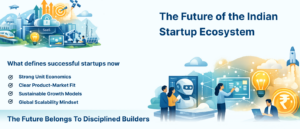
The Indian startup ecosystem is entering a more disciplined and sustainable phase.
While the funding boom of the early 2020s created rapid growth, the current environment emphasizes strong business fundamentals, operational discipline and profitability-focused scaling.
This transition is ultimately positive.
It encourages founders to build companies that are:
- Financially sustainable
- Globally competitive
- Technologically innovative
India continues to offer one of the most promising startup environments in the world, supported by:
- A massive digital market
- Growing venture capital networks
- Government innovation policies
- Expanding global recognition
For founders willing to adapt, the opportunities remain enormous.
Scaling a startup today requires a careful balance between growth ambition and sustainable economics.
And if you are building or planning to scale a startup, focusing on MVP validation, leveraging reliable MVP development services, and implementing the right startup growth strategies in India can significantly improve your chances of success.
If you’re exploring how to validate your idea, build your product, or scale your startup effectively, you can also Book a call with our team to discuss your roadmap and explore how the right technology and product strategy can accelerate your growth journey.