India’s startup ecosystem stands at an inflection point in early 2026. After a decade of rapid expansion, the ecosystem is now entering a more disciplined phase driven by sustainable growth and strong unit economics. While total startup funding declined modestly to $11 billion in 2025 from $12 billion in 2024, the quality of capital deployment has improved significantly, with investors prioritizing business fundamentals over aggressive growth narratives.
This shift is shaping the next generation of Indian unicorn companies, where valuation milestones are increasingly earned through operational efficiency, proven product-market fit and clear profitability pathways.
The ecosystem minted six new unicorns in 2025 and entered 2026 with three additional startups Juspay, Neysa and Dhan crossing the billion dollar mark. Their emergence highlights a new reality: today’s emerging Indian startups must demonstrate real value creation before reaching unicorn status.
Here, we examines the next wave of startups positioned to join the league of Indian unicorn companies within the next 24 – 36 months, analyzing sector trends, funding dynamics and the strategic approaches driving India’s next billion dollar ventures.
Structural Shift in the Indian Startup Ecosystem

India’s startup ecosystem has undergone a structural reset between 2025 and 2026, producing several critical insights for founders, investors and startup builders operating in the MVP market and early-stage innovation ecosystem.
First, capital selectivity has fundamentally transformed founder expectations around unit economics. Investors now treat profitability pathways as a baseline requirement rather than an aspirational milestone.
Second, deep tech and artificial intelligence have emerged as the primary magnets for venture capital. Deep tech funding accounted for approximately 15 percent of venture capital activity in 2025 up from only 4 percent in 2016.
Third, public markets are increasingly becoming the preferred exit route. Eighteen Indian startups went public in 2025, collectively raising nearly ₹41,000 crore.
Fourth, domestic capital is becoming more influential. Indian investors accounted for nearly half of funding activity in 2025, reflecting a shift away from dependence on global venture flows.
Together, these trends are redefining how emerging Indian startups scale from MVP to market leadership and how founders approach building companies that could eventually become the next Indian unicorn companies.
Market Data and India’s Startup Funding Landscape in 2025–2026
Overall Funding Trends and Capital Dynamics
India’s startup ecosystem raised approximately $11 billion across 1,518 funding rounds in 2025, maintaining its position as the world’s third-largest startup ecosystem after the United States and the United Kingdom.
However, the distribution of funding across stages revealed significant shifts.
Seed-stage funding declined by 30 percent to $1.1 billion, while early-stage investments rose by 7 percent, reaching $3.9 billion. This indicates growing investor preference for startups that have already validated their MVP and demonstrated product-market fit.
Late-stage funding declined by 26 percent to $5.5 billion as investors became more selective about scale and profitability.
This recalibration has created a unique dynamic in the MVP market, where startups building strong minimum viable products and demonstrating early traction are still able to attract capital efficiently.
For founders working with a reliable MVP development services, this environment presents an opportunity to build lean, scalable startups capable of attracting high-quality investors.
Collapse of Deal Velocity
One of the most notable trends in 2025 was the decline in deal velocity.
Startup funding rounds dropped from 2,500 transactions in 2024 to 1,518 in 2025, while the number of participating investors fell from 6,800 to roughly 3,170.
This signals the rise of a two-tier startup ecosystem:
- Startups backed by leading venture funds raise capital efficiently
- Other startups face longer fundraising cycles and stricter due diligence
As a result, founders are increasingly focusing on building sustainable SaaS startups and AI-driven platforms capable of demonstrating early revenue and clear value propositions.
Recent Indian Unicorn Companies and Milestone Achievements
The year 2025 saw the creation of six new Indian unicorn companies, bringing the total to 127 unicorn startups in India.
The first unicorn of 2025 was Bengaluru based deep tech logistics company Netradyne, which reached a $1.34 billion valuation after raising $90 million in Series D funding.
The beginning of 2026 has already produced three additional unicorns:
- Juspay: A fintech infrastructure startup that became India’s first unicorn of 2026 after raising $50 million in Series D funding.
- Dhan: A fast-growing investment and stock trading platform that crossed the $1.2 billion valuation mark.
- Neysa: An AI infrastructure company that raised $1.2 billion, one of the largest funding rounds for any Indian startup.
Neysa’s success highlights a broader trend that AI infrastructure and deep tech companies are increasingly leading the next generation of Indian unicorn companies.
Sector Funding Breakdown and Startup Growth Trends

Fintech: India’s Most Mature Startup Sector:
Fintech continues to dominate India’s startup ecosystem.
In 2025, fintech startups attracted $9 billion across 190 deals, making it the largest sector by funding volume.
Payments infrastructure startups remain particularly attractive to investors. Companies like Razorpay are preparing for IPOs while expanding their SaaS-based financial infrastructure platforms.
AI-powered lending, credit analytics, and fraud detection platforms are also gaining traction among investors.
Artificial Intelligence and Enterprise Automation:
AI has become a structural driver of startup funding. Indian AI startups raised $643 million across 100 deals in 2025, with most capital flowing into application-layer AI products rather than foundational models. Notably, vertical AI startups building solutions across healthcare, banking, compliance automation, legal workflows and manufacturing are emerging as strong candidates for future unicorn status.
Deep Tech: India’s Next Unicorn Factory:
Deep tech startups are becoming the largest long-term opportunity for Indian unicorn companies.
India’s deep tech ecosystem grew from 1,600 startups in 2019 to more than 3,600 in 2024, attracting billions in investment across sectors such as:
- semiconductors
- robotics
- space technology
- quantum computing
- climate technology
Government programs like the National Quantum Mission and the Semiconductor PLI scheme are accelerating these sectors.
SaaS Startups and Enterprise Technology
India’s SaaS startups attracted approximately $2.9 billion in funding in 2025.
Enterprise SaaS platforms with strong retention rates and subscription revenue models are particularly attractive because they deliver predictable growth and high margins.
Many of these companies began as lean MVPs before scaling globally – a pattern that highlights the importance of strong early-stage product development and MVP validation.
Geographic Concentration of Startup Innovation
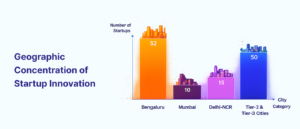
Bengaluru continues to dominate India’s startup ecosystem, hosting over 52 unicorn companies and attracting more than $4.5 billion in funding in 2025.
Mumbai follows as the second-largest funding hub due to its strong fintech ecosystem.
Delhi-NCR remains a major center for consumer tech and logistics startups.
However, tier-2 and tier-3 cities are increasingly becoming innovation hubs, supported by government initiatives like Startup India.
Nearly half of India’s recognized startups are now located outside metro cities.
Emerging Unicorn Startups to Watch
Several startups are positioned to become the next Indian unicorn companies within the next 24- 36 months.
- Spinny: A full-stack used car platform that has transformed India’s automotive resale market through standardized inspections and transparent pricing.
- Temple: A wearable technology startup founded by Zomato co-founder Deepinder Goyal that focuses on advanced biometric tracking.
- Uniphore: An enterprise AI company valued at $2.5 billion, building conversational automation platforms.
- Neysa: A fast-growing AI infrastructure startup building India’s domestic GPU computing ecosystem.
Government Support Accelerating Startup Growth
The Indian government has introduced several major initiatives to support innovation:
Startup India Fund of Funds 2.0
A ₹10,000 crore initiative designed to strengthen venture capital support for startups.
Research, Development and Innovation Fund
A massive ₹1 trillion fund focused on deep tech sectors like AI, biotechnology and quantum computing.
National Quantum Mission
A government-backed initiative supporting research hubs at leading institutions such as IIT Madras, IIT Bombay and IISc Bengaluru.
These programs are expected to significantly accelerate the creation of new Indian unicorn companies in deep tech and AI sectors.
The IPO Wave Reshaping India’s Startup Ecosystem
2025 marked a major turning point as 18 startups went public, raising ₹41,000 crore.
Major IPO candidates for 2026 include:
- Razorpay
- PhonePe
- Zepto
- OYO
- Fractal Analytics
If these IPOs proceed successfully, 2026 could become the largest year for startup listings in India’s history.
The Future of Indian Unicorn Companies

India’s startup ecosystem is entering a more mature and sustainable phase.
The next generation of Indian unicorn companies will likely share several common traits:
- strong unit economics
- defensible technology
- scalable SaaS or AI platforms
- deep market specialization
- global expansion potential
Deep tech, AI infrastructure, fintech innovation and enterprise SaaS startups are expected to dominate the next wave of unicorn creation.
For founders and entrepreneurs building today, the focus is no longer simply growth. It is about building durable, profitable companies that solve real problems at scale.
Many of the startups that will become India’s next unicorn companies are likely already in the MVP stage today, building early traction, validating market demand and refining their product strategy.
If you’re building a startup and looking to validate your idea, launch faster, or scale your product into a venture-backed business, working with the right product and technology partners can make a significant difference.
And if you’d like to explore how your startup idea can evolve from MVP to a scalable product in today’s competitive MVP market, you’re always welcome to Book a call to discuss your vision and explore the possibilities.