In the current technological landscape, a DevOps team is often equipped with the most advanced automation and orchestration assets available. However, having the right stack does not guarantee success. Many organizations face a significant DevOps transformation failure because they treat their toolset as a series of standalone projects rather than an embedded capability. When tools are simply “bolted on” to existing environments, they fail to modify the manner in which engineers utilize their time and attention, leading to friction instead of efficiency.
The problem usually results from not paying sufficient attention to the workflow level. To ensure that a DevOps team succeeds, intelligence and automation need to be built right into the system, transforming the passive repository into an active workflow. Otherwise, data stays siloed, the upgrade process becomes very slow, and analytics cannot really work at all.
Overcoming DevOps Tooling Overload through Modular Architecture
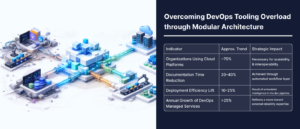
A common driver of DevOps transformation failure is DevOps tooling overload. When a team manages too many disparate platforms, each with different standards, interoperability becomes the primary obstacle. This fragmentation creates a high mental load for clinicians of the code, much like legacy systems create barriers in healthcare data integration.
To cope with the problem of DevOps tooling overload, the company should introduce a layer that will help integrate all of them. The DevOps team needs to apply APIs that will allow standardizing data to ensure that all models and tools operate autonomously without reliance on one particular data source. DevOps consulting services helps reduce the chances of total system breakdown and contributes to stabilizing the process of developing software.
Performance Signals and Industry Benchmarks (2026)
|
Indicator |
Approximate Trend |
Strategic Impact |
|
Organizations Using Cloud Platforms |
~70% |
Necessary for scalability and interoperability. |
|
Documentation Time Reduction |
20–40% |
Achieved through automated workflow layers. |
|
Deployment Efficiency Lift |
10–25% |
Result of embedded intelligence in the dev pipeline. |
|
Annual Growth of DevOps Managed Services |
>25% |
Reflects a move toward external reliability expertise. |
Infrastructure as the Enabler of Reliability
In the excitement of adopting a new tool, a DevOps team can easily get distracted
by the cool things the new tool can do without realizing how important infrastructure is to its overall success. The most successful teams know that infrastructure is not about having great servers but rather about reliability, security, and performance.
This is where DevOps consulting
and managed cloud services become critical. These services provide the elastic computing resources required to run analytics across population-level datasets of code and logs. By moving workloads into shared, scalable environments, a DevOps team gains the ability to process information in near real-time, which is essential for modern threat detection and site reliability engineering. Utilizing DevOps managed services ensures that high availability and redundancy are baked into the environment from the start.
The move towards a cloud-native ecosystem is what makes it possible for a high-performing DevOps team to handle their real time analysis and data streams over population scale data sets. The modern DevOps managed services understands that an organization’s infrastructure is not just about utilities; it is the engine running behind stability and high availability. Shifting the workload to a shared scalable environment ensures that one avoids the “brittle” nature of hard-wired systems that cause DevOps transformation failure.
When foundations are stable, DevOps consulting and managed cloud services allow the system to focus on delivering high-fidelity intelligence rather than managing physical constraints. Ultimately, this elastic computing approach supports the redundancy necessary for mission-critical reliability, ensuring that the DevOps team can maintain a rigorous security posture without sacrificing performance.
Real-Time Feedback Loops and Observability
A major cause of DevOps transformation failure is the lack of a feedback loop. If your controls and monitoring only fire once per night, you are chasing yesterday’s bugs with today’s users. Real-time observability turns the stream of signals already being collected into a rolling judgment of system health.
For a modern DevOps team, this means implementing:
– Event Streams: Every significant event (commit, deployment, failure) needs to fire off an event stream.
– Feature Services: Maintaining a sliding window to calculate velocity and z-score cohorts.
– Scoring Layers: Applying deterministic scoring and lightweight models to account for subtleties of the system’s behavior.
– Policy Engines: Mapping score ranges to actions to be taken, including throttling dangerous deployments and manual reviews.
Through DevOps policy engines to mitigate DevOps tooling overload, developers can maintain a standardized decision-making process for all microservices. The accuracy of the decision-making process provides a sense of peace to the development process and facilitates smooth traffic flow.
Case Snapshots: Stabilizing the Pipeline
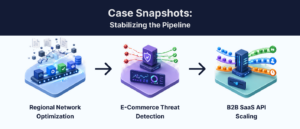
- Regional Network Optimization: Documentation delays and transition challenges were handled through the implementation of an online software program for clinical workflows. In just five months, documentation was completed on time, and interruptions among clinicians were minimized.
- E-Commerce Threat Detection: The company relied on live risk scoring to detect credential stuffing sequences. Through monitoring of IP freshening and reuse of devices, attack success rates were reduced by two figures, but only 2% of customers were affected.
- B2B SaaS API Scaling: Using datacenter ASN signals, a team triggered staged throttles for write endpoints, ensuring that high-value partner traffic was never interrupted.
Technical FAQs
1. How does “interoperability” solve DevOps tooling overload?
Interoperability allows disparate systems to exchange data through standards-based APIs. This means a DevOps team can use a modular layer to connect existing tools smartly, rather than being forced into a single, brittle vendor ecosystem.
2. Why is cloud infrastructure essential for a modern DevOps team?
Cloud infrastructure provides the scalability, availability, and interoperability functions required to deploy and maintain complex models across entire systems. It allows teams to scale workloads without investing in fixed hardware, supporting a more agile DevOps managed services model.
3. What role does “real-time risk scoring” play in a DevOps transformation?
It fixes the issue of static monitoring. By turning system signals into a single, interpretable score, the DevOps team can automate responses, such as step-up authentication or rate-limiting, based on the current context rather than outdated rules.
4. When should we seek DevOps consulting and managed cloud services?
If your team is struggling with DevOps tooling overload, high latency in decision-making, or “brittle” legacy systems, external DevOps consulting services can help harden your integration and on-call automation. This is especially critical when governance, security, and trust are paramount.
Turning Scattered Signals into a Steady Decision

The organizations that will succeed in this regard are those that incorporate intelligence within their processes themselves. To prevent a DevOps transformation failure, it is essential to make a paradigm shift from the current perspective, where tools are seen as “add-ons,” to an approach where they are integrated capabilities. The use of a DevOps team that focuses on modularity and immediate action can help organizations overcome the challenge of interoperability while addressing the problem of DevOps tooling overload.
Partnering with professional DevOps consulting services to harden these integrations ensures that the platform provides the systems necessary to operate at the same speed as the industry itself. The key to establishing stable operations is the dedication to providing high-fidelity DevOps consulting and managed cloud services . It is precisely through such a dedication that what could become a set of operational weaknesses turns into a stable path to success. Such an approach based on DevOps managed services guarantees each requirement and deployment a solid and well-informed decision.
Do you like to read more educational content? Read our blogs at Cloudastra Technologies or contact us for business enquiry at Cloudastra Contact Us.