In terms of water treatment engineering, historically this field has had an emphasis on stability rather than adaptability. Water treatment plants are usually quite large, extremely regulated, and highly integrated, which makes them both dangerous and slow to experiment with. Yet in 2026, cloud computing and AI have come together to change the way that companies run these facilities on a daily basis.
Instead of treating intelligence as a standalone research project, modern AI water platforms embed intelligence directly into operational and business workflows. When deployed on scalable cloud infrastructure, these systems do not just analyze data after the fact; they participate in decision-making as work happens. The intersection of cloud and water treatment engineering has turned AI from a research topic into a fundamental operational tool.
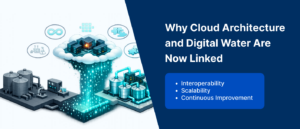
Why Cloud Architecture and Digital Water Are Now Linked
The industrial water treatment industry has traditionally used image acquisition and laboratory equipment that were reliable but rarely integrated into each other. Data silos existed within which updates took a long time, and advanced analytics was hard to implement. The addition of artificial intelligence technology in such an environment was normally done through bolt-on solutions.
The adoption of cloud-native digital water solutions has changed this foundation by moving data and workloads into shared, scalable environments. This shift provides:
- Interoperability: Cloud platforms allow AI water models to process information centrally and in near real-time.
- Scalability: AI simulation tools require elastic computing resources to process population-level datasets or complex chemical simulations without investing in fixed hardware.
- Continuous Improvement: Digital water models can be updated and re-trained based on new data as it becomes available, avoiding the potential pitfall of becoming outdated or brittle.
Enhancing Efficiency in Industrial Water Treatment
Efficiency in the modern water treatment system is no longer an abstract goal. By automating documentation and monitoring, AI water platforms reduce the “documentation burden” on operators. For example, the use of natural language processing (NLP) enables digital water solutions to identify and pull structured data from unstructured manual logs or “free-text” notes written by technicians.
Reference Metrics and Performance Indicators
The following table illustrates the approximate trends and benchmarks for AI water and digital water adoption in 2026:
|
Indicator |
Approximate Trend |
Strategic Impact |
|
Organizations using cloud platforms |
~70% |
Infrastructure Scalability |
|
Planning time reduction with AI |
20–40% |
Workflow Efficiency |
|
Diagnostic/Predictive accuracy lift |
10–25% |
Operational Reliability |
|
Annual growth of digital water solutions |
>25% |
Industry Adoption |
The Architecture of Modern Water Treatment: From Signals to Actions
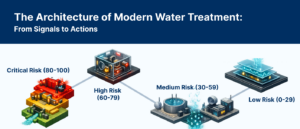
For any effective water treatment technology in 2026, an architecture should be able to ingest live signals without breaking down latency. Any successful water treatment system in industries leverages an event stream from the edge that generates small events for any significant process. The information is sent through a feature service that keeps rolling windows on a per-device or per-site basis to generate insights such as chemical speed or z-scores.
In the scoring layer, there are small but quick models together with guardrail rules to capture nuances. In essence, it translates to a policy engine that converts scores ranging from zero to 100 into decisions:
- 0–29 (Low Risk): Allow the process and log the data.
- 30–59 (Medium Risk): Allow on most routes but require gentle verification on sensitive chemical adjustments.
- 60–79 (High Risk): Step-up authentication or apply light throttling on risky endpoints.
- 80–100 (Critical Risk): Block the action outright or require immediate manual review.
Governance, Security, and Trust in Digital Water
When considering the AI water systems in infrastructures, governance becomes an essential component. The combination of the two leads to crucial issues related to data protection, model explanations, and accountability. As the need for trust grows, the engineering tools for water treatment increasingly implement explainability and auditing mechanisms.
In addition to security, one must consider that the cloud architecture should be designed with all necessary security mechanisms in place. If done effectively, cloud-based digital water systems can offer comparable or even better security than their traditional counterparts. Trust makes the decision, AI water systems work well when engineers comprehend the workings and purpose of the AI.
Predictive Modeling and AI Simulation Tools
Among some of the greatest benefits that result from the use of AI simulation tools for industrial water treatment is the ability to forecast. This involves using the simulation algorithm of the technology in analyzing past trends as well as current trends like flow rate and admission rate.
This uniform approach, delivered through cloud-based digital water platforms, allows consistent deployment across multiple facilities. By converting a water treatment system from a static repository of data into a living workflow, engineers can identify risks of deterioration or necessary interventions early enough to potentially prevent a crisis.
Case Snapshots: Efficiency and Risk Mitigation
- Regional Network Efficiency: A regional system with delays in transition and large manual workloads used AI water applications on the cloud. After six months, there was increased efficiency in document processing and less operational disruption.
- Real-Time Threat Detection: Using AI simulation tools and risk scoring on login and reusing devices, the organization achieved double-digit reductions in credential stuffing successes, while “talking” to just around 2% of their customers.
- Predictive Intervention: Forecasting algorithms identified patients and systems at greater risk of failure, enabling care teams to take action early enough to prevent additional hospitalization or system downtime.
Technical FAQs
1. How does AI Water integrate with an existing water treatment system?
Most platforms adopt standards-based APIs and modular layers intended to work alongside legacy systems. This modular approach allows the AI water models to function independently from a singular data source, decreasing the risk of system-wide failure during adoption.
2. Can AI simulation tools handle “unstructured” data in engineering?
Yes. Through natural language processing (NLP), AI models can identify and pull structured data from unstructured “free-text” notes or logs written by clinicians and engineers. This enables the water treatment system to continuously update and re-train itself based on all available inputs.
3. What role does “real-time risk scoring” play in digital water solutions?
Scoring in real time converts random signals into an orderly decision-making process. This gives the system continuous feedback on its health status, guiding the application on whether to approve a transaction, strengthen its validation efforts, or reject a transaction flow altogether depending on the prevailing risk bands.
4. Why is cloud infrastructure essential for high-performance water treatment engineering?
Cloud infrastructure provides the scalability, high availability, and redundancy required for clinical and industrial environments. It allows digital water solutions to scale workloads up or down without the constraints of fixed hardware, ensuring the system focuses on intelligence rather than server management.
5. How do we reduce bias in AI water fraud and scoring systems?
The teams need to conduct an audit on feature proxies towards protected classes, analyze the percentage rate of false positives for different groups, and adjust the bands independently if necessary. Recording policy exceptions and maintaining a transparent appeals process is crucial.
The Roadmap to Integrated Water Management
The field of water treatment engineering has gone beyond the phase of bolted-on applications. AI water is now an integral aspect of the process, which has proven to increase efficiency by decreasing documentation requirements and providing foresight. The businesses that will succeed as more data becomes available are those that incorporate intelligence into their operations.
With the help of digital water solutions and AI simulation tools, entrepreneurs and technologists are able to tackle challenges associated with interoperability by intelligently linking the existing technologies rather than developing brand new systems. The process allows industrial water treatment to match the pace at which data is generated.
In the end, the organizations that will flourish in a world where data is abundant and care is complex will be those with intelligent systems built directly into the way they do business. Getting around some of the common mistakes made when developing solutions will require a change in mindset, one that no longer looks at software as something that is added on but rather sees it as a key part of the process. Using a strong UX strategy based on modularity and quick reactions not only helps address technical challenges related to interoperability, it also helps address business concerns.
Do you like to read more educational content? Read our blogs at Cloudastra Technologies or contact us for business enquiry at Cloudastra Contact Us.