Risk management software for fintech helps companies identify risky customers, suspicious transactions, compliance gaps, fraud signals and audit issues before they become bigger financial or regulatory problems.
For fintech companies, risk is not limited to fraud. It also includes AML compliance, sanctions screening, PEP checks, watchlist monitoring, customer onboarding risk, transaction behaviour, audit readiness, operational control, and vendor-related exposure. As digital payments, lending platforms, NBFCs and embedded finance businesses grow, these risks become harder to manage manually.
That is why risk management software has become an important part of fintech operations. It gives compliance, risk, and operations teams a structured way to screen customers, monitor activity, flag high-risk cases and keep proper records for audits.
In simple terms, it helps fintech companies grow faster without losing control over compliance, fraud, and customer risk.
What Problem Does Risk Management Software Solve?
Fintech companies face one major challenge: they need to scale quickly without letting risky customers, suspicious transactions, compliance failures, or audit gaps enter the system.
As a fintech platform grows, it starts handling more customers, more payments, more loan applications, more repayments, more onboarding checks and more external partner data. With that growth comes higher exposure to financial crime, AML violations, sanctions risks, PEP risks, mule accounts, identity misuse, transaction fraud and operational mistakes.
Risk management software solves this by helping fintech teams detect risk early, monitor it continuously, and maintain audit-ready records for every important decision.
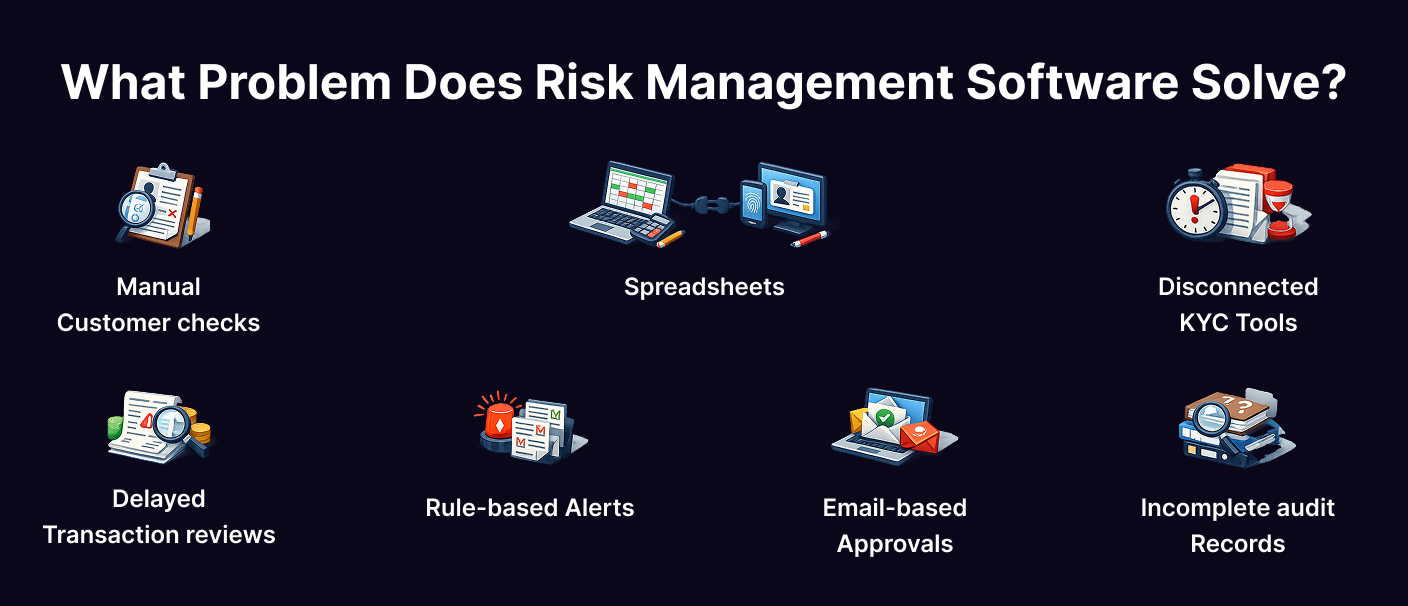
Without a proper system, teams often rely on:
- Manual customer checks
- Spreadsheets
- Disconnected KYC tools
- Delayed transaction reviews
- Rule-based alerts
- Email-based approvals
- Incomplete audit records
These methods may work in the early stage, but they become risky when the company starts handling thousands or millions of users and transactions.
What Is Risk Management Software for Fintech?
Risk management software is a digital system that helps fintech companies identify, assess, monitor and control financial, compliance, fraud, and operational risks.
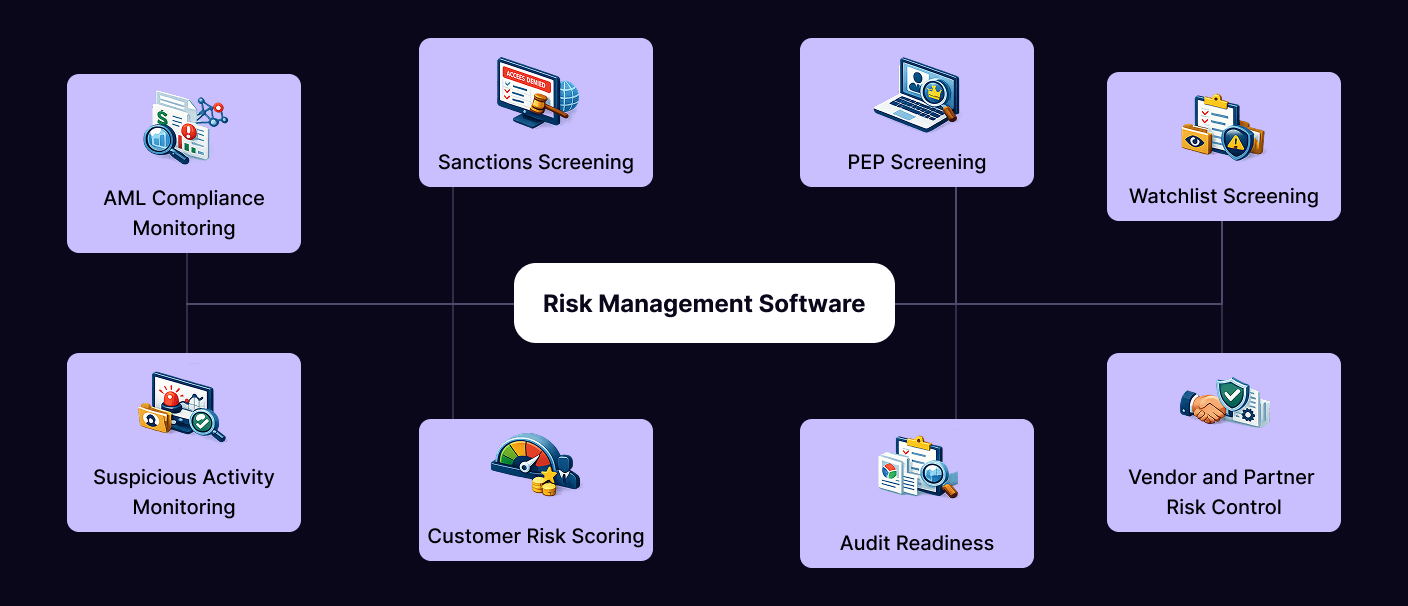
In fintech, it is commonly used for:
- AML compliance monitoring
- Sanctions screening
- PEP screening
- Watchlist screening
- Customer risk scoring
- Suspicious activity detection
- Fraud risk monitoring
- Transaction risk checks
- Audit trail creation
- Compliance reporting
- Vendor and partner risk control
- It helps risk and compliance teams answer practical questions such as:
- Is this customer safe to onboard?
- Is this user present on a sanctions list?
- Is this person politically exposed?
- Is this transaction suspicious?
- Is this customer linked to risky activity?
- Can we prove our compliance process during an audit?
- Are high-risk cases being reviewed on time?
- Are external vendors creating hidden compliance or operational risk?
For fintech companies, risk management software is not just a compliance tool. It is a business protection system.
Why Do Fintech Companies Need Risk Management Software?
Fintech companies need risk management software because financial activity is now digital, instant, and large-scale.
A payment app may process thousands of transactions every minute. A lending platform may receive applications from different regions. An NBFC may need to screen borrowers, partners, and vendors. A neobank may need to monitor users continuously even after onboarding.
This speed creates risk.
When checks are manual, delayed or scattered across multiple tools, important warning signs can be missed. A risky customer may get approved. A suspicious transaction may be detected too late. A sanctions match may not be escalated. Audit evidence may be hard to find when regulators ask for it.
Risk management software helps reduce these gaps by automating checks, centralizing risk data, and making compliance decisions easier to track.
For fintechs working with external partners, third party risk management also becomes important because vendors, APIs, data providers, payment partners and service providers can create compliance and operational exposure if they are not reviewed properly.
How Big Is the Risk Problem in Fintech?
The risk problem is growing because digital finance itself is growing quickly.
According to the Press Information Bureau’s UPI 10-year report, UPI processed more than 24,161 crore annual transactions worth around ₹314 lakh crore in FY 2025–26, with more than 700 banks live on UPI. This shows the massive scale of digital financial activity in India.
This does not mean every transaction is risky. It means fintech companies are now operating in a high-volume environment where manual risk monitoring becomes difficult.
Financial crime compliance is also becoming more expensive. LexisNexis Risk Solutions reported that the annual cost of financial crime compliance reached around US$45 billion in APAC study countries in 2023, and compliance costs increased for 98% of APAC financial institutions surveyed.
Global financial crime is also increasing. Nasdaq’s 2024 Global Financial Crime Report reported that more than US$3.1 trillion in illicit funds flowed through the global financial system in 2023, and global fraud losses were more than US$485 billion.
Nasdaq Verafin’s 2026 Global Financial Crime Report also estimates US$4.4 trillion in illicit financial activity globally in 2025 and US$579.4 billion in losses from fraud scams and bank fraud schemes.
The Association of Certified Fraud Examiners Report to the Nations also shows how common fraud investigations are globally. Its 2026 report is based on 2,402 real occupational fraud cases from 143 countries and territories.
These numbers show why fintech risk management is no longer optional. As transaction volume, digital onboarding, compliance pressure, and financial crime exposure increase, fintech companies need stronger systems to detect and manage risk before it creates financial or regulatory damage.
Key Use Cases of Risk Management Software in Fintech
1. AML Compliance Monitoring
AML compliance monitoring helps fintech companies detect and prevent money laundering risks.
Risk management software supports AML compliance by screening customers, monitoring risk profiles, detecting suspicious behaviour and keeping records for compliance reviews.
This is useful for:
- NBFCs
- Digital lenders
- Neobanks
- Payment companies
- Embedded finance platforms
- Loan servicing companies
For fintech teams, AML monitoring is not just about checking a customer once. Risk can change over time, so companies need systems that can support ongoing screening, alerting and recordkeeping.
2. Sanctions Screening
Sanctions screening helps fintech companies check whether a customer, business, vendor or related party appears on a restricted or sanctions list.
This is important because onboarding or transacting with a sanctioned individual or entity can create legal, regulatory, and reputational risk.
Risk management software automates sanctions screening and alerts compliance teams when a possible match is found. This makes the process faster, more consistent and easier to prove during audits.
3. PEP Screening
PEP screening helps identify Politically Exposed Persons who may require enhanced due diligence.
A PEP is not automatically a criminal or rejected customer. However, PEPs may carry higher compliance risk because of their public role, influence, or exposure to corruption-related risks.
Risk management software helps detect PEP matches and route those cases for deeper review. This gives compliance teams a clearer way to handle high-risk profiles without slowing down every customer journey.
4. Watchlist Screening
Watchlist screening helps fintech companies compare customers and entities against multiple risk databases.
These may include:
- Sanctions lists
- PEP databases
- Adverse media lists
- Enforcement lists
- Regulatory blacklists
- Criminal watchlists
Manual watchlist checking is slow and inconsistent, especially when customer volume grows. Automated screening helps fintech teams detect high-risk customers, vendors or entities faster and take action before the risk becomes bigger.
For fintech companies, watchlist screening is especially useful during onboarding, transaction approval, vendor review and ongoing customer monitoring.
5. Customer Risk Scoring
Customer risk scoring helps fintech teams classify users as low risk, medium risk or high risk.
Risk scores can be based on:
- Identity details
- Geography
- Business type
- Transaction behaviour
- PEP status
- Sanctions matches
- Watchlist results
- Adverse media signals
- Linked entities
- Past activity
This helps teams focus more attention on high-risk cases instead of reviewing every customer manually.
For example, a low-risk customer may move through onboarding faster, while a high-risk customer can be sent for manual review, enhanced due diligence or additional verification.
6. Suspicious Activity Monitoring
Suspicious activity monitoring helps fintech teams detect unusual behaviour that may indicate fraud, money laundering or platform misuse.
Examples include:
- Sudden transaction spikes
- Unusual repayment patterns
- Multiple accounts linked to one identity
- High-risk location activity
- Repeated failed verification attempts
- Large-value movement from new accounts
- Rapid fund movement between linked accounts
These signals are easy to miss when teams depend only on manual reviews. Risk management software helps identify them earlier so teams can investigate before the problem becomes larger.
7. Vendor and Partner Risk Control
Fintech companies often depend on external vendors and partners for KYC, payments, data, APIs, cloud infrastructure, collections and customer support.
Each external partner can create risk if their compliance process, data handling, security controls or service reliability is weak.
This is where vendor risk management software becomes useful. It helps fintech teams review vendors, track documentation, maintain approval records, and reduce the chances of missed compliance gaps.
For regulated fintech companies, this is important because vendor failures can affect customer data, service quality, compliance reporting, and audit readiness.
A strong third party risk management software approach helps fintech companies manage external relationships with more structure instead of relying only on emails, spreadsheets, or scattered approvals.
8. Audit Readiness
Audit readiness is one of the most important benefits of risk management software.
Fintech companies need to prove:
- When a customer was screened
- Which checks were completed
- What alert was generated
- Who reviewed the alert
- What action was taken
- Why the decision was made
- Whether the case was escalated
- What evidence supports the decision
Risk management software keeps these records in one place. This makes it easier for compliance teams to respond during audits, internal reviews, regulatory checks and partner due diligence requests.
Common Risk Management Challenges in Fintech
Manual Risk Checks Are Too Slow
Manual reviews delay customer onboarding and increase workload for risk and compliance teams. As transaction volume grows, manual checks become harder to manage without errors or delays.
False Positives Waste Team Time
Risk teams often spend too much time reviewing alerts that are not actually risky. This reduces focus on genuine high risk cases that need faster investigation.
Compliance Data Is Scattered
Customer data, KYC data, transaction history, alert records, and audit notes are often stored in different systems. This makes it difficult to get a complete risk view when the team needs it.
Risk Is Detected Too Late
Delayed monitoring can allow suspicious customers or transactions to pass through before teams detect the issue.
Audit Records Are Incomplete
When regulators or internal teams ask for proof, fintech companies may struggle to show complete records if decisions were made across emails, spreadsheets and disconnected tools.
Vendor Oversight Becomes Difficult
As fintech companies add more partners and service providers, vendor oversight becomes harder to manage manually. Missing documents, unclear approval trails and delayed reviews can create compliance and operational gaps.
What Features Should Fintech Risk Management Software Have?
A strong fintech risk management platform should include:
- Real-time customer screening
- AML monitoring
- Sanctions screening
- PEP screening
- Watchlist screening
- Customer risk scoring
- Suspicious activity alerts
- Case management
- Audit trails
- Compliance reporting
- API integration
- Role-based access
- Configurable rules
- Secure data handling
- Automated workflows
- Vendor and partner review support
The most important features for fintech companies are AML monitoring, sanctions screening, PEP screening, watchlist checks, risk scoring, audit trails, real-time alerts, and compliance reporting.
How RiskIntel Helps Fintech Companies Manage Risk
RiskIntel is designed for fintech companies, NBFCs, digital lenders, and financial service providers that need better control over compliance and customer risk.
RiskIntel helps fintech teams with:
- AML compliance checks
- Sanctions screening
- PEP screening
- Watchlist monitoring
- High-risk customer identification
- Compliance alerts
- Customer risk scoring
- Audit-ready records
- Faster onboarding decisions
- Reduced manual screening effort
Instead of relying on spreadsheets or disconnected tools, fintech teams can use RiskIntel to centralize compliance risk monitoring and make risk decisions faster.RiskIntel is useful for companies that want to reduce compliance gaps without slowing down customer onboarding.
Who Should Use Risk Management Software?
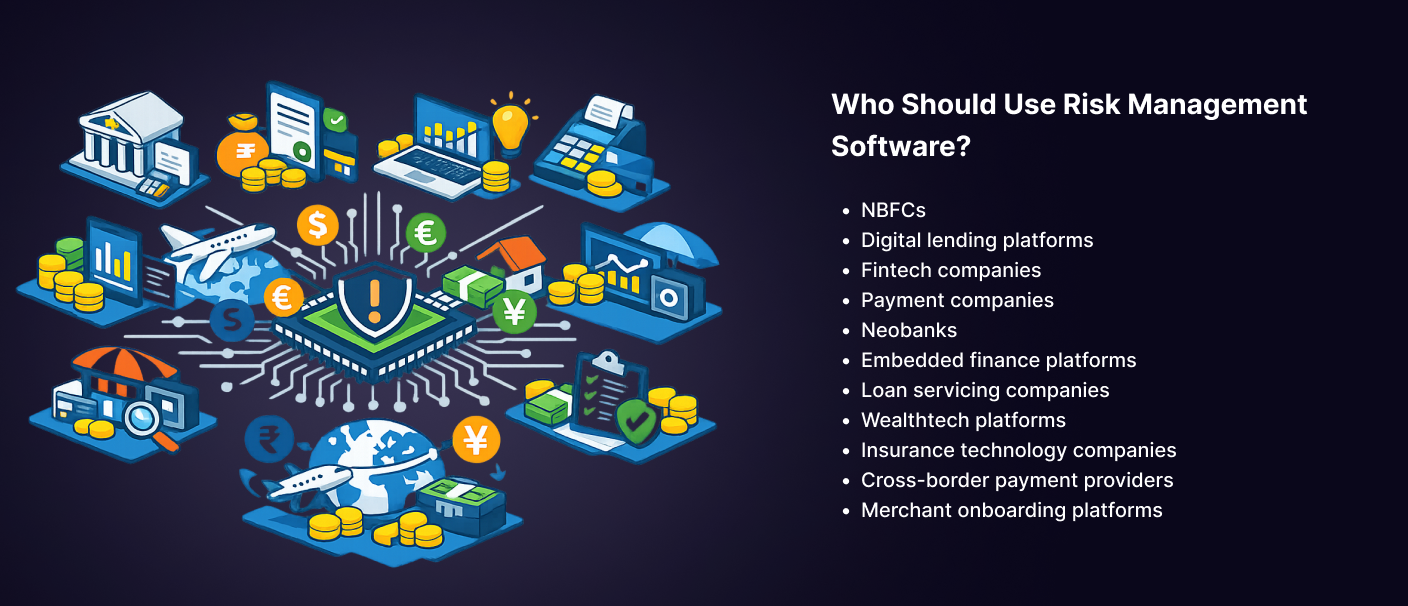
Risk management software is useful for:
- NBFCs
- Digital lending platforms
- Fintech companies
- Payment companies
- Neobanks
- Embedded finance platforms
- Loan servicing companies
- Wealthtech platforms
- Insurance technology companies
- Cross-border payment providers
- Merchant onboarding platforms
Any fintech company that handles customer onboarding, financial transactions, lending, repayments, compliance checks, partner reviews or sensitive financial data should consider using risk management software.
FAQs
1. What is risk management software for fintech companies?
Risk management software for fintech companies is a platform that helps identify, monitor, and reduce risks related to AML compliance, sanctions screening, PEP checks, watchlist monitoring, fraud detection, customer onboarding, vendor oversight, and audit readiness.
2. Why do fintech companies need risk management software?
Fintech companies need risk management software because they handle high volumes of digital transactions, customer data, compliance checks, and financial decisions. As the company grows, manual checks can become slow, inconsistent, and difficult to audit.
3. What are the main use cases of risk management software in fintech?
The main use cases include AML compliance monitoring, sanctions screening, PEP screening, watchlist screening, customer risk scoring, suspicious activity monitoring, vendor and partner risk control, and audit readiness.
4. How does RiskIntel help fintech companies?
RiskIntel helps fintech companies automate AML checks, sanctions screening, PEP screening, watchlist monitoring, risk alerts, and audit-ready compliance workflows. It helps teams reduce manual screening effort, improve compliance visibility, and make faster risk decisions
Do you like to read more educational content? Read our blogs at Cloudastra Technologies or contact us for business enquiry at Cloudastra Contact Us.