Fraud prevention helps fintech companies, banks, NBFCs, and payment platforms stop suspicious transactions before they turn into financial loss, customer complaints, or compliance issues.
The challenge is not only about blocking risky payments. The real challenge in fraud prevention for fintech is stopping suspicious activity without creating friction for genuine customers. SecureFlow helps payment and risk teams use real-time transaction monitoring, fraud rules, risk signals, and anti-fraud AI workflows to detect suspicious payment activity while keeping safe transactions moving.
Introduction
Fintech products are built for speed.
Customers expect instant onboarding, fast payments, quick transfers, smooth repayments, and low-friction digital experiences. But the same speed that improves customer experience also gives fraudsters more room to move quickly.
A suspicious transaction may happen within seconds. A mule account may move money through multiple accounts before a manual review starts. An account takeover may result in a high-value payment before the customer even notices. A fraud pattern may not look risky in one transaction, but becomes clear when seen across velocity, beneficiary, device, and account behavior.
This is why fraud prevention has become a serious priority for fintech companies.
But there is another problem.
If the fraud system is too strict, genuine customers get blocked. If the fraud system is too loose, suspicious payments go through. Both outcomes hurt the business.
A good fraud prevention strategy should reduce fraud risk while keeping legitimate payments smooth.
What Is Fraud Prevention?
Fraud prevention is the process of identifying, stopping, or reducing fraudulent activity before it causes financial loss.
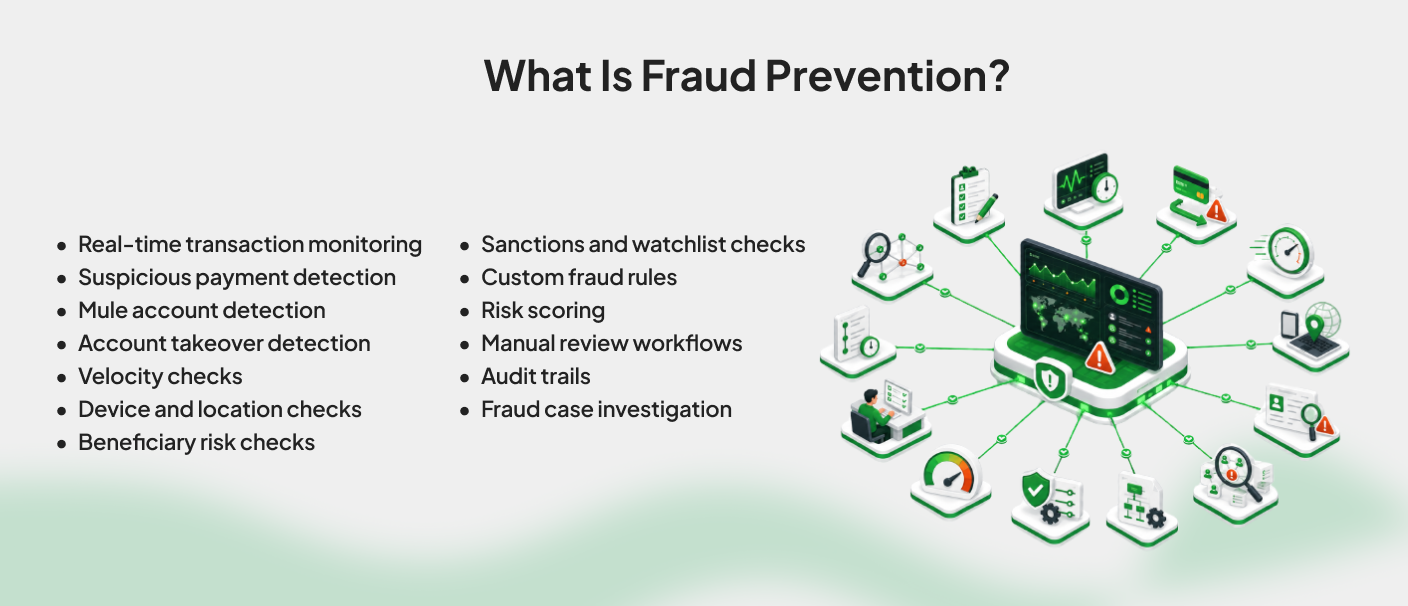
In fintech, fraud prevention usually includes:
- Real-time transaction monitoring
- Suspicious payment detection
- Mule account detection
- Account takeover detection
- Velocity checks
- Device and location checks
- Beneficiary risk checks
- Sanctions and watchlist checks
- Custom fraud rules
- Risk scoring
- Manual review workflows
- Audit trails
- Fraud case investigation
Fraud prevention is different from fraud investigation.
Fraud investigation usually happens after a suspicious activity has already occurred. Fraud prevention focuses on stopping the risky action before it creates damage.
For payment teams, this means checking a transaction before funds settle.
For lending teams, it means detecting risky users before loan approval.
For fintech platforms, it means identifying suspicious behavior before it affects customers, revenue, compliance, or trust.
Why Fintech Companies Need Fraud Prevention
Fintech companies need fraud prevention because digital financial activity happens at high speed and high volume.
Manual review alone cannot keep up with modern payment flows.
A payment platform may process thousands of transactions in a short period. A lender may receive many loan applications daily. A wallet company may handle instant transfers. An embedded finance platform may manage payments, accounts, and customer activity across partners.
In all these cases, fraud signals can appear quickly.
Without a structured fraud prevention system, teams may face problems such as:
- Fraud detected after funds move
- Too many manual reviews
- Genuine customers being blocked unnecessarily
- Suspicious transactions missed due to weak rules
- Analysts spending time on low-risk alerts
- Mule accounts moving money before review
- No clear reason behind pass or block decisions
- Slow escalation
- Poor audit records
- Weak visibility across payment risk
Fraud prevention helps fintech teams move from reactive investigation to proactive risk control.
Instead of asking “What happened after the fraud?”, the team can ask “How do we stop this before it settles?”
How Fraud Prevention Works in Fintech
Fraud prevention works by checking users, transactions, devices, patterns, and risk signals before a final decision is made.
Here is how the workflow usually works.
1. Transaction Data Is Captured
The system first captures transaction data when a payment is initiated.
This may include:
- Sender account
- Receiver account
- Transaction amount
- Payment rail
- Time of transaction
- Device information
- Location information
- Customer profile
- Beneficiary history
- Account age
- Previous transaction activity
- Payment message data
This gives the system the basic information needed to evaluate risk.
The faster this data is captured, the better the chance of stopping suspicious activity before settlement.
2. Risk Signals Are Checked
The transaction is checked against different risk signals.
These may include:
- High payment velocity
- New beneficiary activity
- Sudden high-value transfer
- Unusual transaction timing
- Multiple failed attempts
- New device login
- Location mismatch
- Repeated small-value transfers
- High-risk counterparty
- Suspicious account movement
- Mule account indicators
- Sanctions or watchlist exposure
A single signal may not always be enough to block a transaction.
For example, a new device login may be normal. A high-value payment may also be normal. But a new device, new beneficiary, high-value transfer, and unusual location together may indicate higher risk.
Fraud prevention works best when signals are evaluated together.
3. Rules and Risk Models Evaluate the Transaction
Fraud prevention systems use rules, risk logic, and AI-assisted models to evaluate suspicious behavior.
Rules may check simple conditions such as:
- Is the transaction above a threshold?
- Is the beneficiary new?
- Has the user made too many transactions in a short time?
- Is the account newly created?
- Is the device different from normal?
- Is the counterparty risky?
More advanced systems may also identify patterns such as:
- Mule account behavior
- Smurfing
- Account takeover
- Rapid fund movement
- Synthetic identity behavior
- Repeated suspicious transfers
- Linked account activity
This is where fraud detection and prevention software becomes more useful than basic manual checks.
It helps teams combine multiple signals and make faster decisions.
4. The Transaction Is Classified
After evaluation, the transaction is classified based on risk.
Common classifications include:
- Low risk
- Medium risk
- High risk
- Critical risk
- Needs review
- Should be blocked
This helps teams decide what should happen next.
A low-risk payment may pass instantly. A medium-risk payment may be flagged. A high-risk payment may be held for review. A critical-risk payment may be blocked.
The goal is to match the action with the level of risk.
5. A Decision Is Made
The fraud prevention system then returns a decision.
This may be:
- Pass
- Flag
- Hold
- Block
- Escalate
A strong system should also explain why the decision was made.
For example:
- High-value transfer to new beneficiary
- Multiple payments within a short window
- Device mismatch with unusual location
- Possible mule account pattern
- Suspicious velocity behavior
- Sanctions or watchlist signal
- Repeated failed login followed by payment attempt
This helps risk teams review suspicious payment detection decisions clearly.
6. The Decision Is Logged
Every fraud prevention decision should be stored with the full context.
This may include:
- Transaction details
- Risk signals
- Rule triggers
- Final decision
- Reviewer action
- Timestamp
- Escalation status
- Notes
- Outcome
This creates an audit trail.
For fintech companies, auditability matters because teams need to prove why a transaction was passed, flagged, or blocked.
Key Features of Fraud Prevention Software
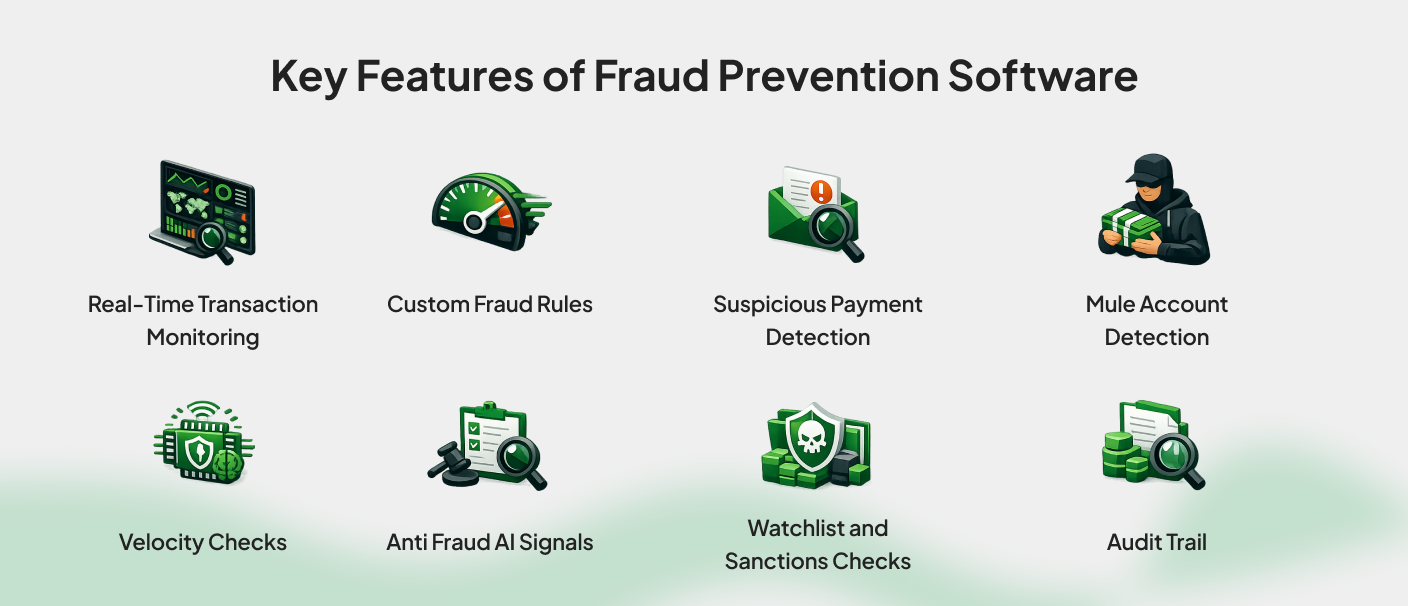
Real-Time Transaction Monitoring
Fraud prevention needs to happen in real time.
If alerts come after settlement, the team is already chasing recovery. Real-time transaction monitoring helps teams detect suspicious activity while action is still possible.
Custom Fraud Rules
Fraud patterns change quickly.
Risk teams should be able to create and adjust rules based on new fraud behavior, payment trends, product risk, geography, customer type, and internal policy.
Suspicious Payment Detection
Suspicious payment detection helps identify payments that show unusual behavior.
This may include abnormal value, frequency, beneficiary changes, device mismatch, or account movement patterns.
Mule Account Detection
Mule accounts are used to receive and move suspicious funds.
A fraud prevention system should look for patterns such as rapid fund movement, low balance retention, multiple incoming transfers, and fast outgoing transfers.
Velocity Checks
Velocity checks detect unusual transaction speed or frequency.
They are useful for identifying rapid payment attempts, repeated transfers, and possible abuse before funds move further.
Anti Fraud AI Signals
Anti fraud AI can help detect patterns that simple rules may miss.
It can support behavior analysis, anomaly detection, risk prioritization, and alert scoring. Human teams still need to review important decisions, but AI can help surface risk faster.
Watchlist and Sanctions Checks
Fraud prevention and compliance often overlap.
If a payment involves restricted or high-risk parties, the system should flag it for review before approval.
Audit Trail
Every decision should be traceable.
Risk and compliance teams need to know what was checked, which rule triggered, who reviewed the case, and what action was taken.
Use Cases of Fraud Prevention in Fintech
1. Instant Payment Fraud Prevention
Instant payments leave very little time for manual review.
Fraud prevention systems help check transaction risk before funds settle, allowing teams to pass safe payments and stop suspicious ones.
2. Mule Account Monitoring
Fintech teams can use fraud prevention workflows to identify accounts that receive and quickly move funds.
This helps detect mule behavior before the account becomes part of a larger fraud network.
3. Account Takeover Prevention
If a user suddenly logs in from a new device, changes behavior, adds a new beneficiary, and initiates a high-value payment, the system can flag the transaction for review.
This helps reduce account takeover-related losses.
4. Smurfing Detection
Smurfing happens when larger amounts are split into smaller transactions to avoid detection.
Fraud prevention systems can track repeated small-value transfers, linked accounts, and suspicious frequency.
5. New Beneficiary Risk Checks
Payments to new beneficiaries may carry higher risk, especially when combined with high value, device change, or unusual timing.
A fraud prevention system can apply stronger checks for these cases.
6. Cross-Border Payment Review
Cross-border payments may require additional checks for sanctions exposure, geography risk, counterparty risk, and unusual payment behavior.
Fraud prevention workflows help teams apply these checks consistently.
7. Analyst Queue Prioritization
Risk teams often receive many alerts.
Fraud prevention software can prioritize alerts based on risk level so analysts focus on the most suspicious transactions first.
Benefits of Fraud Prevention for Fintech
Lower Fraud Losses
The biggest benefit is stopping suspicious activity before it becomes financial loss.
Prevention is usually more effective than trying to recover funds after settlement.
Better Customer Experience
Good fraud prevention should not block every unusual transaction.
It should reduce unnecessary friction for genuine customers while applying stronger checks to risky payments.
Faster Risk Decisions
Automated risk checks help teams make faster pass, flag, hold, or block decisions.
This is important for high-volume payment platforms.
Reduced Manual Review Load
Fraud teams can spend less time reviewing low-risk alerts and more time investigating high-risk cases.
This improves analyst productivity.
Stronger Compliance Support
Fraud prevention systems with audit trails help teams maintain better records for internal reviews, audits, and compliance checks.
Better Visibility Into Fraud Patterns
Teams can see which rules are triggering, which payment types are riskier, which accounts are showing suspicious behavior, and where fraud attempts are increasing.
Improved Trust
Customers trust fintech platforms that protect their money without making every transaction difficult.
Strong fraud prevention supports both safety and customer confidence.
Common Fraud Prevention Challenges
Too Many False Positives
If rules are too strict, genuine payments may get blocked.
This creates customer frustration and support workload.
Fraud Detected Too Late
If monitoring happens after settlement, the fraud prevention system becomes a reporting tool.
For payment fraud, timing is critical.
Weak Rule Tuning
Old rules may stop working when fraudsters change tactics.
Risk teams need flexible rule tuning.
Scattered Risk Data
If customer data, transaction data, device data, and compliance signals are stored in different tools, the fraud view becomes incomplete.
No Clear Decision Reason
A blocked payment without a reason creates confusion.
Risk teams need explainable decisions with rule triggers and risk context.
Manual Review Overload
If every suspicious signal becomes a manual alert, analysts get overwhelmed.
Risk scoring and prioritization are needed.
No Audit Trail
Without complete records, teams cannot prove why a payment was allowed, flagged, or blocked.
This creates governance and compliance gaps.
How SecureFlow Helps With Fraud Prevention
SecureFlow by Cloudastra helps fintech companies, banks, NBFCs, payment platforms, and digital finance teams prevent fraud before risky payments settle.
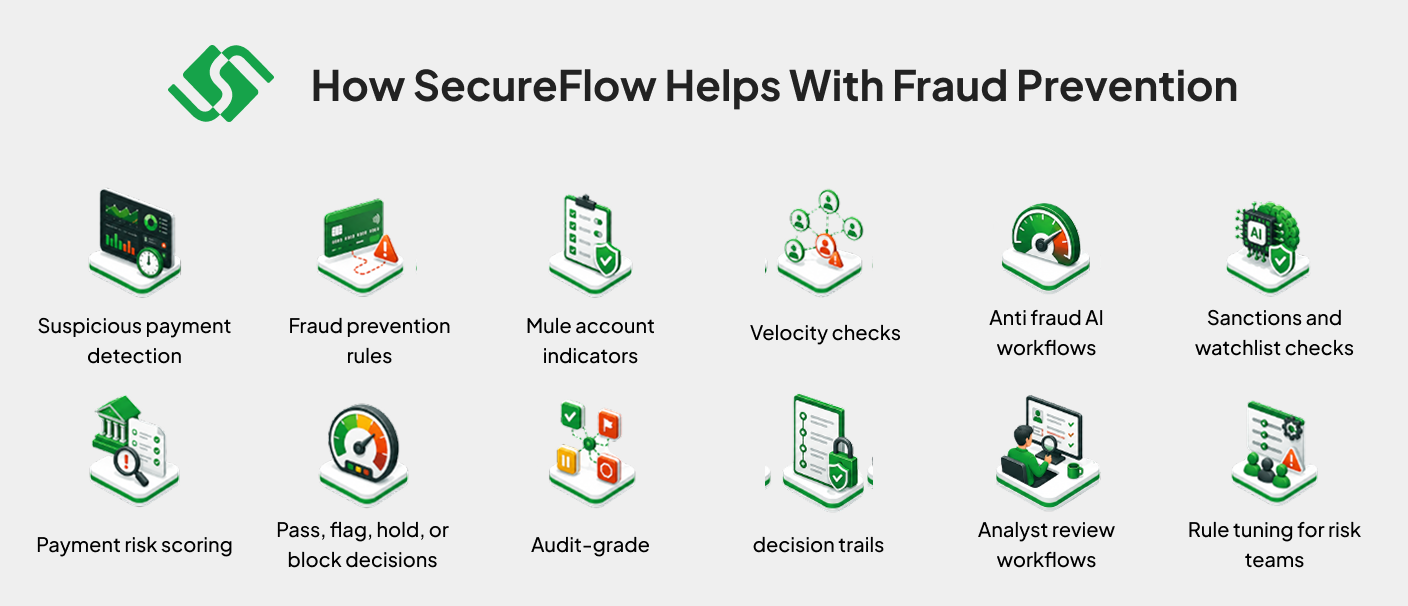
SecureFlow supports:
- Real-time transaction monitoring
- Suspicious payment detection
- Fraud prevention rules
- Mule account indicators
- Velocity checks
- Anti fraud AI workflows
- Sanctions and watchlist checks
- Payment risk scoring
- Pass, flag, hold, or block decisions
- Audit-grade decision trails
- Analyst review workflows
- Rule tuning for risk teams
Instead of waiting for fraud to become a recovery problem, SecureFlow helps teams detect risky payment behavior at the transaction moment.
For fintech teams, this means stronger fraud control without slowing every genuine customer.
Who Should Use SecureFlow?
SecureFlow is useful for:
- Fintech companies
- Banks
- NBFCs
- Payment gateways
- Payment aggregators
- Digital lenders
- Wallet companies
- Neo-banks
- Embedded finance platforms
- Cross-border payment providers
- Risk teams
- Fraud operations teams
- Compliance teams
- Transaction monitoring teams
It is especially useful for teams that need to stop suspicious payments before settlement while keeping safe transactions moving.
Want to explore more helpful insights on AI, automation, and enterprise technology? Read more blogs at Cloudastra Technologies or connect with us for business enquiries through Cloudastra Contact Us
FAQs
1. What is fraud prevention in fintech?
Fraud prevention in fintech is the process of detecting and stopping suspicious users, transactions, accounts, or payment behavior before they create financial loss, compliance risk, or customer harm.
2. Why do fintech companies need fraud prevention?
Fintech companies need fraud prevention because digital payments move quickly. Without real-time checks, suspicious payments may settle before risk teams can act.
3. What is fraud detection and prevention software?
Fraud detection and prevention software monitors transactions, users, devices, accounts, and payment behavior to identify suspicious activity and help teams stop fraud before damage occurs.
4. How does real-time transaction monitoring help fraud prevention?
Real-time transaction monitoring checks payments as they happen, allowing teams to pass safe transactions, flag suspicious ones, and block high-risk payments before settlement.
5. Can fraud prevention reduce false positives?
Yes. A well-designed fraud prevention system can reduce false positives by combining multiple risk signals, applying better scoring, and prioritizing only transactions that show stronger suspicious patterns.
6. How does SecureFlow support fraud prevention?
SecureFlow supports fraud prevention through real-time transaction monitoring, suspicious payment detection, custom fraud rules, mule account indicators, velocity checks, anti fraud AI workflows, and audit-ready decision trails.
7. Who should use fraud prevention software?
Fraud prevention software is useful for fintech companies, banks, NBFCs, payment gateways, payment aggregators, digital lenders, wallet providers, and payment risk teams.
8. What is the difference between fraud prevention and fraud investigation?
Fraud prevention focuses on stopping suspicious activity before loss happens. Fraud investigation usually happens after suspicious activity has already occurred and teams need to understand what happened.