Customer risk scoring helps fintech companies identify which users, borrowers, merchants, vendors, or business accounts need deeper review before onboarding or approval.
For fintech teams, the goal is not to slow down every customer during onboarding. The real objective of customer risk scoring for fintech is to identify low-risk users and high risk profiles early, allowing compliance teams to focus on cases that genuinely require attention. RiskIntel helps fintech companies automate this process using AML signals, sanctions screening, PEP checks, watchlist monitoring, and audit ready risk records.
Introduction
Fintech onboarding needs to be fast, but it also needs to be safe.
A digital lender may receive hundreds of borrower applications every day. A payment platform may onboard merchants quickly. An embedded finance company may need to verify users, vendors, and partners before giving access to financial services.
The challenge is that not every customer carries the same level of risk.
Some users are low risk and can move through onboarding faster. Some users need additional verification. Some may be linked to sanctions, PEP exposure, adverse media, suspicious activity, high-risk geographies, or unusual entity relationships.
If every customer is reviewed manually, onboarding becomes slow. If every customer is approved too quickly, compliance and fraud risk increases.
That is why fintech companies need customer risk scoring.
It gives compliance and risk teams a structured way to identify high-risk users before they create regulatory, fraud, or operational problems.
What Is Customer Risk Scoring?
Customer risk scoring is the process of assigning a risk level to a customer based on identity details, compliance signals, geography, business profile, transaction behavior, watchlist matches, and other risk indicators.
A customer risk score helps classify users into categories such as:
- Low risk
- Medium risk
- High risk
- Critical risk
- Needs manual review
- Needs enhanced due diligence
In fintech, customer risk scoring is commonly used during:
- Customer onboarding
- Borrower screening
- Merchant onboarding
- Vendor review
- Business account approval
- Loan application checks
- Ongoing customer monitoring
- Compliance case review
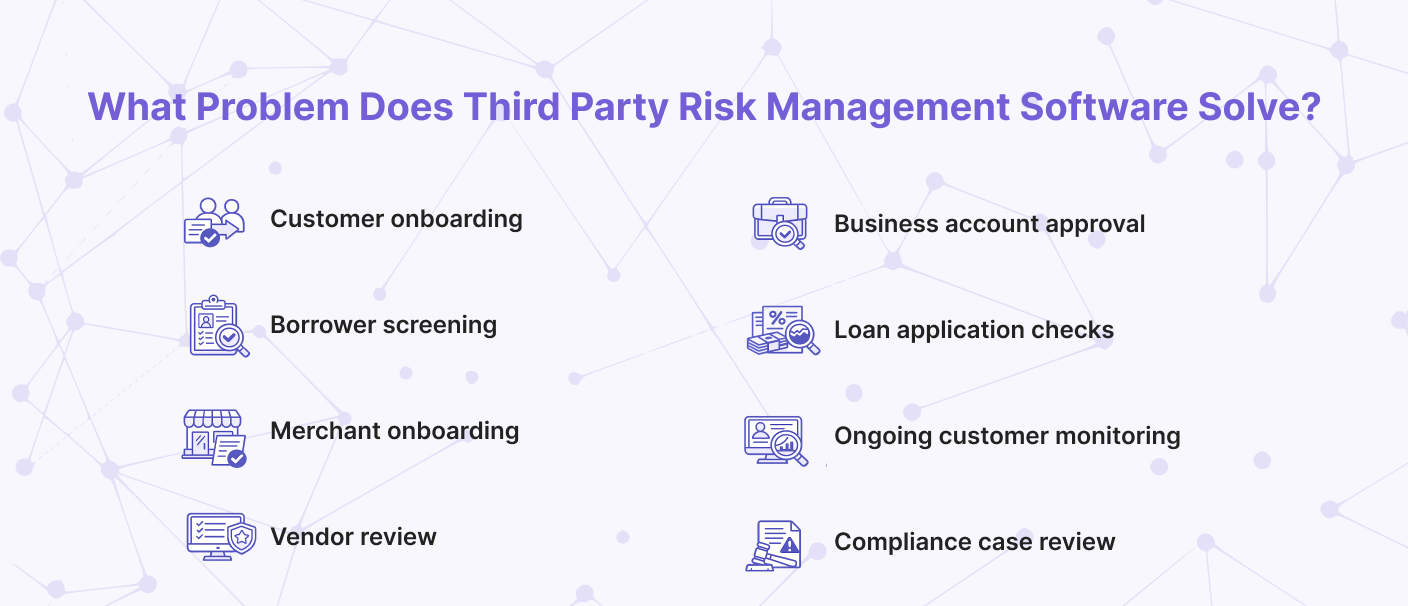
Third-party risk management software helps fintech teams strengthen onboarding, screening, approvals, vendor reviews, ongoing monitoring, and compliance case management.
The score helps teams answer practical questions:
- Is this customer safe to onboard?
- Does this user appear on a sanctions list?
- Is this person politically exposed?
- Does this account need enhanced due diligence?
- Is this business linked to high-risk activity?
- Should this application be approved, reviewed, or rejected?
- Can we prove why this decision was made?
In simple terms, customer risk scoring helps fintech companies make faster and more consistent onboarding decisions without ignoring compliance risk.
Why Fintech Companies Need Customer Risk Scoring
Fintech companies need customer risk scoring because digital onboarding happens at scale.
A growing fintech platform may handle thousands of user sign-ups, merchant applications, borrower checks, loan approvals, and partner reviews. Manual screening may work at the early stage, but it becomes difficult as the business grows.
Without a structured scoring system, teams often face problems such as:
- Too many manual reviews
- Inconsistent onboarding decisions
- High-risk users passing through
- Sanctions checks happening too late
- PEP cases not being escalated properly
- Watchlist matches getting missed
- Compliance teams spending time on low-risk users
- Audit records being incomplete
- Risk decisions depending on individual judgment
- Customer onboarding becoming slow
Customer risk scoring solves this by giving every user a clear risk level.
Instead of treating every user the same, fintech companies can apply different workflows based on risk.
For example:
- Low risk users can move faster
- Medium risk users can be reviewed with standard checks
- High risk users can be sent for enhanced due diligence
- Critical risk users can be blocked or escalated immediately
This helps fintech teams balance growth, customer experience, and compliance control.
How Customer Risk Scoring Works
Customer risk scoring works by collecting customer data, checking compliance signals, applying risk rules, and assigning a risk level.
Here is how the process usually works.
1. Customer Data Is Collected
The system first collects customer information during onboarding or review.
This may include:
- Full name
- Date of birth
- PAN or identity details
- Address
- Nationality
- Business name
- Business type
- Industry
- Location
- Phone number
- Beneficial owners
- Directors
- Linked entities
- Loan or product type
- Customer category
For business accounts, the system may also collect company registration details, ownership structure, and related party information.
This data becomes the base for customer risk scoring.
2. Identity and Profile Checks Are Completed
Once customer data is collected, the system checks whether the profile is complete, consistent, and suitable for onboarding.
This may include:
- Identity validation
- Name matching
- Document checks
- Address checks
- Business type review
- High risk industry checks
- Geography based risk checks
- Linked entity checks
If a customer profile has missing or inconsistent information, the system can increase the risk score or send the case for review.
3. Sanctions Screening Is Performed
Sanctions screening checks whether the customer, business, director, beneficial owner, or linked party appears on a restricted or sanctions list.
This is important because onboarding or transacting with a sanctioned individual or entity can create serious regulatory and reputational risk.
A customer risk scoring system should not treat sanctions exposure as a normal alert.
If a possible sanctions match appears, the case should be flagged for immediate review, escalation, or rejection depending on the company’s compliance policy.
4. PEP Screening Is Completed
PEP screening checks whether a customer is a Politically Exposed Person or connected to one.
A PEP is not automatically rejected, but the profile usually requires deeper review because of higher exposure to bribery, corruption, influence, or misuse of financial systems.
Customer risk scoring helps fintech teams identify PEP related risk and route those cases into enhanced due diligence.
This helps teams handle high risk users properly without slowing down every customer.
5. Watchlist Monitoring Is Applied
Watchlist monitoring checks customer profiles against different risk databases.
These may include:
- Sanctions lists
- PEP databases
- Adverse media lists
- Enforcement lists
- Regulatory blacklists
- Criminal watchlists
- Internal blocklists
- High risk entity databases
Manual watchlist checks can be slow and inconsistent.
Automated watchlist monitoring helps fintech teams detect risky users earlier and maintain clear records for future audits.
6. AML Risk Scoring Is Calculated
AML risk scoring helps fintech companies identify users who may require stronger monitoring from an anti money laundering perspective.
AML risk may be based on:
- Customer type
- Geography
- Business activity
- Source of funds
- Transaction behavior
- Ownership structure
- Watchlist exposure
- PEP status
- Sanctions indicators
- High-risk industry signals
- Linked entity risk
The goal is to identify customers who may need enhanced checks before onboarding or closer monitoring after approval.
7. A Final Risk Level Is Assigned
After all checks are completed, the system assigns a final customer risk level.
This may look like:
- Low risk: approve or fast-track
- Medium risk: standard review
- High risk: enhanced due diligence
- Critical risk: reject or escalate
The final score should include the reason behind the decision.
For example:
- PEP match found
- High risk geography
- Sanctions name similarity
- Adverse media signal
- Business type requires enhanced review
- Missing beneficial owner information
- Linked entity appears on watchlist
This makes the decision easier to explain and audit later.
Key Features of Customer Risk Scoring Software
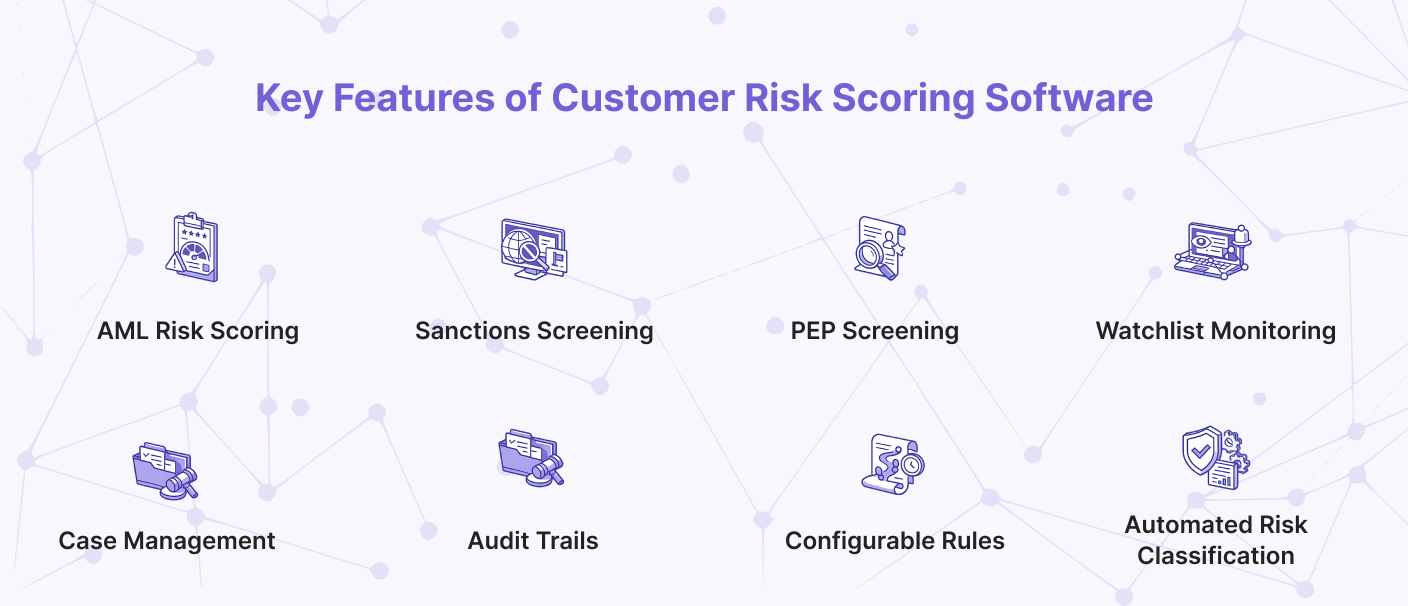
Automated Risk Classification
The system should automatically classify customers into risk levels based on defined rules and risk signals.
This helps teams avoid manual guesswork.
AML Risk Scoring
AML risk scoring helps compliance teams identify customers who may need deeper review or ongoing monitoring.
This is useful for fintech companies, NBFCs, payment platforms, digital lenders, and neobanks.
Sanctions Screening
Sanctions screening helps detect customers, vendors, businesses, and linked parties that may appear on restricted lists.
This reduces the risk of onboarding prohibited entities.
PEP Screening
PEP screening helps identify politically exposed users and route them into enhanced due diligence workflows.
This gives compliance teams better control over high risk profiles.
Watchlist Monitoring
Watchlist monitoring helps compare users against multiple risk databases during onboarding and ongoing review.
This is useful for detecting customer risk before it becomes a bigger issue.
Case Management
A strong customer risk scoring system should allow teams to manage flagged users as cases.
Each case should include risk signals, notes, reviewer actions, escalation status, and final decisions.
Audit Trails
Every risk decision should be logged with the score, rule triggers, reviewer details, timestamp, and action taken.
This helps teams respond during internal audits, regulatory checks, and partner due diligence reviews.
Configurable Rules
Compliance teams should be able to adjust risk rules based on policy changes, product changes, geography, customer type, and new compliance requirements.
This keeps the system flexible.
Use Cases of Customer Risk Scoring in Fintech
1. Digital Lending Onboarding
Digital lenders can use customer risk scoring to review borrowers before loan approval.
A low risk borrower may move faster, while a high risk borrower can be sent for additional checks before approval.
2. NBFC Customer Screening
NBFCs can use risk scoring to classify customers based on identity details, geography, sanctions exposure, PEP status, and repayment-related risk signals.
This helps reduce manual review pressure.
3. Merchant Onboarding
Payment companies and payment aggregators can use customer risk scoring to identify high risk merchants before activation.
This is important because risky merchants can create fraud, chargeback, compliance, and reputational issues.
4. Business Account Review
Fintech platforms serving SMEs or business customers can score companies based on business type, owners, directors, linked parties, industry, and watchlist exposure.
This helps teams review complex profiles more consistently.
5. Vendor and Partner Screening
Fintech companies can also score vendors, API partners, KYC providers, payment partners, and service providers before onboarding them.
This helps reduce third-party compliance and operational risk.
6. Enhanced Due Diligence Routing
High risk users can be automatically routed to enhanced due diligence workflows.
This ensures that risky profiles receive deeper review while low risk customers are not delayed unnecessarily.
7. Ongoing Customer Monitoring
Customer risk does not end after onboarding.
A user who was low risk during onboarding may become risky later because of new watchlist matches, suspicious activity, ownership changes, or transaction behavior.
Risk scoring helps teams monitor this over time.
Benefits of Customer Risk Scoring
Faster Onboarding
Low-risk customers can move through onboarding faster because teams do not need to manually review every profile.
This improves customer experience.
Better High-Risk User Detection
Risk scoring helps fintech teams identify users who need deeper review before approval.
This reduces the chance of risky users entering the system unnoticed.
Reduced Manual Review Load
Compliance teams can focus on high risk cases instead of spending time on every customer equally.
This improves operational efficiency.
More Consistent Decisions
A scoring framework helps teams apply the same rules across users, branches, products, and reviewers.
This reduces decision inconsistency.
Stronger Audit Readiness
Every decision can be recorded with risk reasons, checks completed, reviewer notes, and final action.
This helps during audits and regulatory reviews.
Better Compliance Control
Risk scoring supports AML checks, sanctions screening, PEP screening, and watchlist monitoring in one structured workflow.
This gives teams better control over onboarding risk.
Improved Risk Visibility
Managers can see how many users are low, medium, high, or critical risk.
This helps leaders understand onboarding risk across the portfolio.
Common Mistakes in Customer Risk Scoring
Using Only Manual Reviews
Manual reviews are slow and inconsistent when customer volume grows.
They also make it harder to maintain complete audit records.
Treating Every User the Same
Not every customer needs the same level of review.
Low risk users should move faster, while high risk users should receive deeper checks.
Ignoring Linked Parties
For business accounts, risk may come from directors, owners, beneficial owners, or connected entities.
Ignoring linked parties can create hidden compliance risk.
No Ongoing Monitoring
Customer risk can change after onboarding.
If screening happens only once, teams may miss new sanctions, PEP, adverse media, or watchlist exposure.
Poor Risk Explanation
A risk score without reason is not very useful.
Teams need to know why the user was marked as high risk.
Weak Audit Trail
If decisions happen across emails, spreadsheets, and disconnected tools, it becomes difficult to prove what was checked and why the decision was made.
No Rule Flexibility
Compliance policies change over time.
If the system cannot update rules easily, teams become dependent on manual workarounds.
How RiskIntel Helps With Customer Risk Scoring
RiskIntel by Cloudastra helps fintech companies, NBFCs, digital lenders, payment platforms, and financial service providers identify high risk users before onboarding or approval.
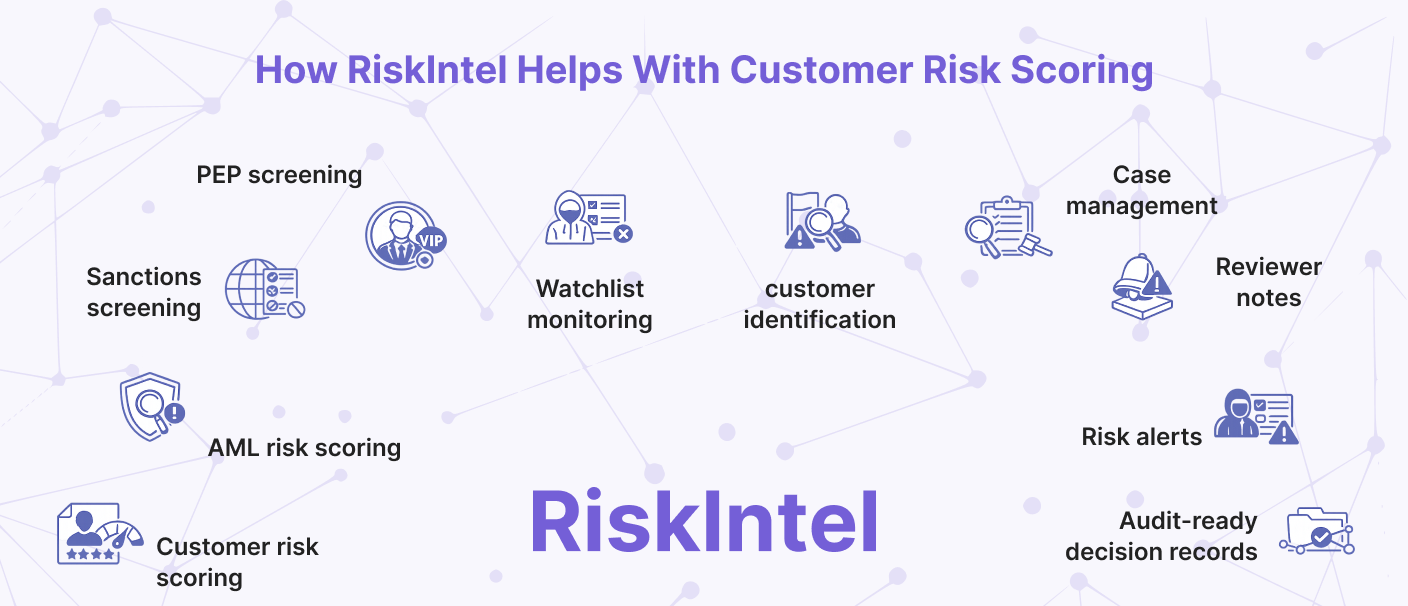
RiskIntel supports:
- Customer risk scoring
- AML risk scoring
- Sanctions screening
- PEP screening
- Watchlist monitoring
- High risk customer identification
- Case management
- Reviewer notes
- Risk alerts
- Audit ready decision records
- Faster onboarding decisions
- Ongoing customer monitoring
Instead of depending on spreadsheets or disconnected compliance tools, fintech teams can use RiskIntel to centralize customer risk checks and make onboarding decisions faster.
RiskIntel helps teams approve low risk users smoothly, escalate high risk users properly, and maintain clear records for every decision.
For fintech companies that want to grow without losing control over compliance risk, RiskIntel gives risk and compliance teams a more structured way to screen, score, and monitor customers.
Who Should Use RiskIntel?
RiskIntel is useful for:
- NBFCs
- Digital lending platforms
- Fintech companies
- Payment companies
- Payment aggregators
- Neobanks
- Embedded finance platforms
- Loan servicing companies
- Merchant onboarding platforms
- Wealthtech platforms
- Insurance technology companies
- Cross border payment providers
- Compliance teams
- Risk teams
- Operations leaders
- Founders and product teams
It is especially useful for companies that need to onboard customers quickly while maintaining AML, sanctions, PEP, watchlist, and audit control.
Want to explore more helpful insights on AI, automation, and enterprise technology? Read more blogs at Cloudastra Technologies or connect with us for business enquiries through Cloudastra Contact Us
FAQs
1. What is customer risk scoring?
Customer risk scoring is the process of assigning a risk level to a user, borrower, merchant, vendor, or business based on identity details, AML signals, sanctions exposure, PEP status, watchlist matches, geography, and other risk factors.
2. Why do fintech companies need customer risk scoring?
Fintech companies need customer risk scoring because they onboard users at scale. Risk scoring helps them approve low-risk users faster and send high risk profiles for deeper review.
3. How does customer risk scoring support AML compliance?
Customer risk scoring supports AML compliance by identifying users who may need enhanced due diligence, closer monitoring, or escalation based on risk signals such as geography, business type, transaction behavior, and watchlist exposure.
4. What is AML risk scoring?
AML risk scoring is a method of assessing how much money laundering risk a customer may carry based on their profile, source of funds, geography, business activity, transaction behavior, and compliance screening results.
5. How does sanctions screening affect customer risk scoring?
If a customer, business, owner, or linked party appears on a sanctions list or shows a close match, the risk score should increase and the case should be flagged for compliance review.
6. What is the role of PEP screening in customer risk scoring?
PEP screening helps identify politically exposed users who may require enhanced due diligence. It does not automatically mean rejection, but it usually increases the need for deeper review.
7. Can RiskIntel help reduce manual customer reviews?
Yes. RiskIntel helps reduce manual review workload by automatically screening customers, assigning risk levels, flagging high risk cases, and maintaining audit ready decision records.
8. Who should use customer risk scoring software?
Customer risk scoring software is useful for NBFCs, fintech companies, digital lenders, payment platforms, neobanks, merchant onboarding teams, embedded finance platforms, and compliance teams.