AML compliance automation helps fintech companies, NBFCs, banks, lenders, and payment platforms automate customer screening, risk checks, watchlist monitoring, and compliance review workflows.
Instead of depending on spreadsheets, disconnected tools, and manual searches, fintech teams can use AML compliance automation to identify risky customers faster, reduce onboarding delays, and maintain audit-ready compliance records. RiskIntel helps compliance teams automate AML checks, sanctions screening, PEP screening, watchlist monitoring, customer risk alerts, and case review workflows.
Introduction
Fintech onboarding needs to be fast.
But compliance cannot be weak.
Every new customer, merchant, borrower, vendor, or business partner may carry some level of financial crime risk. The risk may come from sanctions exposure, political connections, hidden business ownership, suspicious profiles, high-risk jurisdictions, litigation history, or negative regulatory records.
When compliance teams manage these checks manually, the process becomes slow and inconsistent.
A team may use spreadsheets, separate search tools, email approvals, document folders, and manual notes. This creates delays during onboarding and makes it difficult to prove what was checked later.
AML compliance automation solves this problem by turning manual screening into a structured workflow.
It helps fintech companies screen customers, detect risk signals, assign risk levels, route cases for review, and store every decision with clear evidence.
The goal is not only faster onboarding.
The goal is faster onboarding with better risk control.
What Is AML Compliance Automation?
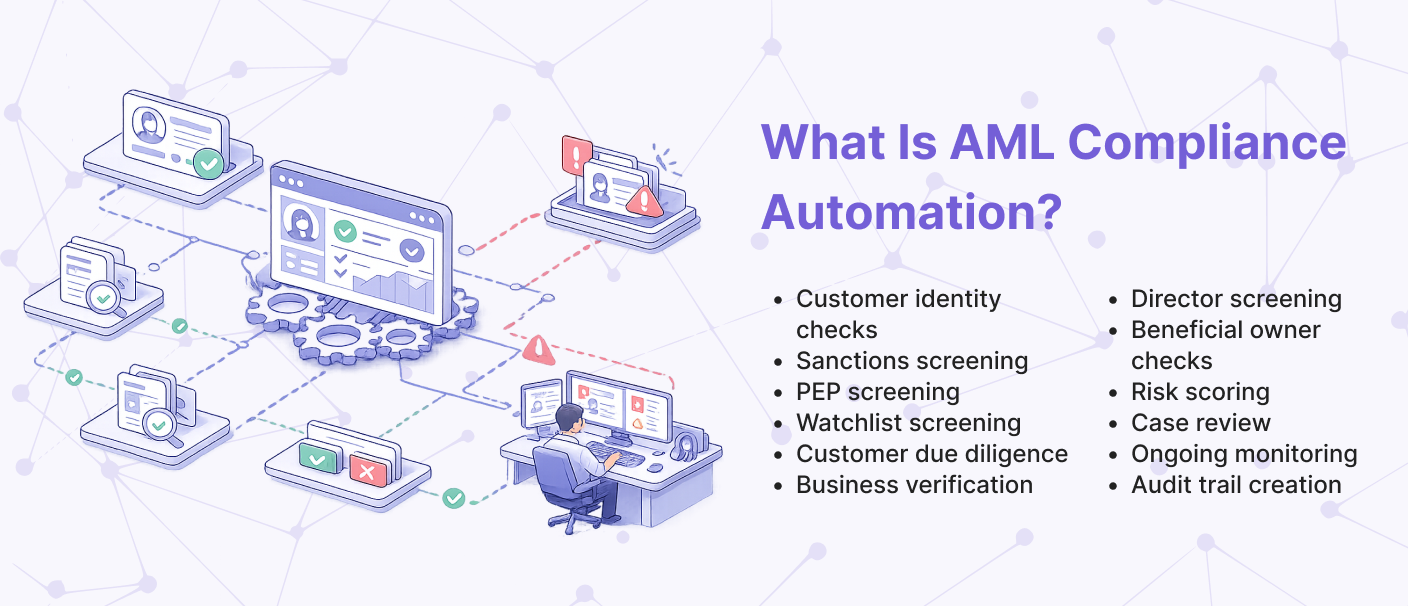
AML compliance automation is the use of software and workflow automation to manage anti-money laundering checks across customer onboarding, business screening, risk monitoring, and case review.
It helps teams automate tasks such as:
- Customer identity checks
- Sanctions screening
- PEP screening
- Watchlist screening
- Customer due diligence
- Business verification
- Director screening
- Beneficial owner checks
- Risk scoring
- Case review
- Ongoing monitoring
- Audit trail creation
AML compliance automation does not remove human judgment.
It reduces manual work and helps analysts focus on cases that actually need deeper review.
In simple terms, AML compliance automation helps fintech teams answer:
Can this customer be onboarded safely, or does the relationship need enhanced review before approval?
Why Fintech Companies Need AML Compliance Automation
Fintech companies need AML compliance automation because manual compliance processes do not scale with digital onboarding.
A fintech platform may onboard hundreds or thousands of users, merchants, or borrowers every month.
Each profile may require checks across different risk sources.
These may include:
- Sanctions lists
- PEP databases
- Watchlists
- Internal blocklists
- Regulatory records
- Litigation records
- Business registration data
- Director networks
- Beneficial ownership data
- High-risk country indicators
Manual review becomes difficult when volume increases.
Compliance teams may face:
- Slow onboarding approvals
- Missed risk signals
- Inconsistent review quality
- Too many false positives
- Poor documentation
- Delayed escalations
- Scattered case records
- Weak audit trails
- Overdependence on spreadsheets
- High analyst workload
This creates risk for both compliance and business growth.
If the process is too slow, genuine customers may drop off.
If the process is too weak, risky customers may enter the system.
AML compliance automation helps balance both needs.
It allows low-risk customers to move faster while higher-risk cases are flagged for proper review.
How AML Compliance Automation Works
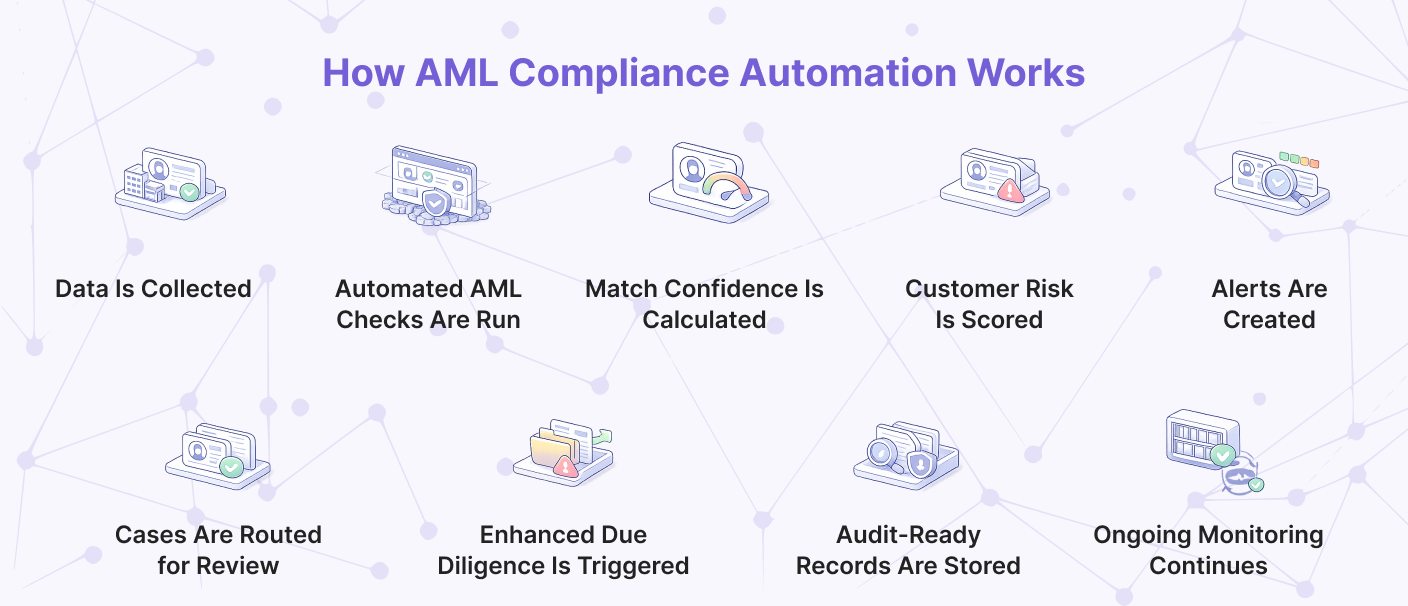
AML compliance automation works by collecting customer data, screening it against risk sources, scoring the risk, creating alerts, routing cases, and recording the final decision.
1. Customer or Business Data Is Collected
The process starts with customer or business information.
For an individual customer, this may include:
- Full name
- Date of birth
- Address
- Nationality
- Identification number
- Contact details
- Occupation
- Source of funds
- Country of residence
- Account type
For a business customer, this may include:
- Legal business name
- Registration number
- GSTIN or tax information
- Directors
- Shareholders
- Beneficial owners
- Authorized signatories
- Business address
- Industry
- Parent company
- Related entities
The quality of this data matters.
Incomplete or incorrect data can create false matches, missed matches, or delayed reviews.
2. Automated AML Checks Are Run
The system then screens the customer or business against relevant AML risk sources.
These checks may include:
- Sanctions screening
- PEP screening
- Watchlist screening
- Adverse media checks
- Internal blacklist checks
- Litigation checks
- Regulatory action checks
- Business verification
- Director screening
- Beneficial ownership screening
The system can run these checks faster than manual review.
It also helps ensure that every profile goes through the same baseline screening process.
3. Match Confidence Is Calculated
Not every name match is a real risk.
A customer may share a name with a sanctioned person or politically exposed individual.
AML compliance automation should help analysts understand match confidence.
It may compare:
- Full name
- Date of birth
- Nationality
- Address
- Country
- Identification number
- Business relationship
- Director details
- Associated entities
The alert may be classified as:
- Low-confidence match
- Possible match
- High-confidence match
- Confirmed match
This helps reduce unnecessary review and makes alert handling more practical.
4. Customer Risk Is Scored
After screening, the system assigns a risk level to the customer or business.
The score may consider:
- Sanctions exposure
- PEP exposure
- Watchlist match
- High-risk country
- Business type
- Ownership structure
- Director risk
- Litigation history
- Regulatory records
- Adverse media
- Customer profile
- Transaction behavior
- Previous alerts
The profile may be classified as:
- Low risk
- Medium risk
- High risk
- Critical risk
- Requires enhanced due diligence
Risk scoring helps teams prioritize reviews.
Low-risk profiles can move forward faster, while high-risk profiles can be routed to analysts.
5. Alerts Are Created
If a risk signal is found, the system creates an alert.
A useful alert should include:
- Customer details
- Matched record
- Risk source
- Match confidence
- Risk reason
- Supporting evidence
- Related entities
- Recommended action
- Review priority
This helps compliance analysts investigate faster.
A weak alert only says “match found.”
A strong alert explains why the match matters.
6. Cases Are Routed for Review
High-risk or uncertain cases should move into a structured review workflow.
The system may route cases based on:
- Risk level
- Match type
- Customer segment
- Product type
- Geography
- Business relationship
- Analyst workload
- Escalation rules
Analysts can then review the case, add notes, request more information, approve, reject, escalate, or mark the match as false positive.
7. Enhanced Due Diligence Is Triggered
Some profiles may require enhanced due diligence.
This may happen when:
- A customer is politically exposed
- A sanctions match is possible
- A business has complex ownership
- A director is linked to litigation
- A customer comes from a high-risk jurisdiction
- A business structure looks unusual
- A watchlist match needs review
Enhanced due diligence may include:
- Source of funds review
- Source of wealth review
- Additional document collection
- Ownership verification
- Senior approval
- More frequent monitoring
- Manual analyst review
Automation helps trigger these steps consistently.
8. Audit-Ready Records Are Stored
Every AML decision should be recorded.
The system should store:
- Screening result
- Alerts generated
- Analyst notes
- Documents reviewed
- Risk score
- Decision reason
- Approval history
- Escalation history
- Timestamp
- Reviewer details
This creates an audit-ready record.
If regulators, auditors, or internal teams ask why a customer was approved, the company can show what was checked and why the decision was made.
9. Ongoing Monitoring Continues
AML compliance does not stop after onboarding.
A customer who was low risk during onboarding may become risky later.
Ongoing monitoring helps detect changes such as:
- New sanctions match
- Updated PEP status
- Watchlist update
- Ownership change
- Director change
- New litigation record
- Regulatory action
- Suspicious transaction activity
- Change in risk profile
This helps fintech companies manage compliance risk throughout the customer relationship.
Key Features of AML Compliance Automation Software
Automated AML Checks
The system should automate AML checks across customers, businesses, directors, shareholders, and beneficial owners.
This reduces manual screening effort.
Sanctions Screening
Sanctions screening helps identify restricted individuals, companies, entities, or jurisdictions before onboarding or transaction approval.
PEP Screening
PEP screening helps detect politically exposed persons and connected individuals who may require enhanced due diligence.
Watchlist Screening
Watchlist screening helps identify customers or businesses appearing on regulatory, enforcement, internal, or risk-based lists.
Customer Due Diligence Workflow
The software should support customer due diligence by organizing identity data, documents, risk signals, and analyst decisions in one place.
Business Verification
For corporate customers, the system should help verify company records, directors, registration data, tax identifiers, and ownership information.
Risk Scoring
Risk scoring helps classify customers based on AML exposure and review priority.
This helps analysts focus on the most important cases first.
Case Management
Alerts should move into a structured case workflow.
Analysts should be able to review evidence, add notes, assign cases, escalate issues, and record final decisions.
Ongoing Monitoring
Customers should be monitored after onboarding so new risk signals can be detected over time.
Audit Trail
Every screening action, review step, escalation, and decision should be recorded for audit readiness.
API Integration
API integration allows AML compliance automation to run inside onboarding, lending, merchant approval, vendor review, or business KYC workflows.
Use Cases of AML Compliance Automation
1. Digital Customer Onboarding
Fintech companies can screen new users during onboarding and identify customers who need review before account activation.
This helps reduce onboarding risk without slowing every customer.
2. Merchant Onboarding
Payment gateways and aggregators can screen merchants, business owners, directors, and beneficial owners before enabling payment acceptance.
This helps identify hidden business risk.
3. Corporate Lending
NBFCs and digital lenders can screen corporate borrowers, promoters, directors, and related entities before loan approval.
This supports better credit and compliance decisions.
4. Vendor and Partner Due Diligence
Fintech companies can screen vendors, outsourcing partners, collection agencies, consultants, and technology partners.
This helps reduce third-party compliance risk.
5. Enhanced Due Diligence
High-risk customers can be routed into enhanced due diligence workflows with additional documentation and senior approval.
6. Ongoing Customer Monitoring
Existing customers can be rescreened when watchlists, sanctions lists, PEP databases, or business records change.
7. Business KYC
Companies can verify corporate customers, directors, shareholders, beneficial owners, and related entities before approval.
8. Internal Audit Preparation
Compliance teams can use stored records to prepare for audits, internal reviews, and regulatory questions.
Benefits of AML Compliance Automation
Faster Onboarding
Low-risk customers can move through onboarding faster because the system handles routine screening automatically.
Reduced Manual Work
Compliance teams spend less time searching across different systems and more time reviewing meaningful cases.
Better Risk Detection
Automated checks help identify sanctions, PEP, watchlist, litigation, and business-risk signals earlier.
More Consistent Decisions
Every customer can be reviewed through the same baseline process.
This reduces inconsistency between analysts.
Better False Positive Management
Match confidence, customer data, and supporting evidence help analysts clear false positives faster.
Stronger Audit Readiness
Screening results, notes, approvals, and decisions are stored in one place.
This makes audit preparation easier.
Better Customer Due Diligence
Teams get a clearer view of customer identity, business ownership, and connected risk signals.
Improved Analyst Productivity
Analysts can focus on high-risk cases instead of repeating manual checks for every customer.
Ongoing Risk Visibility
Teams can monitor existing customers for new risk signals after onboarding.
Common Challenges in AML Compliance Automation
Poor Data Quality
Incomplete names, outdated business records, missing ID details, or incorrect addresses can create weak screening results.
Too Many False Positives
Broad matching rules may generate too many alerts.
This can overload analysts and slow onboarding.
Screening Only at Onboarding
AML risk can change after onboarding.
Ongoing monitoring is important.
No Case Management Workflow
If alerts are handled through emails or spreadsheets, cases become difficult to track.
Weak Audit Trails
Without proper records, teams may struggle to prove what was checked and why a decision was made.
Disconnected Tools
Using separate tools for sanctions, PEP, watchlists, customer records, and case notes creates operational gaps.
No Risk-Based Prioritization
Treating every alert equally wastes analyst time.
Risk scoring helps teams focus on serious cases first.
Ignoring Business Relationships
For business customers, risk may come from directors, shareholders, beneficial owners, or related entities.
Screening only the company name is not enough.
How RiskIntel Helps With AML Compliance Automation
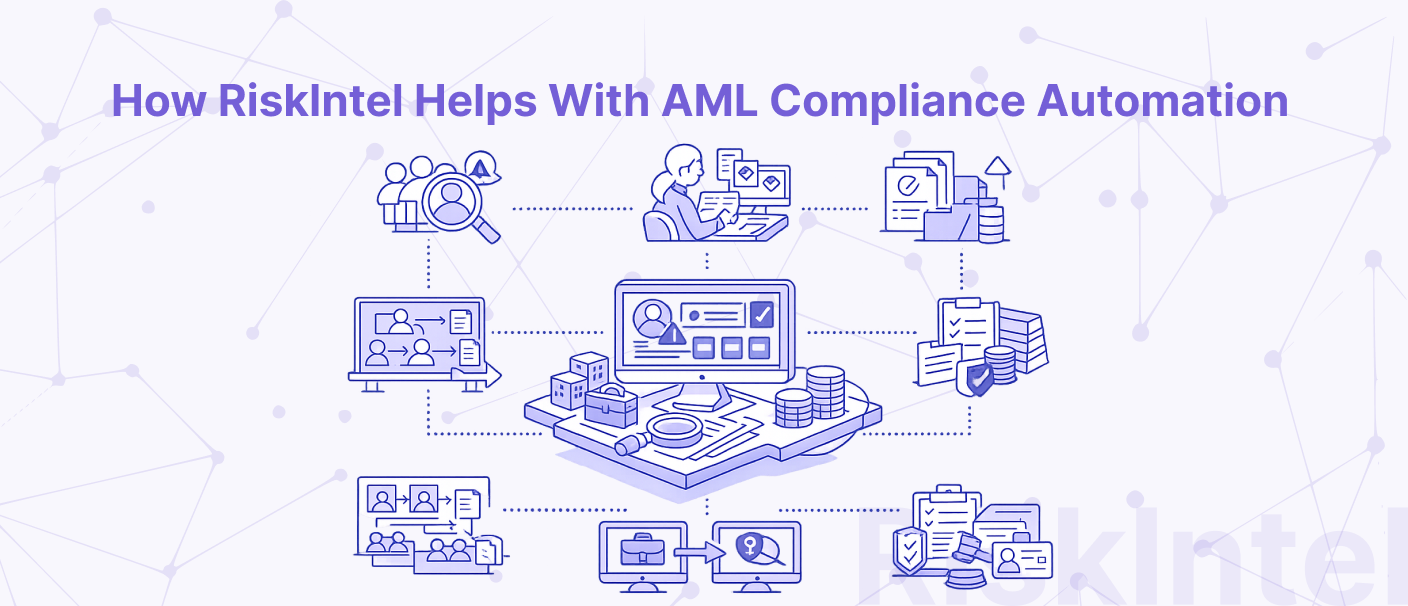
RiskIntel by Cloudastra helps fintech companies, NBFCs, banks, digital lenders, payment platforms, and financial institutions automate AML compliance workflows and customer risk screening.
RiskIntel supports:
- AML compliance automation
- Automated AML checks
- Sanctions screening
- PEP screening
- Watchlist screening
- Customer due diligence
- Business verification
- Director screening
- Beneficial owner checks
- Customer risk scoring
- Risk alerts
- Case management
- Ongoing monitoring
- Audit-ready compliance records
Instead of depending on manual checks, spreadsheets, and disconnected tools, compliance teams can use RiskIntel to centralize AML screening and case review.
RiskIntel helps teams identify risky customers, businesses, directors, shareholders, and beneficial owners before approval.
Possible matches can be reviewed through structured workflows with supporting evidence, analyst notes, escalation history, and final decision records.
This helps fintech teams reduce compliance gaps while keeping onboarding faster and more consistent.
Who Should Use RiskIntel?
RiskIntel is useful for:
- Fintech companies
- NBFCs
- Banks
- Digital lenders
- Payment gateways
- Payment aggregators
- Neobanks
- Embedded finance platforms
- Corporate lending teams
- Merchant onboarding teams
- Vendor risk teams
- Compliance teams
- AML teams
- Risk teams
- Business operations teams
It is especially useful for organizations that onboard customers, merchants, corporate borrowers, vendors, directors, beneficial owners, or financial partners.
Want to explore more practical insights on AI development, automation, and conversational AI? Read more blogs at Cloudastra Technologies or contact us for business enquiries through Cloudastra Contact Us.
FAQs
1. What is AML compliance automation?
AML compliance automation is the use of software to automate anti-money laundering checks, customer screening, risk scoring, case review, and ongoing monitoring.
2. Why do fintech companies need AML compliance automation?
Fintech companies need AML compliance automation to reduce manual screening, detect risky customers faster, improve onboarding speed, and maintain audit-ready compliance records.
3. What are automated AML checks?
Automated AML checks are system-driven checks for sanctions, PEP exposure, watchlists, customer risk, business records, directors, beneficial owners, and other compliance signals.
4. Does AML compliance automation replace compliance analysts?
No. It reduces manual work and helps analysts focus on higher-risk cases, but human judgment is still important for complex reviews and final decisions.
5. What is the difference between AML automation and customer due diligence?
Customer due diligence is the process of verifying and assessing customer risk. AML automation helps run and manage this process faster through screening, scoring, alerts, workflows, and audit records.
6. Can AML compliance automation reduce false positives?
Yes. It can reduce false positives when it uses better customer data, match confidence, risk scoring, and structured analyst review.
7. Should AML screening happen after onboarding?
Yes. AML risk can change over time, so ongoing monitoring is important for existing customers and business relationships.
8. How does RiskIntel support AML compliance automation?
RiskIntel helps fintech teams automate AML checks, sanctions screening, PEP screening, watchlist monitoring, customer due diligence, risk alerts, case management, ongoing monitoring, and audit-ready compliance workflows.