Fraud rule management helps banks and fintech companies create, test, update and monitor the rules used to identify suspicious payments.
These rules may examine transaction value, payment frequency, beneficiary behaviour, device changes, customer location, account activity, sanctions exposure and other payment-risk signals.
For financial institutions, the challenge is not simply creating fraud rules.
The bigger challenge is keeping those rules effective as customer behaviour, payment products and fraud patterns change.
A rule that works today may create too many false positives tomorrow. A threshold designed for individual customers may not work for business accounts. A payment control created for one transaction rail may not be suitable for another.
When every rule change requires a development ticket, testing cycle and software release, fraud teams may struggle to respond quickly.
That is why banks and fintechs need a structured fraud rule management process.
It allows authorised risk teams to adjust payment controls, evaluate rule performance and respond to new fraud patterns without applying the same broad conditions to every transaction.
In simple terms, fraud rule management helps financial institutions answer one important question:
Are our payment controls detecting the right transactions without disrupting genuine customers?
What Problem Does Fraud Rule Management Solve?
Banks and fintech companies process large volumes of digital payments every day.
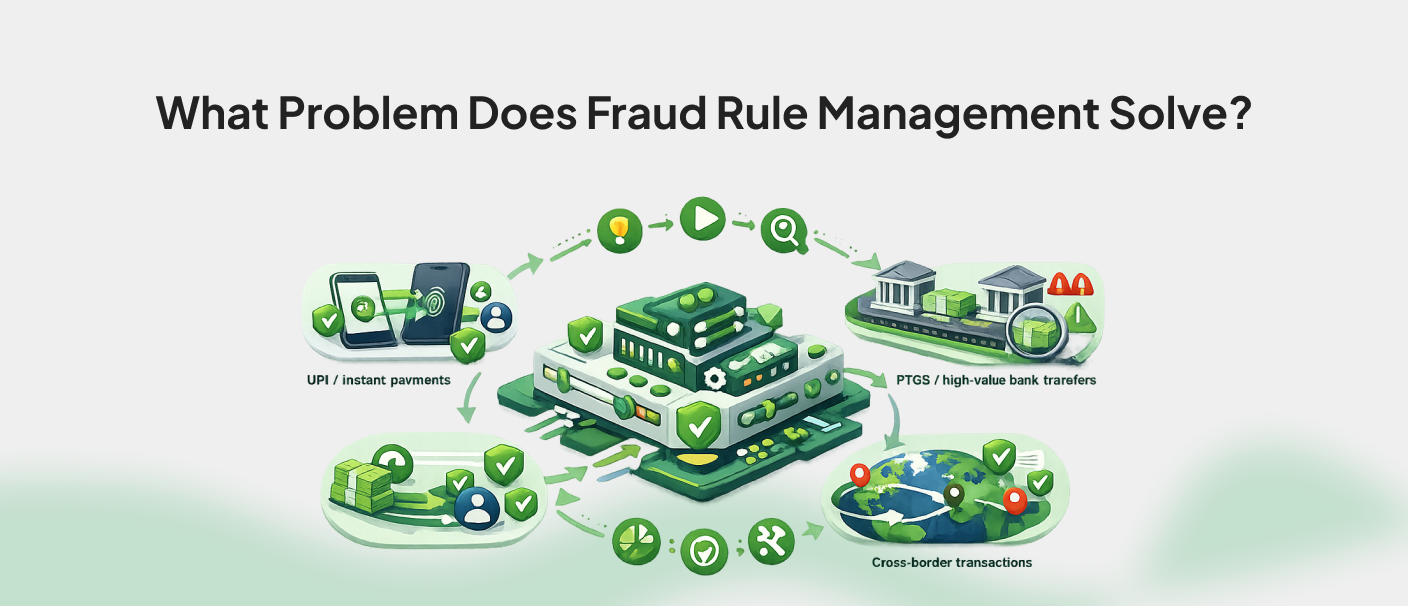
These transactions may move through:
- UPI
- IMPS
- RTGS
- SWIFT
- ISO 20022 payment environments
- Wallet systems
- Merchant payment platforms
- Account-to-account transfers
- Cross-border payment networks
Each payment environment can present different fraud risks.
UPI payments may require strong velocity, device and beneficiary checks. RTGS transfers may require closer review of unusual high-value payments. Cross-border transactions may require additional geography, sanctions and beneficiary-risk controls.
A single set of fixed rules cannot manage every payment type effectively.
Without a proper fraud rule management process, teams often face:
- Rules that are too broad
- Excessive false-positive alerts
- Genuine payments being blocked
- High-risk payments being missed
- Slow rule updates
- Dependence on engineering teams
- Different rules across disconnected systems
- Inconsistent thresholds
- Limited rule performance data
- Poor version control
- Weak approval processes
- Incomplete decision records
- Difficulty explaining why a payment was blocked
These problems become more serious as transaction volume grows.
Fraud rule management solves this by giving teams a structured way to manage the complete lifecycle of a fraud rule.
This includes:
- Rule creation
- Rule testing
- Rule approval
- Rule deployment
- Rule monitoring
- Threshold adjustment
- Rule versioning
- Rule retirement
- Performance review
- Decision recording
The objective is not to create the highest number of fraud alerts.
The objective is to create accurate and explainable payment controls that identify meaningful risk.
What Is Fraud Rule Management?
Fraud rule management is the process of creating, configuring, testing, approving, deploying and reviewing the rules used to monitor transactions.
A fraud rule defines a condition or combination of conditions that may indicate suspicious activity.
For example:
Flag a payment when a new beneficiary receives a high-value transaction from a recently changed device.
Another rule may be:
Hold a transaction when an account makes several payments to different beneficiaries within a short period.
A rule may examine:
- Transaction value
- Payment frequency
- Payment time
- Customer history
- Account age
- Beneficiary age
- Device information
- Customer location
- IP address
- Failed authentication attempts
- New-beneficiary activity
- Rapid fund movement
- Account relationships
- Sanctions signals
- Watchlist exposure
- High-risk geography
- Previous fraud alerts
Fraud rule management helps risk teams decide:
- Which conditions should trigger an alert?
- How much weight should each signal receive?
- Which customer groups should the rule affect?
- Which payment rails should use the rule?
- Should the payment pass, be flagged, held or blocked?
- Who must approve a rule change?
- How long should a rule remain active?
- Is the rule detecting confirmed fraud?
- Is the rule creating unnecessary customer friction?
- Can the institution explain the rule’s decision?
A well-managed fraud rule should have a clear purpose, defined conditions, an owner and measurable performance.
Why Are Static Fraud Rules Not Enough?
Static fraud rules remain useful for known fraud indicators and clear business policies.
However, they can become less effective when they are not reviewed regularly.
Fraudsters Change Their Behaviour
When fraudsters learn that high-value payments are being blocked, they may divide the amount into smaller transactions.
When new accounts receive additional monitoring, fraudsters may use older compromised accounts.
When one beneficiary is blocked, a fraud network may route money through several new accounts.
Fraud rules must change as these behaviours change.
Customer Behaviour Also Changes
Not every unusual transaction is fraudulent.
A customer may:
- Purchase a new device
- Travel to another location
- Start using a new merchant
- Make a larger payment than usual
- Add a new beneficiary
- Increase payment frequency
- Begin using a business account differently
If the rules do not consider customer context, genuine activity may be flagged unnecessarily.
The Same Threshold Does Not Work for Every Customer
An individual customer, small merchant and large business account may have very different transaction behaviour.
For example, ten payments in an hour may be unusual for an individual but normal for a merchant.
Rules should consider customer type and expected activity.
Fraud Risk Differs Across Payment Rails
UPI, IMPS, RTGS and cross-border payments do not always require the same controls.
A high-value threshold that works for one payment type may be ineffective for another.
Fraud rule management helps institutions apply rail-specific conditions and actions.
Broad Rules Create Too Many Alerts
A rule that flags every transaction from a new device may create a large number of alerts.
If most of those alerts are genuine, analysts spend time reviewing low-risk cases instead of investigating meaningful fraud.
Rules should combine multiple signals wherever appropriate.
How Does Fraud Rule Management Work?
Fraud rule management follows a structured process from identifying the risk to reviewing the rule’s results.
1. The Fraud Scenario Is Defined
The institution first identifies the behaviour it needs to detect.
Examples include:
- Account takeover
- Mule-account activity
- Velocity abuse
- Transaction splitting
- New-beneficiary fraud
- Suspicious cross-border payments
- High-risk geography
- Sanctions exposure
- Dormant-account reactivation
- Repeated failed payment attempts
The scenario should be clearly defined before a rule is created.
For example:
Detect possible account takeover when a customer uses a new device, resets authentication information and sends a high-value payment to a new beneficiary.
This is more useful than creating several unrelated alerts without a clear fraud objective.
2. Relevant Risk Signals Are Selected
The team identifies the signals that may indicate the fraud scenario.
For account takeover, relevant signals may include:
- New device
- Password or PIN reset
- Multiple failed authentication attempts
- Unusual customer location
- New beneficiary
- High transaction value
- Sudden payment-frequency increase
For mule-account activity, relevant signals may include:
- Several incoming payments
- Unrelated sender accounts
- Rapid outgoing transfers
- Low balance retention
- Common beneficiaries
- Shared devices
- Fan-in and fan-out behaviour
The selected signals should be relevant to the fraud pattern.
Adding too many weak signals may reduce clarity and create unnecessary alerts.
3. Conditions and Thresholds Are Configured
Each signal requires a condition or threshold.
Examples include:
- More than five payment attempts within ten minutes
- Transaction value above the customer’s normal range
- New beneficiary added within the last 24 hours
- Payment initiated from an unfamiliar device
- Funds transferred within minutes of receipt
- Several unrelated accounts paying the same beneficiary
- Transaction involving a high-risk jurisdiction
Thresholds should be based on historical transaction behaviour and customer segments wherever possible.
A threshold should not be selected only because it is easy to configure.
4. Risk Weights Are Assigned
Not every signal has the same importance.
A minor location change may carry a small risk weight.
A strong sanctions match or combination of account-takeover indicators may carry a much higher weight.
The rule may assign different scores to different conditions.
For example:
- New device: low weight
- New beneficiary: moderate weight
- Recent password reset: moderate weight
- High-value payment: moderate weight
- Several signals together: high combined risk
This creates more contextual fraud detection than a simple yes-or-no rule.
5. The Payment Action Is Defined
The team determines what should happen when the rule triggers.
Possible actions include:
- Pass
- Flag
- Request additional authentication
- Hold
- Block
- Escalate
- Send for manual review
Not every alert should lead to an immediate block.
A medium-risk payment may require additional authentication.
A high-risk transaction may require a temporary hold.
A critical-risk payment may be blocked.
The action should match the strength and impact of the detected risk.
6. The Rule Is Tested
Before a new rule affects live payments, it should be tested against historical or controlled transaction data.
Testing can help teams understand:
- How many transactions trigger the rule
- How many alerts match confirmed fraud
- How many genuine payments are affected
- Which customer groups are affected
- Whether the threshold is too broad
- Whether important cases are missed
- How much analyst workload will be created
- Whether the necessary data is available
Testing reduces the risk of deploying a rule that blocks large numbers of genuine customers.
7. The Rule Is Approved
High-impact fraud rules should follow an approval process.
The approval record may include:
- Rule name
- Fraud scenario
- Rule owner
- Conditions
- Thresholds
- Risk weights
- Payment action
- Test results
- Expected alert volume
- Approver
- Deployment date
- Review date
Clear approval processes prevent uncontrolled rule changes.
8. The Rule Is Deployed
After approval, the rule can be activated in the relevant payment environment.
The institution may deploy it to:
- All customers
- A specific customer segment
- One payment rail
- A particular product
- High-risk accounts
- New customers
- Selected geographies
- A limited test group
A phased deployment may be safer than applying a new rule across every transaction immediately.
9. Rule Performance Is Monitored
After deployment, teams should monitor the rule continuously.
Important metrics include:
- Number of alerts
- Confirmed fraud detected
- False-positive rate
- False-negative cases
- Payment value stopped
- Customer complaints
- Manual-review workload
- Analyst resolution time
- Rule-to-case conversion
- Customer segments affected
- Average decision time
A rule should not remain active indefinitely without performance review.
10. The Rule Is Updated or Retired
A rule may need to be adjusted when:
- Fraud behaviour changes
- The false-positive rate increases
- Customer patterns change
- A new product is launched
- A payment rail changes
- New data becomes available
- A rule duplicates another control
- The fraud scenario is no longer relevant
Old or ineffective rules should be retired.
Keeping unnecessary rules active can increase processing complexity and alert volume.
What Types of Fraud Rules Do Banks and Fintechs Need?
Transaction Value Rules
Transaction value rules identify payments that exceed defined limits or differ significantly from the customer’s history.
Examples include:
- Payment above a fixed threshold
- Payment several times larger than the customer’s normal value
- High-value payment from a new account
- High-value transfer to a new beneficiary
A fixed threshold should be combined with customer context where possible.
Payment Velocity Rules
Velocity rules monitor how many transactions or attempts occur within a defined period.
Examples include:
- Multiple payments within minutes
- Repeated failed transactions
- Several payments to different beneficiaries
- Sudden increase in payment frequency
- Several account changes followed by payments
Velocity thresholds should differ by customer type and payment rail.
New-Beneficiary Rules
New-beneficiary rules examine payments made shortly after a beneficiary is added.
Useful supporting signals include:
- New device
- Recent password reset
- Unusual location
- High payment amount
- Multiple failed attempts
- Beneficiary linked to previous alerts
A new beneficiary alone should not automatically result in a payment block.
Device and Location Rules
These rules examine changes in the customer’s device or geographic behaviour.
Examples include:
- Login from a new device
- Several accounts using the same device
- Sudden geographic change
- Transaction from a high-risk location
- Device associated with previous fraud
Device and location signals should be combined with transaction context.
Account Takeover Rules
Account takeover rules combine authentication, device and payment signals.
A possible rule may include:
New device + recent password reset + new beneficiary + unusual payment value
This combined rule is more meaningful than separate low-level alerts.
Mule-Account Rules
Mule-account rules focus on receiving and transferring behaviour.
Possible conditions include:
- Payments from several unrelated accounts
- Rapid outgoing transfers
- Low balance retention
- Fan-in and fan-out activity
- Shared devices
- Repeated common beneficiaries
- Sudden activity in a dormant account
Mule detection often requires analysing connected transactions rather than one payment.
Transaction-Splitting Rules
These rules identify several smaller transactions that may be part of one larger suspicious movement.
Possible conditions include:
- Repeated transactions below a threshold
- Similar payment values
- Several payments within a short period
- Linked beneficiaries
- Multiple accounts paying one receiver
- One account distributing funds to several receivers
Sanctions and Watchlist Rules
These rules examine whether the sender, beneficiary or related party may match sanctions or watchlist data.
Possible matches should be reviewed using available identifying information.
A name similarity alone may not be enough to confirm a match.
Cross-Border Payment Rules
Cross-border rules may examine:
- Sender country
- Beneficiary country
- High-risk jurisdiction
- Payment purpose
- Payment value
- Unusual international activity
- Sanctions exposure
- Repeated international beneficiaries
These rules should reflect the institution’s cross-border products and risk policy.
How Can Fraud Teams Reduce False Positives?
False positives occur when genuine transactions are flagged as suspicious.
They can increase:
- Customer friction
- Payment delays
- Support complaints
- Analyst workload
- Investigation costs
- Alert fatigue
Fraud teams can reduce false positives through better rule management.
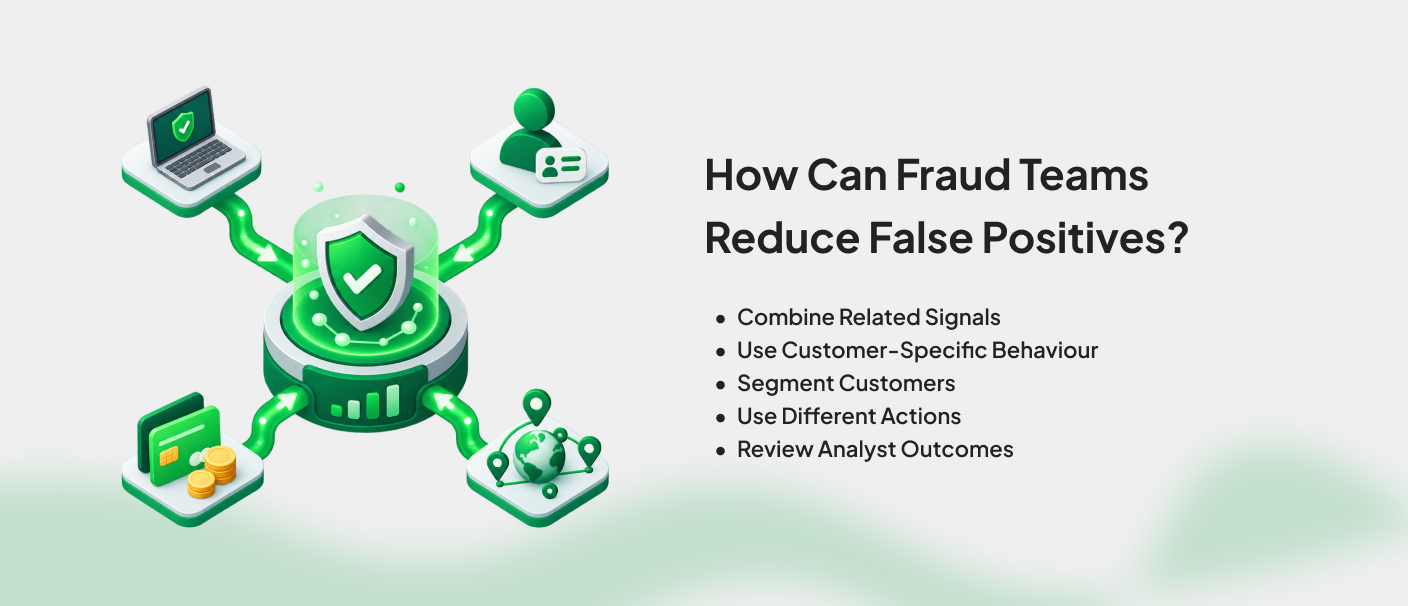
Combine Related Signals
Do not block payments based on one weak signal when additional context is available.
For example, a new device may not justify a block.
A new device combined with a password reset, new beneficiary and high-value payment creates a stronger case.
Use Customer-Specific Behaviour
Compare the payment with the customer’s own history.
A payment pattern may be normal for one customer and unusual for another.
Segment Customers
Create different rules for:
- Individual customers
- Merchants
- Businesses
- High-value customers
- Newly opened accounts
- Cross-border customers
- Higher-risk customer groups
Use Different Actions
Not every alert requires the same action.
Use:
- Pass for low risk
- Flag for medium risk
- Additional authentication for uncertain risk
- Hold for high risk
- Block for critical risk
Review Analyst Outcomes
Analyst feedback should show whether an alert was:
- Confirmed fraud
- Genuine activity
- False positive
- Suspicious but unconfirmed
- Account takeover
- Mule-account activity
- Customer-authorised scam
- Policy violation
This information helps teams improve thresholds and rule combinations.
What Is the Fraud Rule Lifecycle?
A fraud rule should move through a controlled lifecycle.
|
Stage |
Main activity |
|
Identification |
Define the fraud scenario |
|
Design |
Select signals, conditions and thresholds |
|
Testing |
Measure alerts, fraud detection and false positives |
|
Approval |
Document owner, purpose and authorised decision |
|
Deployment |
Activate the rule for the correct segment or rail |
|
Monitoring |
Measure rule accuracy and operational impact |
|
Optimisation |
Adjust thresholds, signals or actions |
|
Retirement |
Remove ineffective or unnecessary rules |
A complete lifecycle prevents rules from remaining active without review.
What Governance Controls Should Fraud Rule Management Include?
Fraud rules can directly affect customers and payments.
Therefore, institutions need governance controls around rule changes.
Important controls include:
- Named rule owner
- Clear fraud objective
- Documented thresholds
- Approval requirements
- Testing evidence
- Version history
- Change reason
- Deployment date
- Reviewer access
- Role-based permissions
- Performance reporting
- Scheduled review date
- Retirement process
- Complete decision records
Governance does not need to make every change slow.
The objective is to make changes controlled, explainable and reviewable.
What Features Should Fraud Rule Management Software Have?
A strong fraud rule management platform should include:
- Visual rule creation
- Configurable thresholds
- Customer segmentation
- Payment-rail segmentation
- Transaction-risk scoring
- Rule testing
- Monitoring or shadow mode
- Rule approval workflows
- Version control
- Rule-performance reporting
- Alert prioritisation
- Pass, flag, hold or block decisions
- Typology-level scoring
- Analyst feedback
- Decision history
- API integration
- Role-based access
- Audit trails
- Secure data handling
- Real-time transaction monitoring
For banks and fintech companies, the most important features are flexible rule configuration, real-time evaluation, explainable decisions, performance measurement and controlled rule changes.
Manual Rule Changes vs Structured Fraud Rule Management
|
Capability |
Manual Rule Process |
Structured Fraud Rule Management |
|
Rule creation |
Written through development requests |
Configured through a managed interface |
|
Rule changes |
Dependent on engineering releases |
Updated by authorised risk teams |
|
Testing |
Often limited or manual |
Tested against historical or controlled data |
|
Customer segmentation |
Difficult to manage |
Rules applied to defined customer groups |
|
Payment-rail support |
Broad rules across systems |
Rail-specific conditions |
|
Version control |
Stored in documents or tickets |
Complete rule history |
|
Approval |
Email-based or informal |
Structured approval workflow |
|
Performance review |
Manually calculated |
Rule-level reporting |
|
False-positive tuning |
Slow threshold changes |
Faster rule optimisation |
|
Decision explanation |
Limited |
Supporting rules and signals recorded |
|
Audit readiness |
Scattered records |
Centralised decision trail |
How SecureFlow Helps Banks and Fintechs Manage Fraud Rules
SecureFlow by Cloudastra helps banks, fintech companies, NBFCs and payment platforms manage payment-risk rules while transactions are being processed.
The platform evaluates payments across UPI, IMPS, RTGS, SWIFT, ISO 20022 and cross-border payment environments.
SecureFlow supports:
- Visual fraud rule editing
- Configurable transaction controls
- Real-time payment scoring
- Parallel rule evaluation
- Payment velocity checks
- Mule-account signals
- Account takeover indicators
- Sanctions signals
- UPI anomaly monitoring
- Typology-level risk scoring
- Pass, flag, hold or block decisions
- Live interdiction for suspicious payments
- Analyst review workflows
- Audit-grade decision trails
- Rule and decision history
- API-based integration
- India-focused payment-risk monitoring
The visual rule editor allows authorised risk and compliance teams to adjust payment conditions without depending on engineering teams for every threshold change.
SecureFlow can evaluate several relevant signals at the same time.
For example, the platform can examine transaction value, payment velocity, customer behaviour, beneficiary activity, mule indicators and sanctions exposure during one payment-risk decision.
The platform also records the rules and signals behind the outcome.
This helps teams understand why a transaction was passed, flagged, held or blocked.
Instead of treating fraud rules as fixed technical configurations, SecureFlow helps financial institutions manage them as active payment-risk controls.
How Can Banks and Fintechs Implement Fraud Rule Management?
Create a Fraud Typology Library
Document the payment risks the institution needs to detect.
For each typology, define:
- Risk description
- Relevant signals
- Customer segments
- Payment rails
- Suggested thresholds
- Payment action
- Escalation process
- Rule owner
Review Existing Rules
Identify:
- Rules producing too many alerts
- Rules detecting confirmed fraud
- Duplicate rules
- Rules with unclear ownership
- Rules using outdated thresholds
- Rules that have not been reviewed
- Rules causing customer complaints
Connect Relevant Data Sources
Fraud rules may require information from:
- Payment systems
- Core banking platforms
- Customer databases
- Device-intelligence tools
- Authentication systems
- Beneficiary records
- Sanctions databases
- Fraud case-management platforms
- Complaint records
- Historical transaction repositories
Test Rules Before Blocking Payments
Use historical data or shadow mode to evaluate new rules.
Measure:
- Alert volume
- Fraud-detection rate
- False-positive rate
- Customer impact
- Analyst workload
- Decision speed
- Missing data
Define Approval Roles
Decide who can:
- Create a rule
- Edit thresholds
- Approve deployment
- Activate blocking actions
- Review performance
- Retire the rule
Monitor Rule Performance
Create regular rule reviews.
A high-impact rule may require weekly monitoring, while stable rules may be reviewed monthly or quarterly.
Maintain Complete Records
Keep a record of:
- Rule purpose
- Conditions
- Thresholds
- Risk weights
- Actions
- Test results
- Approvals
- Changes
- Performance
- Retirement reason
Common Fraud Rule Management Challenges
Too Many Rules
Adding a new rule for every fraud case can create complexity and duplicate alerts.
Rules should be reviewed as a complete system.
Conflicting Rules
One rule may pass a transaction while another recommends a block.
Institutions need clear decision priorities and risk-score logic.
Poor Data Quality
A rule cannot work effectively when customer, device or beneficiary data is missing or delayed.
No Customer Segmentation
Applying one threshold to every customer can create false positives.
Engineering Dependence
When every change requires development work, risk teams cannot respond quickly to new fraud patterns.
No Performance Measurement
Without rule-level results, teams cannot identify which controls are useful.
Weak Change Governance
Uncontrolled rule changes may affect large numbers of customers.
Rules Are Never Retired
Old rules can continue creating alerts even when they no longer detect meaningful risk.
Benefits of Fraud Rule Management
Faster Response to New Fraud Patterns
Risk teams can update controls when fraud behaviour changes.
Reduced False Positives
Contextual conditions and customer segmentation help reduce unnecessary alerts.
Better Fraud Detection
Related signals can be combined into stronger fraud typologies.
Lower Engineering Dependence
Authorised teams can manage thresholds and conditions through structured workflows.
Improved Analyst Productivity
Better-quality alerts allow analysts to focus on higher-risk cases.
Stronger Customer Experience
Genuine payments are less likely to be blocked by broad rules.
Explainable Decisions
Teams can see which rules and signals affected the transaction.
Better Audit Readiness
Rule versions, approvals and payment decisions can be recorded.
Consistent Payment Controls
Rules can follow a defined lifecycle across customer groups and payment rails.
Who Should Use Fraud Rule Management Software?
Fraud rule management software is useful for:
- Banks
- Fintech companies
- NBFCs
- Payment gateways
- Payment aggregators
- Digital lenders
- Neobanks
- Wallet providers
- Merchant payment platforms
- Cross-border payment providers
- Fraud operations teams
- Payment-risk teams
- Transaction-monitoring teams
- Compliance teams
- Fraud investigation teams
- Payment operations teams
Any organisation that processes digital payments and needs to update fraud controls regularly should consider using a structured fraud rule management platform.
Want to explore more practical insights on AI development, automation, and conversational AI? Read more blogs at Cloudastra Technologies or contact us for business enquiries through Cloudastra Contact Us.
Frequently Asked Questions
1. What is fraud rule management?
Fraud rule management is the process of creating, testing, approving, deploying, monitoring and updating the rules used to detect suspicious transactions.
2. Why do banks need fraud rule management?
Banks need fraud rule management because payment behaviour and fraud patterns change. Static rules can become ineffective or create too many false positives.
3. What is a fraud rule engine?
A fraud rule engine evaluates transaction data against configured conditions and returns an alert, risk score or payment action.
4. What signals can fraud rules use?
Fraud rules may use transaction value, payment velocity, customer history, device information, location, beneficiary activity, account age, sanctions signals and previous fraud alerts.
5. Can fraud rules reduce false positives?
Yes. Fraud rules can reduce false positives when they combine multiple signals, use customer segmentation and apply risk-based actions.
6. Should every triggered fraud rule block a payment?
No. A triggered rule may result in a flag, additional authentication, hold, manual review or block depending on the risk level.
7. How often should fraud rules be reviewed?
High-impact rules should be monitored regularly. Review frequency depends on alert volume, customer impact, fraud trends and institutional policy.
8. What is fraud rule testing?
Fraud rule testing evaluates a proposed rule against historical or controlled transactions to measure alerts, confirmed fraud and false positives before live deployment.
9. What is rule version control?
Rule version control records each change to a fraud rule, including the conditions, thresholds, approver, deployment date and reason for the update.
10. How does SecureFlow support fraud rule management?
SecureFlow supports visual rule editing, configurable payment controls, real-time scoring, typology-level risk analysis and audit-grade decision trails.
11. Can SecureFlow evaluate multiple fraud rules at once?
Yes. SecureFlow can evaluate relevant transaction, customer, beneficiary, velocity, mule and sanctions signals in parallel during the payment decision process.
12. Can risk teams update rules without engineering support?
SecureFlow’s visual rule-editing capability is designed to help authorised risk and compliance teams adjust configured rules and thresholds with less dependence on engineering teams.
13. Does SecureFlow record why a payment was blocked?
SecureFlow can maintain the triggered rules, risk signals, scores and decision history associated with a payment.
14. Which payment environments can SecureFlow support?
SecureFlow can support payment-risk monitoring across UPI, IMPS, RTGS, SWIFT, ISO 20022 and cross-border payment environments.