Collection agent performance management helps lenders monitor agent activity, assign overdue accounts, track borrower follow-ups and understand which collection actions are producing meaningful recovery outcomes.
For banks, NBFCs and fintech lenders, collection performance is not determined only by how many calls an agent makes.
A collection agent may contact many borrowers but recover very little. Another agent may handle fewer accounts but secure more payments, resolve more promises to pay and maintain stronger borrower communication.
This is why lenders need more than basic activity counts.
They need visibility into:
- Which accounts were assigned
- Which borrowers were contacted
- Which communication channels were used
- What response the borrower provided
- Whether a promise to pay was recorded
- Whether the promised payment was completed
- Which cases need escalation
- How much overdue value was recovered
- Which agents are managing cases effectively
- Where collection workflows are slowing down
Collection agent performance management gives collection leaders a structured way to measure productivity, improve accountability and help agents focus on the accounts most likely to require action.
Instead of managing teams through spreadsheets, call counts and manual reports, lenders can use DebtPulse to connect case assignment, borrower communication, repayment commitments, escalations and recovery results in one collection workflow.
What Problem Does Collection Agent Performance Management Solve?
Lenders often manage large portfolios of overdue borrowers across different delinquency stages.
These accounts may differ by:
- Days past due
- Outstanding amount
- Borrower risk
- Loan product
- Repayment history
- Communication response
- Promise-to-pay status
- Previous collection activity
- Location
- Escalation stage
Collection managers need to distribute these accounts across agents and make sure each case receives the right follow-up.
When this process is managed manually, several problems can occur.

Cases Are Assigned Without Clear Priorities
Agents may receive flat lists of overdue borrowers without knowing which cases require immediate attention.
A borrower who has broken several repayment promises may appear in the same list as a borrower who missed a payment for the first time.
This makes it difficult for agents to decide where to begin.
Managers Cannot See Daily Agent Activity
Collection managers may not know:
- Which borrowers were contacted
- How many attempts were made
- Which cases received no action
- Which promises are due
- Which escalations are pending
- Which accounts have not been updated
- Which agents are overloaded
Without this visibility, managers often depend on manual status updates.
Call Volume Is Mistaken for Performance
A high number of calls does not automatically mean strong collection performance.
Calls may be:
- Unanswered
- Made at ineffective times
- Repeated without a clear strategy
- Completed without recording the outcome
- Focused on low-priority accounts
- Unconnected to actual payments
Performance should be measured using recovery outcomes, not activity volume alone.
Borrower Communication Is Inconsistent
Different agents may communicate with borrowers in different ways.
One agent may provide clear repayment options, while another may repeat the same reminder without understanding the borrower’s situation.
Inconsistent communication can affect:
- Borrower experience
- Promise-to-pay quality
- Follow-up accuracy
- Escalation decisions
- Compliance
- Recovery results
Promises to Pay Are Not Followed Up
A borrower may agree to pay on a particular date, but the commitment may remain only in agent notes.
If the promised date passes without payment, the case may not receive immediate attention.
This creates missed recovery opportunities.
Agent Reports Are Prepared Manually
Managers may spend hours combining:
- Call logs
- Spreadsheet updates
- Payment reports
- Promise-to-pay records
- Agent notes
- Escalation lists
- Recovery totals
This delays decision-making and reduces the time available for coaching and strategy.
Collection agent performance management solves these problems by bringing assignments, activities, borrower responses, payment commitments and outcomes into one measurable workflow.
What Is Collection Agent Performance Management?
Collection agent performance management is the process of assigning recovery cases, monitoring agent activity, measuring collection outcomes and improving how agents manage overdue borrowers.
It helps collection leaders answer questions such as:
- How many accounts has each agent received?
- Which cases have been contacted?
- Which cases have not received action?
- How many borrowers responded?
- How many promises to pay were recorded?
- How many promises were fulfilled?
- How many promises were broken?
- How much overdue value was recovered?
- Which cases were escalated?
- Which agents need additional support?
- Which collection strategies are working?
- Which borrower segments are producing better outcomes?
A strong performance-management process should examine both activity and results.
Activity Metrics
Activity metrics show what the agent did.
Examples include:
- Accounts assigned
- Calls attempted
- Calls connected
- Messages sent
- Emails sent
- Follow-up tasks completed
- Borrower records updated
- Cases escalated
- Promises recorded
Outcome Metrics
Outcome metrics show what the activity achieved.
Examples include:
- Payments received
- Recovery amount
- Promise-to-pay fulfilment
- Partial payments
- Accounts resolved
- Delinquency movement
- Broken promises reduced
- Escalation success
- Cost per recovery
Both types of metrics are important.
Activity without outcomes may indicate ineffective follow-up. Outcomes without activity records make it difficult to understand what worked.
Why Do Lenders Need Collection Agent Performance Management?
Lenders need performance management because collection operations become harder to control as portfolios grow.
A small lending team may manage overdue accounts through spreadsheets and daily calls.
However, as the number of borrowers increases, managers need to coordinate:
- More agents
- More communication channels
- More loan products
- More delinquency stages
- More repayment promises
- More escalations
- More reporting requirements
Without a structured system, collection performance becomes dependent on individual working styles.
To Prioritise the Right Accounts
Every overdue borrower does not require the same action.
Some borrowers may only need a reminder.
Others may require:
- Agent follow-up
- Payment-plan discussion
- Promise-to-pay monitoring
- Manager review
- Field escalation
- Legal or policy-based escalation
Borrower risk and delinquency data help managers assign cases more effectively.
To Balance Agent Workloads
One agent may receive too many high-value or complex accounts, while another receives fewer cases.
Uneven case distribution can lead to:
- Delayed follow-ups
- Agent fatigue
- Missed commitments
- Poor borrower experience
- Lower recovery productivity
Performance visibility helps managers redistribute workloads when required.
To Improve Accountability
Every overdue case should have a clear owner and next action.
Accountability requires visibility into:
- Who owns the case
- What action was completed
- When the action occurred
- What the borrower said
- What should happen next
- Whether the case requires escalation
To Identify Coaching Needs
Performance data can help managers identify where an agent needs support.
For example, an agent may have:
- Strong contact rates but weak promise conversion
- Many promises but low fulfilment
- Good recovery on early-stage accounts but weak results on complex cases
- Delayed case updates
- Too many unresolved escalations
- Low usage of available communication channels
Managers can use this information for targeted coaching.
To Improve Recovery Forecasting
Promise-to-pay records, borrower responses and agent outcomes can help managers estimate expected recovery.
This is more useful than relying only on overdue balance.
How Does Collection Agent Performance Management Work?
Collection agent performance management follows the complete journey from case allocation to recovery outcome.
1. Overdue Accounts Are Collected in One Workflow
The process begins by bringing overdue-account information into the collection system.
This may include:
- Borrower name
- Loan account
- Outstanding balance
- EMI amount
- Due date
- Days past due
- Delinquency bucket
- Repayment history
- Previous communication
- Promise-to-pay status
- Borrower risk
- Contact details
- Loan product
- Assigned agent
This creates a complete starting view for collection activity.
2. Borrowers Are Segmented by Risk and Recovery Priority
Borrowers can be grouped according to factors such as:
- Days past due
- Overdue amount
- Payment history
- Previous broken promises
- Communication response
- Borrower risk score
- Loan type
- Account value
- Delinquency stage
- Previous recovery action
Segmentation helps teams determine which accounts should receive automated reminders and which require human attention.
3. Cases Are Assigned to Collection Agents
Cases can be distributed according to:
- Agent workload
- Borrower location
- Loan product
- Delinquency bucket
- Account value
- Agent experience
- Language
- Recovery stage
- Case complexity
A clear assignment process reduces duplicate work and ensures that every case has an owner.
4. Agents Receive Prioritised Worklists
Instead of working from one flat overdue list, agents can receive a structured work queue.
The queue may prioritise:
- High-value overdue accounts
- Broken promises
- Uncontacted borrowers
- Promises due today
- Accounts approaching a deeper delinquency stage
- Borrowers who recently responded
- Cases requiring escalation
- Accounts without recent activity
This helps agents focus on cases where timely action may matter most.
5. Every Collection Activity Is Recorded
Agent activity may include:
- Call attempt
- Connected call
- WhatsApp message
- SMS
- Voice reminder
- Borrower response
- Promise to pay
- Payment-plan request
- Partial payment
- Dispute
- Escalation
- Case closure
Recording these actions creates a reliable communication and recovery history.
6. Borrower Responses Are Classified
Borrower responses should be recorded in a structured way.
Possible outcomes include:
- Will pay today
- Promise to pay on a future date
- Partial payment planned
- Payment already completed
- Financial hardship
- Dispute raised
- Unable to contact
- Wrong contact details
- Requests payment plan
- Refuses payment
- Requires escalation
Structured outcomes make reporting and follow-up more accurate.
7. Promises to Pay Are Tracked
When a borrower agrees to make a payment, the agent should record:
- Promised date
- Promised amount
- Payment method
- Partial or full payment
- Next follow-up date
- Borrower notes
- Responsible agent
The system should then classify the promise as:
- Upcoming
- Due today
- Fulfilled
- Partially fulfilled
- Broken
- Rescheduled
8. Follow-Up Tasks Are Generated
Based on the borrower’s response, the next task can be created automatically.
For example:
- Send reminder before the promised date
- Contact the borrower when the promise becomes due
- Create a task after a broken promise
- Escalate repeated non-response
- Assign a manager review
- Begin a payment-plan workflow
- Close the case after full payment
9. Recovery Outcomes Are Connected to Agent Activity
Payments should be connected to the relevant case and activity history.
This helps managers understand:
- Which action led to payment
- Which channel produced the response
- Which agent handled the account
- How long recovery took
- Whether a promise was fulfilled
- Whether the account moved into a better delinquency stage
10. Managers Review Performance Dashboards
Collection dashboards can help managers monitor:
- Agent workload
- Contact attempts
- Contact rates
- Promise-to-pay activity
- Fulfilled promises
- Broken promises
- Recovery amounts
- Cases with no recent action
- Pending escalations
- Delinquency movement
- Portfolio recovery progress
This allows managers to take action without waiting for manual reports.
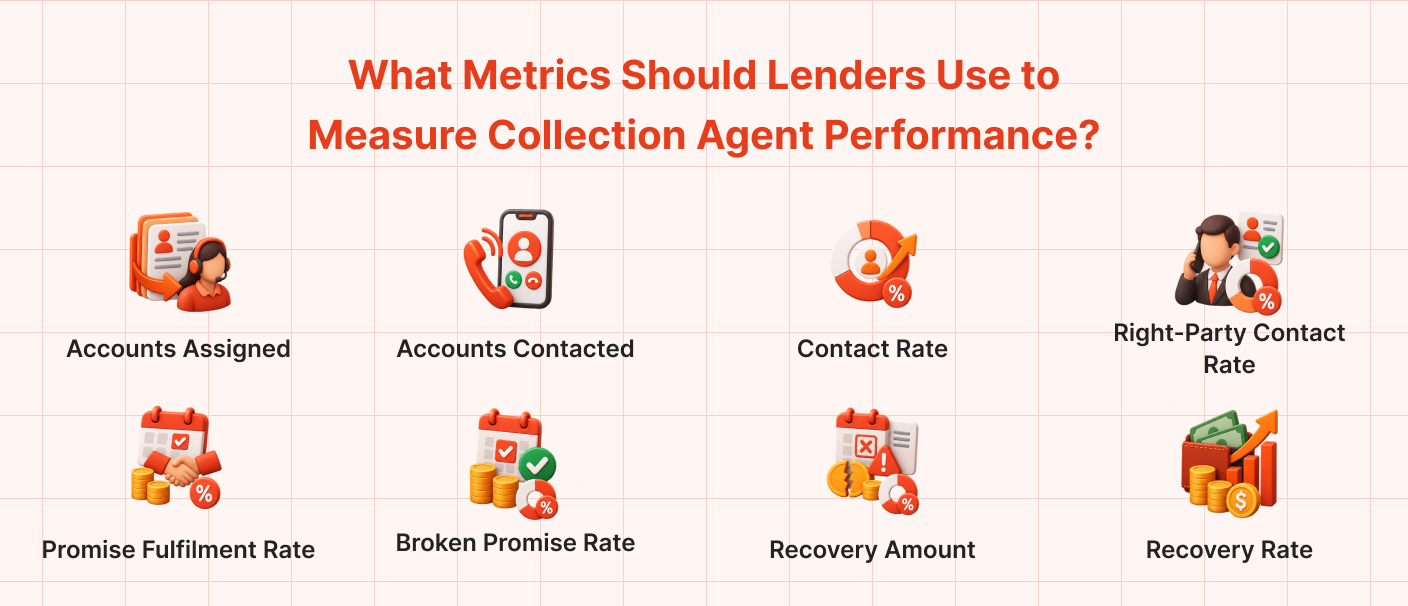
What Metrics Should Lenders Use to Measure Collection Agent Performance?
Collection teams should avoid measuring performance through one metric alone.
A balanced view should include productivity, quality and recovery outcomes.
Accounts Assigned
This shows the number of cases allocated to each agent.
It helps managers understand workload distribution.
Accounts Contacted
This measures how many assigned borrowers received an attempted or completed follow-up.
Contact Rate
Contact rate measures how many attempts resulted in contact with the borrower.
A low contact rate may indicate:
- Incorrect contact information
- Poor contact timing
- Weak channel strategy
- Borrower avoidance
Right-Party Contact Rate
This measures whether the agent reached the actual borrower or authorised contact.
It is more meaningful than counting every connected call.
Promise-to-Pay Rate
This measures how many contacted borrowers committed to making a payment.
A high promise rate can indicate effective borrower communication, but it should be considered alongside fulfilment.
Promise Fulfilment Rate
Promise fulfilment rate measures how many repayment commitments resulted in the expected payment.
A high number of promises with low fulfilment may indicate weak commitment quality.
Broken Promise Rate
This measures how many promises were not completed by the agreed date.
Repeated broken promises may require a different follow-up strategy.
Recovery Amount
This shows the amount recovered by an agent, team, borrower segment or collection workflow.
Recovery Rate
Recovery rate compares the amount recovered with the overdue amount assigned.
Partial Payment Rate
Some borrowers may be unable to clear the full overdue amount immediately.
Tracking partial payments gives a more complete view of collection outcomes.
Average Time to Recovery
This measures how long it takes to recover an overdue amount after assignment or first contact.
Case Resolution Rate
This shows how many cases were:
- Fully paid
- Restructured
- Moved to a payment plan
- Escalated
- Closed for another reason
Escalation Rate
This measures how many cases require manager, field, legal or specialist review.
An unusually high escalation rate may indicate a difficult portfolio or weak early-stage follow-up.
Cases Without Recent Activity
This identifies assigned accounts that have not received action within the required period.
Data-Update Quality
Agents should record complete and accurate outcomes after each interaction.
Incomplete notes and missing status updates reduce the value of performance reporting.
Activity Metrics vs Outcome Metrics
|
Performance area |
Activity metric |
Outcome metric |
|
Calling |
Calls attempted |
Right-party contacts |
|
Communication |
Messages sent |
Borrower responses |
|
Commitments |
Promises recorded |
Promises fulfilled |
|
Recovery |
Accounts worked |
Amount recovered |
|
Follow-up |
Tasks completed |
Cases resolved |
|
Escalation |
Cases escalated |
Escalated cases recovered |
|
Documentation |
Records updated |
Complete and usable case history |
Activity metrics show effort.
Outcome metrics show whether that effort produced recovery progress.
Lenders should use both when evaluating agents.
How Can Lenders Improve Collection Agent Productivity?
Prioritise Cases Instead of Increasing Call Targets
Increasing call targets may produce more activity but not necessarily more recovery.
Agents should receive prioritised cases based on:
- Borrower risk
- Account value
- Days past due
- Promise status
- Response history
- Delinquency movement
- Probability of recovery
Automate Routine Reminders
Agents should not spend most of their time sending repetitive reminders.
Automated communication can handle:
- Pre-due reminders
- Due-date reminders
- Early overdue reminders
- Promise-to-pay reminders
- Payment confirmation
- Follow-up scheduling
Agents can then focus on borrowers who require conversation, negotiation or escalation.
Give Agents Complete Borrower Context
Before contacting a borrower, agents should see:
- Account details
- Outstanding balance
- Payment history
- Previous calls
- Messages sent
- Borrower responses
- Promise-to-pay records
- Disputes
- Current recovery stage
- Next recommended action
This reduces repeated questions and improves borrower experience.
Define Clear Next Actions
Every borrower interaction should lead to a defined next step.
The next step may be:
- Wait for promised payment
- Send reminder
- Request documentation
- Offer payment-plan review
- Escalate non-response
- Assign manager review
- Close the account after payment
Track Quality, Not Only Quantity
Managers should assess:
- Accuracy of case notes
- Promise quality
- Borrower handling
- Compliance with communication policy
- Follow-up timeliness
- Recovery outcomes
- Escalation accuracy
Use Coaching Based on Data
Managers can coach agents using actual workflow results.
For example:
- Improve contact strategy
- Strengthen payment-plan conversations
- Record promises more accurately
- Reduce delayed follow-ups
- Use alternative channels
- Improve handling of disputed cases
How Should Cases Be Assigned to Collection Agents?
Case assignment should reflect both portfolio risk and agent capacity.
Workload-Based Assignment
Cases can be distributed according to the number and complexity of accounts already assigned.
Delinquency-Based Assignment
Agents may specialise in:
- Early delinquency
- Mid-stage delinquency
- Late-stage delinquency
- Escalated accounts
Value-Based Assignment
High-value accounts may be assigned to more experienced agents or specialised teams.
Geography-Based Assignment
Location-based assignment may be useful when language, local knowledge or field recovery is involved.
Product-Based Assignment
Agents may specialise in:
- Consumer loans
- Business loans
- Vehicle finance
- Personal loans
- Microfinance
- Buy Now, Pay Later
- Credit products
Skill-Based Assignment
Complex cases can be assigned according to agent skills, language, experience or negotiation ability.
Common Collection Agent Performance Challenges
Incomplete Activity Records
If agents do not update borrower outcomes, managers cannot trust performance reports.
Too Much Manual Reporting
Manual reports take time and may contain inconsistent information.
Uneven Case Distribution
Some agents may be overloaded while others have unused capacity.
No Connection Between Activity and Payment
Call counts have limited value when they are not linked to repayment outcomes.
Weak Promise-to-Pay Tracking
Promises may be recorded without clear amounts, dates or follow-up tasks.
Delayed Escalation
Cases may remain with the same agent even after repeated non-response or broken promises.
Multiple Agents Contact the Same Borrower
Disconnected systems can lead to duplicate communication and poor borrower experience.
Agents Work From Different Data
If teams use separate spreadsheets, they may not have the latest borrower status.
Performance Is Judged Only by Recovery Value
Recovery value is important, but agents may handle portfolios with different risk and difficulty.
Performance comparisons should consider:
- Assigned account quality
- Delinquency stage
- Account value
- Borrower risk
- Available contact data
- Case complexity
What Features Should Collection Agent Performance Software Have?
A strong collection performance platform should include:
- Borrower risk segmentation
- Case assignment
- Prioritised agent worklists
- Agent activity tracking
- Multi-channel communication records
- Promise-to-pay tracking
- Broken-promise alerts
- Follow-up task creation
- Escalation workflows
- Repayment-plan tracking
- Delinquency monitoring
- Payment-status updates
- Recovery dashboards
- Agent performance dashboards
- Portfolio-level reporting
- Role-based access
- Audit trails
- API integration
- Secure data handling
- Communication history
- Manager review workflows
For lenders, the most important features are case prioritisation, agent activity visibility, promise tracking, recovery reporting, escalation management and complete borrower history.
Manual Agent Management vs DebtPulse
|
Capability |
Manual collection management |
DebtPulse |
|
Case assignment |
Spreadsheet or manager allocation |
Structured agent case assignment |
|
Work prioritisation |
Flat overdue lists |
Borrower-risk and recovery-based priorities |
|
Activity tracking |
Manual daily reports |
Centralised agent activity history |
|
Borrower communication |
Stored across separate channels |
Connected communication records |
|
Promise tracking |
Agent notes or spreadsheets |
Structured promise-to-pay tracking |
|
Broken promises |
Identified late |
Follow-up and escalation workflows |
|
Performance reporting |
Manually compiled |
Recovery and agent dashboards |
|
Escalations |
Email or verbal handoff |
Defined escalation workflow |
|
Payment visibility |
Separate payment reports |
Connected recovery status |
|
Audit history |
Scattered records |
Audit-ready collection history |
How DebtPulse Helps Lenders Manage Collection Agent Performance
DebtPulse is an AI-powered debt intelligence and recovery platform built for banks, NBFCs, fintech lenders and loan servicing teams.
It helps lenders move from manual agent management to a structured recovery workflow.
DebtPulse supports:
- Borrower risk segmentation
- Overdue-account prioritisation
- Agent case assignment
- Agent activity tracking
- Automated multi-channel communication
- Borrower follow-up workflows
- Promise-to-pay tracking
- Broken-promise monitoring
- Escalation workflows
- Delinquency tracking
- Repayment-plan management
- Borrower communication history
- Portfolio recovery dashboards
- Agent performance visibility
- Audit-ready collection history
- Recovery reporting
- Role-based access
Instead of giving agents one flat list of overdue accounts, lenders can use DebtPulse to identify which borrowers need automated reminders, agent follow-up or escalation.
Agents can review borrower information, repayment history, previous communication and promise status before taking action.
Managers can monitor:
- Assigned workload
- Completed follow-ups
- Borrower responses
- Promise-to-pay activity
- Broken promises
- Escalations
- Recovery outcomes
- Cases without recent activity
DebtPulse helps connect agent actions with borrower and portfolio outcomes.
This gives collection leaders better visibility into where recovery work is progressing and where intervention is required.
The platform does not replace the judgement of collection managers or agents.
It gives them a structured system for prioritising accounts, recording actions and improving recovery accountability.
Benefits of Using DebtPulse for Collection Agent Performance
Better Agent Prioritisation
Agents can focus on accounts requiring timely human action instead of manually sorting large overdue lists.
Clearer Workload Visibility
Managers can see how cases are distributed and identify agents who are overloaded.
Stronger Accountability
Every case can have an assigned owner, activity history and next action.
Improved Promise Tracking
Promised dates, amounts and outcomes can be recorded and followed through structured workflows.
Faster Escalations
Broken promises, repeated non-response and high-risk cases can move into the appropriate escalation process.
Reduced Manual Reporting
Managers can use dashboards instead of compiling activity and recovery data from multiple spreadsheets.
Better Agent Coaching
Performance data can reveal where agents need help with contact strategy, promise quality or follow-up discipline.
Improved Borrower Experience
Agents can access previous communication before contacting a borrower, reducing repeated or inconsistent conversations.
Audit-Ready Collection Records
Collection actions, borrower responses, payment commitments and escalations can be maintained in one history.
Better Recovery Visibility
Managers can monitor agent, team and portfolio progress through a connected recovery workflow.
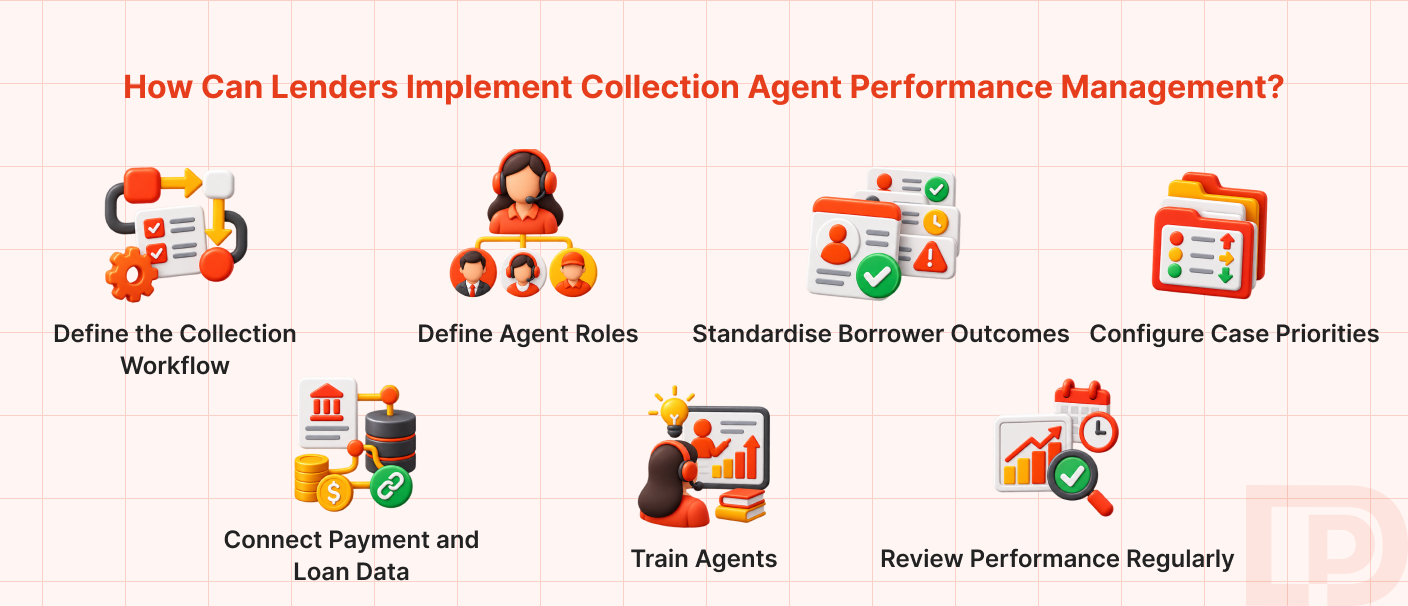
How Can Lenders Implement Collection Agent Performance Management?
Define the Collection Workflow
Document each recovery stage, from reminder to escalation.
Define:
- Entry conditions
- Assigned team
- Required actions
- Communication channels
- Follow-up timelines
- Escalation rules
- Exit conditions
Define Agent Roles
Clarify who handles:
- Early-stage reminders
- Standard overdue accounts
- High-value cases
- Broken promises
- Hardship requests
- Disputes
- Escalated cases
- Field recovery
- Manager reviews
Standardise Borrower Outcomes
Use consistent outcome categories after every interaction.
This improves reporting and automation.
Configure Case Priorities
Define how borrowers will be prioritised using:
- Days past due
- Outstanding amount
- Risk score
- Promise status
- Response history
- Account value
- Delinquency movement
Connect Payment and Loan Data
DebtPulse should receive relevant information from:
- Loan management system
- Core lending platform
- Payment system
- Customer database
- Communication tools
- CRM
- Existing collection records
Train Agents
Agents should understand:
- How cases are prioritised
- How to update outcomes
- How to record promises
- When to escalate
- How performance is measured
- How borrower communication should be documented
Review Performance Regularly
Managers should review:
- Agent workloads
- Contact rates
- Promise fulfilment
- Broken promises
- Recovery rates
- Escalation patterns
- Cases without recent action
- Data quality
Who Should Use Collection Agent Performance Management Software?
Collection agent performance management software is useful for:
- Banks
- NBFCs
- Fintech lenders
- Digital lending platforms
- Microfinance institutions
- Loan servicing companies
- Buy Now, Pay Later providers
- Consumer lenders
- Business lenders
- Vehicle finance companies
- Collection agencies
- Recovery operations teams
- Collection managers
- Portfolio managers
Any lender managing large overdue portfolios and multiple collection agents can benefit from structured case assignment, activity monitoring and recovery reporting.
Want to explore more practical insights on AI development, automation, and conversational AI? Read more blogs at Cloudastra Technologies or contact us for business enquiries through Cloudastra Contact Us.
Frequently Asked Questions
1. What is collection agent performance management?
Collection agent performance management is the process of assigning recovery cases, monitoring collection activity, measuring outcomes and improving how agents manage overdue borrowers.
2. Which metrics should lenders use to measure collection agents?
Important metrics include accounts assigned, contact rate, promise-to-pay rate, promise fulfilment, broken promises, recovery amount, recovery rate, case resolution and cases without recent activity.
3. Are call counts enough to measure collection performance?
No. Call counts show activity but do not show whether the activity produced borrower responses, payment commitments or recovery.
4. What is agent activity tracking?
Agent activity tracking records collection actions such as calls, messages, borrower responses, promises, follow-ups, payments and escalations.
5. How does case assignment improve recovery?
Case assignment gives every account a clear owner and helps distribute work according to borrower risk, delinquency stage, agent skill and workload.
6. What is a promise-to-pay fulfilment rate?
Promise-to-pay fulfilment rate measures how many borrower commitments result in the expected payment by the promised date.
7. How can lenders reduce manual collection reporting?
Lenders can use a centralised collection platform that records agent activity, borrower outcomes, repayment commitments and recovery performance automatically.
8. Can collection software help balance agent workloads?
Yes. Managers can review assigned cases, case complexity and pending activities before redistributing work.
9. How does DebtPulse track collection agent performance?
DebtPulse connects case assignment, agent activity, borrower communication, promise-to-pay status, escalations and recovery dashboards in one collection workflow.
10. Can DebtPulse help identify cases with no follow-up?
DebtPulse can help collection managers view assigned accounts, activity history and pending workflow actions so unattended cases can be identified.
11. Does DebtPulse support promise-to-pay tracking?
Yes. DebtPulse supports promised dates and amounts, borrower follow-ups, broken-promise monitoring and escalation workflows.
12. Who should use DebtPulse?
DebtPulse is useful for banks, NBFCs, fintech lenders, digital lending platforms, loan servicing companies and recovery teams managing overdue borrower portfolios.