AI-Powered Digital Twins in 2026: How Businesses Predict Failures and Optimize Operations
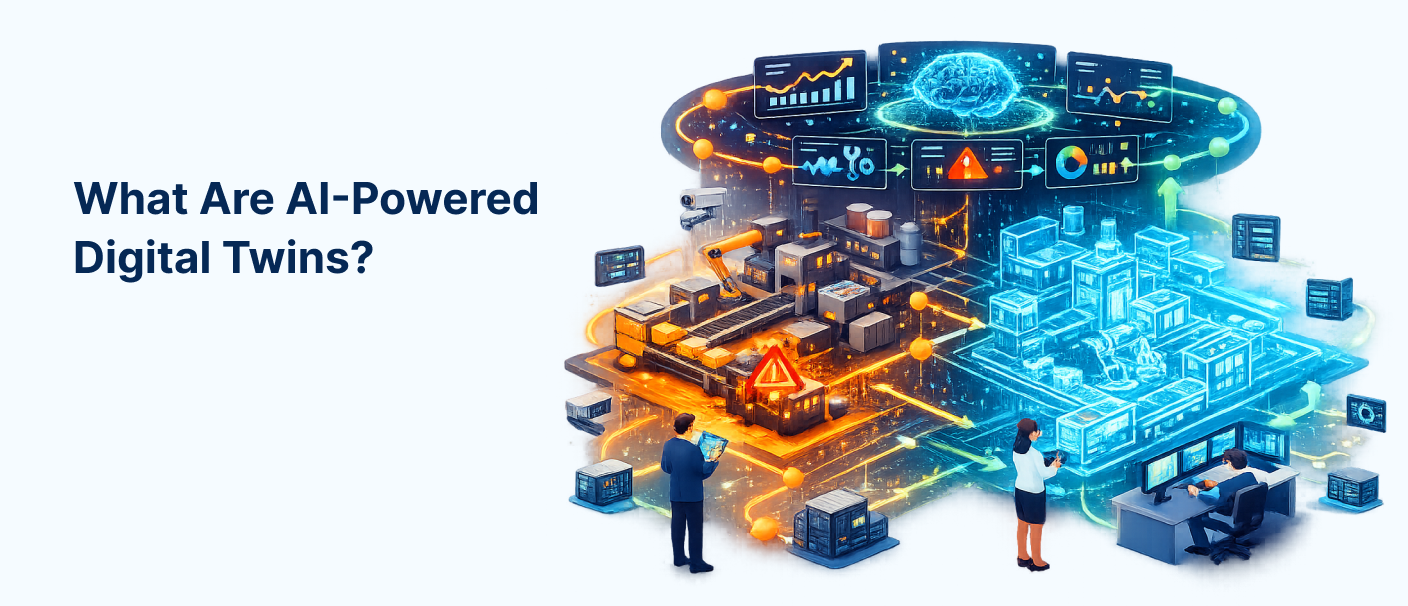
AI-powered digital twins are real-time virtual replicas of physical assets, processes, or systems that use live sensor data, artificial intelligence, and simulation to predict failures, test scenarios, and improve operations.
Unlike traditional digital twins that mainly show what is happening, AI-powered digital twins can predict what may happen next and recommend the best action. They help manufacturers, construction companies, infrastructure operators, and energy businesses reduce downtime, improve maintenance planning, and optimize performance.
Introduction
Traditional monitoring systems tell teams what is happening right now.
AI-powered digital twins go further.
They combine live operational data, virtual system models, machine learning, simulation, and feedback workflows to help businesses understand current performance, predict future problems, and test operational changes before applying them to real assets.
For example, a manufacturer can use an AI-powered digital twin to detect early signs of machine failure. An energy company can model turbine performance under different weather conditions. A construction company can compare planned progress with actual site activity.
This is different from a static 3D model or a normal dashboard.
A production digital twin continuously receives data from the physical system. It updates its virtual state, runs AI models, simulates possible outcomes, and gives operators recommendations based on real conditions.
This makes digital twin technology useful for industries where downtime, equipment failure, poor planning, and inefficient operations create significant financial loss.
What Are AI-Powered Digital Twins?
Businesses looking to improve operational performance beyond physical assets can also explore how collection agent performance management helps lenders increase recovery productivity, strengthen accountability, and make performance more measurable.
AI-powered digital twins are virtual representations of physical assets, processes, facilities, or systems that are continuously updated using real-world data.
They may represent:
- A machine
- A factory
- A production line
- A wind turbine
- A power grid
- A building
- A bridge
- A pipeline
- A warehouse
- A logistics network
- An entire industrial facility
The digital twin receives information from sensors, IoT devices, enterprise systems, and operational platforms.
Artificial intelligence then analyzes this data to identify patterns, detect anomalies, predict failures and recommend operational improvements.
A traditional digital twin may show the current condition of an asset.
An AI-powered digital twin can also answer:
- Is this component likely to fail?
- How much useful life remains?
- What happens if production speed increases?
- Which maintenance action should happen first?
- How can energy consumption be reduced?
- What operational setting produces the best outcome?
- What happens under different demand or weather conditions?
In simple terms, an AI-powered digital twin does not only mirror the real system. It helps businesses make better decisions about it.
Why Businesses Need AI-Powered Digital Twins
Businesses need AI-powered digital twins because complex physical operations are difficult to manage using dashboards, spreadsheets, and manual analysis alone.
Industrial operations may generate data from thousands of sensors.
A manufacturing facility may track:
- Temperature
- Pressure
- Vibration
- Flow rate
- Electrical load
- Machine speed
- Product quality
- Energy consumption
- Equipment condition
Operators may be able to view this information, but identifying relationships across all these signals is difficult.
A small increase in vibration may look harmless. But when it appears with temperature changes, pressure variation, and reduced output, it may indicate an upcoming equipment failure.
AI-powered digital twins help connect these signals.
They allow businesses to:
- Predict failures before breakdown
- Reduce unplanned downtime
- Improve maintenance schedules
- Test operational changes safely
- Optimize resource usage
- Improve production quality
- Reduce energy consumption
- Monitor infrastructure health
- Improve planning accuracy
- Make decisions using real-time data
Without a digital twin, businesses often make decisions after a problem occurs.
With an AI-powered digital twin, they can act earlier.
How AI-Powered Digital Twins Work
AI-powered digital twins work through several connected technology layers.
A production digital twin usually includes data acquisition, virtual modeling, AI inference, simulation, and decision feedback.
1. Data Is Collected From the Physical System
The first step is collecting live operational data.
This data may come from:
- IoT sensors
- PLCs
- SCADA systems
- Cameras
- Industrial machines
- Building management systems
- Enterprise software
- Maintenance records
- Historical databases
- Weather systems
- Energy meters
Common sensor data includes:
- Temperature
- Pressure
- Vibration
- Flow rate
- Humidity
- Speed
- Voltage
- Current
- Load
- Position
- Equipment state
The quality of the digital twin depends on the quality of this data.
If sensor data is incomplete, delayed, or inaccurate, the twin cannot represent the physical system correctly.
2. Data Is Processed and Stored
Raw sensor data usually needs cleaning and processing before it becomes useful.
The system may need to:
- Remove noise
- Handle missing data
- Detect faulty sensors
- Standardize units
- Aggregate readings
- Match timestamps
- Store historical states
- Process data at the edge
- Send data to cloud systems
Industrial protocols such as MQTT, OPC-UA, and Modbus may be connected to platforms like Kafka, Azure Event Hub, AWS IoT Core, or similar data services.
Time-series databases are commonly used because sensor data is generated continuously.
3. A Digital State Model Is Created
The digital state model represents the physical system virtually.
It may contain:
- Asset hierarchy
- Equipment structure
- Component relationships
- Sensor mappings
- Current operating state
- Historical states
- Engineering parameters
- Geometry
- Physics models
For example, a factory twin may be organized as:
Factory → Production line → Machine → Component → Sensor
The model connects each sensor reading to the correct physical component.
This allows teams to understand not only the data, but where that data belongs inside the real system.
4. AI Models Analyze the Data
The AI layer turns the digital twin from a monitoring system into an intelligent system.
Common AI models include:
Anomaly Detection Models
Anomaly detection models learn what normal operating behavior looks like.
They can identify unusual patterns that may indicate:
- Equipment degradation
- Sensor problems
- Process instability
- Quality issues
- Energy inefficiency
- Safety risk
Predictive Maintenance Models
Predictive maintenance models estimate when equipment may fail.
They may calculate:
- Failure probability
- Remaining useful life
- Maintenance urgency
- Component risk
- Expected downtime
This helps businesses move from calendar-based maintenance to condition-based maintenance.
Optimization Models
Optimization models test different operating settings and recommend better options.
They may optimize:
- Production speed
- Energy usage
- Temperature settings
- Resource allocation
- Machine scheduling
- Maintenance timing
- Output quality
5. The Simulation Engine Tests Scenarios
Simulation is one of the most valuable parts of digital twin development.
The twin can test possible changes without risking the real system.
For example, businesses can simulate:
- Increasing machine speed
- Delaying maintenance
- Changing production schedules
- Adjusting turbine settings
- Adding new equipment
- Changing material flow
- Reducing energy consumption
- Responding to component failure
A simulation engine may use:
- Physics-based simulation
- Monte Carlo simulation
- Agent-based simulation
- Structural analysis
- Thermal analysis
- Process simulation
The twin can run many scenarios and compare the possible outcomes.
6. Recommendations Are Generated
After analyzing data and simulation results, the digital twin can generate recommendations.
Examples include:
- Inspect bearing within seven days
- Reduce machine speed by 5%
- Replace component during the next maintenance window
- Adjust temperature setpoint
- Increase turbine blade pitch
- Move production to another line
- Delay inspection safely
- Investigate an abnormal sensor pattern
The recommendation should include supporting context and confidence.
7. Operators Approve or Apply the Action
The decision layer determines what happens next.
In a low-autonomy system, recommendations are shown to human operators.
The operator decides whether to approve the action.
In a more advanced system, routine changes may be sent directly to SCADA, DCS, or control systems within defined safety limits.
High-impact decisions should still involve human approval.
8. Results Are Added Back to the Twin
The digital twin records whether the recommendation was accepted and what happened afterward.
This creates a feedback loop.
The system can learn from:
- Successful recommendations
- Rejected recommendations
- Maintenance outcomes
- False alerts
- Equipment failures
- Changed operating conditions
This feedback improves future predictions and recommendations.
Key Features of AI-Powered Digital Twins
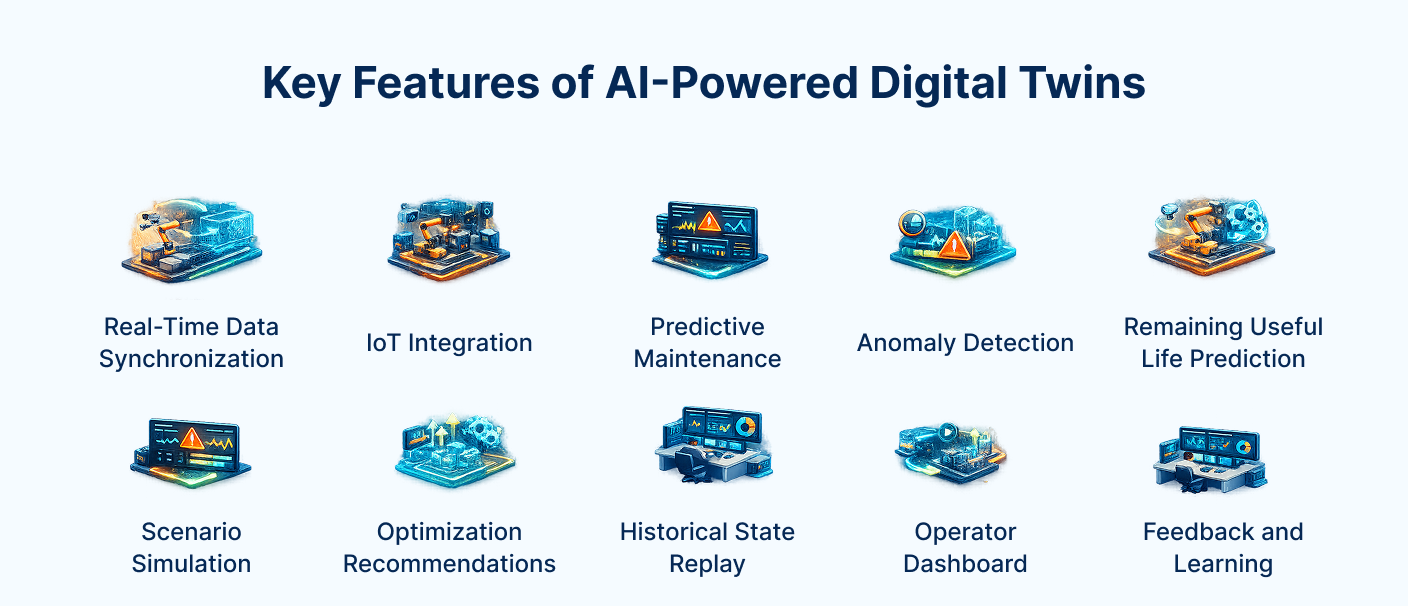
Real-Time Data Synchronization
The virtual twin should update continuously using data from the physical system.
This keeps the digital state aligned with real operations.
IoT Integration
An IoT digital twin should connect with sensors, machines, gateways, and industrial data platforms.
Strong integration is necessary for accurate monitoring.
Predictive Maintenance
Predictive maintenance helps businesses identify equipment risk before failure.
This reduces emergency repairs and unplanned downtime.
Anomaly Detection
AI models can detect patterns that fall outside normal operating behavior.
This gives teams early warning of potential issues.
Remaining Useful Life Prediction
Remaining useful life models estimate how long a component can continue operating safely.
This helps teams plan maintenance more accurately.
Scenario Simulation
The twin should allow teams to test operational changes without affecting the physical system.
Optimization Recommendations
AI models can recommend better operating settings based on performance, cost, quality, and safety goals.
Historical State Replay
Teams should be able to review what the system looked like at a previous point in time.
This is useful for incident analysis.
Operator Dashboard
The dashboard should show:
- Current asset state
- Alerts
- Predictions
- Simulation results
- Recommended actions
- Maintenance priorities
- Sensor trends
- Risk levels
Feedback and Learning
The system should capture operator decisions and actual outcomes to improve future predictions.
Use Cases of AI-Powered Digital Twins
1. Predictive Maintenance in Manufacturing
Manufacturers can use AI-powered digital twins to identify equipment degradation before breakdown.
The twin may detect changes in:
- Vibration
- Temperature
- Pressure
- Electrical load
- Production output
This allows maintenance teams to schedule repairs before operations stop unexpectedly.
2. Production Line Optimization
Manufacturing twins can simulate changes to production speed, machine settings, staffing, and material flow.
This helps improve:
- Throughput
- Product quality
- Energy efficiency
- Equipment usage
- Production scheduling
3. Quality Control
A digital twin can compare process conditions with final product quality.
It can help identify which machine settings or environmental conditions increase defect rates.
4. Construction Planning
Construction companies can combine BIM models, IoT data, and computer vision to track actual progress.
The twin can support:
- Schedule comparison
- Clash detection
- Resource planning
- Progress tracking
- Delay prediction
- Site coordination
5. Infrastructure Health Monitoring
Digital twins can monitor bridges, pipelines, tunnels, buildings, and other infrastructure.
Sensors may track:
- Structural strain
- Vibration
- Movement
- Temperature
- Pressure
- Material condition
AI models can identify signs of deterioration before visible damage appears.
6. Wind Turbine Optimization
Energy companies can use digital twins to optimize turbine blade pitch and yaw settings.
This helps improve power generation under changing wind conditions.
7. Power Grid Management
Grid twins can model:
- Demand changes
- Generator availability
- Renewable energy output
- Storage capacity
- Failure scenarios
This supports better balancing and renewable integration.
8. Energy Consumption Optimization
Businesses can simulate how changes to equipment, schedules, and operating conditions affect energy consumption.
This helps reduce cost and emissions.
Benefits of AI-Powered Digital Twins
Reduced Unplanned Downtime
Predictive maintenance helps identify failures before equipment stops working.
This allows repairs to be scheduled at a more convenient time.
Better Maintenance Planning
Teams can maintain equipment based on actual condition instead of fixed calendar schedules.
Improved Operational Efficiency
Simulation and optimization help businesses identify better operating settings.
Faster Decision-Making
Operators receive real-time alerts, predictions, and recommendations instead of manually reviewing large amounts of sensor data.
Safer Testing
Businesses can test changes inside the virtual twin before applying them to the real system.
Improved Product Quality
The twin can identify relationships between process conditions and product defects.
Better Asset Visibility
Managers can see the current and predicted condition of important assets.
Lower Energy Costs
Optimization models can recommend settings that reduce unnecessary energy usage.
Longer Asset Life
Better maintenance and operating decisions can reduce equipment stress and extend asset life.
Stronger Incident Analysis
Historical state replay helps teams understand what happened before an equipment issue or process failure.
Common Challenges in AI-Powered Digital Twin Projects
Starting With Visualization Instead of Data
A beautiful 3D model does not create value if the data pipeline is unreliable.
Data ingestion and quality should be built first.
Poor Sensor Data Quality
Missing, inaccurate, or delayed data weakens AI predictions.
Sensor health and data validation must be monitored.
Limited Historical Failure Data
Predictive maintenance models need examples of failure behavior.
If failure events are rare, businesses may need physics simulations or synthetic data.
Ignoring Domain Experts
AI engineers understand models, but maintenance and operations teams understand the physical system.
Domain experts should help define:
- Meaningful anomalies
- Failure conditions
- Safety limits
- Useful recommendations
- Acceptable false positives
Underestimating Legacy Integration
Industrial environments may include old PLCs, proprietary SCADA systems, and incompatible protocols.
Integration often takes longer than expected.
Treating the Twin as a One-Time Project
Physical assets change over time.
AI models can become less accurate as equipment ages and operating conditions change.
Digital twins need ongoing maintenance and model retraining.
No Decision Feedback Loop
A twin that only displays recommendations becomes an expensive monitoring dashboard.
The system should connect recommendations to real operational action.
Building Too Much at Once
Trying to create a twin for an entire facility immediately can increase cost and risk.
A smaller pilot focused on high-value assets is often more practical.
How Cloudastra Helps With AI-Powered Digital Twins
Cloudastra helps businesses plan, build, and deploy AI-powered digital twins for manufacturing, energy, infrastructure, and other complex physical operations.
Cloudastra can support:
- Digital twin architecture
- IoT integration
- Sensor data pipelines
- Industrial protocol integration
- Time-series data platforms
- AI anomaly detection
- Predictive maintenance models
- Remaining useful life models
- Simulation integration
- Operator dashboards
- Cloud deployment
- Edge AI deployment
- Azure Digital Twins implementation
- AWS IoT TwinMaker implementation
- Custom digital twin development
- Model monitoring and retraining
Instead of beginning with an expensive full-scale build, Cloudastra can help businesses identify the highest-value asset or process for an initial pilot.
This makes it possible to validate data quality, technical feasibility, and business value before expanding the twin across the full operation.
The goal is not only to create a virtual model.
The goal is to build a production system that improves maintenance, planning, efficiency, and operational decision-making.
Who Should Use AI-Powered Digital Twins?
AI-powered digital twins are useful for:
- Manufacturing companies
- Energy companies
- Construction businesses
- Infrastructure operators
- Utilities
- Wind farm operators
- Oil and gas companies
- Logistics businesses
- Industrial equipment manufacturers
- Smart building operators
- Engineering teams
- Maintenance teams
- Operations leaders
- Asset managers
- Digital transformation teams
They are especially useful for businesses where equipment downtime, maintenance costs, energy consumption, or planning delays have a major financial impact.
Want to explore more practical insights on AI development, automation, and conversational AI? Read more blogs at Cloudastra Technologies or contact us for business enquiries through Cloudastra Contact Us.
FAQs
1. What are AI-powered digital twins?
AI-powered digital twins are virtual replicas of physical assets, processes, or systems that use live data, artificial intelligence, and simulation to monitor current conditions, predict future problems, and recommend actions.
2. How is an AI-powered digital twin different from a traditional digital twin?
A traditional digital twin mainly shows the current state of a system. An AI-powered digital twin can also detect anomalies, predict failures, run simulations, and recommend operational changes.
3. What is the difference between a digital twin and a simulation?
A simulation is usually based on assumptions and runs separately from the real system. A digital twin is continuously updated using live data from the physical asset.
4. Do businesses need AI to benefit from digital twins?
No. A traditional twin can still support monitoring and visualization. AI becomes useful when businesses need prediction, anomaly detection, optimization, or complex decision support.
5. How much data is required for predictive maintenance?
Anomaly detection may require several months of normal operating data. Predictive maintenance models usually need historical failure data or simulation-generated examples of failure behavior.
6. Can a small business use an AI-powered digital twin?
Yes. A smaller business can begin with a limited pilot focused on one high-value asset or process instead of building a full-facility twin.
7. How is a digital twin different from SCADA?
SCADA systems monitor and control industrial operations. A digital twin uses SCADA and other data to build a virtual model, run AI predictions, and simulate future scenarios.
8. How does Cloudastra help with digital twin development?
Cloudastra helps businesses design digital twin architecture, connect IoT and industrial data, build AI models, integrate simulations, create dashboards, and deploy production-ready digital twin systems.